Huawei

Search documents
David Sacks on Nvidia Chips to China, US Tech Stack
Bloomberg Technology· 2025-07-15 17:03
Market Competition and Geopolitics - The US administration restricts the sale of state-of-the-art semiconductors to China, allowing the sale of heavily deprecated chips like the H-20 as part of trade negotiations [1][2] - Huawei's Cloud Matrix technology, networking multiple chips, is becoming a viable competitor to Nvidia, potentially impacting market share [5][6][8] - Preventing American companies from competing in the Chinese market could give Huawei a significant advantage in R&D and global competition [7][8] - The US aims to encourage countries like the UAE to adopt American technology and build data centers on the American tech stack, countering China's influence [12][13] - The industry emphasizes the importance of American companies competing globally to maintain market share and win the AI race, with a target of 80% market share for American companies in five years [11][15] Technology and Security - Nvidia's chips are currently three times more powerful than Huawei's, but networking Huawei's chips can achieve similar results [6] - Security concerns regarding chip sales can be addressed through inspections of data centers to monitor server racks [16] - The US seeks to establish American technology as the global standard, similar to the US dollar as the world's reserve currency, emphasizing the importance of a strong partner ecosystem [18][22] Energy and Infrastructure - Energy security is a national security priority, with concerns about having enough energy resources to power data centers [26] - Pennsylvania is a major energy-producing state with abundant natural gas, which is expected to power data centers in the near term [26][27] - The US electric grid's growth has lagged behind China's, necessitating major new investments to support data centers [28][29]


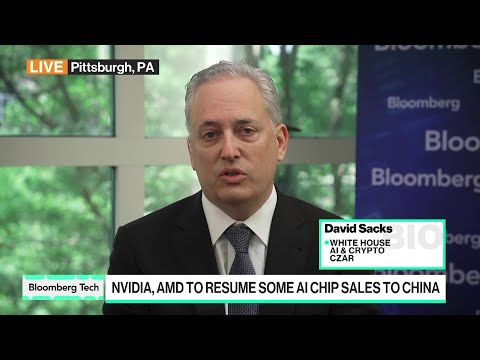
We want American technology to be the golden standard, says White House crypto czar David Sacks
CNBC Television· 2025-07-15 15:41
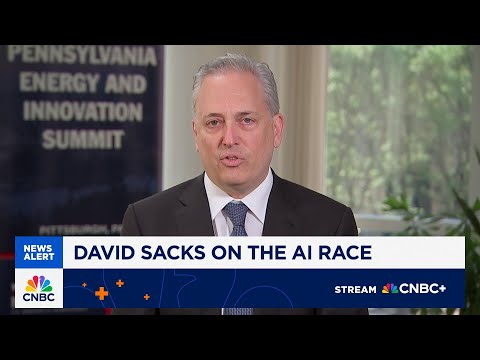
AI Race Strategy - The US aims to win the AI race through innovation, AI infrastructure, and AI exports [2][3][5] - Government's role is to enable the private sector by removing red tape, particularly in energy, to support AI infrastructure [3] - AI infrastructure requires significant investments in power generation and grid improvements [4] - Exporting American technology to make it the global standard is crucial for creating a large ecosystem [5] Semiconductor Policy and Competition - The US should not sell its most advanced semiconductors to China [7] - Selling deprecated chips like H20 to China is a continuation of existing policy [7] - Huawei has made significant progress and is exporting its technology, necessitating competition to take market share [8] - Restricting all sales to China could create a subsidy for Huawei, funding their R&D and developer ecosystem [8][9]
Australia's Prime Minister Walks Fine Line Between Xi, Trump in China
Bloomberg Television· 2025-07-15 07:20
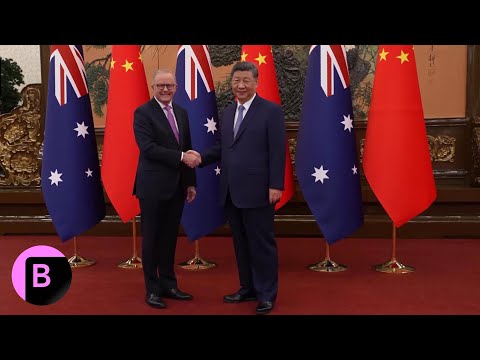
Geopolitical Relations - The Australian Prime Minister is scheduled to meet with the Chinese President amidst US tariff threats, requiring a delicate balance between Australia's major trading partner and key security ally [1] - The meeting occurs as both sides aim for a successful visit, despite the challenging global environment and diplomatic demands [3] - The meeting presents an opportunity for Beijing to engage with Australia after a period of strained relations [4] - While both sides seek to emphasize the positive, significant differences persist on regional geopolitical issues, including Taiwan and the South China Sea [5] - Australia has maintained its position on Taiwan, supporting the status quo, which is considered a reasonable stance [6] Economic Cooperation and Trade - The agenda is heavily influenced by the strong trading relationship between Australia and China, with a focus on economics and job creation [4] - China seeks greater access to the Australian economy, potentially including artificial intelligence in the free trade agreement [9][11] - Australia is wary of China's technology and prefers to maintain control over sensitive mineral investments [12] - Australia aims to develop its rare earths processing capacity, contributing to the friend-shoring initiative with the US and other partners [13] - The strategic issue of rare earths is likely to be an ongoing point of contention and potential growth [14]
Traveling To China, Nvidia's Jensen Huang Embraces Economic Reality
Forbes· 2025-07-14 18:05
Core Perspective - Nvidia co-founder Jensen Huang's trip to China is seen as a strategic move to expand in a crucial market for U.S. companies, emphasizing the importance of economic interconnection for global peace and prosperity [2][3]. Group 1: Strategic Importance of Nvidia - Senators Elizabeth Warren and Jim Banks acknowledge the strategic importance of Nvidia's advanced AI hardware, particularly its GPUs, but fail to grasp the broader implications of global economic collaboration [4]. - The U.S. Department of Commerce restricts Nvidia's ability to sell advanced chips to China, which may inadvertently benefit the Chinese Communist Party by pushing U.S. technology out of the Chinese market [6][7]. - Chinese technologists have a strong desire for American innovation, and U.S. political actions may hinder Nvidia's growth opportunities in China, which will continue to develop regardless of U.S. involvement [8][9]. Group 2: Consequences of Protectionism - The global market will inevitably see Nvidia's technology, regardless of U.S. restrictions, as competitors will find ways to innovate and fill the void left by U.S. companies [9][10]. - Protectionist measures have historically allowed companies like Huawei to thrive independently, demonstrating that such policies can backfire and lead to increased competition from non-U.S. firms [10][11]. - Huang's recognition of the necessity for Nvidia to engage with Chinese talent is crucial for the company's survival and competitiveness in the global AI landscape [11][12].

Jefferies:亚洲 - 关税情绪波动
2025-07-14 00:36
Summary of Key Points from the Conference Call Industry Overview - The focus of the conference call was on the impact of the Trump administration's tariff policies on global equities, particularly the S&P 500, which reached a new all-time high following a dramatic rally after "Liberation Day" on April 2, 2025 [13][38]. - The call highlighted the ongoing negotiations between the US and China regarding tariffs, with indications that the US lacks leverage over China in these discussions [6][15]. Core Insights and Arguments - **Tariff Policies**: The expectation is that tariffs may stabilize at a universal rate of 10% and 20% for China, with potential negotiations on specific tariffs related to fentanyl [18][30]. - **US Dollar Trends**: The US dollar is experiencing a structural decline, failing to rally during risk-off moves, which suggests a potential regime change in global currency dynamics [4][55]. - **Emerging Markets**: A weaker dollar is anticipated to benefit emerging market equities, allowing for more accommodative monetary policies [5]. - **Big Tech Capital Expenditure**: Concerns were raised about the potential misallocation of capital by major tech companies in the AI sector, with an estimated US$327 billion expected to be spent this year [3][97]. - **Private Equity Industry**: The private equity sector is relieved by the reduced risks of a US recession due to the tariff de-escalation, with significant recovery in private equity stock performance noted [108][109]. Additional Important Points - **China's Trade Surplus**: China continues to report record trade surpluses, underscoring its dominance in global manufacturing [6]. - **US Current Account Deficit**: The US current account deficit has risen to 6% of GDP, the highest since 2006, indicating significant economic pressures [79]. - **Income Distribution**: The top 1% of Americans accounted for 22.4% of total gross individual income and 40.4% of income taxes paid in 2022, highlighting extreme income inequality [90]. - **Renminbi Usage**: China's cross-border goods trade settlement in renminbi has increased significantly, indicating a shift towards trade outside the US dollar [47][50]. This summary encapsulates the critical insights and trends discussed during the conference call, providing a comprehensive overview of the current economic landscape and its implications for various sectors.
科技冷战与商业地缘政治
2025-07-14 00:36
Summary of Key Points from the Document Industry Overview - The document discusses the **Tech Cold War** between the **US and China**, highlighting the geopolitical implications of technology and business practices in this context [2][3][4]. Core Arguments and Insights - The **Tech Cold War** is characterized by increasing strategic competition, with technology becoming a primary field of geopolitical competition, including areas like **semiconductors, 5G, quantum computing, and artificial intelligence** [2][3]. - A survey conducted by **Ernst & Young** in 2023 revealed that **97% of CEOs** made significant business changes in response to geopolitical developments over the past year, indicating the profound impact of geopolitics on corporate strategies [4]. - The **unipolar moment** that followed the Cold War has been replaced by a **bipolar world** where the US and China are pulling the geopolitical and tech landscape apart, leading to a bifurcation of the **IT stack** into Western and China-centric versions [3][11]. - The **weaponization of technology** for geopolitical purposes has become a new strategy for the US government, particularly during the Trump administration, which set the agenda for tech policies that China has had to respond to [15][17]. Historical Context - The **Tech Cold War** began with the **Snowden affair** in 2013, which raised global scrutiny over the dependencies created by the IT stack, and was further accelerated by China's **Made in China 2025** strategy in 2015 [12][13]. - The years **2016 to 2021** marked a significant escalation in the Tech Cold War, with the US government actively shaping the global tech industry according to its geopolitical theories [14][15]. Current Dynamics - The **Biden administration** has continued the previous administration's geotech agenda, focusing on the **weaponization of supply chains** as a key element of foreign policy [17]. - Companies are increasingly forced to navigate a complex landscape where they must choose sides due to **cybersecurity laws, export controls, and sanctions** [18]. - The concept of **non-alignment** is gaining traction among countries like **India, South Korea, and Indonesia**, which are trying to accommodate both superpowers [19]. Future Implications - The document predicts the emergence of a new type of corporation, termed the **geopolitically adapted enterprise (GAE)**, which will leverage geopolitical dynamics to gain competitive advantages [22]. - The bifurcation of the IT stack will fundamentally alter how tech companies approach growth, investments, and global employment, leading to a dilemma of whether to invest in both stacks or focus on one [21]. - The authors conclude with a cautiously optimistic outlook, emphasizing the need for restraint and understanding in the geopolitical landscape [23]. Additional Insights - The book aims to fill a gap in existing literature regarding the interplay between technology and geopolitics, particularly from the perspective of private technology companies [7][8]. - The authors, **Ansgar Baums** and **Nicholas Butts**, have extensive experience in geopolitical issues and have worked with major corporations to navigate challenges posed by the Tech Cold War [25][26][27].
Nvidia CEO to hold media briefing in Beijing this week in high-stakes visit
New York Post· 2025-07-13 20:31
Group 1 - Nvidia CEO Jensen Huang will hold a media briefing in Beijing, marking his second visit to China, emphasizing the importance of the Chinese market [1] - The U.S. government has imposed restrictions on the export of Nvidia's advanced chips to China since 2022, citing military application concerns [1][2] - Nvidia generated $17 billion in revenue from China in the fiscal year ended January 26, accounting for 13% of the company's total sales [4] Group 2 - Huang's visit is being closely monitored by U.S. lawmakers, who have urged him to avoid meetings with companies linked to military or intelligence in China [3] - Nvidia faces increased competition from Chinese companies like Huawei, but demand for Nvidia's chips remains strong due to its CUDA computing platform [6] - Nvidia's market value reached $4 trillion for the first time last week, reinforcing its position in the AI technology sector [6][7]
Nvidia's China ban effectively hands country's AI market to Huawei, says Bernstein's Stacy Rasgon
CNBC Television· 2025-07-11 13:42
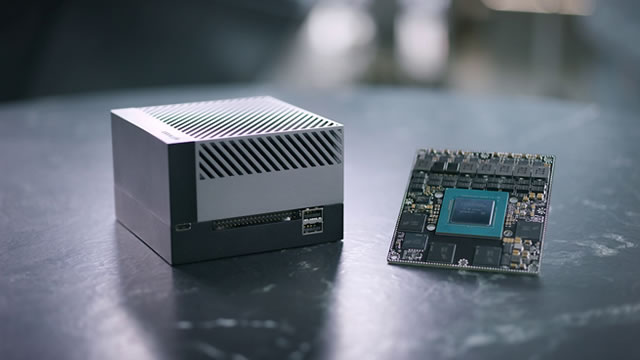
Nvidia and China Market - Nvidia faces potential loss of $50 billion in revenue due to being shut out of the Chinese market, but this has already been factored into their financial models [2][3] - If Nvidia is banned from selling into China, the Chinese AI market will effectively be handed over to Huawei [5] - Banning Nvidia encourages Chinese customers to invest in the Huawei ecosystem, potentially leading Huawei to expand sales beyond China [7] - Nvidia had previously removed $8 billion from China in its guidance, indicating the overall market size is still substantial [9] Nvidia's Growth and Valuation - The market is large enough for Nvidia to grow significantly even without access to the Chinese market [5][8] - Nvidia's valuation is not considered aggressive, with a price-to-earnings ratio in the mid to upper 20s based on next 12-month earnings [12][13] Semiconductor Sector Dynamics - There is a rotation occurring within the semiconductor sector, with non-AI chip companies like Texas Instruments and Intel gaining some traction [10] - Some investors are playing a cyclical recovery in companies like Texas Instruments, although it's uncertain if this is a genuine recovery or due to inventory stocking or tariff pull-forward [11][12] - Despite the cyclical recovery play, the analyst still prefers AI-related stocks, particularly Nvidia, due to eased Blackwell supply constraints and China being zeroed out [12]

从科研到落地,从端到端到VLA!一个近4000人的智驾社区,大家在这里报团取暖~
自动驾驶之心· 2025-07-11 11:23
Core Viewpoint - The article emphasizes the establishment of a comprehensive community for autonomous driving, aiming to gather industry professionals and facilitate rapid responses to challenges, with a target of building a community of 10,000 members within three years [2]. Group 1: Community Development - The community aims to integrate academic research, product development, and recruitment, creating a closed-loop system for education and technical discussions [2][5]. - It has already attracted notable figures from the industry, including talents from Huawei and leading researchers in autonomous driving [2]. - The community will provide resources such as video courses, hardware, and practical coding experiences related to autonomous driving [2][3]. Group 2: Learning Resources - A structured learning roadmap is available, covering essential topics for newcomers, including how to ask questions and access weekly Q&A sessions [3][4]. - The community offers a variety of courses on foundational topics like deep learning, computer vision, and advanced algorithms in autonomous driving [4][21]. - Members can access exclusive content, including over 5,000 resources and discounts on paid courses [19][21]. Group 3: Industry Engagement - The community collaborates with numerous companies in the autonomous driving sector, providing direct recruitment channels and job postings [5][6]. - It aims to connect students and professionals with industry leaders, enhancing networking opportunities and knowledge sharing [5][6]. - The community is positioned as a hub for both academic and industrial advancements in autonomous driving technology [12][14]. Group 4: Technological Focus - The article highlights the rapid evolution of technology in autonomous driving, with a focus on end-to-end systems and the integration of large models [7][24]. - Key areas of interest include visual language models, world models, and closed-loop simulations, which are critical for the future of autonomous driving [7][24]. - The community plans to host live sessions with experts from top conferences to discuss practical applications and research advancements [23][24].

美银:中国投资指南针-2025 年第三季度:保持防御姿态,聚焦自下而上的盈利表现
美银· 2025-07-11 02:23
Investment Rating - The report maintains a neutral/cautious outlook on the near-term performance of the China market due to earnings risks and unattractive valuations, while remaining structurally bullish on China's long-term turnaround [1]. Core Insights - The China market outperformed in 1Q25 but traded sideways in 2Q25, with MSCI China showing a flat performance of +0.7% compared to significant gains in global indices [2][16]. - The report emphasizes a focus on bottom-up earnings stories, particularly in mid-small-cap stocks, while avoiding sectors heavily reliant on policy stimulus or exports [1][4]. - Key macroeconomic indicators show signs of weakness, with credit growth modestly increasing but insufficient to drive meaningful GDP recovery [3][12]. Market Performance - In 2Q25, MSCI China lagged behind global peers, with a P/E valuation of 11.4x, near long-term averages [2][9]. - Best-performing sectors included Healthcare (+11.5%), Financials (+11.1%), and IT (+9.5%), while Consumer Discretionary (-11.2%), Real Estate (-3.1%), and Consumer Staples (-1.6%) underperformed [2][16]. Macro Environment - Credit growth rose from 8.0% YoY in 2024 to 8.7% in May 2025, but loan growth declined from 7.0% to 6.7% [3][54]. - The property market showed recovery in late 2024 but declined again in 2Q25, indicating ongoing challenges in the real estate sector [3][15]. - The report anticipates nominal GDP growth to decelerate to 3-4% in 2H25 amid trade tensions and insufficient credit growth [47][48]. Sector Model Portfolio - For 3Q25, the report favors sectors focused on domestic demand, such as financials and internet, while downgrading liquors and real estate due to earnings risks [4][14]. - The model portfolio includes banks and brokers for better downside protection, while tech hardware and gold sectors are upgraded [4][14]. Valuation and Earnings Revision - The average 12-month forward P/E valuation for the CSI 300 rebounded to 13x, while the MSCI China Index remained above 11x, indicating a discount to long-term averages [38][39]. - In 2Q25, consensus earnings for MSCI China were revised down by 0.9% QoQ, with significant downgrades in Real Estate, Utilities, and Energy sectors [42][42].