Ares Capital

Search documents
Ares Capital(ARCC) - 2025 Q4 - Annual Results
2026-02-04 11:04
Exhibit 99.1 ARES CAPITAL CORPORATION ANNOUNCES DECEMBER 31, 2025 FINANCIAL RESULTS AND DECLARES FIRST QUARTER 2026 DIVIDEND OF $0.48 PER SHARE DIVIDEND DECLARATIONS New York, NY — February 4, 2026 — Ares Capital Corporation ("Ares Capital") (NASDAQ: ARCC) announced that its Board of Directors has declared a first quarter 2026 dividend of $0.48 per share. The first quarter 2026 dividend is payable on March 31, 2026 to stockholders of record as of March 13, 2026. DECEMBER 31, 2025 FINANCIAL RESULTS Ares Capi ...

报道称软件股敞口巨大,美国PE公司遭遇新一轮抛售
Hua Er Jie Jian Wen· 2026-02-03 01:53
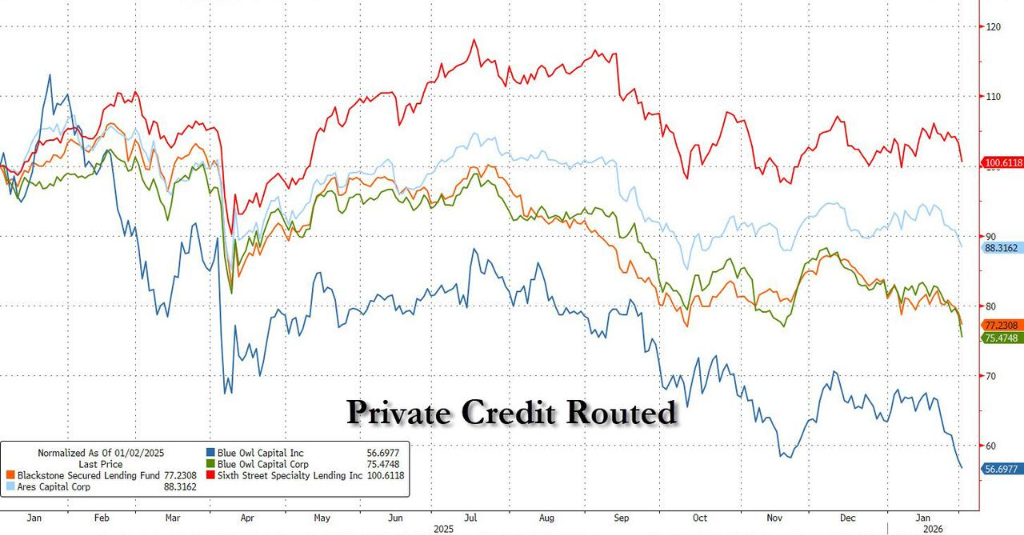
Core Viewpoint - The software industry is facing significant risks, leading to a sell-off of U.S. publicly traded private equity (PE) and business development companies (BDC) due to concerns over the valuation of billions in private software debt [1][5]. Group 1: Market Reaction - On February 3, following reports from Goldman Sachs and Barclays, there was a notable sell-off in the market, with Blue Owl Capital's stock dropping approximately 5% and other industry leaders like Ares Capital and Sixth Street Specialty Lending declining over 3% [2]. - A report from Goldman Sachs indicated that hedge funds are rapidly rotating out of software stocks, marking the highest net sell-off in the tech sector since September 2024, with software stocks leading the decline [4]. Group 2: Impact on Private Credit Institutions - The sell-off has severely impacted private credit institutions that finance software companies, with a software stock index plummeting 15% in January, the largest monthly drop since October 2008 [5]. - Barclays analysts highlighted that software constitutes about 20% of BDC portfolios, making them particularly sensitive to declines in software equity and credit valuations, with total exposure estimated at $100 billion [7]. Group 3: Concerns Over Default Rates - UBS strategists warned that if AI leads to the large-scale elimination of traditional software companies, default rates in U.S. private credit could soar to as high as 13% [9]. - Apollo Global Management has already begun reducing its software exposure from 20% to below 10%, indicating a cautious approach towards the software sector [9]. Group 4: Market Sentiment and Analyst Opinions - Despite the prevailing panic, some analysts believe the market may be overreacting, as there is no new fundamental information to justify the declines [12]. - Recent negative news, including significant withdrawals from funds like Blue Owl and TCP Capital Corp., has heightened investor anxiety ahead of the earnings season, leading to a preemptive market downturn [12].

Is Ares Capital Stock Worth Owning Ahead of Q4 Earnings?
ZACKS· 2026-02-02 19:01
Key Takeaways ARCC to report Q4 and 2025 results on Feb. 4, with Q4 revenues expected to rise 2.3% y/y.ARCC's Q4 EPS estimate is unchanged at 50 cents, implying a 9.1% decline from last year.ARCC faces higher expenses and yield compression from the 2025 rate cuts, pressuring spreads.Ares Capital Corporation (ARCC) is scheduled to announce fourth-quarter and 2025 results on Feb. 4, before market close. Similar to the previous reported quarter, the company is expected to have recorded an improvement in total ...

Ares Capital Vs. FS KKR Stock: Buy The Winner, Avoid The Outsider (NASDAQ:ARCC)
Seeking Alpha· 2026-02-01 10:39
Group 1 - Ares Capital (ARCC) and FS KKR Capital Corp. (FSK) are direct competitors in the Business Development Company (BDC) sector, both having access to institutional capital [1] - The analysis emphasizes the importance of identifying profitable and undervalued investment opportunities primarily in the U.S. market to build a high-yield, balanced portfolio [1] - The author combines macro-economic analysis with real-world trading experience to provide actionable investment ideas [1] Group 2 - The article does not provide any specific financial data or performance metrics related to ARCC or FSK [3]


Ares Capital Vs. FS KKR: Buy The Winner, Avoid The Outsider
Seeking Alpha· 2026-02-01 10:39
Ares Capital ( ARCC ) and FS KKR Capital Corp. ( FSK ) are two direct competitors in the BDC sector. While they are similar in appearance due to their access to institutional capital fromMy professional journey in the investment field began in 2011. Today, I combine the roles of an Investment Consultant and an Active Intraday Trader. This synergistic approach allows me to maximize returns by leveraging deep knowledge in economics, fundamental investment analysis, and technical trading. What You Will Find in ...

The 'Great Rotation' Of 2026 Will Benefit BDCs
Seeking Alpha· 2026-01-31 12:30
Core Viewpoint - The narrative suggests that 2026 will be a significant year for small-cap stocks, indicating a potential shift in market dynamics favoring smaller companies [1]. Group 1: Investment Strategy - The company emphasizes the importance of a diversified investment approach, combining classic dividend growth stocks with Business Development Companies, REITs, and Closed End Funds to enhance income and total return [1]. - A hybrid investment system is proposed, which aims to achieve total returns comparable to traditional index funds like the S&P 500 while focusing on income generation [1].

Ares Capital Stock Becomes More Attractive As Pricing Changes (NASDAQ:ARCC)
Seeking Alpha· 2026-01-31 05:25
Core Insights - Private lending has gained significant attention in recent years, particularly in the post-pandemic era, where it has emerged as a prominent source of capital [1] Industry Overview - The private credit market has become a focal point for investors seeking alternative financing options as traditional lending sources have become more constrained [1]

Ares Capital Becomes More Attractive As Pricing Changes
Seeking Alpha· 2026-01-31 05:25
Core Insights - Private lending has gained significant attention in recent years, particularly in the post-pandemic era, where it has emerged as a prominent source of capital [1] Industry Overview - The private credit market has become a focal point for investors seeking alternative financing options as traditional lending sources have become more constrained [1]

Ares Capital (ARCC) Q4 Earnings Preview: What You Should Know Beyond the Headline Estimates
ZACKS· 2026-01-30 15:20
Core Viewpoint - Wall Street analysts anticipate Ares Capital (ARCC) to report quarterly earnings of $0.50 per share, reflecting a year-over-year decline of 9.1%, while revenues are expected to be $795.35 million, an increase of 4.8% from the previous year [1] Group 1: Earnings and Revenue Estimates - Analysts expect Ares Capital to post earnings of $0.50 per share, indicating a 9.1% decline year-over-year [1] - Revenue projections stand at $795.35 million, which is a 4.8% increase compared to the same quarter last year [1] - The consensus EPS estimate has not changed over the past 30 days, indicating stability in analyst projections [1] Group 2: Specific Income Metrics - 'Dividend income' is projected to be $152.09 million, slightly down from $153.00 million reported in the same quarter last year [4] - 'Other Income' is expected to reach $17.85 million, up from $16.00 million in the previous year [4] - 'Capital Structuring Service Fees' are estimated at $51.37 million, an increase from $48.00 million year-over-year [5] - 'Interest Income from Investments' is projected to be $570.68 million, compared to $542.00 million reported in the same quarter last year [5] Group 3: Market Performance - Ares Capital shares have experienced a -0.4% change over the past month, contrasting with the Zacks S&P 500 composite's +0.9% performance [5] - The company holds a Zacks Rank of 3 (Hold), suggesting it is expected to closely follow overall market performance in the near term [5]

Investing Experts Live: Steven Bavaria And Samuel Smith's Top Income Picks
Seeking Alpha· 2026-01-28 19:50
Core Insights - The discussion centers around investment strategies for 2026, highlighting the importance of cautious approaches in uncertain economic times [4][14]. - Two key investment picks are presented: Cohen & Steers Closed End Opportunity Fund (FOF) by Steven Bavaria and Blue Owl Capital (OWL) by Samuel Smith, both emphasizing income generation and stability [37][57]. Investment Strategies - Steven Bavaria advocates for the "Income Factory" strategy, which focuses on generating income through high cash yields rather than relying on capital gains [19][21]. - Bavaria's pick, FOF, is a closed-end fund that holds over 100 other funds, providing diversification and a stable income stream with a current yield around 7.7% [37][42]. - Samuel Smith emphasizes portfolio diversification, targeting high-quality companies with strong balance sheets and defensive business models, while also exploring cyclical opportunities [52][53]. Company Analysis - FOF has demonstrated a total return record of over 10% annually, with a market price return of 13.3% and a net asset value (NAV) increase of 20% over the past year, indicating it is undervalued [39][40]. - Blue Owl Capital manages over $295 billion in assets, with 75% in permanent capital, providing a stable fee stream and allowing for long-term investment strategies [59][61]. - OWL's current yield is approximately 6.2%, with projected distributable earnings per share growth of 15.7% CAGR through the end of the decade, suggesting strong potential for total returns [75][76]. Market Context - The economic environment is characterized by declining consumer confidence and geopolitical tensions, which may impact investment strategies and market performance [5][6][51]. - Concerns about private credit and potential economic downturns are noted, but both FOF and OWL are positioned to weather such challenges due to their diversified and defensive investment approaches [80][84]. Valuation Insights - OWL is trading at a valuation of about 17 times forward earnings, significantly lower than peers like Blackstone and Brookfield, which trade at much higher multiples despite similar growth expectations [105][106]. - The valuation disconnect suggests that OWL offers a compelling combination of yield, growth, and value compared to its competitors [109].