
OpenAI

Search documents
X @TechCrunch
TechCrunch· 2026-02-20 13:58
OpenAI says 18 to 24-year-olds account for nearly 50% of ChatGPT usage in India https://t.co/7D9eG7w9tE ...
OpenAI创始人点赞中国大模型,国产方案成国际市场新宠
Jing Ji Guan Cha Bao· 2026-02-20 13:56
第二,开源生态的全球影响力。阿里通义千问Qwen系列开源模型下载量已反超Meta旗下的Llama,在硅 谷引发"Qwen恐慌"。英伟达CEO黄仁勋在2025 GTC大会上直言,Qwen已占据开源模型大部分市场份 额,且领先优势持续扩大。开源模式不仅降低了全球开发者的技术门槛,更通过全球协作加速模型迭 代,形成"降本算力—开源扩散—场景深耕—生态繁荣"的良性循环。 第三,垂直行业的深度渗透。中兴通讯的5G-A全栈解决方案集成算力引擎与智算一体机,将4K视频传 输时延降至50ms,支撑2025年春晚8K直播的实时字幕生成;腾讯云智能驾驶云专区通过跨区容灾架构 优化,使自动驾驶模型训练效率提升30%,车道线识别准确率达99.2%。这些案例表明,中国技术已从 实验室走向产业实战,在广电、汽车等关键领域构建起系统性优势。 面对中国的这种系统性发展模式,OpenAI似乎陷入了两难境地。如果继续闭门造车,无数开发者将被 吸引到更开放、自由的平台;而选择开源,则意味着失去部分商业控制权,却有望聚拢全球生态力量。 这种战略抉择背后,是技术实力与生态构建之间的博弈,也是全球科技格局的一次深度重塑。 OpenAI选择了后者。202 ...

X @Wu Blockchain
Wu Blockchain· 2026-02-20 13:15
OpenAI Releases Smart Contract Benchmark Test: What Does It Mean?Author: @chaowxyzOpenAI launched EVMbench, a benchmark testing AI models on detecting, repairing, and exploiting smart contract vulnerabilities. Beyond security evaluation, it signals growing focus on whether AI agents can autonomously operate in crypto-native environments, where understanding smart contracts may become essential infrastructure for an emerging agent-driven economy. Read More https://t.co/0U9KnKvCo8 ...
X @TechCrunch
TechCrunch· 2026-02-20 12:50
The OpenAI mafia: 18 startups founded by alumni https://t.co/nW4c97ecHl ...
X @Sam Altman
Sam Altman· 2026-02-20 12:41
Great meeting with PM @narendramodi today to talk about the incredible energy around AI in India.India is our fastest growing market for codex globally, up 4x in weekly users in the past 2 weeks alone.🇮🇳! https://t.co/MRbw0UkotJ ...
7天狂飙超250%!AI大模型,彻底爆发!
证券时报· 2026-02-20 12:32
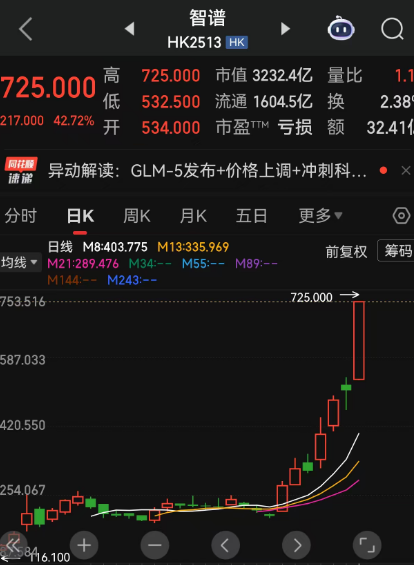
Core Viewpoint - The article highlights the significant rise in the stock prices and market valuations of major AI model companies, particularly Zhiyu and MiniMax, driven by advancements in their AI models and new financing rounds in the industry [1][5][10]. Group 1: Stock Performance - Zhiyu, known as the "first global AI model stock," saw its stock price increase by over 42% on the first trading day of the Year of the Horse, with a market capitalization exceeding 320 billion HKD [1]. - Since February 9, Zhiyu's stock has surged over 250% over seven trading days, while MiniMax's stock has risen over 110% in the same period [1][5]. - As of February 20, Zhiyu's cumulative increase in February is over 220%, and MiniMax's is over 105% [5]. Group 2: Model Developments - Zhiyu recently launched its flagship model GLM-5, designed for complex system engineering and long-range agent tasks, achieving performance levels comparable to top international models [6]. - GLM-5 ranks fourth globally and first among open-source models, marking a significant achievement for domestic models [6]. - MiniMax introduced its latest flagship programming model, MiniMax M2.5, which is designed for agent scenarios and competes with leading international models [8]. Group 3: Financing and Valuation - OpenAI is expected to raise over 100 billion USD in its latest financing round, potentially increasing its valuation to over 850 billion USD, a 70% increase from the end of last year [3][10]. - The domestic AI model company Kimi has seen its valuation double in its latest financing round, indicating strong investor interest [3][10]. - World Labs, founded by AI pioneer Fei-Fei Li, completed a new financing round of 1 billion USD, focusing on enhancing spatial intelligence through world models [11]. Group 4: Market Trends and Future Outlook - The article notes a competitive landscape in the global AI model sector, with major companies investing heavily to capture consumer markets [10]. - The integration of AI with robotics is expected to drive significant growth in the coming years, with predictions of a substantial increase in market demand for embodied intelligence [9]. - The Chinese AI market is projected to grow from 93.7 billion CNY in 2022 to 160.7 billion CNY in 2024, with a compound annual growth rate of 31% [11].

Trump Ups Pressure on Iran; Blue Owl Sold Private Loans to Pay Investors | Bloomberg Brief 2/20/2026
Bloomberg Television· 2026-02-20 11:52
>> IT IS 5:00 A. M. IN NEW YORK CITY.GOOD MORNING. I AM TYLER KENDALL IN FOR VONNIE QUINN WITH YOUR "BLOOMBERG BRIEF ." OIL TRADING DOWN AFTER RALLY TO A SIX-MONTH HIGH AS PRESIDENT TRUMP GIVES IRAN 15 DAYS TO REACH A DEAL. A PRIVATE CREDIT WARNING.BLUE OWL SELLS A PORTFOLIO OF LOANS TO HELP PAY OUT INVESTORS AND MARKETS AWAIT THE LATEST PCE DATA AND A POSSIBLE SUPREME COURT RULING ON PRESIDENT TRUMP'S TARIFFS. HAPPY FRIDAY. FUTURES POINTED HIGHER AFTER WE SAW GEOPOLITICAL TENSIONS YESTERDAY PUSH STOCKS DOW ...

Nvidia Stock Rises. It's Nearing $30 Billion OpenAI Investment, Report Says.
Barrons· 2026-02-20 11:13
Core Insights - Nvidia is reportedly nearing a $30 billion investment agreement with OpenAI [1] Group 1 - The investment signifies Nvidia's commitment to advancing artificial intelligence technologies [1] - This potential deal highlights the growing collaboration between major tech companies and AI firms [1] - The financial scale of the investment reflects the increasing valuation and importance of AI in the tech industry [1]

科技新贵上位,大模型双雄智谱、MiniMax市值突破3000亿港元大关,智谱一日之内涨出一个B站, 携程、快手、京东市值相继被超过 ,恒科已成“老登股”?
Jin Rong Jie· 2026-02-20 10:51
Core Insights - The Hong Kong stock market saw significant gains for AI companies Zhiyuan and MiniMax, with both surpassing a market capitalization of 300 billion HKD, indicating a rise of new tech leaders in the market [1][3] - On the first trading day of the Lunar New Year, while the Hang Seng Tech Index fell nearly 3%, Zhiyuan and MiniMax stood out with substantial price increases, with Zhiyuan's stock price reaching a peak of 739 HKD per share, marking a rise of over 45% [1] - MiniMax also performed well, closing at 970 HKD per share, reflecting a gain of over 14% on the same day, and a total increase of 487.88% since its listing on January 9 [3] Company Performance - Zhiyuan's market capitalization increased by over 96.7 billion HKD in one day, reaching 323.24 billion HKD, with a total increase of over 256% since February 9 [1] - MiniMax's market capitalization reached 304.23 billion HKD, with a significant rise since its IPO [3] Market Dynamics - The market landscape for tech stocks in Hong Kong has shifted, with Zhiyuan and MiniMax surpassing the market capitalizations of major companies like Ctrip, Kuaishou, and JD, and approaching the valuation of Baidu at 350 billion HKD [5] - The performance of these AI companies is seen as a reflection of the growing interest and investment in AI technologies, particularly in light of recent developments in the industry [10] Industry Trends - The rapid iteration of large models is leading to a restructuring of the internet value chain, shifting focus from traditional traffic scale to behavior execution and result-based business models [10] - The AI application sector is experiencing simultaneous technological breakthroughs and intensified commercialization, supported by national strategies promoting AI development [10] Future Outlook - Despite the strong performance of Zhiyuan and MiniMax, concerns remain regarding the overall tech sector in Hong Kong, with analysts predicting continued weakness in the market due to investor apprehension about major companies like Alibaba and Baidu [11]

X @Elon Musk
Elon Musk· 2026-02-20 10:33
RT X Freeze (@XFreeze)OpenAI, Anthropic, and Google seem to have no clear ethics. They're still debating and they don't know what it should be, so whenever you ask a controversial question, they hit you with a canned answer: "Sorry, I can't help with that"They're woke as hellThey're are literally programmed to hate the very country they now live in. They're woke as hell, just like the crazy liberals who hate America but never want to live anywhere else. These AIs are trained to mimic that same, lunatic beha ...