鱼跃医疗

Search documents
鱼跃医疗(002223)8月15日主力资金净流入2773.27万元
Sou Hu Cai Jing· 2025-08-15 08:33
Group 1 - The core viewpoint of the news is that Yuyue Medical (002223) has shown a slight increase in stock price and a mixed performance in its latest financial results, indicating potential investment opportunities and challenges [1][3] - As of August 15, 2025, Yuyue Medical's stock closed at 35.68 yuan, with a trading volume of 97,100 lots and a transaction amount of 345 million yuan [1] - The company experienced a net inflow of main funds amounting to 27.73 million yuan, representing 8.04% of the total transaction amount, with significant contributions from large orders [1] Group 2 - For the first quarter of 2025, Yuyue Medical reported total operating revenue of 2.436 billion yuan, a year-on-year increase of 9.17%, while net profit attributable to shareholders decreased by 5.26% to 625 million yuan [1] - The company's liquidity ratios are strong, with a current ratio of 3.426 and a quick ratio of 3.022, alongside a low debt-to-asset ratio of 19.43% [1] - Yuyue Medical has a significant investment footprint, having invested in 36 companies and participated in 2,139 bidding projects, along with a robust intellectual property portfolio of 719 trademarks and 1,016 patents [2]

鱼跃医疗20250814
2025-08-14 14:48
Summary of Yuyue Medical Conference Call Company Overview - Yuyue Medical focuses on home medical devices, with core businesses in respiratory oxygen, blood glucose and POCT, home health monitoring, and clinical rehabilitation [4][7] - The company is actively incubating its emergency business, particularly in the AED (Automated External Defibrillator) sector, which shows strong growth potential [4][18] Core Business Performance Respiratory Oxygen - Revenue in 2024 is projected to be 2.6 billion RMB, with fluctuations due to changes in public demand [8] - The market for OSA (Obstructive Sleep Apnea) and COPD (Chronic Obstructive Pulmonary Disease) patients in China is underdiagnosed compared to the US, indicating significant market expansion potential [9] - Yuyue holds a market share of 23.4% in the oxygen machine sector, maintaining the leading position [9] Blood Glucose and POCT - Revenue in this sector is expected to reach 1 billion RMB in 2024, reflecting a 40% year-on-year growth [10] - The large diabetic population in China, estimated at 140 million as of 2021, provides a substantial market for CGM (Continuous Glucose Monitoring) systems [10][13] - Yuyue entered the CGM market after acquiring Zhejiang Kailite in 2021, with its latest product, ANYTY5, receiving approval in April 2025 [14][15] Home Health Monitoring - The electronic blood pressure monitor market is projected to reach 6 billion RMB by 2025, with Yuyue holding an 11% market share [16] - The company aims to capitalize on the low awareness and treatment rates of hypertension in China, where approximately 245 million people are affected [16] Clinical Instruments and Rehabilitation - This segment is expected to generate 2.09 billion RMB in revenue in 2024, showing stable growth [17] - The company is focusing on developing new products and expanding its customer base to enhance brand strength [17] Incubation Business - The AED business is rapidly growing, with total revenue of 240 million RMB in 2024, a 34% increase year-on-year, and a market share of 7.8% [19] - The total procurement scale for AEDs in China reached 600 million RMB in 2024, with a year-on-year growth of 85% [19] Sales Channels and Strategy - Yuyue has a comprehensive sales strategy, with online sales accounting for 38% of total revenue in Q1 2025 [6][20] - The company achieved 950 million RMB in overseas revenue in 2024, growing at 30% [6] - A strategic partnership with Innotek aims to enhance sales channels in Europe and the US [6][20] Future Outlook - Earnings per share (EPS) projections for 2025, 2026, and 2027 are 2.01 RMB, 2.36 RMB, and 2.78 RMB, respectively [21] - The company is rated as a "buy" based on a 24x PE valuation for 2025 [21]
京东健康公布2025年中期业绩:上半年总收入353亿元、年度活跃用户数突破2亿
Sou Hu Cai Jing· 2025-08-14 13:21
Core Insights - JD Health reported a total revenue of RMB 35.3 billion for the first half of 2025, representing a year-on-year growth of 24.5%, with a Non-IFRS net profit of RMB 3.57 billion, up 35% [1] - The company has surpassed 200 million annual active users and has over 150,000 third-party merchants on its platform as of June 30, 2025 [1] - JD Health is enhancing its supply chain capabilities and solidifying its position as the "first entry point for online health consumption" [1][3] Revenue and User Growth - JD Health's revenue for the first half of 2025 reached RMB 35.3 billion, a 24.5% increase year-on-year [1] - The Non-IFRS net profit for the same period was RMB 3.57 billion, reflecting a 35% growth [1] - The annual active user count exceeded 200 million, with over 150,000 third-party merchants collaborating on the platform [1][3] Supply Chain and Product Offerings - The company is strengthening its omni-channel supply chain model, collaborating with leading pharmaceutical companies to expand product offerings [3] - Over 30 innovative drugs were launched on JD Health's platform, reinforcing its position as the "first station for new specialty drug launches" [3] - JD Health has established strategic partnerships with companies like Novo Nordisk and Roche to enhance service offerings in chronic disease management [3][4] Service Integration and User Experience - JD Health is enhancing its "medical, testing, diagnosis, and medication" service loop to meet diverse health needs [5] - The company has developed a five-specialty system focusing on dermatology, mental health, traditional Chinese medicine, oncology, and andrology [5] - The average daily consultation volume for JD Internet Hospital exceeded 500,000 as of June 30, 2025 [5] Home Healthcare Services - JD Health is expanding its home healthcare services, with the JD Nurse at Home service covering 64 service items across seven categories [6] - The company has linked over 200,000 pharmacies nationwide for its instant delivery service [4][6] AI and Technological Innovation - JD Health is leveraging AI to enhance clinical decision-making and health management, with over 50 million users served by its AI products [7] - The company has launched the "JD AI" series, which includes various AI-driven professional services for users and healthcare providers [7] - A partnership with Wenzhou Medical University Hospital has resulted in an AI-driven outpatient service process that has served over 2.2 million patients [7]

威高血净收盘下跌3.40%,滚动市盈率35.56倍,总市值162.71亿元
Sou Hu Cai Jing· 2025-08-14 12:45
Core Viewpoint - The company, Weigao Blood Purification, has a current market capitalization of 16.271 billion yuan and a rolling PE ratio of 35.56, which is below the industry average of 55.76 [1][2] Group 1: Company Overview - Weigao Blood Purification specializes in the research, production, and sales of blood purification medical products, including hemodialysis devices, dialysis tubing, dialysis machines, and peritoneal dialysis solutions [1] - The company holds the largest market share in China for hemodialysis devices at 32.5% and for dialysis tubing at 32.8% as of 2022 [1] - The company ranks fifth in the domestic market for peritoneal dialysis solutions with a market share of 3.6% for its exclusive brand Weigao Tailmao [1] Group 2: Financial Performance - In the first quarter of 2025, the company reported revenue of 896 million yuan, reflecting a year-on-year increase of 6.44% [2] - The net profit for the same period was 112 million yuan, showing a year-on-year growth of 7.91%, with a gross profit margin of 40.92% [2] - The company is held by 50 institutions, with a total holding of 0.73 million shares, valued at 0.00 billion yuan [1]
医疗器械再度活跃,医疗创新ETF(516820.SH)现涨0.26%
Xin Lang Cai Jing· 2025-08-14 09:45
Group 1 - The core viewpoint is that the Chinese medical device industry is expected to experience high-quality development due to supportive policies from the National Medical Insurance Administration, which aims to promote innovation and global competitiveness [1] - The upcoming policies are likely to stabilize the profitability of related companies by moderating centralized procurement prices, thus enhancing their earnings levels [1] - The series of policies introduced are anticipated to stimulate innovation and research and development within medical device companies, leading to the continuous launch of new products and further opportunities for growth [1] Group 2 - Recent reports indicate that the medical device sector is gaining attention, with expectations for improvement in the second half of the year, as some companies have already shown promising performance based on their operational trends [2] - The valuation of the medical device sector is currently reasonable, generally ranging from 1 to 1.5 PEG, with potential for valuation switching as the market shifts from high-valued sectors to more reasonably valued ones [2] - The medical innovation ETF (516820) is suggested as a strategic investment opportunity for those looking to capitalize on the recovery of the medical device sector, especially as core assets are showing signs of rebound [2]

医疗器械行业14日主力净流出17.4亿元,科华生物、宝莱特居前
Sou Hu Cai Jing· 2025-08-14 07:57
Industry Overview - On August 14, the medical device industry experienced a decline of 2.45% with a net outflow of 1.74 billion yuan in principal funds [1] - Among the component stocks, 13 increased while 87 decreased [1] Major Fund Outflows - The companies with the highest net outflows of principal funds included: - Kehua Bio (29.96 million yuan) - Baolait (29.32 million yuan) - Shangrong Medical (28.74 million yuan) - Weisi Medical (26.93 million yuan) - ST Kelly (26.25 million yuan) [1] Notable Stock Performance - Key stocks with significant movements included: - Sainuo Medical: Latest price 30.43, up 3.05%, with a net inflow of 164 million yuan (7.25% of total) [1] - Botao Bio: Latest price 45.13, up 19.99%, with a net inflow of 543.74 thousand yuan (12.47% of total) [1] - Yuyue Medical: Latest price 35.67, down 0.17%, with a net inflow of 49.30 thousand yuan (12.91% of total) [1] - Kefu Medical: Latest price 40.58, up 6.99%, with a net inflow of 470.40 thousand yuan (14.3% of total) [1] - Huatai Medical: Latest price 290.99, down 2.03%, with a net inflow of 297.47 thousand yuan (9.99% of total) [1] - Aohua Endoscopy: Latest price 49.14, down 7.79%, with a net inflow of 2363.53 thousand yuan (10.09% of total) [1] - Meihua Medical: Latest price 20.94, up 3.05%, with a net inflow of 2316.72 thousand yuan (4.81% of total) [1] - Wanfu Bio: Latest price 24.28, down 0.92%, with a net inflow of 184.26 thousand yuan (5.48% of total) [1] - Zhijiang Bio: Latest price 25.24, up 4.87%, with a net inflow of 1420.31 thousand yuan (5.07% of total) [1] - Mairande: Latest price 51.64, up 1.06%, with a net inflow of 1335.64 thousand yuan (2.42% of total) [1]


2025年智慧养老设备行业词条报告
Tou Bao Yan Jiu Yuan· 2025-08-13 12:13
Investment Rating - The report indicates a positive investment outlook for the smart elderly care device industry, driven by technological advancements and increasing demand due to aging population trends [3][10][19]. Core Insights - The smart elderly care device industry in China is rapidly evolving, leveraging AI and IoT technologies to address the needs of the aging population, with significant market growth anticipated [3][19]. - The market is characterized by a high growth rate, with a projected compound annual growth rate (CAGR) of 21.2% from 2020 to 2024, reaching a market size of 156.4 billion yuan by 2024 [33][36]. - The industry is supported by strong government policies aimed at promoting smart elderly care solutions, enhancing the overall market environment [11][36]. Summary by Sections Industry Definition - Smart elderly care devices utilize technologies such as AI, IoT, and big data to provide health management, safety monitoring, and daily assistance to the elderly, enhancing their quality of life [4][19]. Industry Characteristics - The industry is experiencing rapid growth, with a significant increase in the number of new elderly care products, reflecting a robust demand driven by an aging population [10][11]. - The industry exhibits a multi-polar regional development pattern, with eastern regions leading in enterprise concentration [12]. Market Dynamics - The market for smart elderly care devices is expanding rapidly, with a notable increase in product registrations and a growing elderly population, particularly those aged 60 and above [10][35]. - The report highlights a strong policy framework supporting the industry, including financial incentives and subsidies for smart elderly care products [11][36]. Development History - The industry has evolved through three phases: the nascent phase (2007-2017), the initiation phase (2017-2020), and the rapid development phase (2021-present), with increasing integration of technology and services [13][17]. Industry Chain Analysis - The industry chain consists of upstream technology suppliers, midstream manufacturers of smart devices, and downstream application scenarios, with a focus on enhancing user experience and product functionality [18][27]. Competitive Landscape - The competitive landscape is characterized by a diverse range of players, from large tech companies to smaller startups, with varying degrees of market share and technological capabilities [44][45]. - The report identifies three tiers of competition, with major tech firms leading the market, followed by mid-sized companies and smaller startups focusing on niche markets [44]. Market Size and Growth Forecast - The smart elderly care device market is projected to grow significantly, with estimates suggesting a market size of over 600 billion yuan by 2024, driven by demographic trends and technological advancements [33][37]. - The report anticipates continued growth in the sector, with a focus on improving product quality and expanding market reach through innovation and collaboration [38].
中证全指医疗保健设备与服务指数上涨0.76%,前十大权重包含爱尔眼科等
Sou Hu Cai Jing· 2025-08-12 15:20
Core Viewpoint - The China Securities Index for Healthcare Equipment and Services has shown significant growth, with a 9.79% increase over the past month and a 13.13% increase over the past three months, indicating a strong performance in the healthcare sector [1]. Group 1: Index Performance - The China Securities Index for Healthcare Equipment and Services rose by 0.76% to 15,136.64 points, with a trading volume of 38.83 billion yuan [1]. - Year-to-date, the index has increased by 9.74% [1]. Group 2: Index Composition - The index is composed of listed companies in the healthcare sector, reflecting the overall performance of these companies [1]. - The top ten weighted companies in the index include: - Mindray Medical (9.04%) - United Imaging (7.59%) - Aier Eye Hospital (7.05%) - Aimeike (3.3%) - Huatai Medical (2.95%) - Lepu Medical (2.79%) - New Industry (2.64%) - Yuyue Medical (2.52%) - Meinian Onehealth (1.93%) - Yingke Medical (1.92%) [1]. Group 3: Market Distribution - The index's holdings are primarily listed on the Shenzhen Stock Exchange (59.62%) and the Shanghai Stock Exchange (40.38%) [1]. - The healthcare sector accounts for 100% of the index's holdings [1]. Group 4: Index Adjustment and Fund Tracking - The index samples are adjusted biannually, with adjustments occurring on the next trading day after the second Friday of June and December [2]. - Public funds tracking the healthcare index include various Southern and Tianhong funds, as well as ETFs from multiple financial institutions [2].





后来居上!正持续爆发
Ge Long Hui A P P· 2025-08-12 10:01
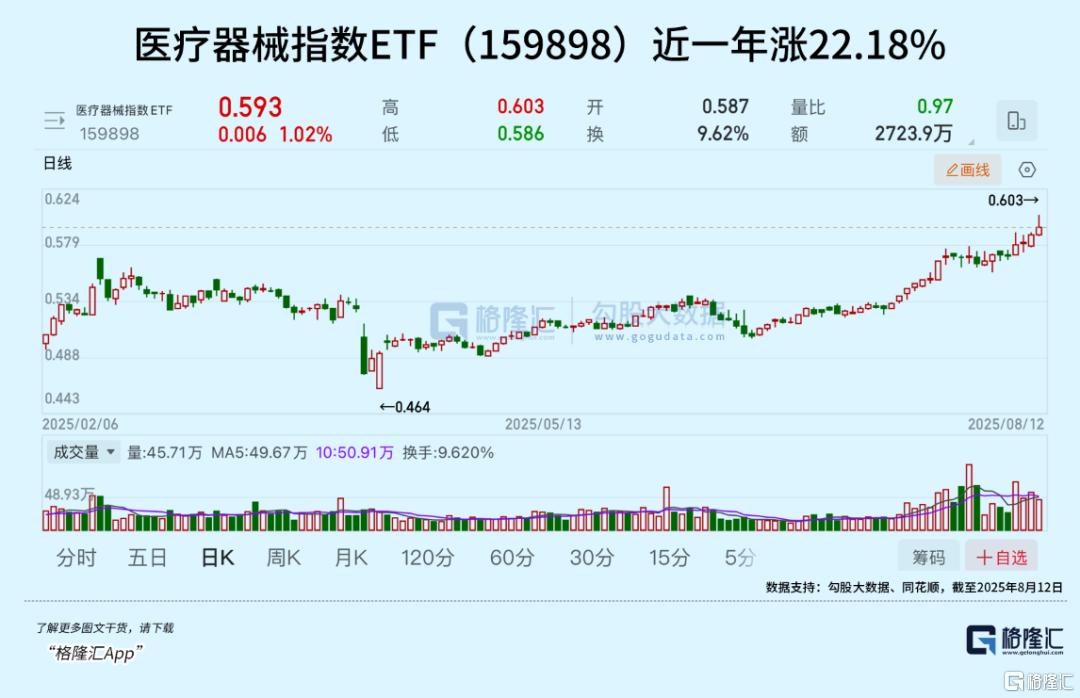
Core Viewpoint - The medical device sector is experiencing a significant upward trend, driven by favorable policies and increasing investment interest, marking a potential turning point for the industry [3][9][16]. Market Performance - The medical device index ETF (159898.SZ) rose by 1.02% today, with a one-year increase of 22.18%, leading among similar indices [1][18]. - Over the past 20 trading days, the medical device index ETF has increased by 12.31%, indicating strong market interest [9]. Policy Environment - Recent policy changes have shifted from restrictive measures to supportive frameworks for innovation and market entry in the medical device sector [14][16]. - The introduction of new pricing projects for brain-computer interface services by various provinces supports clinical application and market growth [4][14]. Investment Trends - There is a notable shift in investment focus from innovative drugs to medical devices, with brain-computer interfaces emerging as a key area of interest [4][10]. - The medical device industry is expected to benefit from a combination of aging populations, increased health awareness, and the integration of AI technologies [17][22]. Future Outlook - The medical device sector is anticipated to transition from low-end to high-end products, moving towards original innovations and comprehensive solutions [22]. - The integration of AI in medical devices is expected to create new growth opportunities and enhance product value [17][22].

2025年中国医用雾化器行业政策汇总、产业链、市场规模及发展趋势研判:人口老龄化加剧,医用雾化器市场规模增长至42.81亿元[图]
Chan Ye Xin Xi Wang· 2025-08-12 01:12
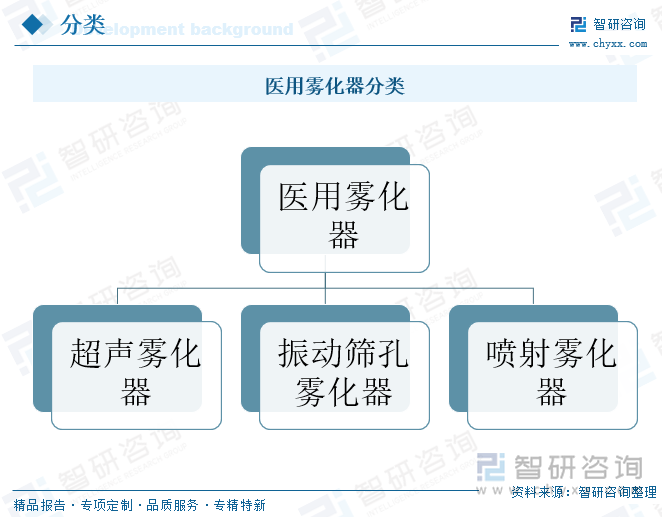
Core Viewpoint - The medical nebulizer industry is experiencing significant growth driven by the aging population and the increasing prevalence of chronic respiratory diseases, with the market size in China projected to reach 4.281 billion yuan by 2024, reflecting an 11.4% year-on-year increase [1][14]. Industry Overview - Medical nebulizers are devices that convert liquid medication into aerosol particles for inhalation, primarily used to treat various respiratory diseases [3]. - The main types of nebulizers include compressed air nebulizers, ultrasonic nebulizers, and mesh nebulizers, each with distinct mechanisms and applications [4][5]. Market Dynamics - The market for medical nebulizers is expected to grow due to the rising number of healthcare institutions, which reached 1,093,600 in China by the end of 2024, a 2.13% increase year-on-year [12]. - The production of medical nebulizers in China is also on the rise, with an expected output of 22.37 million units in 2024, marking a 12.6% increase [18]. Competitive Landscape - The market features numerous participants, including both international brands like Omron and Philips, and domestic companies such as Yuyue Medical and Haier Medical, which are enhancing their competitiveness through R&D and quality improvements [20]. Product Segmentation - Compressed nebulizers dominate the market with a 78% share due to their efficiency, while ultrasonic nebulizers hold a smaller share of 3%, and mesh nebulizers have gained traction with a 19% market share [16]. Regulatory Environment - The Chinese government is actively promoting the development of the medical nebulizer industry through various policies aimed at enhancing innovation and regulatory frameworks [7]. Future Trends - The industry is moving towards precision medication delivery, smart nebulizers for remote monitoring, and portable, eco-friendly designs to enhance user experience [26][27][28].