
苏州银行

Search documents
稳了?国有大行集体反弹,百亿银行ETF(512800)逆市涨逾1%,近2日逾4亿资金涌入
Xin Lang Ji Jin· 2025-09-23 02:38
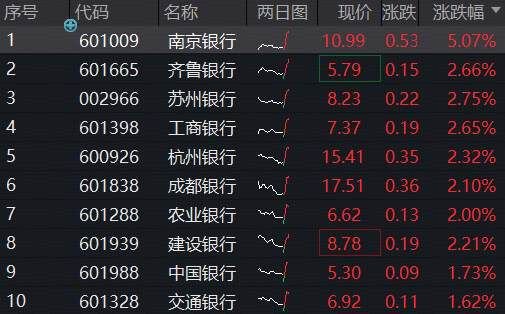
回顾近期行情表现,自7月11日高点以来,银行板块一路震荡向下,截至上周五(9月19日),银行ETF (512800)跟踪的中证银行指数区间已累计下跌13.67%。 中信证券指出,伴随着前期回调,目前A股上市银行算术平均静态股息率回升至4.3%,算术平均静态 PB水平则回落至0.61x,隐含较高的权益回报空间。无论是基于慢牛的板块接续、还是长线资金的欠配 空间,银行股绝对收益空间开始显现,建议投资者积极配置。 9月23日,行情风云变幻,资金再度涌入银行板块。截至发稿,主力资金净流入银行板块逾30亿元,高 居所有行业(申万一级)第2位。银行股集体反弹,南京银行领涨5%,工、农、建三大行等7股涨逾 2%,中行、交行涨逾1%。 | | | | 现价 | 淵鉄 | 涨跌幅 | | --- | --- | --- | --- | --- | --- | | | 601009 | 南京银行 | | 日 53 | | | 2 | 601665 | 齐鲁银行 | 5.79 | 0.15 | 2.66% | | 3 | 002966 | 苏州银行 | 8.23 | 0.22 | 2.75% | | 4 | 601398 | 工商 ...

A股银行股集体上涨,南京银行涨超4%
Ge Long Hui A P P· 2025-09-23 02:27
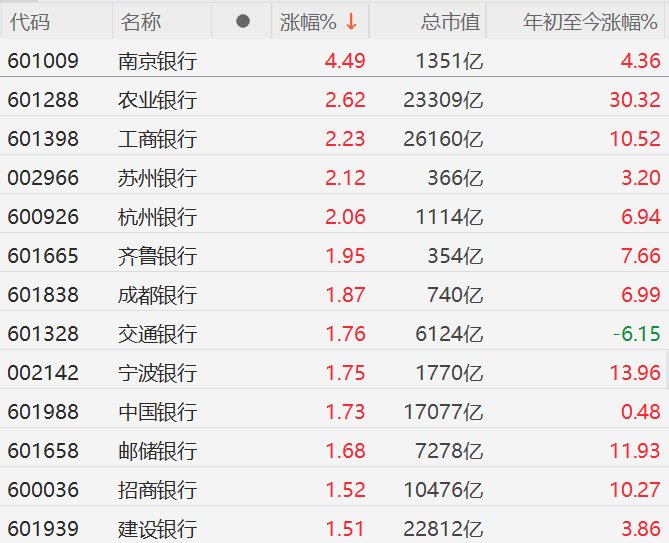
Core Viewpoint - The A-share market has seen a collective rise in bank stocks, with notable increases in several banks' share prices, indicating positive market sentiment towards the banking sector [1]. Group 1: Stock Performance - Nanjing Bank experienced a rise of 4.49%, with a total market capitalization of 135.1 billion and a year-to-date increase of 4.36% [2]. - Agricultural Bank saw a 2.62% increase, bringing its market value to 2,330.9 billion, with a year-to-date rise of 30.32% [2]. - Industrial and Commercial Bank's shares rose by 2.23%, with a market cap of 2,616.0 billion and a year-to-date increase of 10.52% [2]. - Suzhou Bank and Hangzhou Bank both increased by over 2%, with market caps of 36.6 billion and 111.4 billion respectively [2]. - Other banks such as Qilu Bank, Chengdu Bank, and Ningbo Bank also showed positive performance, with increases ranging from 1.75% to 1.95% [2]. Group 2: Technical Indicators - The formation of a MACD golden cross signal suggests a strong upward momentum in these bank stocks, contributing to their positive performance [1].




小红日报|标普红利ETF(562060)9月22日龙虎榜
Xin Lang Ji Jin· 2025-09-23 01:00
Group 1 - The article highlights the top 20 stocks in the S&P China A-Share Dividend Opportunity Index, showcasing their performance in terms of daily increase, year-to-date increase, and dividend yield [1] - The stock with the highest daily increase is Jiufeng Energy (605090.SH) at 8.09%, with a year-to-date increase of 22.18% and a dividend yield of 3.51% [1] - Zhongchuang Zhiling (601 TASH) shows a remarkable year-to-date increase of 99.44%, despite a daily increase of 6.31% and a dividend yield of 4.62% [1] Group 2 - Other notable performers include Jiansheng Group (603558.2H) with a daily increase of 4.45% and a year-to-date increase of 1.78%, offering a dividend yield of 5.45% [1] - Kuka Home (603816.SH) has a daily increase of 4.03% and a year-to-date increase of 20.64%, with a dividend yield of 4.38% [1] - The list also includes companies like China Foreign Trade (601598.SH) with a year-to-date increase of 32.43% and a dividend yield of 4.17% [1]



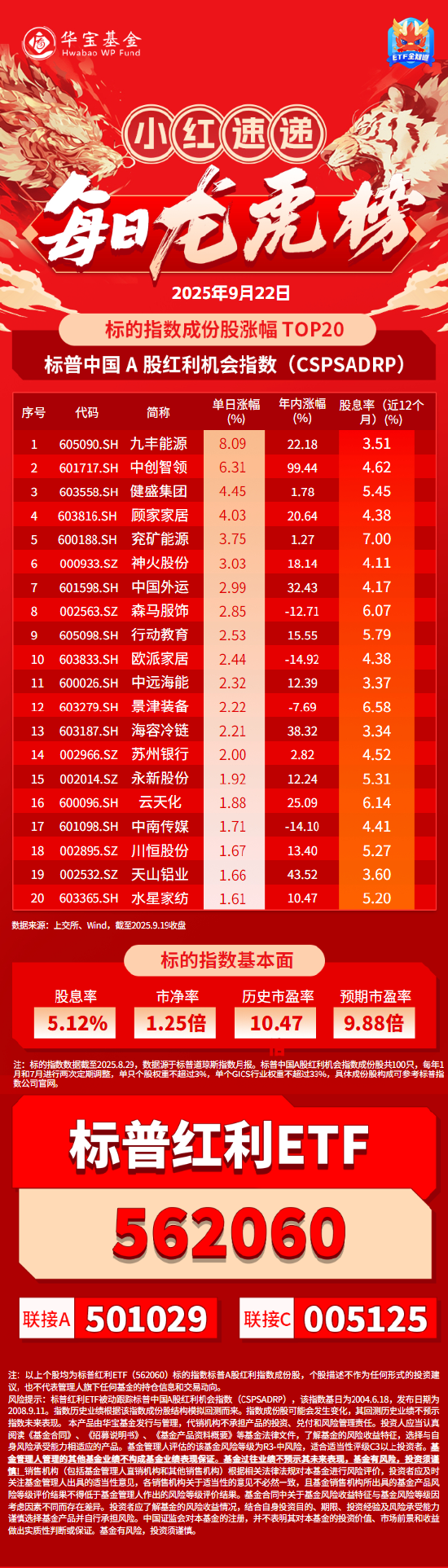
2600亿元!银行发行科创债再扩容,30余家地方性银行涌入
证券时报· 2025-09-22 09:03
Core Viewpoint - The issuance of technology innovation bonds (科创债) has expanded significantly since its launch, with local banks actively participating alongside larger financial institutions [1][4][5]. Group 1: Issuance Scale and Participants - As of September 18, 2023, 45 banks have issued 50 technology innovation bonds, totaling approximately 2580 billion yuan, with expectations to exceed 2600 billion yuan by the end of September [4]. - The participating banks include 2 policy banks, 6 state-owned banks, 6 joint-stock banks, and over 31 local banks, indicating a broad participation across different types of financial institutions [4][5]. - In September alone, several local banks, including Qilu Bank and Suzhou Bank, issued their first technology innovation bonds, with a total issuance of 94 billion yuan [3]. Group 2: Characteristics of Issued Bonds - The majority of technology innovation bonds issued by local banks have a term of 5 years, with interest rates generally ranging from 1.71% to 1.95% [5][9]. - The highest interest rate recorded for a technology innovation bond was 2.03% from Laishang Bank, while the lowest was 1.84% from Qilu Bank [3][9]. - The longest term for a technology innovation bond issued so far is 7 years, with a rate of 1.65% from the Agricultural Development Bank of China [7]. Group 3: Future Trends and Policy Support - Financial institutions are encouraged to issue longer-term bonds to better align with the funding needs of technology enterprises, as highlighted by a joint announcement from the central bank and the securities regulatory authority [8]. - There is an expectation for an increase in the issuance of long-term technology innovation bonds, which would provide technology companies with access to low-cost, long-term funding [9]. - The ongoing support from policies is anticipated to further enhance the scale of technology innovation bond issuance in the future [8].

城商行板块9月22日跌1.17%,杭州银行领跌,主力资金净流出1.32亿元
Zheng Xing Xing Ye Ri Bao· 2025-09-22 08:47
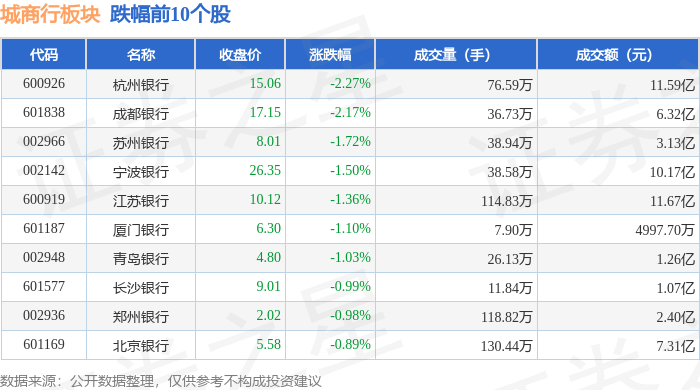
Market Overview - On September 22, the city commercial bank sector declined by 1.17%, with Hangzhou Bank leading the drop [1] - The Shanghai Composite Index closed at 3828.58, up 0.22%, while the Shenzhen Component Index closed at 13157.97, up 0.67% [1] Individual Bank Performance - Hangzhou Bank's closing price was 15.06, down 2.27% with a trading volume of 765,900 shares and a transaction value of 1.159 billion yuan [1] - Chengdu Bank closed at 17.15, down 2.17%, with a trading volume of 367,300 shares [1] - Suzhou Bank closed at 8.01, down 1.72%, with a trading volume of 389,400 shares [1] - Ningbo Bank closed at 26.35, down 1.50%, with a trading volume of 138,580 shares [1] - Jiangsu Bank closed at 10.12, down 1.36%, with a trading volume of 1,148,300 shares [1] - Xiamen Bank closed at 6.30, down 1.10%, with a trading volume of 79,000 shares [1] - Qingdao Bank closed at 4.80, down 1.03%, with a trading volume of 261,300 shares [1] - Changsha Bank closed at 9.01, down 0.99%, with a trading volume of 118,400 shares [1] - Zhengzhou Bank closed at 2.02, down 0.98%, with a trading volume of 1,188,200 shares [1] - Beijing Bank closed at 5.58, down 0.89%, with a trading volume of 1,304,400 shares [1] Capital Flow Analysis - The city commercial bank sector experienced a net outflow of 132 million yuan from institutional investors, while retail investors saw a net inflow of 132 million yuan [1] - The table shows the net capital flow for individual banks, indicating varying levels of institutional and retail investor activity [2] Individual Bank Capital Flow - Hangzhou Bank had a net inflow of 127 million yuan from institutional investors, but a net outflow of 15.3 million yuan from retail investors [2] - Shanghai Bank saw a net inflow of 7.31 million yuan from institutional investors, with a net outflow of 13.26 million yuan from retail investors [2] - Guiyang Bank had a net inflow of 4.12 million yuan from institutional investors, with a net outflow of 4.91 million yuan from retail investors [2] - Qilu Bank experienced a net inflow of 3.48 million yuan from institutional investors, but a significant net outflow of 30.56 million yuan from retail investors [2] - Changsha Bank had a net inflow of 1.00 million yuan from institutional investors, while retail investors saw a net outflow of 6.67 million yuan [2] - Other banks like Xiamen Bank, Qingdao Bank, and Zhengzhou Bank also showed varying trends in capital flow, with some experiencing net outflows from both institutional and retail investors [2]



2600亿元!银行发行科创债再扩容,30余家地方性银行涌入
券商中国· 2025-09-22 07:35
债市"科技板"落地至今已四月有余,科创债发行主体和规模持续扩容。金融机构中,在前期国有大行、股份行的先入 参与后,地方性银行正积极入场。 9月19日,青岛银行发行了"25青岛银行科创债",发行规模10亿元,此外,重庆三峡银行也将于9月22日至24日发行该 行"25三峡银行科创债01",计划发行规模20亿元。 券商中国记者梳理,过去一周有余时间,已有9家地方性银行成功发行、上市了科创债。另外,Wind统计数据显示,截 至9月18日,国内银行共发行了50只科创债,发行规模近2600亿元,其中包含地方性银行30余家。 中小银行积极入场发行科创债 9月以来,已有齐鲁银行、赣州银行、武汉农商行、苏州银行、厦门银行、东莞农商行、福州农商行和莱商银行成功发行 了其今年首批科创债,发行规模94亿元。 发行规模较大的是齐鲁银行和苏州银行,两家银行均在9月发行了20亿元规模的科创债。其中,苏州银行近日成功发行了 20亿元规模的"25苏州银行科创01",并成功于9月15日上市,票面利率1.89%,期限为5年期,募集资金用于科创领域,包 括发放科技贷款、投资科技创新企业发行的债券等,专项支持科技创新领域业务。 发行科创债规模最小的是 ...

重要股东增持排行榜:6股增持金额超亿元
Zheng Quan Shi Bao Wang· 2025-09-22 02:02
Summary of Key Points Core Viewpoint - In the recent five trading days (September 15 to September 19), significant shareholder activities were observed, with 24 companies experiencing stock increases totaling 299 million shares and an aggregate investment of 3.428 billion yuan, while 147 companies saw a reduction in shares amounting to 16.460 billion yuan [1]. Group 1: Shareholder Activities - A total of 24 companies had significant shareholder increases, with a cumulative increase of 299 million shares and an investment of 3.428 billion yuan [1]. - The company with the highest increase in investment was Nanjing Bank, which saw an increase of 12.91 million yuan from 12.31 million shares [1]. - Four companies had shareholders increase their stakes more than twice in the past five days, with Suzhou Bank leading at 12 increases [1]. Group 2: Market Performance - Stocks with shareholder increases averaged a rise of 1.77% over the past five days, outperforming the Shanghai Composite Index [2]. - The top gainers included Junsheng Electronics with a 44.25% increase, followed by *ST Yatai at 18.55% and Antong Holdings at 5.70% [2]. - Conversely, Jin Hui Co. and Nanjing Bank experienced declines of 5.70% and 5.07%, respectively [2]. Group 3: Fund Flow - Among the stocks with shareholder increases, six saw net inflows of main funds, with Suzhou Bank receiving the highest net inflow of 0.22 million yuan [2]. - The companies with the largest net outflows included Huichuan Technology and Shandong Gold, with outflows of 5.79 billion yuan and 5.53 billion yuan, respectively [2].



中信证券:银行绝对收益空间显现
Ge Long Hui· 2025-09-22 01:49
本文来自格隆汇专栏:中信证券研究 作者:肖斐斐 林楠 7月高点至今中信银行股指数(CI005021.WI)累计回调近13%,上周回调超4%,目前A股上市银行算术 平均静态股息率回升至4.3%,算术平均静态PB水平则回落至0.61x,隐含较高的权益回报空间。二季度 以来的市场风格和资金面波动,双向影响板块走势,且上周开始资金面影响强于市场风格,给配置型资 金带来机会。无论是基于慢牛的板块接续、还是长线资金的欠配空间,银行股绝对收益空间开始显现, 建议投资者积极配置。 ▍事项: 2025年9月17日,国务院新闻办公室举行新闻发布会,中国人民银行信贷市场司参会并介绍扩大服务消 费有关政策措施。 ▍银行系统积极支持扩大服务消费。 1)结构性货币政策工具持续发力:①服务消费与养老再贷款,截至2025年9月,金融机构申报该项工具 近600亿元,涉及经营主体近4000家、贷款5700多笔;②科技创新和技术改造再贷款,今年上半年,该 项工具支持住宿餐饮、文体教育、旅游领域等项目近100项,签订贷款合同约119亿元。 2)消费领域信贷投放持续加大:截至7月末,全国服务消费重点领域贷款余额2.79万亿元,同比增长 5.3%,比年 ...

银行业周度追踪2025年第37周:银行股调整后股东增持加速-20250922
Changjiang Securities· 2025-09-21 23:30
Investment Rating - The report maintains a "Positive" investment rating for the banking sector [11] Core Insights - Recent adjustments in bank stocks have led to accelerated share buybacks by state-owned shareholders and management, indicating strong recognition of investment value [2][6] - The systematic increase in holdings by state-owned shareholders reflects a demand to optimize financial equity layouts amid asset scarcity, highlighting the core advantages of low valuations, stable profits, and dividends in bank stocks [7][41] - The report emphasizes the long-term investment value of regional leading city commercial banks, particularly after two rounds of debt restructuring [7][41] Summary by Sections Shareholder Activity - In the past week, banks such as Qingdao Bank, Nanjing Bank, and Chengdu Bank have disclosed progress in share buybacks by state-owned shareholders, showcasing their confidence in investment value [2][6] - Nanjing Bank has seen its state-owned shareholder, Nanjing High-tech, increase its stake by 1.05%, bringing its total holding to 9.99% [6][41] - Other banks, including Suzhou Bank and Qingdao Bank, have also reported significant buyback plans, with Suzhou Bank's shareholders increasing their holdings by 856 million yuan earlier this year [6][41] Market Performance - The banking index has experienced a cumulative decline of 4.1% this week, underperforming the CSI 300 index by 3.6% and the ChiNext index by 6.4% [9][20] - Despite the recent downturn, the long-term investment logic remains solid, with individual stocks like Qilu Bank showing resilience due to management buybacks [9][20] Dividend and Earnings Outlook - The report notes that the expected dividend yield for leading city commercial banks has risen to around 5%, with specific banks like Jiangsu Bank and Chengdu Bank reaching yields of 5.5% [7][8] - The stability of the banking sector's fundamentals is highlighted, with expectations for net interest income to maintain stable growth despite market fluctuations [8][40] - Mid-term dividends are set to commence, with several banks planning to distribute dividends in the fourth quarter, creating an attractive entry point for absolute return funds [8][40] Valuation and Investment Opportunities - The report suggests that the recent valuation adjustments have created significant investment opportunities in bank stocks, particularly for those focusing on dividend yields [7][44] - The ongoing adjustments in the bond market and the anticipated stabilization of loan interest rates are expected to support the banks' revenue streams [8][44]

本周聚焦:三阶段视角:银行资产质量及拨备计提力度如何?
GOLDEN SUN SECURITIES· 2025-09-21 10:34
Investment Rating - The report maintains a positive outlook on the banking sector, suggesting potential investment opportunities due to favorable policy catalysts and improving fundamentals in certain banks [12]. Core Insights - The report highlights the adequacy of loan loss provisions among listed banks, with a provision coverage ratio of 70.8% for Stage 3 loans, indicating limited future impact on profits [2][12]. - It emphasizes the improvement in asset quality, particularly in Stage 3 loans, with notable reductions in the proportion of such loans for several banks compared to the end of Q4 2024 [1][2]. - The report suggests a focus on banks with positive fundamental changes and continuous improvement in financial statements, recommending specific banks for investment [12]. Summary by Sections 1. Loan Quality and Provisioning - The proportion of Stage 3 loans is relatively low for banks like Chengdu Bank (0.66%) and Ningbo Bank (0.76) [1]. - Significant improvements in Stage 3 loan ratios were observed for Chongqing Bank (-61bp) and Guiyang Bank (-48bp) compared to Q4 2024 [1]. - The provision coverage for Stage 3 loans is high, with leading banks like Qingnong Bank (4.35%) and Yunan Bank (4.16%) showing strong provisioning ratios [2]. 2. Financial Assets - The proportion of Stage 3 financial assets is low, with most banks not exceeding 0.05%, indicating manageable asset quality pressure [4]. - The report notes that the provision coverage for financial investments is also robust, with Zhejiang Bank (3.16%) and Qingdao Bank (2.85%) leading in provisioning ratios [8]. 3. Sector Outlook - The report anticipates that expansionary policies aimed at stabilizing the economy will benefit the banking sector, with a focus on banks like Ningbo Bank and Jiangsu Bank for potential investment [12]. - It highlights the ongoing economic recovery and the potential for interest rate cuts, suggesting a sustained dividend strategy for certain banks [12].




