瑞众人寿

Search documents
民生人寿出手举牌,4家险企争相竞逐浙商银行,年内险资26次举牌11次涉及银行股
Xin Lang Cai Jing· 2025-08-14 05:17
Core Viewpoint - Minsheng Life Insurance increased its stake in Zheshang Bank, reaching 5% of the bank's H-share capital, triggering a mandatory disclosure under Hong Kong stock market rules [1][2]. Group 1: Investment Activity - On August 11, Minsheng Life purchased 1 million shares of Zheshang Bank H-shares for HKD 2.7679 per share, totaling HKD 276.79 million [2][3]. - Following this transaction, Minsheng Life holds 296,023,000 shares of Zheshang Bank H-shares, representing 5% of the bank's total H-share capital [2][3]. - Other insurance companies, including Ping An Life and Xinhua Insurance, have also been actively increasing their holdings in bank stocks, with over 100 instances of share purchases this year [1][10]. Group 2: Strategic Rationale - The shift in accounting standards and the low-interest-rate environment are driving insurance companies to seek stable returns in equity markets, with listed banks being a preferred investment due to their solid operational performance and attractive dividend yields [2][10]. - Minsheng Life's investment strategy aims to balance long-term investment returns with current profit volatility, leveraging the support from its major shareholder, Wanxiang Holdings, which is also a founding shareholder of Zheshang Bank [1][2][4]. Group 3: Market Context - The insurance sector is increasingly focusing on high-dividend assets to stabilize cash flow and mitigate profit fluctuations caused by equity price volatility [10][12]. - In 2023, insurance companies have made 26 instances of share purchases, with 11 involving bank stocks, indicating a strong preference for this sector [10][12].



瞄准“地方主线”,险资入“市”火花加速碰撞
Bei Jing Shang Bao· 2025-08-10 14:08
Core Viewpoint - Insurance capital is increasingly being utilized to support local economic development across various regions in China, demonstrating its role as a stable and patient source of funding for key sectors and projects [1][2][3] Group 1: Investment Trends - Recent developments in insurance capital investment include the establishment of the first S fund in Henan, with a registered capital of 700 million yuan and a duration of 12 years, aimed at revitalizing the regional equity investment market [1] - In addition to Henan, regions like Zhejiang and Sichuan are actively attracting insurance investments, with strategic cooperation agreements being signed to enhance collaboration in project planning and industrial layout [2] Group 2: Characteristics of Insurance Capital - Insurance capital is characterized by its long-term, large-scale, stable nature, and flexible investment forms, making it suitable for financing long-cycle projects such as infrastructure and industrial upgrades [2][3] - The preference for stable returns allows insurance capital to lower financing costs for significant local projects compared to market-driven private equity funds [2] Group 3: Government and Regulatory Support - Local governments and regulatory bodies are actively guiding insurance capital into local economic transformations, creating favorable conditions for its integration into infrastructure projects [3][5] - Incentives such as interest subsidies are provided to project owners who attract insurance capital for major infrastructure and public welfare projects [3] Group 4: Future Outlook - The integration of insurance capital with local economies is expected to deepen, with ongoing policy support and potential relaxation of investment regulations to enhance the vitality of insurance capital [5] - Investment models are anticipated to diversify, with tools like REITs, equity investments, and industrial funds becoming more prevalent, improving the alignment of insurance capital with local projects [5]

险资年内完成22次举牌,银行、公用事业成重点布局方向
Sou Hu Cai Jing· 2025-08-09 18:09
Group 1 - The core viewpoint is that insurance capital has been increasingly active in the secondary market, with 22 instances of shareholding increases reported by the China Insurance Industry Association as of August 8, surpassing the total for the previous year [1] - The targeted sectors for increased holdings are concentrated in banking, public utilities, energy, transportation, and environmental protection, characterized by reasonable valuations, stable dividend returns, and high operational certainty [1][3] - Hongkang Life's recent purchase of Honghua Smart Energy H-shares, exceeding a 5% stake, exemplifies this trend [1] Group 2 - Public utilities have become a focal point for insurance companies, with Honghua Smart Energy being a recent example, projecting over HKD 21.3 billion in revenue for 2024, alongside improvements in net profit and earnings per share [3] - The banking sector is also a key area for insurance capital, with institutions like Ping An Life and Xinhua Insurance increasing their stakes in banks such as China Merchants Bank and Agricultural Bank of China, attracted by the high dividend yield and low valuation in the H-share market [3] - The frequency of shareholding increases and the number of participating insurance institutions have significantly risen this year, with multiple companies, including China Life and Ruizhong Life, disclosing shareholding announcements [3] Group 3 - In terms of fund utilization, some of the targeted shares are classified as FVOCI assets to smooth profit fluctuations, while others are included as long-term equity investments measured by the equity method [4] - The core logic behind these strategies is to secure high-dividend, low-volatility, and sustainably operating quality assets, enhancing the stability of insurance companies' investment portfolios [4] - This asset allocation approach is particularly beneficial in addressing the pressures on the asset side in a low-interest-rate environment [4]

今年险资举牌已达22次,重点盯上这些领域
21世纪经济报道· 2025-08-09 12:14
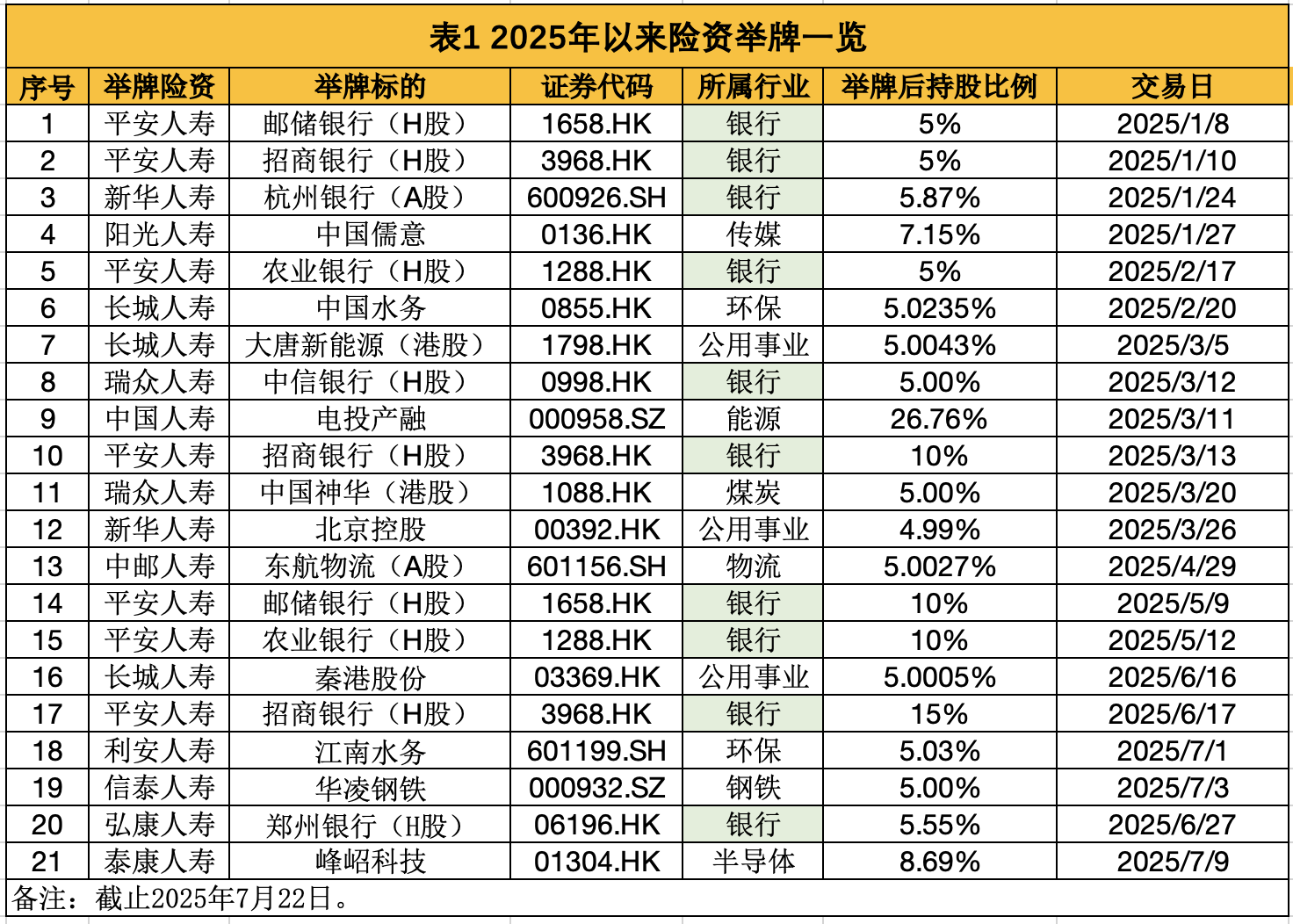
编辑丨杨希 险资举牌越战越勇。 近日,弘康人寿通过港股通二级市场,买入港股上市公司港华智慧能源股票,持股比例达到5%,触发举 牌。 中国保险行业协会披露信息显示,今年以来,险资举牌已经达到22次。梳理举牌标的可以发现,险 资偏好较低估值、较低波动、较高分红、较高业绩确定性等资产。 | 今年以来险资举牌一览 记者 叶麦穗 编辑 | | | --- | --- | | 险企 | 举牌公司 | | 平安人寿 | 邮储银行H股2次、农业银行H股2次、招商银行H股 3次 | | 瑞众人寿 | 中信银行H股、中国神华H股 | | 长城人寿 | 中国水务H股、大唐新能源H股、秦港股份H股 | | 新华保险 | 杭州银行、北京控股H股 | | 中国人寿 | 电投产融 | | 中邮人寿 | 东航物流、绿色动力环保H股 | | 阳光人寿 | 中国儒意H股 | | 利安人寿 | 江南水务 | | 信泰人寿 | 华菱钢铁 | | 弘康人寿 | 港华智慧能源H股 | | 泰康人寿 | 峰昭科技H股 | 记者丨叶麦穗 弘康人寿今年首次举牌 8月7日,弘康人寿公告称,公司参与举牌港华智慧能源。弘康人寿表示,本次举牌前,公司直接持有港 华智 ...

拍卖槌下的保险股权:折价、流拍与接盘者
经济观察报· 2025-08-09 08:57
Core Viewpoint - The insurance industry is experiencing a significant shift, with private enterprises increasingly selling their equity stakes in insurance companies, while state-owned capital is stepping in to stabilize the sector [2][3][15]. Group 1: Current Market Dynamics - A growing number of insurance equity stakes are being listed for sale on platforms like Alibaba and JD.com, as well as on property exchange websites in Beijing and Shanghai [2]. - Despite multiple attempts to sell these stakes, including price reductions and repeated listings, many potential buyers remain elusive [2]. - The insurance sector has transitioned from a phase of rapid growth, characterized by a surge in applications for insurance licenses, to a more challenging environment marked by stricter regulations and declining interest rates [2][12]. Group 2: Shift in Ownership - Since 2020, nearly 20 insurance companies have seen changes in their largest shareholders, with an increasing proportion of ownership being transferred to state-owned entities [3][15]. - The trend of private capital exiting the insurance sector is evident, with state-owned capital becoming a crucial stabilizing force [15][16]. - The ownership structure of companies like Guobao Life is shifting significantly, with state-owned shareholders potentially increasing their stake from 33.5% to over 75% [15]. Group 3: Financial Challenges and Responses - Many insurance companies are struggling with capital adequacy and operational profitability, leading to a rise in equity sales as a means to raise necessary funds [8][15]. - A significant number of insurance firms reported losses, with 18 out of 75 life insurance companies disclosing negative earnings in 2024 [8]. - The regulatory environment has tightened, emphasizing risk management and the need for insurance companies to maintain adequate capital levels [12][14]. Group 4: Historical Context and Future Outlook - The rapid expansion of the insurance industry from 2015 to 2017 was fueled by regulatory changes and a favorable market environment, which has since reversed [10][11]. - The shift from a growth-oriented to a risk-oriented regulatory framework has led to a decrease in new insurance license applications and a focus on stabilizing existing firms [14][17]. - The ongoing changes in ownership and capital structure reflect broader economic shifts in China, indicating a more coordinated development within the insurance sector [17].

港险将推报行合一;平安、国寿等五大上市险分红近千亿;泰康、友邦等接盘160亿购物中心|13精周报
13个精算师· 2025-08-09 02:07
Regulatory Dynamics - Seven departments are promoting long-term funds from government investment funds and insurance companies to focus on future manufacturing, information, materials, and other sectors under controllable risks [5][9] - Two departments announced the resumption of value-added tax on interest income from newly issued government bonds and financial bonds starting August 8 [6] - The China Insurance Asset Management Association may be renamed to include banking insurance asset management [8] - Hainan encourages increasing the proportion of loans to the manufacturing sector and developing multi-level capital markets and industrial insurance [9] - Shanghai's seven departments issued measures to promote the joint development of medical insurance and commercial insurance, supporting innovative drugs and medical devices [10][11] Company Dynamics - Hongkang Life increased its stake in Zhengzhou Bank to 14.03% by acquiring 675,000 shares [17] - Hongkang Life also increased its stake in Honghua Wisdom Energy by acquiring 458,000 shares [18] - Ping An Insurance increased its stake in Postal Savings Bank by acquiring 9.357 million shares [19] - Sunshine Life reduced its stake in Victory Shares to 4.72% by selling 0.5% of its shares [20] - Taiping Life's investment in China Power Construction has turned profitable after two years, with a 3.5 billion yuan investment [22] - China Life, along with other partners, established a 5 billion yuan equity investment fund in Hebei [23] - TaiKang Life is leading a consortium to acquire three shopping centers for 16 billion yuan [24] - Zhongyou Life reported insurance business revenue of 118 billion yuan in the first half of the year, with two listed companies targeted for investment [25][26] Industry Dynamics - 58 non-listed life insurance companies reported a combined net profit of 28.6 billion yuan in the first half of the year, a year-on-year increase of 242% [44] - 76 property insurance companies achieved a net profit of over 9.2 billion yuan in the first half of the year, with significant growth attributed to improved underwriting and investment returns [45] - The five major listed insurance companies announced a total dividend of 907.89 billion yuan for 2024, a year-on-year increase of 20.21% [46] - 143 insurance companies disclosed their solvency reports, with five companies failing to meet standards [47][48] - Four problematic insurance companies faced severe penalties, including license revocation and operational bans [49] - *ST Tianmao is likely to voluntarily delist, marking the third such case this year [50] - Citigroup reported that policies promoting the high-quality development of commercial health insurance in Shanghai will benefit companies like Heng Rui Pharmaceutical [51] Product and Service Innovations - Sunshine Life launched the "Beautiful Life" silver-haired product system, enhancing coverage for the elderly [59] - The first "loan + insurance" climate loan product was launched in Chengdu, integrating banking and insurance services [60]



四家险企 风险处置收官
Jin Rong Shi Bao· 2025-08-08 07:42
瑞众人寿整体受让华夏人寿。2023年7月3日,瑞众人寿获得保险许可证的信息出现在金融监管总局 网站上。行政许可信息显示,瑞众人寿注册资本565亿元。从股权结构看,九州启航(北京)股权投资 基金(有限合伙)出资339亿元,持股60%,由多家险企和深圳市深基启航投资发展有限公司共同投资 组成。 8月1日,金融监管总局公示了对5家金融机构的行政处罚,其中一家为华夏人寿。因报送的报告中 存在虚假记载和重大遗漏、客户信息不真实、虚假列支费用等违法违规行为,金融监管总局吊销华夏人 寿业务许可证,并对23名责任人进行处罚。 对华夏人寿处罚的落地,意味着自2020年7月原银保监会启动对天安财险、华夏人寿、天安人寿、 易安财险四家"明天系"保险机构实施接管以来,完成了对四家问题保险公司的风险处置工作。 风险处置方案落地 2020年7月17日,因存在违反保险法规定的经营行为,触发了接管条件,原银保监会宣布对天安财 险、华夏人寿、天安人寿、易安财险四家"明天系"保险机构实施接管。接管原定期限一年,后延长至 2022年7月16日。 随后,四家保险机构的风险处置方案于2023年密集落地。 根据协议,瑞众人寿受让协议约定的华夏人寿截至2 ...
新一轮保险预定利率调降启幕 合资公司同方全球人寿打响市场第一枪 1.5%预定利率分红险上新
Zhong Guo Jing Ji Wang· 2025-08-08 07:25
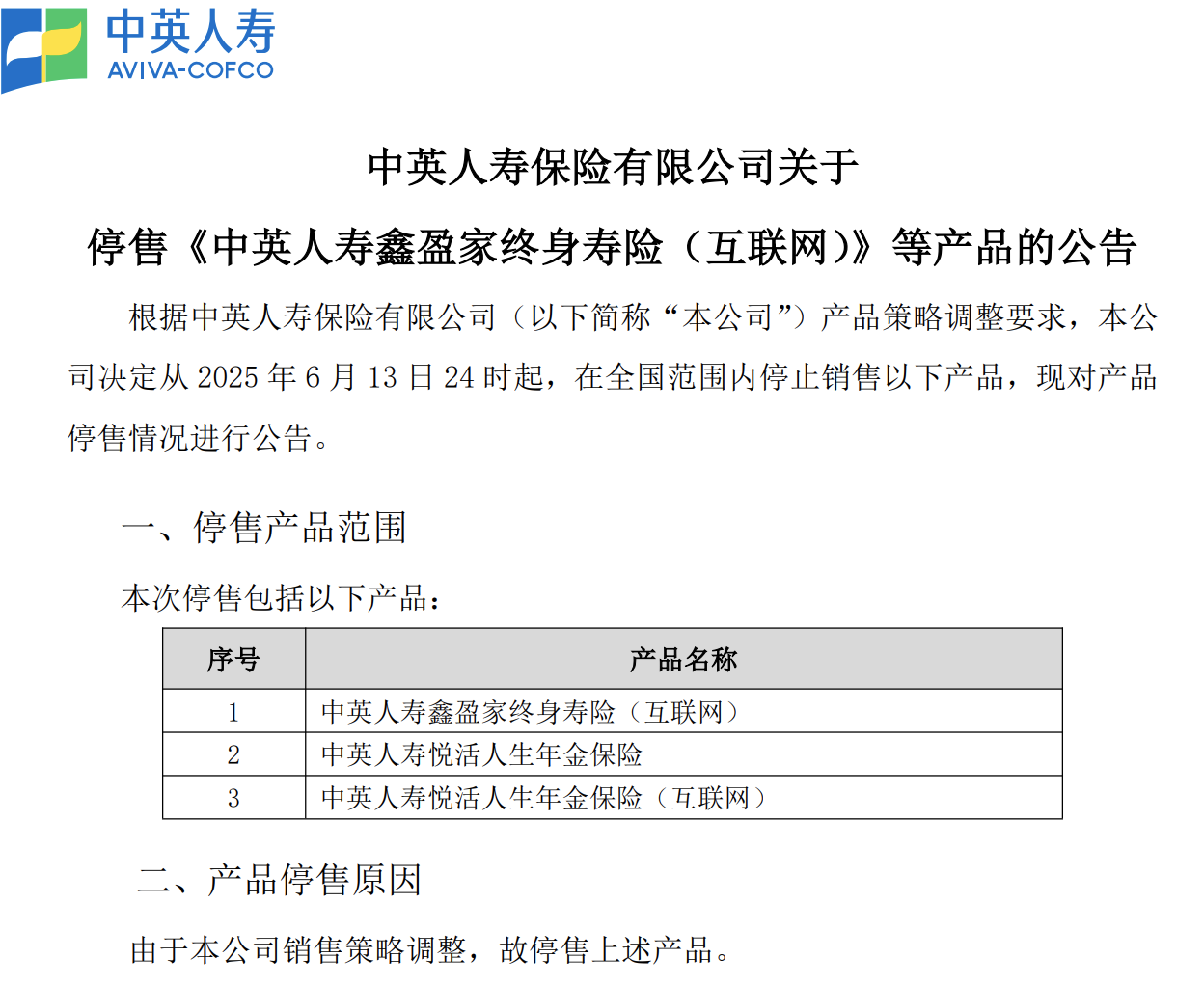
Core Viewpoint - A new round of insurance "interest rate cuts" has begun, with companies adjusting their product offerings in response to changing market conditions, particularly the decline in preset interest rates for insurance products [1][2][12]. Group 1: Insurance Product Adjustments - Many life insurance products with a preset interest rate of 2.5% are being discontinued ahead of the third quarter, as companies restructure their product matrices to focus on "protection + savings" [1][3]. - Tongfang Global Life has launched new dividend insurance products with a preset interest rate reduced from the market cap of 2% to 1.5%, marking the start of this new round of interest rate cuts [2][3]. - Other companies, such as Zhongying Life and Fosun Baodexin, have also begun to suspend sales of various insurance products, indicating a broader trend of product discontinuation across the industry [6][8][11]. Group 2: Market Trends and Expert Insights - Industry experts suggest that the gradual reduction of preset interest rates is a necessary adjustment for the insurance sector to lower liability costs and promote sustainable development [3][12]. - The shift towards lower preset interest rates is expected to lead to a more competitive environment focused on risk management, asset allocation, and service value rather than solely on high interest rates [1][3]. - The current market environment, characterized by declining interest rates, is pressuring insurance companies to increase their equity allocations, as over 78% of their asset-liability costs remain in the 3%-4.025% range [13][14]. Group 3: Future Outlook - The long-term trend indicates a transition from high guaranteed returns to low guaranteed returns combined with floating interest rate products, which may enhance the equity allocation space for insurance funds [12][14]. - As the guarantee costs decrease, the insurance industry is expected to adapt by focusing on more flexible product offerings that align with changing consumer needs and market conditions [12][14].
险资年内合计举牌20次 已达去年全年水平
Zheng Quan Ri Bao· 2025-08-08 07:24
从今年举牌上市公司的险企来看,既有大型险企,也有中小险企。从举牌标的来看,高股息标的和H股 上市公司占比较高。天职国际会计师事务所保险咨询主管合伙人周瑾认为,这主要是因为这些标的与保 险资金期限长、投资风格稳健等特性高度契合,同时,H股的估值较A股呈现出一定折价,增值空间更 大,且通过港股通投资还有一定的税收优惠,因此是险资权益配置的重点。 周瑾表示,随着新会计准则即将全面实施,更多险企希望通过举牌来实现权益法核算,以减少当期损益 的波动性,这一因素也将推动险企增加举牌行为。同时,当前股票市场的估值较低,未来或有较大的升 值空间,险企需把握低估值机会增配权益资产。 具体来看,港交所披露易信息显示,弘康人寿于6月27日以每股1.2068港元增持郑州银行H股1600万股, 增持后持股比例占其H股的5.55%,根据香港市场规则,触发举牌。随后,弘康人寿于下一个交易日(6 月30日)继续增持郑州银行H股2300万股,每股价格1.1804港元。至此,弘康人寿持有郑州银行H股数 量达到1.35亿股,持股比例上升至6.68%。 《证券日报》记者根据公开信息统计,今年截至目前已有10家保险机构对16家上市公司进行举牌,举牌 ...
年内险资上百次增持银行股、10度触发举牌 低利率时代银保抱团取暖渐成趋势
Zhong Guo Jing Ji Wang· 2025-08-08 07:05
Core Viewpoint - Insurance capital is increasingly investing in bank stocks, driven by high dividends and strategic considerations related to the insurance-banking partnership [1][10][15]. Group 1: Investment Trends - Insurance companies have made over 100 purchases of bank stocks in 2025, with significant activity in both Hong Kong and A-shares [5][6]. - The "Ping An system" has been particularly active, making 90 purchases, including major state-owned banks like CCB, ABC, and ICBC, with holding ratios exceeding 40% [6][7]. - As of July 22, 2025, insurance capital has triggered 21 instances of stock purchases, with 10 involving bank stocks, indicating a strong preference for this sector [3][5]. Group 2: Strategic Considerations - The shift towards bancassurance is seen as a key strategy for insurance companies, with predictions that the new business value from bank channels will surpass that of individual insurance in the next 10-15 years [1][10]. - The integration of banking and insurance operations is expected to enhance the value of bancassurance channels, making them a primary growth driver for many insurance firms [10][12]. - The current low-interest-rate environment is pushing both banks and insurance companies to form strategic alliances, emphasizing the importance of capital ties for long-term benefits [2][18]. Group 3: Market Predictions - Analysts predict that insurance capital will continue to flow into bank stocks, with an estimated 200 billion yuan in new funds expected to enter the banking sector from 2025 to 2027 [16][17]. - The bancassurance channel is projected to reach parity with individual insurance in terms of new business value by 2026, highlighting its growing importance [17]. - The complementary nature of banks and insurance companies is expected to drive deeper customer engagement and value creation in the financial services sector [17][18].