Biogen

Search documents
Denali Therapeutics Announces Key Anticipated Milestones and Priorities for 2026 Including Commercial Launch of Tividenofusp Alfa for Hunter Syndrome
Globenewswire· 2026-01-06 13:00
Core Insights - Denali Therapeutics Inc. is poised for significant advancements in 2026, focusing on the launch of its first TV-enabled medicine, tividenofusp alfa, for Hunter syndrome, which is expected to set a new standard of care [2][4] - The company anticipates multiple clinical data readouts and plans to initiate clinical studies for Alzheimer's disease and Pompe disease, emphasizing its commitment to developing transformative medicines [2][7] Clinical Programs - **Tividenofusp alfa (DNL310, ETV:IDS)**: Denali is preparing for a commercial launch pending FDA's decision on the Biologics License Application (BLA) with a target action date of April 5, 2026. The Phase 1/2 trial results were published in The New England Journal of Medicine [4][5] - **DNL126 (ETV:SGSH)**: Initial clinical data from the ongoing Phase 1/2 study for Sanfilippo syndrome Type A will be presented at the 2026 WORLDSymposium [5] - **TAK-594/DNL593 (PTV:PGRN)**: The ongoing Phase 1/2 study for frontotemporal dementia is expected to yield initial patient data in 2026 [6] - **DNL628 (OTV:MAPT)**: This program targets Alzheimer's disease and is designed to cross the blood-brain barrier. The Phase 1b study has been approved and is set to begin [7][8] - **DNL952 (ETV:GAA)**: The FDA has lifted the clinical hold on this program for Pompe disease, allowing the Phase 1 study to proceed [9] - **BIIB122/DNL151**: The Phase 2b LUMA study for Parkinson's disease completed enrollment in 2025, with results expected in 2026 [10] Financial Outlook - As of September 30, 2025, Denali had approximately $872.9 million in cash and equivalents. In December 2025, the company completed an equity financing of about $200 million and entered a royalty funding agreement with Royalty Pharma, potentially yielding up to $275 million based on future sales of tividenofusp alfa [14] Key Anticipated 2026 Milestones - **Tividenofusp alfa**: Expected US Accelerated Approval in the first half of 2026 [15] - **DNL126**: Phase 1/2 data presentation in the first half of 2026 [15] - **DNL628**: Initiation of Phase 1b study in the first half of 2026 [15] - **DNL952**: Initiation of Phase 1 study in the first half of 2026 [15] - **DNL151/BIIB122**: Phase 2b LUMA data expected in the first half of 2026 [15] - **DNL126**: Phase 3 study initiation in the second half of 2026 [15] - **DNL593**: Phase 1/2 data expected in the second half of 2026 [15]



Biologics License Application for Subcutaneous Formulation of “LEQEMBI®” (lecanemab) for the Treatment of Early Alzheimer's Disease Accepted in China
Globenewswire· 2026-01-06 01:00
Core Viewpoint - Eisai and Biogen announced the acceptance of the Biologics License Application (BLA) for the subcutaneous formulation of LEQEMBI (lecanemab) by the National Medical Products Administration (NMPA) in China, which could allow for at-home administration of the treatment for Alzheimer's disease [1][2]. Group 1: Product Details - The subcutaneous autoinjector (SC-AI) formulation of LEQEMBI allows for a 500 mg dose (two 250 mg injections) to be administered weekly at home, providing an alternative to the current intravenous (IV) administration [2]. - Each autoinjector delivers a 250 mg injection in approximately 15 seconds, potentially reducing healthcare resources associated with IV dosing [2]. - LEQEMBI targets protofibrils of amyloid beta (Aβ), which are believed to contribute to cognitive decline in Alzheimer's disease [4]. Group 2: Market Potential - Eisai estimates that there were 17 million patients with mild cognitive impairment (MCI) or mild dementia due to Alzheimer's disease in China in 2024, a number expected to rise with the aging population [3]. - The approval of the SC-AI formulation could expand treatment options for patients and caregivers, facilitating easier access to therapy [2]. Group 3: Collaboration and Development - Eisai leads the global development and regulatory submissions for LEQEMBI, with both Eisai and Biogen co-commercializing and co-promoting the product [3][8]. - The collaboration between Eisai and BioArctic, initiated in 2005, has been crucial for the development and commercialization of lecanemab [9]. Group 4: Regulatory Status - LEQEMBI has been approved in 52 countries and is under regulatory review in 8 countries, with recent approvals including subcutaneous maintenance dosing in the U.S. and inclusion in China's "Commercial Insurance Innovative Drug List" [6].


Biogen: Competing With Eli Lilly's Kisunla, Safety Gives Market Edge (NASDAQ:BIIB)
Seeking Alpha· 2025-12-30 13:57
Core Insights - Biogen Inc. (BIIB) stock has increased by 18.4% since October, outperforming the S&P 500 which returned 2.9% and the iShares Biotechnology ETF which returned 14% [1] Company Performance - Biogen's stock performance indicates strong market interest and potential growth in the biotech sector, particularly in comparison to major indices and ETFs [1] Investment Strategy - Allka Research emphasizes a conservative investment approach, focusing on identifying undervalued assets across various sectors including ETFs, commodities, technology, and pharmaceuticals [1] - The firm aims to simplify investment strategies for both experienced and novice investors, fostering a community of informed investors [1]

Biogen: Competing With Eli Lilly's Kisunla, Safety Gives Market Edge
Seeking Alpha· 2025-12-30 13:57
Core Insights - Biogen Inc. (BIIB) stock has increased by 18.4% since October, outperforming the S&P 500 which returned 2.9% and the iShares Biotechnology ETF which returned 14% [1] Company Performance - Biogen's stock performance indicates strong market interest and potential growth in the biotech sector, particularly in comparison to major indices and ETFs [1] Investment Strategy - Allka Research emphasizes a conservative investment approach, focusing on identifying undervalued assets across various sectors including ETFs, commodities, technology, and pharmaceuticals [1] - The firm aims to simplify investment strategies for both experienced and novice investors, fostering a community of informed investors [1]

Royalty Pharma Acquires Remaining Royalty Interest in Roche's Evrysdi for $240 Million and Potential Milestones
Globenewswire· 2025-12-29 21:40
Core Insights - Royalty Pharma has acquired the final portion of PTC Therapeutics' royalty on Roche's Evrysdi for $240 million upfront and up to $60 million in sales-based milestones [1] Group 1: Transaction Details - Royalty Pharma will own 100% of the tiered royalty structure ranging from 8% to 16% on worldwide net sales of Evrysdi [3] - The royalty rates are structured as follows: 8% on sales up to $500 million, 11% on sales between $500 million and $1 billion, 14% on sales between $1 billion and $2 billion, and 16% on sales over $2 billion [3] - Royalty Pharma will start receiving the increased royalty rates in Q1 2026 based on Evrysdi sales in Q4 2025 [3] Group 2: Product Information - Evrysdi is an orally administered SMN2 splicing modifier for treating spinal muscular atrophy, approved by the FDA in 2020 [2] - The product has treated over 21,000 patients globally and generated sales of approximately CHF 1.6 billion ($1.9 billion) in 2024, reflecting an 18% year-over-year growth at constant exchange rates [2] - Analyst consensus projects Evrysdi sales to reach CHF 2.3 billion ($2.9 billion) by 2030 [2] Group 3: Company Background - Royalty Pharma, founded in 1996, is the largest buyer of biopharmaceutical royalties and a key funder of innovation in the biopharmaceutical sector [5] - The company collaborates with various entities, including academic institutions and leading pharmaceutical companies, to fund innovation directly and indirectly [5] - Royalty Pharma's portfolio includes royalties on over 35 commercial products and 20 development-stage candidates [5]



The Journal of the American Medical Association (JAMA) Neurology Publishes Long Term Results from the QALSODY Phase 3 VALOR Study and its Open-Label Extension in SOD1-ALS
Globenewswire· 2025-12-22 16:20
Core Insights - Biogen announced the final results of the Phase 3 VALOR study and its open-label extension, demonstrating that early initiation of QALSODY (tofersen) is associated with a slower decline in clinical function, breathing, and strength in patients with SOD1-ALS, along with a reduced risk of death or permanent ventilation [1][2][7] Company Overview - Biogen is a leading biotechnology company focused on innovative science to develop new medicines, with a commitment to advancing ALS research and treatment [14][13] - The company has received approval for QALSODY in 44 countries, including accelerated approval in the US [3] Study Details - The VALOR study was a six-month Phase 3, randomized, double-blind, placebo-controlled trial involving 108 participants, with 72 receiving tofersen and 36 receiving a placebo [4] - The open-label extension study had a median follow-up of 4.9 years, with significant findings regarding muscle strength improvements in 27% of early-start participants [5][6] Treatment Mechanism - QALSODY is an antisense oligonucleotide designed to reduce SOD1 protein production, which is implicated in the degeneration of motor neurons in SOD1-ALS [8][11] - The treatment is administered intrathecally with a specific dosing regimen, and its approval in the US is based on the reduction of plasma neurofilament light chain (NfL) [8][10] Future Research - Biogen is advancing additional ALS research, including the ongoing QALSODY ATLAS study aimed at evaluating the treatment's potential to delay clinical onset in presymptomatic individuals with SOD1 mutations [10][7] - The company is also exploring a robust discovery pipeline targeting TDP43 pathology, which is present in 97% of ALS cases [13]
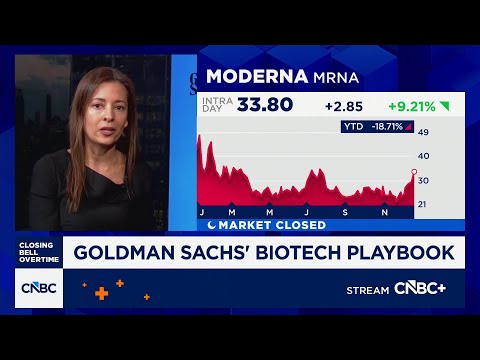
This year's biotech laggards primed for 2026 recovery, says Goldman Sachs' Richter
CNBC Television· 2025-12-19 22:25
Despite pressure from the administration, a rough start to the year, biotech has seen a rebound this year. Our next guest is betting that that recovery will continue into 2026. So joining us now, Salivine Richtor.She is the lead US biotech analyst at Goldman Sachs Research. And Salivine, it's great to have you on the show. Welcome.>> Thank you for having me. What's interesting to me is that these names of these, you know, these stocks of these pharma companies that did inc this deal with the president just ...
Biogen: Alzheimer's Disease Treatment Needs More Real-World Data (NASDAQ:BIIB)
Seeking Alpha· 2025-12-15 03:22
Core Insights - Eisai's Leqembi has been highlighted for its potential to slow the progression of Alzheimer's disease, despite the CTAD conference yielding no major breakthroughs in treatment [1] Group 1: Alzheimer's Disease Research - The article emphasizes that Alzheimer's disease is primarily caused by oxidation and nitration, with many current treatments only addressing symptoms rather than the root causes [1] - Most Alzheimer's treatments focus on misfolded amyloid and tau proteins and neuroinflammation, but few target oxidative and nitrostative stress directly [1] - Natural products like panax ginseng and essential oils are suggested to have the potential to stabilize Alzheimer's disease by inhibiting oxidation and nitration [1]

生物制药 - 2026 年展望:政策退居幕后,基本面主导行情-Biopharma-2026 Outlook Policy in the rearview, fundamentals in the driver's seat
2025-12-15 01:55
Summary of Biopharma Industry Conference Call Industry Overview - The focus for 2026 in the Biopharma sector is shifting back to fundamentals as policy overhangs diminish, particularly regarding drug pricing dynamics [1][2][23] - Key players in the industry include major biopharma companies such as Pfizer (PFE), AstraZeneca (AZN), Eli Lilly (LLY), and Novo Nordisk [2][24] Core Insights - **Policy Changes**: The most-favored nation (MFN) drug pricing agreements signed by five biopharma companies have significantly reduced policy overhangs, leading to an expansion in P/E multiples [2][23] - **Healthcare Sector Upgrade**: The US Equity Strategists upgraded the Healthcare sector to overweight, anticipating benefits from rate cuts, supportive earnings momentum, and M&A tailwinds [3] - **M&A Environment**: An estimated $150 billion in revenue from large-cap biopharma companies will go off patent by the end of the decade, creating favorable conditions for M&A activity [10] Key Products and Pipelines - **New Product Cycles**: Focus on new products such as LLY's Orforglipron for diabesity, GILD's Yeztugo for HIV PREP, and JNJ/PTGX's Ico for psoriasis [5] - **Pipeline Catalysts**: Significant upcoming data releases include LLY's obesity and T2D data, Novo's obesity data, and various trials across therapeutic areas such as Alzheimer's, oncology, immunology, and cardiology [6][12] Financial Metrics - **Valuation Context**: The relative valuation for the Healthcare sector remains in the bottom 6th percentile of historical levels over the last 30 years, indicating potential for growth [3] - **Earnings Projections**: Companies like LLY and GILD are projected to see significant earnings growth, with LLY's EPS expected to rise by 10% [13][19] Additional Considerations - **Legal Landscape**: The SCOTUS ruling on IEEPA tariffs and ongoing investigations could impact future policy and pricing strategies [2][25][30] - **FDA Uncertainty**: Changes in FDA leadership and potential delays in drug approvals due to workforce reductions are areas of concern as the industry moves into 2026 [33][34] - **CMS Pilot Programs**: Proposed drug pricing pilot programs by CMS could influence market dynamics, particularly for companies that have signed MFN deals [32] Conclusion - The Biopharma industry is poised for a shift towards fundamentals in 2026, with significant opportunities arising from new product launches, M&A activity, and favorable policy changes. However, ongoing legal and regulatory uncertainties remain critical factors to monitor.

Tiziana Life Sciences to Dose First Patient in Phase 2 Alzheimer's Trial
Globenewswire· 2025-12-12 19:10
Core Viewpoint - Tiziana Life Sciences has initiated enrollment for a Phase 2 clinical trial of intranasal foralumab, targeting early Alzheimer's disease, with the first patient expected to be dosed next week [1][10]. Group 1: Clinical Trial Details - The Phase 2 trial will assess intranasal foralumab as both a monotherapy and in combination with FDA-approved anti-amyloid therapies, lecanemab or donanemab, in early Alzheimer's patients [2][9]. - Baseline assessments including cognitive testing and TSPO-PET imaging have been completed for initial participants [2][11]. - Key endpoints of the trial will include measures of neuroinflammation, cognitive function, and changes in biomarkers related to amyloid and tau pathology [11]. Group 2: Scientific Insights - New TSPO-PET imaging evidence shows persistent microglial activation in an Alzheimer's patient treated with lecanemab, indicating ongoing neuroinflammation despite amyloid plaque reduction [3][4]. - Dr. Howard Weiner emphasized that clearing amyloid does not eliminate the brain's inflammatory response, suggesting that intranasal foralumab may effectively address this residual neuroinflammation [6][10]. Group 3: Mechanism of Action - Intranasal foralumab is designed to induce regulatory T cells to migrate to the brain, potentially calming activated microglia and reducing neuroinflammation [6][10]. - The therapy aims to provide an additive or synergistic benefit when used alongside anti-amyloid treatments by targeting both amyloid pathology and persistent microglial inflammation [9][10]. Group 4: Company Overview - Tiziana Life Sciences is a clinical-stage biopharmaceutical company focused on developing innovative therapies using alternative drug delivery technologies, with intranasal foralumab being the only fully human anti-CD3 monoclonal antibody in clinical development [13]. - The company aims to improve efficacy, safety, and tolerability of treatments compared to traditional intravenous delivery methods [13].