
中国太平

Search documents
保险资金 “长钱长投”加速落地
Jin Rong Shi Bao· 2025-08-13 02:44
Core Viewpoint - The recent approval of private equity fund management companies by major insurance firms in China indicates a significant shift towards long-term investment strategies in the capital market, driven by regulatory support and the need for stable returns in a changing economic landscape [1][2][4]. Group 1: Establishment of Private Equity Funds - China Taiping's subsidiary, Taiping Asset, has received approval to establish Taiping (Shenzhen) Private Securities Investment Fund Management Co., marking a trend among major insurance companies to set up private equity funds [1]. - As of now, several large insurance companies, including China Life, China Ping An, and others, have established or are operating private investment funds, reflecting a broader industry movement towards private equity investments [1][2]. Group 2: Investment Scale and Strategy - The first batch of pilot funds, including the Honghu Fund, has a total scale of 500 billion yuan, with China Life and Xinhua Insurance each contributing 250 billion yuan [2]. - The second batch of pilot funds has been initiated, with a total scale of 1,120 billion yuan, involving companies like Taikang Life and Sunshine Life [2][3]. - The third batch of pilot funds is expected to further expand the scale to 2,220 billion yuan, including participation from smaller insurance companies [3]. Group 3: Investment Focus and Market Impact - The Honghu Fund primarily targets key industries related to national interests, focusing on companies with strong competitive advantages and good governance [6]. - The insurance sector is increasingly seen as a stabilizing force in the capital market, with a push for long-term investments to support economic transformation and development [4][7]. - Experts suggest that insurance funds should diversify their investment strategies to enhance long-term returns and manage risks effectively [7].


非银板块半年报关注度提升!港股通非银ETF(513750)连续5天净流入,年内累计“吸金”超116亿元!
Xin Lang Cai Jing· 2025-08-13 01:47
Group 1 - The Hong Kong Stock Connect Non-Bank ETF (513750) reached a record size of 13.757 billion yuan and a record share of 8.194 billion as of August 12, 2025 [1] - The ETF experienced continuous net inflows over the past five days, with a maximum single-day net inflow of 303 million yuan, totaling 814 million yuan [1] - The ETF has rebounded 53.97% since its year-to-date low on April 10, 2025, and closed up 1.75% on August 12, 2025 [1] Group 2 - The Hong Kong Stock Connect Non-Bank ETF has seen a net value increase of 92.81% over the past year, ranking 37th out of 2954 index stock funds, placing it in the top 1.25% [2] - The ETF's highest monthly return since inception was 31.47%, with the longest consecutive monthly gains being four months and an average monthly return of 7.36% [2] - The ETF closely tracks the CSI Hong Kong Stock Connect Non-Bank Financial Theme Index, which includes up to 50 listed companies reflecting the overall performance of non-bank financial theme companies [2] Group 3 - As of July 31, 2025, the top ten weighted stocks in the CSI Hong Kong Stock Connect Non-Bank Financial Theme Index accounted for 78.19%, with the top three stocks (China Ping An, AIA, and Hong Kong Exchanges) each exceeding 13% [3] - The margin financing balance in the Shanghai and Shenzhen markets reached 2.0131 trillion yuan, marking a ten-year high and reflecting active capital engagement and market recovery [3] - The report indicates that structural funds are being attracted to sectors with strong fundamentals and long-term logic, particularly in the dividend strategy and technology growth sectors [3] Group 4 - The new "National Ten Measures" policy aims to promote high-quality development in commercial health insurance, focusing on strong regulation and risk prevention [4] - The non-bank sector is expected to see increased attention as half-year reports approach, with anticipated improvements in investment returns for listed insurance companies due to favorable market conditions [4] - The Hong Kong Stock Connect Non-Bank ETF is the first and only ETF tracking the Hong Kong non-bank index, with over 60% of its composition in insurance stocks [4]
从产品创新到长线资金布局 保险业全链条护航新型工业化
Jin Rong Shi Bao· 2025-08-13 01:27
Group 1 - The People's Bank of China and six other departments issued guidelines to support new industrialization, proposing 18 targeted measures to enhance the financial system for manufacturing by 2027 [1] - The insurance industry is developing a service ecosystem covering the entire lifecycle of technological innovation, including trial insurance to facilitate technology transfer and comprehensive insurance for innovation processes [1][2] - A pilot project in Zhoushan, Zhejiang, has implemented a "trial insurance + comprehensive financial support" model, providing 1 billion yuan in bank support and 1 billion yuan in insurance coverage for technology companies [2] Group 2 - The first trial insurance for drug research and development was established in Wuhan, focusing on risk coverage during the trial phase, addressing a significant gap in the market [3] - A large insurance company suggests establishing a compensation mechanism for trial insurance to cover specific losses, gradually transforming "uninsurable risks" into "insurable risks" [4] - The insurance sector is encouraged to develop various technology insurance products to support the transformation and upgrading of manufacturing and safeguard data asset security [5][6] Group 3 - The insurance industry is expected to provide approximately 9 trillion yuan in technology insurance coverage and invest over 600 billion yuan in technology enterprises by 2024 [6] - Multiple insurance companies are innovating technology insurance products tailored to the needs of technology enterprises, covering various stages from research and development to application [7] - Policies are being implemented to facilitate insurance capital flow into key areas of new industrialization, with a focus on long-term stable funding for advanced manufacturing [8][9] Group 4 - Recent regulatory changes have reduced the institutional costs for insurance investments in strategic emerging industries, stimulating investment activity in sectors like artificial intelligence and big data [9][10] - Insurance funds can utilize diversified investment tools to meet the funding needs of technology enterprises at different development stages, including convertible bonds and corporate venture capital [11]
保险港股龙头率先爆发打开空间,机构称行业估值仍有大幅提升潜力
Xuan Gu Bao· 2025-08-12 23:18
Group 1 - The Hong Kong insurance sector showed strong performance on August 12, with China Pacific Insurance, China Taiping Insurance, and Yunfeng Financial rising by 6.77%, 5.89%, and 5.36% respectively [1] - CITIC Securities believes that compared to international standards, China's insurance industry has the potential to double its assets. Companies with a price-to-book (PB) ratio around 1x have significant safety margins and potential for growth [1] - The recent measures issued by the Shanghai Financial Regulatory Bureau and other departments aim to promote the high-quality development of commercial health insurance, which is expected to enhance the market's growth potential and support the insurance sector's risk pricing capabilities [1] Group 2 - Current PEV valuations for major companies are as follows: China Life at 0.71x, New China Life at 0.69x, Ping An at 0.68x, and China Pacific at 0.59x [2]
港股收评:恒指涨0.25%,半导体股强势上扬,大金融表现活跃
Ge Long Hui A P P· 2025-08-12 08:56
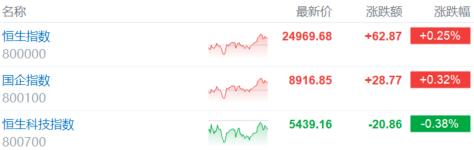
Market Overview - The Hong Kong stock market showed mixed performance with the Hang Seng Index rising by 0.25% to close at 24,969.68 points, briefly surpassing the 25,000 mark [1] - The Hang Seng China Enterprises Index increased by 0.32%, while the Hang Seng Tech Index fell by 0.38% [1] Sector Performance - Large technology stocks exhibited divergent trends, with Xiaomi up by 1.77% and NetEase rising by 1%, while Kuaishou dropped over 9% [3][4] - Semiconductor stocks surged, with macro semiconductor stocks rising over 11%, and companies like Huahong Semiconductor and SMIC increasing by over 5% [4] - Coal stocks saw gains, with China Shenhua up by 3% and Yanzhou Coal Mining and Shougang Resources rising over 2% [5][6] - The insurance sector performed well, with China Pacific Insurance rising over 6% and China Life Insurance increasing by 3.1% [6] Investment Insights - The insurance industry is experiencing a shift as the latest traditional insurance preset interest rate research value is 1.99%, triggering a mechanism for rate adjustments [6] - The Macau gaming sector is projected to recover, with estimates indicating a 7% growth in total gaming revenue by 2025, reaching 83% of 2019 levels [6] - The biotechnology and innovative drug sectors faced declines, with companies like Baoneng Biotech and Lijun Pharmaceutical dropping over 5% [8] Capital Flows - Southbound funds recorded a net inflow of HKD 9.45 billion, with significant contributions from both Shanghai and Shenzhen stock connect [9] Future Outlook - The technology sector in Hong Kong is viewed as having long-term investment value, with leading companies possessing strong competitive advantages and a favorable valuation outlook [11]

港股保险股拉升,中国太保涨超6%
Ge Long Hui A P P· 2025-08-12 07:43
MACD金叉信号形成,这些股涨势不错! | 代码 | 名称 | | 涨跌幅 ▽ | 最新价 | 总市值 | 年初至今涨跌 | | --- | --- | --- | --- | --- | --- | --- | | 02601 | 中国太保 | 0 | 6.33% | 33.940 | 3265.14亿 | 41.29% | | 00966 | 中国太平 | | 4.83% | 17.800 | 639.74亿 | 57.94% | | 01336 | 新华保险 | | 4.46% | 49.200 | 1534.82 乙 | 129.69% | | 02628 | 中国人寿 | | 3.46% | 22.720 | 6421.74亿 | 60.15% | | 02328 | 中国财险 | | 3.28% | 17.000 | 3781.27 7 | 42.90% | | 01339 | 中国人民保险集团 | | 2.96% | 6.270 | 2772.84亿 | 67.56% | | 02318 | 中国平安 | | 2.37% | 56.050 | 1.02万亿 | 26.56% | | 01299 ...



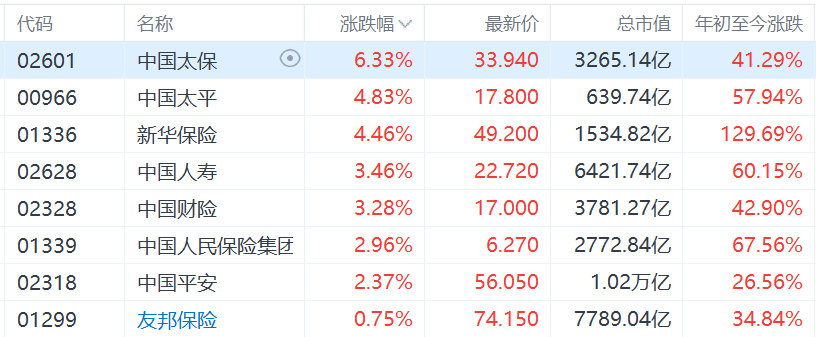
港股保险股午后涨幅持续扩大,中国太保涨超5%,中国太平涨超4%。
Xin Lang Cai Jing· 2025-08-12 07:18
港股保险股午后涨幅持续扩大,中国太保涨超5%,中国太平涨超4%。 ...
净资产对利率的敏感性分析和保单负债成本测算:寿险公司的利差风险或可控
Hua Yuan Zheng Quan· 2025-08-12 07:09
Investment Rating - The report maintains a "Positive" investment rating for the insurance industry [4][49]. Core Insights - The report highlights that the interest spread risk for life insurance companies is manageable, despite concerns in a low interest rate environment. The average net investment yield for six major listed insurance groups has decreased from 4.7% in 2020 to 3.6% in 2024, leading to pessimism regarding the interest spread (investment yield minus liability cost) [4][8]. - The sensitivity of net assets to interest rates varies significantly among companies, with China Life and China Pacific experiencing a 13.6% and 7% decline in net assets, respectively, under a 50 basis point interest rate drop scenario [16][21]. - The cost of new policies has effectively decreased, with major companies like China Life and China Pacific seeing a reduction of approximately 50 basis points in liability costs to 2.4-2.5% in 2024 [4][36]. - The report anticipates a turning point for the cost of existing policies post-2028, as high-cost premium cash flows will cease, and companies like Xinhua are increasing equity allocations to hedge against interest rate declines [4][39]. Summary by Sections Section 1: Interest Rate Sensitivity - Long-term interest rates impact life insurance companies' net assets through three main pathways: duration gap between assets and liabilities, the effect on contracts with Variable Fee Approach (VFA), and the ultimate discount rate applied to policy contracts [13][14]. - Under a stress scenario of a 50 basis point decline in interest rates, the net asset impacts for major companies were calculated, showing varying degrees of sensitivity [16][21][27]. Section 2: New Policy Liability Costs - The liability costs for new policies have significantly decreased, with the report noting that the maximum liability rates for traditional and participating insurance products have been lowered, leading to a reduction in the break-even liability cost for major insurers [36][37]. - The report provides a detailed analysis of the break-even liability costs for major insurers from 2021 to 2024, indicating a downward trend in these costs [38]. Section 3: Existing Policy Costs - The report discusses the potential turning point for existing policy costs, with expectations that high-cost premium cash flows will diminish after 2028, thus reducing liability costs [39][40]. - Xinhua Insurance is highlighted for its strategy of increasing equity exposure to mitigate risks associated with declining interest rates, achieving significant investment returns [39][41].
保险业协会通报122家险企投资管理情况 103家险企具备股权投资能力
Xin Hua Wang· 2025-08-12 06:29
3月23日,中国保险行业协会(以下简称"保险业协会")发布保险公司投资管理能力建设情况通 报。通报显示,截至2月28日,共有122家保险公司具备不同类型的投资管理能力(信用风险管理、股票 投资、股权投资、不动产投资和衍生品运用管理等五项能力)合计287项,其中80项能力为2020年后新 增。 《中国银行保险报》记者注意到,自2020年印发《关于优化保险机构投资管理能力监管有关事项的 通知》(以下简称"45号文件")以来,这是保险业协会第二次通报保险公司投资管理能力建设情况。在 去年6月的首次通报中,共有110家保险公司具备不同类型的投资管理能力合计249项。也就是说,近一 年来新增了12家具备投资管理能力的保险公司。 平安养老具备5项能力 通报显示,8家保险集团(控股)公司中,中华联合保险集团股份有限公司能力最为全面,具备除 衍生品以外的四项能力,包括信用风险、股票、股权、不动产等投资管理能力。 此外,泰康保险集团股份有限公司、阳光保险集团股份有限公司、中国平安保险(集团)股份有限 公司、中国太平洋保险(集团)股份有限公司和中国人寿保险(集团)公司具备股权和不动产两项能 力;中国人民保险集团股份有限公司拿下信 ...
保险业服务乡村振兴走上“快车道”
Xin Hua Wang· 2025-08-12 06:26
Core Viewpoint - The insurance industry is accelerating its support for rural revitalization through innovative agricultural insurance products and long-term financial investments, responding to the government's strategic initiatives for rural development [1][2][3]. Group 1: Agricultural Insurance Development - Various local regulatory bodies are promoting the development of innovative agricultural insurance to address risks in agriculture, including natural disasters and specific crop insurance [2][3]. - The insurance sector has seen a significant increase in agricultural insurance premium income, reaching 97.6 billion yuan in 2021, with a year-on-year growth of nearly 20% [3]. - Insurance companies are developing tailored insurance products based on regional agricultural characteristics, such as cost insurance for greenhouses and specific crops in provinces like Heilongjiang [3]. Group 2: Financial Support for Rural Revitalization - Insurance funds are increasingly being directed towards long-term projects in rural revitalization, including infrastructure development, with significant investments made by companies like Taiping Insurance [4][5]. - The establishment of funds, such as the Taiping Rural Revitalization Fund, aims to enhance financing sources for rural infrastructure and industry development [5]. - The insurance asset management association has encouraged the use of various funding methods, including market-oriented funds and asset management products, to support rural economic development [5].