
保险资金运用

Search documents
港股异动 | 内险股集体走高 中国平安(02318)尾盘涨近3% 资产端投资收益有望推动险企盈利改善
智通财经网· 2026-02-23 07:13
Core Viewpoint - The insurance sector in China is experiencing a significant rise in stock prices, driven by positive annual operating data released by the National Financial Regulatory Administration, indicating growth in premium income and total assets for the industry [1] Group 1: Stock Performance - Major insurance stocks have collectively risen, with ZhongAn Online increasing by 4.53% to HKD 16.63, China Pacific Insurance up by 4.15% to HKD 7.03, Ping An Insurance rising by 2.91% to HKD 72.6, and China Life Insurance gaining 2.8% to HKD 34.5 [1] Group 2: Industry Data - The insurance industry is projected to achieve a premium income of approximately CNY 6.12 trillion by 2025, reflecting a year-on-year growth of 7.43% [1] - Total claims expenditure for the year is expected to reach CNY 2.44 trillion, marking a year-on-year increase of 6.2% [1] - By the end of 2025, the industry's total assets are anticipated to be CNY 41.31 trillion, representing a growth of 15.06% from the beginning of the year [1] Group 3: Investment Trends - The overall balance of stock investments is reported at CNY 3.73 trillion, showing a year-on-year increase of 53.8%, attributed to favorable secondary equity market conditions and the implementation of policies encouraging long-term capital market participation [1] - With high premium growth and expectations of a "slow bull" equity market, the balance of insurance funds is expected to maintain double-digit growth in 2026, with an increasing proportion of equity investments, which is likely to enhance investment returns and improve profitability for insurance companies [1]

保险资金运用数据点评:2025年显著增配核心权益,债券增配节奏放缓
Soochow Securities· 2026-02-13 03:49
Investment Rating - The industry investment rating is maintained as "Increase" [1] Core Insights - The insurance industry is experiencing significant growth in asset allocation towards core equities, with a slowdown in bond allocation pace [5] - By the end of 2025, the total investment balance of the insurance industry reached 38.5 trillion yuan, marking a 15.7% increase from the beginning of the year, the highest growth rate since 2021 [9] - The allocation of "stocks + funds" increased by 1.6 trillion yuan in 2025, with a total balance of 5.7 trillion yuan by year-end [5] - The proportion of "stocks + funds" in total investment reached 15.4% by the end of 2025, an increase of 2.6 percentage points from the beginning of the year [5] - The demand in the market remains strong, and the optimization of liability costs is expected to alleviate pressure from interest rate spreads [5] Summary by Sections Investment Allocation - By the end of 2025, the investment scale of life insurance companies was 34.7 trillion yuan, accounting for 90.1% of the industry [5] - The allocation of bank deposits decreased to 7.6%, while the bond allocation increased to 51.1% [5] - The allocation of stocks and funds reached a high level, with stocks accounting for 10.1% and funds for 5.3% of total investments [5] Market Outlook - The recent decline in the yield of ten-year government bonds to approximately 1.81% is expected to ease the pressure on the investment income of insurance companies [5] - The insurance sector's valuation remains at historical lows, with estimated PEV ranging from 0.64 to 0.86 and PB from 1.15 to 2.24 [5]




再探超长债供需
CAITONG SECURITIES· 2026-01-28 07:01
1. Report Industry Investment Rating The provided content does not mention the industry investment rating. 2. Core Viewpoints of the Report - Since Q4 last year, there have been strong concerns about the supply of ultra - long bonds in the market. In January this year, the issuance scale of ultra - long government bonds increased significantly year - on - year, with the increment mainly from new special bonds, indicating a decent demand for capital for major project construction at the beginning of the year. The central bank's relatively active liquidity injection and banks' increased purchases at the ultra - long end have alleviated market concerns to some extent [3]. - From the perspective of achieving the annual economic target, the annual fiscal increment may exceed market expectations, and fiscal policies may be supplemented in the second half of the year. It is estimated that the net financing of government bonds in 2026 will be 15.1 trillion yuan, and the issuance of ultra - long government bonds will be 7.12 trillion yuan, a year - on - year increase of 0.7 trillion yuan. For Q1, the issuance of ultra - long government bonds is expected to be 2.24 trillion yuan, a year - on - year increase of 416.7 billion yuan, with certain supply pressure in February and March [3]. - Insurance is likely to have a good start, with an expected annual premium growth of 6.6% and the growth rate of the balance of funds utilization remaining at around 15%. It is estimated that in 2026, the proportion of ultra - long bonds allocated by insurance in the annual issuance of ultra - long bonds will drop to about 31%, and the proportion in its own bond investment will remain basically flat at about 71%, corresponding to an investment scale of about 2.2 trillion yuan, basically the same as in 2025 [3]. - It is estimated that the investment scale of commercial banks in ultra - long bonds in 2026 will be about 4.82 trillion yuan, accounting for about 67.7% of the annual issuance of ultra - long bonds, a year - on - year increase of 0.66 trillion yuan [3]. - For trading institutions, based on a neutral judgment of the interest rate trend, the investment scale of funds and securities firms in ultra - long bonds may be higher than that in 2025 but lower than that in 2024, totaling about 10 billion yuan [3]. - The 30 - 10 - year term spread in 2025 mainly widened due to the contraction of trading desks' demand for ultra - long bonds and frictions in the trading process, rather than being mainly determined by primary supply [3]. 3. Summary According to the Directory 3.1 How is the supply of ultra - long government bonds this year calculated according to the upper limit? - It is estimated that the net financing of government bonds in 2026 will be 15.1 trillion yuan, including 7.143 trillion yuan for treasury bonds and 7.938 trillion yuan for local bonds. In terms of issuance, the issuance of general treasury bonds will be 14.1377 trillion yuan, special treasury bonds 2 trillion yuan, new general bonds 80 billion yuan, new special bonds 550 billion yuan, special refinancing bonds 200 billion yuan, and ordinary refinancing bonds 325.8 billion yuan [7]. - The issuance of ultra - long government bonds in 2026 is expected to be 7.12 trillion yuan, a year - on - year increase of 0.7 trillion yuan. Among them, the issuance of ultra - long treasury bonds will be 1.74 trillion yuan, a year - on - year increase of 225 billion yuan, and the issuance of ultra - long local bonds will be 5.38 trillion yuan, a year - on - year increase of 475 billion yuan [8]. - For Q1, the issuance of ultra - long government bonds is expected to be 2.24 trillion yuan, a year - on - year increase of 416.7 billion yuan. The issuance of ultra - long treasury bonds in Q1 is usually low because special treasury bonds need to be approved by the Two Sessions and are expected to start issuing at the end of April. The planned issuance of local bonds in Q1 is about 2.38 trillion yuan, with a relatively high refinancing ratio, and the issuance of replacement bonds is expected to be in the front, making room for new bonds for construction projects later. The issuance progress of new special bonds is expected to be faster than last year [9][10]. 3.2 How is the demand for ultra - long bonds? 3.2.1 Insurance - In 2025, the premium income of insurance companies from January to November was 5.76 trillion yuan, a year - on - year increase of 7.56%. Property insurance increased by 2.48% year - on - year, with auto insurance as the main source of income, accounting for over 52% and highly correlated with the growth rate of vehicle ownership. Personal insurance increased by 9.2% year - on - year, with life insurance accounting for about 77% and growing by 11.47%, mainly driven by the popularity of savings - type insurance products [12][13]. - In 2026, the probability of a "good start" for premium income is high. Favorable factors include high - interest fixed - deposit maturities, the correlation between the stock market's good start in January and premium income growth, and a low base in 2025. Unfavorable factors include pressure on traditional life insurance and the over - consumption of demand due to previous "panic - buying" promotions. It is expected that the annual premium income will achieve stable growth, with property insurance growing by about 2% and personal insurance by about 8%, and the overall insurance premium income increasing by about 6.6% [14][15]. - At the end of Q3 2025, the balance of insurance funds utilization was 37.46 trillion yuan, a year - on - year increase of 16.5%. In 2026, it is expected that the year - on - year growth rate of the balance of insurance funds utilization will decline slightly to 15%. The proportion of bank deposits is expected to drop to 7%, the proportion of stock investment to rise to 11.5%, the proportion of fund investment to rise to 6%, the proportion of long - term equity investment to be stable at 8%, and the proportion of other investments to drop to 16%. The proportion of bonds will remain stable at 51.5%, with a net increment of about 3.1 trillion yuan [20][21]. - From 2022 - 2025, the net purchases of ultra - long bonds by insurance institutions in the secondary market were 0.48, 0.73, 1.71, and 2.28 trillion yuan respectively, accounting for 13.62%, 20.7%, 31.3%, and 35.5% of the annual issuance of ultra - long bonds, and 48%, 41%, 67%, and 72% of the annual bond investment respectively. In 2026, it is expected that the proportion of ultra - long bonds in the annual issuance of ultra - long bonds will drop from 35.5% in 2025 to about 31%, and the proportion in its own bond investment will drop slightly from 72% in 2025 to 71%, corresponding to an investment scale of about 2.2 trillion yuan [25][26]. 3.2.2 Banks - In 2025, the proportion of banks' bond allocation increased significantly. The government bond custody volume of commercial banks was 63.85 trillion yuan, accounting for 67.17% of the outstanding government bonds. The incremental custody of government bonds by commercial banks in 2025 was 10.8 trillion yuan, accounting for 78% of the net financing of government bonds in 2025 [29]. - It is estimated that in 2026, the passive allocation scale of commercial banks for government bonds will be 10.56 trillion yuan, and the scale of bond purchases will be 17.56 trillion yuan. The scale of ultra - long bonds that commercial banks need to undertake may be 4.48 trillion yuan. It is also expected that the excess allocation scale of commercial banks for ultra - long bonds in 2026 will increase slightly to 0.34 trillion yuan compared with last year. Overall, the scale of commercial banks' allocation of ultra - long bonds in 2026 is estimated to be about 4.82 trillion yuan [30][32]. - After the implementation of the redemption new rules at the beginning of this year, part of the banks' entrusted - out investment has been transferred back to self - operated allocation. The probability of using this part of the funds to increase the allocation of ultra - long bonds is not high due to certain indicator pressures [33]. 3.2.3 Trading Institutions - In 2025, securities firms mainly increased their allocation of treasury bonds, reduced their allocation of local bonds, and shortened the duration of government bonds. The investment scale of securities firms in ultra - long bonds decreased by 1.493 billion yuan. In 2026, it is expected that the investment scale of securities firms in ultra - long bonds will be basically the same as in 2025 [40][41]. - At the end of 2025, non - monetary funds held 12.51 trillion yuan in bond investments. In 2025, funds only net - bought 5.82 billion yuan of ultra - long interest - rate bonds. In 2026, due to the implementation of the fund sales new rules and concerns about the cancellation of tax exemption, the liability side of bond - type funds is unstable. It is expected that the investment scale of funds in ultra - long bonds will be higher than that in 2025 but lower than that in 2024, about 10 billion yuan [41][42]. 3.3 Does the 30 - 10 - year term spread depend on primary supply? - The widening of the 30y - 10y treasury bond spread in 2025 mainly occurred in the second half of the year, mainly due to the significant improvement in the stock market sentiment, the fund sales new rules, and the interest - rate adjustment, which led to the selling of ultra - long bonds by trading - like desks. If primary supply were the decisive factor, the spread should have widened in Q2 2025 [45]. - The widening of the 30y - 10y local bond spread also shows that primary supply is not the main influencing factor, as the power of allocation desks is sufficient to hedge the selling pressure [45]. - For the secondary interest - rate trend, the willingness of trading desks to increase holdings and short - term frictions seem to be more crucial [48].
深圳重磅发布!
中国基金报· 2026-01-22 03:45
Core Viewpoint - Shenzhen is implementing a comprehensive action plan to leverage the insurance industry to support technological innovation and industrial development, aiming to establish a modern insurance service system that aligns with the city's economic and social development by 2028 [5][16]. Group 1: Action Plan Overview - The action plan outlines sixteen measures to enhance insurance support for technological innovation and industrial development, with specific responsibilities assigned to various units [3][8]. - The plan aims to provide over 50 trillion yuan in risk protection for technology enterprises annually over the next three years [4][6]. Group 2: Goals by 2028 - Establish a modern insurance service system that supports the "20+8" strategic emerging industry clusters and future industrial development [6][16]. - Achieve an annual growth rate of over 10% in technology insurance premium income, with the introduction of at least 30 innovative insurance products each year [6][16]. - Expand the total assets of insurance entities in Shenzhen to over 11 trillion yuan, with total premium income exceeding 700 billion yuan over three years [6][16]. Group 3: Measures to Support Technological Innovation - Optimize the mechanism for utilizing insurance funds, aiming for over 1 trillion yuan in national insurance capital investment in Shenzhen [7][17]. - Develop technology insurance products for emerging sectors such as artificial intelligence and low-altitude economy, and encourage the establishment of innovation centers for insurance related to artificial intelligence [8][19]. - Enhance insurance services for the "20+8" industry clusters, focusing on comprehensive coverage for technology research, development, and application [18]. Group 4: Collaboration and Development - Strengthen cooperation between the insurance industry and the real economy, providing scenario-based support for insurance institutions [10][23]. - Promote the establishment of insurance innovation centers and support the digital transformation of insurance institutions to improve operational efficiency [12][22]. - Foster collaboration between Shenzhen and Hong Kong in insurance services, particularly in healthcare and elderly care products [21][24]. Group 5: Risk Management and Service Improvement - Implement a comprehensive risk management framework for emerging technologies and industries, including tailored insurance solutions for artificial intelligence and biotechnology [19][20]. - Enhance claims and underwriting services using advanced technologies such as big data and artificial intelligence to improve efficiency and accuracy [12][22]. - Establish a robust organizational coordination mechanism to facilitate the implementation of the action plan and address industry challenges [24][25].


2025政策篇丨大幅调整近尾声,行业地位显著提高,10年从行业发展到顶层设计,130条政策书写保险业变迁
Xin Lang Cai Jing· 2026-01-05 11:51
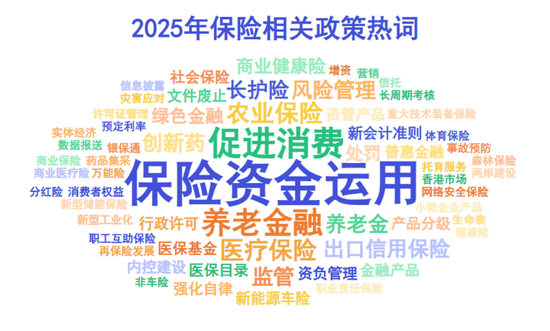
Core Insights - 2025 is a pivotal year for the insurance industry, marking the end of significant policy adjustments and setting the stage for a new era in 2026 [3][31] - The insurance sector's role in the economy is increasingly prominent, with a notable shift in policy focus towards technology innovation, internationalization, and healthcare [3][8] Policy Adjustments - A total of approximately 130 insurance-related policies were issued in 2025, slightly fewer than the 133 in 2024, indicating a stabilization in policy-making expectations [4][5] - The frequency of policy issuance varied, with a peak in July 2025, contrasting with the high issuance months of November and December 2024 [7][8] Regulatory Dynamics - The Financial Regulatory Authority was the most active in issuing policies, with 47 standalone documents, while joint releases totaled 41, indicating a strong regulatory presence [10] - The number of policies issued by the State Council increased significantly, from 7 in 2024 to 15 in 2025, reflecting a heightened focus on the insurance sector [10] Investment Trends - By the end of Q3 2025, the total balance of insurance funds reached 37.46 trillion yuan, a 16.5% increase year-on-year, with equity asset allocation rising to 22.5% [13] - The number of equity stakes acquired by insurance funds reached 39 in 2025, the highest since 2016, driven by supportive policies encouraging market entry [13] Focus Areas - The 2025 policy landscape shifted towards "insurance fund utilization" and "promoting consumption," with a notable emphasis on integrating insurance into broader economic strategies [11][19] - The insurance industry is increasingly involved in the aging population sector, with policies encouraging investment in comprehensive elderly care services [18][19] Healthcare Integration - The insurance sector is transitioning to a comprehensive health guardian role, moving beyond simple compensation to include preventive and management services [24] - Key policies in 2025 focused on commercial health insurance, innovative drugs, and the overall quality of healthcare insurance [25] Consumption Promotion - Policies released in 2025 frequently mentioned "promoting" and "boosting" consumption, highlighting the insurance industry's role in enhancing consumer confidence and spending [26][28] - Insurance products are being utilized to stabilize consumer expectations and directly stimulate spending in various sectors, including tourism and elderly care [28] Historical Context - Over the past decade, the insurance policy direction has evolved from a focus on risk compensation to a more structured approach emphasizing systemic design and integration into national strategies [29][30] - The transition reflects a broader shift towards value-driven growth, with the insurance industry expected to play a crucial role in supporting economic resilience and social stability [31][32]
2025年三季度保险业资金运用情况点评:权益配置持续增加,年底顺势调结构
Guoxin Securities· 2025-11-18 01:29
Investment Rating - The investment rating for the insurance industry is "Outperform the Market" (maintained) [1][9][24] Core Insights - As of the end of Q3 2025, the total balance of insurance funds reached 37.5 trillion yuan, reflecting a year-on-year growth of 16.5% [2][4] - The insurance industry has increased its allocation to equity investments, particularly in direct stock investments, while reducing bank deposit scales [3][24] - The overall asset conversion rate for the industry stands at 83%, indicating a certain degree of under-allocation [3][24] Summary by Sections Fund Utilization - The insurance fund utilization balance exceeded 37 trillion yuan, with a year-on-year growth rate of 16.5% [4][10] - The balance of stock investments reached 3.6 trillion yuan, a significant increase of 55.1% year-on-year [15][24] Fixed Income - Bank deposit scales have decreased, with personal insurance and property insurance companies reducing their bank deposits by 4.9% and 7.5% respectively [11] - Bond allocation has increased, with personal insurance companies holding 17.2 trillion yuan in bonds, up 20.9% year-on-year [11] Equity Investments - The insurance sector has significantly increased its direct equity investments, with personal insurance stock investments reaching 34,124 billion yuan, an increase of 11,445 billion yuan since the beginning of the year [15] - The total scale of securities investment funds for personal and property insurance reached 17,756 billion yuan and 1,964 billion yuan respectively, with quarter-on-quarter growth rates of 20.2% and 6.9% [15] Market Outlook - The report anticipates that in Q4, insurance funds will continue to seek high-dividend investment opportunities and maintain a focus on long-term bonds to match their asset allocation needs [24]
保险资金2025Q3点评:保险资金运用余额持续增长,股票等权益类资产的配比明显提升
Guolian Minsheng Securities· 2025-11-17 11:04
Investment Rating - The report maintains an "Outperform" rating for the industry [7][12] Core Insights - As of the end of Q3 2025, the insurance industry's investment balance reached 37.5 trillion yuan, reflecting a year-to-date increase of 12.6% and a quarter-on-quarter increase of 3.4% [4][9] - The investment balance for life insurance and property insurance companies was 33.7 trillion yuan and 2.4 trillion yuan, respectively, with life insurance showing a year-to-date growth of 12.6% and property insurance at 7.5% [4][9] - Life insurance companies are increasing their allocation to equity assets, with a notable rise in stock and fund investments, while the proportion of bonds is marginally decreasing [10][11] Summary by Sections Investment Balance - The insurance industry's investment balance is 37.5 trillion yuan as of Q3 2025, with life insurance companies holding 33.7 trillion yuan and property insurance companies holding 2.4 trillion yuan [4][9] - The growth rates for these balances are 12.6% for life insurance and 7.5% for property insurance compared to the beginning of the year [4][9] Asset Allocation - Life insurance companies have allocated 19.69 trillion yuan to fixed income assets and 7.89 trillion yuan to equity assets, with the latter increasing by 13.3% from the previous quarter [10] - The allocation ratios for fixed income and equity assets are 58.4% and 23.4%, respectively, indicating a shift towards equities [10] - Property insurance companies have allocated 1.34 trillion yuan to fixed income and 0.55 trillion yuan to equity assets, with equity allocation increasing by 5.8% [11] Future Outlook - The report anticipates that improvements in new business value rates and asset returns will support growth in the insurance sector throughout 2025 [12] - Specific stock recommendations include China Life Insurance, China Pacific Insurance, and others [12]
保险资金运用数据点评:2025Q3核心权益资产规模大幅提升,债券占比下降
Soochow Securities· 2025-11-15 15:29
Investment Rating - The report maintains an "Overweight" rating for the insurance industry, indicating a positive outlook for the sector in the next six months [1]. Core Insights - The insurance industry has seen a significant increase in investment assets, with a total investment balance of 37.5 trillion yuan as of Q3 2025, reflecting a year-to-date growth of 12.6% and a mid-year increase of 3.4% [4][6]. - The investment scale of life insurance companies reached 33.7 trillion yuan, accounting for 90% of the industry, with a year-to-date growth of 12.6% [4]. - The stock and fund investments have increased by over 800 billion yuan in Q3 alone, with a total increase of 1.5 trillion yuan in the first three quarters of 2025 [4]. - The proportion of stocks and funds in the total investment has risen to 15.5% by the end of Q3, up 2.7 percentage points from the beginning of the year [4]. - The report highlights a notable shift in asset allocation, with a decrease in bond holdings and an increase in equity investments, indicating a strategic pivot towards higher-risk, higher-return assets [4]. Summary by Sections Investment Asset Growth - The insurance industry's investment asset balance reached 37.5 trillion yuan by Q3 2025, marking a 12.6% increase from the beginning of the year and a 3.4% increase from mid-year [4][6]. - Life insurance companies' investment scale was 33.7 trillion yuan, while property insurance companies held 2.4 trillion yuan, reflecting respective growth rates of 12.6% and 7.5% [4]. Equity and Fund Investments - The combined scale of stocks and funds increased by 864 billion yuan in Q3, with stocks contributing 552.5 billion yuan and funds 311.5 billion yuan [4]. - By the end of Q3, the stock and fund investments accounted for 15.5% of total investments, with stocks at 10.0% and funds at 5.5%, showing significant increases from earlier in the year [4]. Asset Allocation Changes - The report notes a reduction in bank deposits, with their proportion falling to 7.4% by Q3, and a decrease in bond holdings to 51.0% [4]. - The core equity proportion has significantly increased, with stocks and funds now making up 15.4% of total investments, indicating a strategic shift towards equities [4].
忠旺系君康人寿变身在即,山东国资牵头富泽人寿获批
3 6 Ke· 2025-11-12 04:25
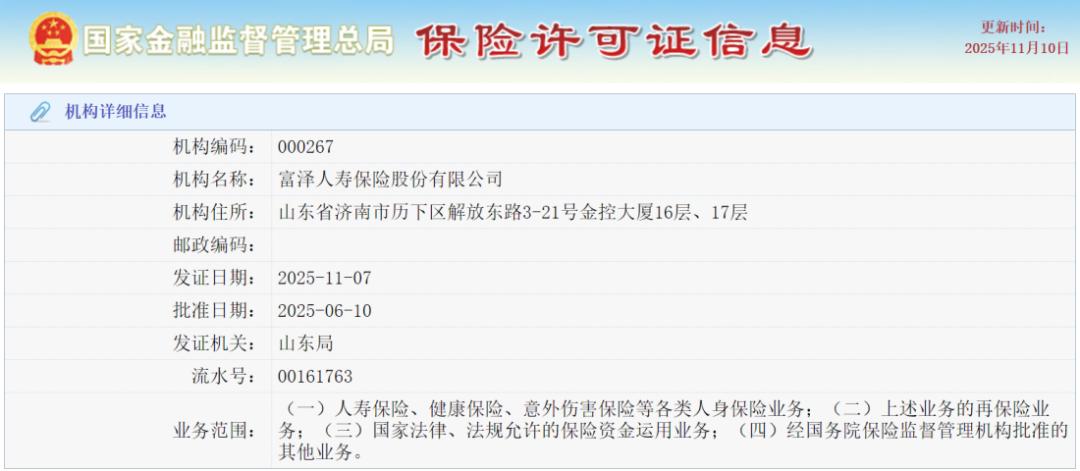
Core Viewpoint - Fuze Life Insurance Co., Ltd. has been officially approved for an insurance license, marking its entry into the insurance market with a focus on various personal insurance products, including life, health, and accident insurance [1][2]. Company Overview - Fuze Life was established on June 19, 2023, with a registered capital of 17 billion yuan [2]. - The company is headquartered in Jinan, Shandong Province, specifically at Jin控大厦, 16th and 17th floors [4]. - The major shareholders include Jinan Jintou Holding Group Co., Ltd. (49.71%) and Jinan Zhengjintongda Investment Group Co., Ltd. (3.53%), collectively holding over 53% of the shares [2][3]. Business Scope - Fuze Life's business scope includes various types of personal insurance, reinsurance for these products, and investment of insurance funds as permitted by laws and regulations [1][2]. Management Team - The chairman and legal representative of Fuze Life is Feng Yi, who is also the director of the Jinan Municipal Financial Supervision Administration [4]. - The general manager is Xie Zhufeng, who previously held senior positions at China Post Life Insurance [4]. Strategic Context - The establishment of Fuze Life is seen as a strategic move to address the risks associated with Jun Kang Life Insurance, with plans to take over its assets and liabilities [5]. - Jun Kang Life, which has undergone several changes in ownership and management, faced significant financial challenges, including a reported net loss of 1.911 billion yuan in 2019 [7].
东证期货连续六年获“IAMAC推介”殊荣
Qi Huo Ri Bao· 2025-10-20 16:04
Core Points - Dongzheng Futures has been recognized for the sixth consecutive year by the China Insurance Asset Management Association (IAMAC) for its outstanding institutional service capabilities in the futures market [1][2] - The recognition includes three categories: "Futures Company - Comprehensive," "Futures Company - Stock Index Futures Business," and "Futures Company - Government Bond Futures Business," highlighting the company's deep engagement and innovation in these areas [1] - IAMAC's initiative aims to promote collaboration between various institutions and the insurance asset management industry for high-quality development [1] Company Summary - Dongzheng Futures focuses on providing integrated futures derivative solutions for insurance funds, covering the entire process from initial planning, strategy design, execution, to ongoing support [1] - The company offers services such as hedging solution design, derivative business capability building, and institutional support [1] Industry Outlook - The use of derivatives in risk management, asset allocation, and yield enhancement will become increasingly critical as insurance fund utilization becomes more diversified, market-oriented, and internationalized [1] - Insurance institutions are expected to expand their use of derivatives from basic hedging to more complex portfolio management and multi-strategy collaboration, leading to a sustained demand for specialized and customized services [1] - Financial technology, intelligent risk control, and compliance system development will emerge as new focal points for industry collaboration [1]