Arista Networks

Search documents
Lumen Stock Soars on Powering the JUNO Trans-Pacific Cable System
ZACKS· 2025-06-04 17:11
Core Insights - Undersea cables are essential for global communication, carrying over 99% of international data traffic, with Lumen Technologies selected to provide terrestrial backhaul for the JUNO Trans-Pacific Cable System, which will connect Japan and the U.S. with high capacity [1][10] - The JUNO cable system spans 10,000 kilometers and utilizes Space Division Multiplexing technology, offering a total capacity of up to 350 terabits per second (Tbps), catering to the increasing demand for high-speed connectivity [3][10] - Lumen's advanced dark fiber backhaul solution connects key locations in the U.S., enhancing control, security, and scalability for the JUNO system, which is crucial for the digital economy [4][5] Financial Performance - Following the announcement of the JUNO project, Lumen's shares increased by 6.75%, closing at $4.11 on June 3, 2025 [2] - For 2025, Lumen anticipates adjusted EBITDA between $3.2 billion and $3.4 billion, with capital spending projected at $4.1 billion to $4.3 billion, expecting a rebound in EBITDA above $3.5 billion by 2026 [8] - Lumen secured $8.5 billion in Private Connectivity Fabric (PCF) deals in 2024, driven by the rising demand for AI technologies, indicating strong future revenue potential [7][10] Industry Impact - The integration of the JUNO cable and Lumen's terrestrial backbone is expected to foster innovation and economic growth, facilitating real-time collaboration and cloud computing on a global scale [5][6] - The demand for Lumen's connectivity solutions is being driven by major tech players like Microsoft, Amazon, Google Cloud, and Meta, highlighting the strategic importance of Lumen in the AI infrastructure landscape [7][10] - Lumen's role in providing essential connectivity services positions it favorably within the rapidly evolving data-centric economy [5][7]



Qorvo Expands DOCSIS 4.0 Portfolio for Broadband Cable Networks
ZACKS· 2025-05-30 14:16
Group 1: Product Launch and Technology - Qorvo, Inc. has launched two hybrid power doubler amplifiers, QPA3311 and QPA3316, designed for DOCSIS 4.0 broadband cable networks, which are crucial for high-speed internet and video services [1][3] - The new amplifiers support downstream operations up to 1.8 GHz, offering higher total composite power and improved signal integrity, which reduces the need for costly booster amps and lowers infrastructure costs [3][4] Group 2: Market Demand and Industry Trends - The demand for intelligent, adaptive hybrid fiber coax (HFC) networks is driven by the proliferation of edge computing, AI workloads, IoT applications, and advanced use cases like remote healthcare and smart cities [2] - The transition from 4G LTE to 5G technology in emerging markets presents a substantial growth opportunity for Qorvo, aligning with its product portfolio [5] Group 3: Financial Performance and Stock Movement - Qorvo's shares have decreased by 22.4% over the past year, which is an improvement compared to the industry's decline of 29.2% [8] - The company is positioned to benefit from its innovative product offerings, which may enhance its commercial prospects and overall market performance [4]


VIAV Solution Boosts Fiber Fault Detection Capabilities: Stock to Gain?
ZACKS· 2025-05-30 14:06
Core Insights - Viavi Solutions, Inc. is collaborating with 3-GIS to enhance fiber fault detection capabilities for enterprises, addressing the operational challenges of maintaining fiber infrastructure as it becomes critical for data communications [1][4] - The integration of Viavi's ONMSi Remote Fiber Test System with 3-GIS' geospatial capabilities aims to automate network issue detection and resolution, improving service quality and minimizing downtime [2][3] Industry Context - The demand for high-quality fiber connections is increasing as service providers face pressure to deliver consistent services for AI workloads and high-performance computing, making intelligent automated systems essential in the telecommunications industry [4] - Viavi's strategy includes expanding its product portfolio across various markets, which is expected to yield long-term benefits, particularly with the acquisition of Spirent Communications' high-speed ethernet and network security business [5] Company Performance - Viavi's stock has increased by 21.8% over the past year, although this is below the industry's growth of 35.4% [6]


金十图示:2025年05月29日(周四)全球主要科技与互联网公司市值变化
news flash· 2025-05-29 03:08
Market Capitalization Changes - The market capitalization of major global technology and internet companies has shown varied changes as of May 29, 2025, with notable fluctuations in percentage terms [1][3][4]. - Companies like Tencent and Alibaba experienced declines of 2.3% and 2.33% respectively, while Oracle saw an increase of 1.2% [3][4]. Company Performance - Notable performers include Palantir with a slight increase of 0.3% and Adobe maintaining a stable position with a market cap of $1.76 billion [4][5]. - Companies such as AMD and Uber reported declines of 1.48% and 0.83% respectively, indicating a challenging market environment for these firms [3][5]. Sector Insights - The semiconductor sector remains under pressure, with companies like Intel and Micron showing declines of 0.88% and 0.21% respectively, reflecting ongoing challenges in the industry [5][6]. - Conversely, companies like SK Hynix and Keyence reported slight increases, suggesting some resilience within specific segments of the technology sector [5][6]. Emerging Trends - The data indicates a mixed outlook for the technology sector, with some companies like Shopify and Spotify showing positive growth trends, while others face headwinds [4][7]. - The overall market sentiment appears cautious, with several companies experiencing minor fluctuations in their market valuations [3][4].

Motorola to Acquire Silvus Technologies, Expand Security Portfolio
ZACKS· 2025-05-28 16:46
Acquisition Overview - Motorola Solutions, Inc. (MSI) has signed a definitive agreement to acquire Silvus Technologies, Inc. for $4.4 billion, expected to close in the second half of 2025, pending regulatory approvals. Silvus may receive an additional earnout of up to $600 million based on business performance between 2027 and 2028 [1][2]. Rationale for the Acquisition - Silvus Technologies specializes in software-defined high-speed mobile ad-hoc network (MANET) technology, which supports secure data, video, and voice communications without fixed infrastructure. The company serves a diverse client base, including military and law enforcement agencies [2]. - Silvus' technology enhances military and tactical communication by maximizing throughput and minimizing risks such as jamming and interception, which are critical in frontline operations where fixed infrastructure may be lacking [3]. Technological Integration - The acquisition will allow MSI to integrate Silvus' mesh technology, which reduces reliance on fixed infrastructure and creates scalable, self-healing networks. This technology supports high-bandwidth applications like video and drones, diversifying MSI's product offerings and enhancing its prospects in defense and military sectors [4]. Market Positioning - The acquisition positions Motorola to capitalize on the growing demand for flexible and adaptive network systems in law enforcement and defense, aligning with the trend of upgrading defense technologies to meet increasing bandwidth needs [5]. - MSI reported strong demand for video security products, achieving quarterly net sales of $2.52 billion, driven by its robust business model and integrated ecosystem [6]. Stock Performance - Over the past year, MSI's stock has increased by 18.1%, while the industry has seen a growth of 41.2%, indicating a need for improved market performance [7].


Quantum Stocks Skyrocket, Led by IonQ's NVIDIA Declaration
MarketBeat· 2025-05-27 13:47
Core Viewpoint - Quantum computing stocks have experienced significant volatility, with notable price increases on May 22, particularly for IonQ, Rigetti Computing, D-Wave Quantum, Quantum Computing, and Quantum-Si [1][2][3] Group 1: Stock Performance - All five quantum computing stocks rose by at least 14% on May 22, and as of May 23, they are up at least 60% over the past month [2] - IonQ shares rose over 36% on the same day, contributing significantly to the overall market capitalization increase of over $3 billion [3][5] - Despite the recent gains, three of these stocks remain down in 2025 overall, highlighting the volatility in the sector [2] Group 2: Market Capitalization and Revenue - The combined market capitalization of these five quantum computing stocks exceeded $23 billion as of May 23 [3] - Over the last 12 months, these companies generated approximately $77 million in revenue, with a free cash flow of -$365 million, indicating the early stage of the industry [2] Group 3: IonQ's Vision and Industry Impact - IonQ's CEO compared the company's future potential to that of NVIDIA, suggesting aspirations to become a leader in the quantum computing ecosystem [4][5] - The success of IonQ is expected to positively influence other quantum firms, similar to how NVIDIA's success has benefited companies like Arista Networks [8][10] Group 4: Market Sentiment and Short Interest - The high short interest in quantum stocks reflects both bearish sentiment and the potential for significant long-term growth in the sector [12][13] - Quantum-Si has the lowest short interest at just over 12%, while Rigetti Computing has a short interest of 23% [12][13]



Should You Buy AMZN Stock At 33 Times Earnings?
Forbes· 2025-05-27 12:30
Core Viewpoint - The article discusses the investment potential of Arista Networks (ANET) compared to Amazon (AMZN), highlighting Arista's superior growth, margins, and financial stability despite its historical volatility during market downturns. Group 1: Growth and Financial Performance - Arista's revenue has been growing at an impressive rate of 34% annually for the past three years, while Amazon's growth rate is about 11% [6] - Arista enjoys operating cash flow margins of over 50%, meaning a greater share of revenue growth turns into actual cash, in contrast to Amazon's operating cash flow margins of roughly 17% [6] - Arista maintains a very strong financial position, with no debt and a high cash-to-assets ratio of 59%, compared to Amazon's 7% debt-to-equity ratio and only 16% of its assets in cash [6] Group 2: Market Position and Investment Considerations - Arista builds essential networking gear that powers the internet, especially for companies involved in cloud computing and AI, indicating a strong long-term investment potential as these sectors continue to grow [4] - Despite its past performance during market shocks, where ANET stock fell 38.4% during the 2022 inflation shock, it has already taken significant damage, dropping from around $130 in January to roughly $90 today [2][3] - For long-term investors looking to invest and forget for the next 3-5 years, ANET stock could be an interesting entry point at current levels [5]



金十图示:2025年05月27日(周二)全球主要科技与互联网公司市值变化
news flash· 2025-05-27 03:05
| | 1737 | | 407.69 | | --- | --- | --- | --- | | ROOKIng Holdings | 1735 | -0.17% | 5332.8 | | (Booking.com) | | | | | DD Holdings (Pinduoduo) | 1692 | -0.47% | 119.24 | | 德州仪器 | 1601 | 2.17% | 176.3 | | 高通 | 1596 | + -1.35% | 145.38 | | S 索尼 | 1540 | 1 0.79% | 25.53 | | Schneider Electric | 1431 | 1.82% | 252 | | arm Arm Holdings | 1344 | -1.62% | 127.18 | | Spotify | 1340 | 2.68% | 653.82 | | Shopify | 1302 | .72% | 101.51 | | 22 自动数据处理 | 1303 | -0.17% | 321.09 | | MercadoLibre | 1271 | -3.77% | 2507.83 ...

The New York Times Company Leverages Digital Subscriptions for Growth
ZACKS· 2025-05-26 15:46
Core Insights - The New York Times Company (NYT) has positioned digital subscriptions as a central element of its growth strategy, focusing on high-quality journalism and personalized content to expand its subscriber base [1][2][6] - The company has diversified its digital offerings beyond news, including cooking, games, and lifestyle features, which contribute to its subscription growth [1][2] Subscriber Growth - As of the end of Q1 2025, NYT had approximately 11.66 million subscribers, with 11.06 million being digital-only subscribers, marking a net addition of 250,000 digital-only subscribers from the previous quarter [3] - The company reported that 5.76 million of its digital-only subscribers were bundle and multi-product subscribers [3] Revenue Performance - Subscription revenues reached $464.3 million in Q1 2025, reflecting an 8.2% year-over-year increase, while digital-only subscription revenues surged by 14.4% to $335 million [4] - The average revenue per user (ARPU) for digital-only subscribers increased to $9.54 from $9.21 year-over-year, driven by subscribers moving to higher rate plans and price increases for long-term non-bundle subscribers [5] Future Outlook - Management anticipates continued growth in subscriptions, projecting total subscription revenue growth of 8-10% and digital-only subscription revenue growth of 13-16% for Q2 2025 [6] - The strategic focus on building a loyal subscriber base has reduced the company's reliance on volatile advertising revenues [6] Market Positioning - NYT's emphasis on subscription growth and digital innovation has been a key factor in its success within a competitive media landscape, showcasing its ability to attract new subscribers and optimize ARPU [7] - Despite the positive trends, the company faces challenges with a decline in print advertising revenues, which fell by 8.5% in Q1 2025 [7] - Over the past three months, NYT shares have increased by 15.7%, outperforming the industry growth of 14.8% [8]


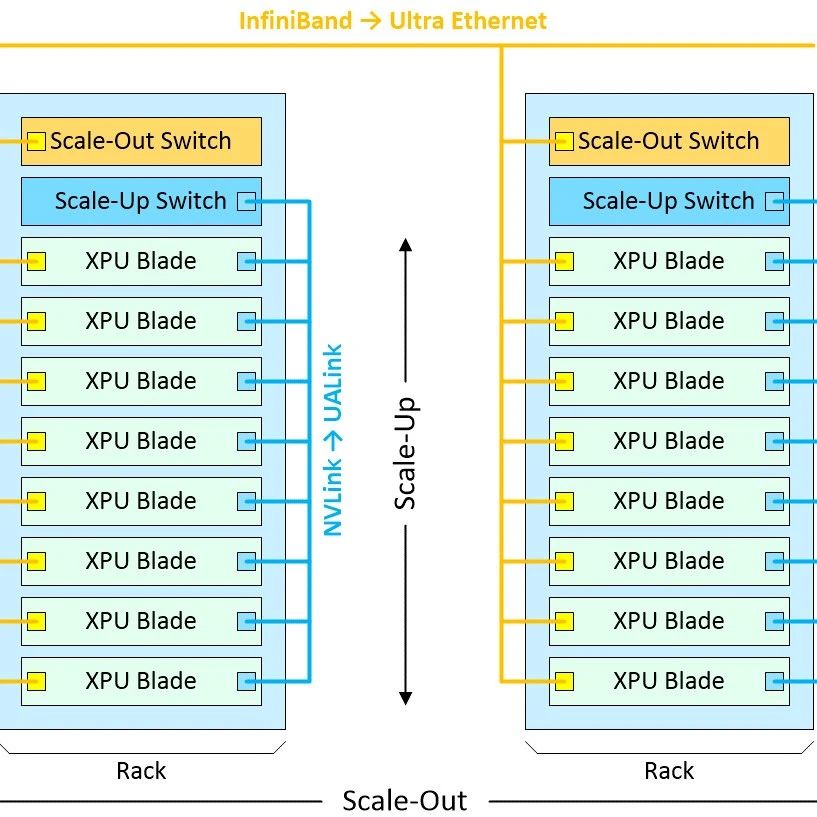
什么是Scale Up和Scale Out?
半导体行业观察· 2025-05-23 01:21
Core Viewpoint - The article discusses the concepts of horizontal and vertical scaling in GPU clusters, particularly in the context of AI Pods, which are modular infrastructure solutions designed to streamline AI workload deployment [2][4]. Group 1: AI Pod and Scaling Concepts - AI Pods integrate computing, storage, networking, and software components into a cohesive unit for efficient AI operations [2]. - Vertical scaling (Scale-Up) involves adding more resources (like processors and memory) to a single AI Pod, while horizontal scaling (Scale-Out) involves adding more AI Pods and connecting them [4][8]. - XPU is a general term for any type of processing unit, which can include various architectures such as CPUs, GPUs, and ASICs [6][5]. Group 2: Advantages and Disadvantages of Scaling - Vertical scaling is straightforward and allows for leveraging powerful server hardware, making it suitable for applications with high memory or processing demands [9][8]. - However, vertical scaling has limitations due to physical hardware constraints, leading to potential bottlenecks in performance [8]. - Horizontal scaling offers long-term scalability and flexibility, allowing for easy reduction in scale when demand decreases [12][13]. Group 3: Communication and Networking - Communication within and between AI Pods is crucial, with pod-to-pod communication typically requiring low latency and high bandwidth [11]. - InfiniBand and Super Ethernet are key competitors in the field of inter-pod and data center architecture, with InfiniBand being a long-standing standard for low-latency, high-bandwidth communication [13].