
Boston Dynamics

Search documents
特斯拉機器人憑什麼完勝波士頓動力?答案出乎意料! #特斯拉 #Optimus #ElonMusk #BostonDynamics #Atlas #人形機器人 #AI #科技
大鱼聊电动· 2025-08-25 04:17
Industry Focus - The report analyzes the competition between Boston Dynamics' Atlas and Tesla's Optimus in the humanoid robot field [1] - It highlights the different design philosophies: Boston Dynamics focuses on high performance regardless of cost, while Tesla prioritizes mass production and affordability [1] Product Comparison - Boston Dynamics' Atlas is portrayed as a highly capable but expensive "special forces" robot, suited for laboratory settings [1] - Tesla's Optimus is designed as a general-purpose robot for tasks like factory work and domestic assistance, emphasizing cost-effectiveness and scalability [1] Market Potential - The report suggests that Tesla's approach of mass production and affordability is more likely to drive widespread adoption and transform the world [1] - It questions the practicality of using a high-end robot like Atlas for everyday tasks, implying a limited market [1]



【Tesla每日快訊】 波士頓動力新 Atlas 亮相!馬斯克預言:機器人將取代所有體力勞動!🔥馬斯克的未來烏托邦(2025/8/25-1)
大鱼聊电动· 2025-08-25 03:57
Robot Technology & AI Development - Boston Dynamics' Atlas robot, enhanced with Toyota Research Institute (TRI) AI, is developing long-range manipulation tasks, aiming for complex process execution [1] - Tesla's Optimus robot prioritizes cost-effective, human-like movements for factory and home use, focusing on mass production and cost control [1] - Tesla leverages real-world AI from its FSD system, processing vast visual data to understand and navigate the physical world, giving Optimus a significant advantage [1] - Bloomberg analysis highlights Tesla's vertical integration in automation and robotics, enabling closed-loop data collection and model training [1] Tesla Production & Business Strategy - Tesla temporarily removed Model S and Model X order pages from its European website, initially misinterpreted as a market retreat [2] - A vehicle model approval document submitted to the EU reveals Tesla is updating the Model S Long Range and Plaid for 2026, indicating continued commitment to the European market [2] - Musk estimates that 20 million automated systems could replace 80 million physical labor jobs in the US, suggesting a significant shift in the labor market [2] Future Economic & Social Implications - Musk envisions a future with "Universal High Income," where AI and robots provide abundance, offering access to the best resources for everyone [2] - Concerns are raised about potential job displacement due to automation and the risk of increased economic pressure and technological dependence [2] - Musk predicts the number of humanoid robots will far exceed humans, driven by individual and industrial demand [2]

AI News: Deepseek Update, GPT-6, Qwen-Image, Meta Restructure, New Robots, and more!
Matthew Berman· 2025-08-21 19:07
AI Model & Technology Advancements - Discussion of GPT-6 news, indicating potential future advancements in the GPT model series [1] - Deepseek v3.1 is mentioned, suggesting updates and improvements in the Deepseek AI model [1] - Qwen-Image-Edit is highlighted, pointing to advancements in image editing capabilities within the Qwen AI model [1] - Perplexity SuperMemory is noted, indicating advancements in memory and information recall capabilities for AI [1] AI Applications & Robotics - Mentions of Agentsmd, suggesting developments and discussions around AI agents [1] - Google AI Voice Assistant Opal is introduced, showcasing advancements in voice assistant technology [1] - Boston Dynamics Atlas demo is featured, highlighting progress in robotics and humanoid movement [1] - Figure 02 Robot is mentioned, indicating advancements in robotics and humanoid development [1] - Cursor Stealth Model is noted, suggesting advancements in AI-powered tools for coding and software development [1] Industry Restructuring & Infrastructure - Meta AI is undergoing restructuring, potentially impacting the company's AI development and strategy [1] - OpenAI's infrastructure is discussed, indicating developments and investments in the resources needed to support AI models [1] - Nvidia is reportedly working on a new AI chip for China that outperforms H20 [1] Resources & Links - Links provided for Amazon Bedrock, Humanities Last Prompt Engineering Guide, and The Matthew Berman Vibe Coding Playbook [1] - Links to various social media platforms (X, Instagram, Discord, TikTok) for updates and community engagement [1]

MuJoCo教程来啦!从0基础到强化学习,再到sim2real
具身智能之心· 2025-08-01 16:02
Core Viewpoint - The article discusses the unprecedented advancements in AI, particularly in embodied intelligence, which is transforming the relationship between humans and machines. This technology is poised to revolutionize various industries, including manufacturing, healthcare, and space exploration [1][3]. Group 1: Embodied Intelligence - Embodied intelligence is characterized by machines that can understand language commands, navigate complex environments, and make intelligent decisions in real-time. This technology is no longer a concept from science fiction but is rapidly becoming a reality [1]. - Major tech companies like Tesla, Boston Dynamics, OpenAI, and Google are competing in the field of embodied intelligence, focusing on creating systems that not only have a "brain" but also a "body" capable of interacting with the physical world [1][3]. Group 2: Technical Challenges - Achieving true embodied intelligence presents significant technical challenges, including the need for advanced algorithms and a deep understanding of physical simulation, robot control, and perception fusion [3][4]. - MuJoCo (Multi-Joint dynamics with Contact) is highlighted as a critical technology in this field, serving as a high-fidelity simulation engine that bridges the virtual and real worlds [4][6]. Group 3: Advantages of MuJoCo - MuJoCo allows researchers to create realistic virtual robots and environments, enabling millions of trials and learning experiences without risking expensive hardware. This significantly accelerates the learning process, as simulations can run hundreds of times faster than real-time [6][8]. - The technology supports high parallelism, allowing thousands of simulation instances to run simultaneously, and provides a variety of sensor models, ensuring robust and precise simulations [6][8]. Group 4: Educational Opportunities - A comprehensive MuJoCo development course has been developed, focusing on practical applications and theoretical foundations, covering topics from physical simulation principles to deep reinforcement learning [9][11]. - The course is structured into six modules, each with specific learning objectives and practical projects, ensuring a solid grasp of embodied intelligence technologies [15][17]. Group 5: Project-Based Learning - The course includes six progressively challenging projects, such as building a smart robotic arm, implementing vision-guided grasping systems, and developing multi-robot collaboration systems, which are designed to provide hands-on experience [19][27]. - Each project is accompanied by detailed documentation and code references, facilitating a deep understanding of the underlying technologies and their applications in real-world scenarios [30][32]. Group 6: Target Audience and Outcomes - The course is suitable for individuals with programming or algorithm backgrounds looking to enter the field of embodied robotics, as well as students and professionals interested in enhancing their practical skills [32][33]. - Upon completion, participants will possess a complete skill set in embodied intelligence, including technical, engineering, and innovative capabilities, making them well-equipped for roles in this rapidly evolving industry [32][33].
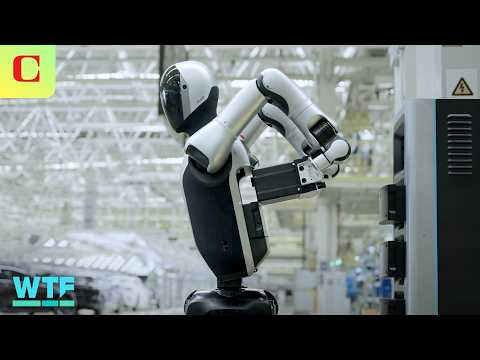
Humanoid Robots Can Swap Their Own Batteries Now | What The Future
CNET· 2025-07-27 12:00
Robot Technology & Innovation - Ubitech's Walker S2 robot features autonomous battery swapping, enabling near 24/7 operation [1] - The Walker S2 utilizes five-finger end effectors and a dual-battery system for continuous power during battery changes [2] - The robot exhibits hypermobility, similar to Atlas from Boston Dynamics and G1 from Unree [3] Swarm Intelligence & Collaboration - Ubitech developed "Swarm Intelligence," allowing multiple robots to collaborate on tasks [4] - Demonstrations show robots lifting objects and handing items to each other [4][5] - Figure's Helix AI showcases similar collaborative capabilities in humanoid robots [5] Industry Applications & Competition - Ubitech and Figure are testing robots for automotive manufacturing, partnering with Zeer and BMW respectively [5][6] - Ubitech's robots have been shown performing various tasks, including delivering flowers and training for a robot half marathon [6] - The humanoid robot games in China will likely push robots to their limits, potentially requiring battery swapping stations [6][7]
Jinqiu Select | 为什么具身机器人的未来无关形态
锦秋集· 2025-07-26 03:00
Core Insights - The breakthrough success of Physical Intelligence's π VLA model marks a significant turning point in the robotics industry, revealing the complexity and fragmentation involved in building true robotic intelligence [1] - The future of robotics will not be about creating more human-like robots but rather about developing a more powerful and flexible technology stack [2] - The article emphasizes that the next wave of successful robotics will focus on diverse forms shaped by tasks, terrain, and environments rather than converging on a single humanoid form [6][14] Group 1: Robotics Evolution - The robotics technology stack is undergoing a major deconstruction, similar to the development of autonomous driving and VR industries, where specialized companies excel in specific areas rather than trying to dominate the entire industry [1] - The success of the π0.5 model raises the stakes for the entire industry, as robotics must prove itself in the real world filled with physical constraints [1] - The article draws parallels between the evolution of robotics and the concept of carcinization in biology, where different species evolve similar traits to adapt to their environments [5] Group 2: Human-like Robots vs. Functional Design - The assumption that robots must mimic human forms to be effective is termed the "humanoid fallacy," which overlooks the potential for innovation through non-human designs [8][9] - The efficiency of bipedal locomotion is questioned, with evidence showing that wheeled robots are significantly more efficient than humanoid robots [9][11] - Successful consumer robots, like vacuum cleaners, thrive not because they resemble humans but due to their unique designs that cater to specific tasks [10] Group 3: Practicality and Deployment - The article highlights that practical applications and deployment in real-world environments are crucial for generating valuable training data for robots [18] - Companies like Formic emphasize that the only way to achieve large-scale deployment is through useful robots that provide economic value from day one [18] - The focus should shift from creating humanoid robots to developing specialized robots that can perform tasks effectively in various environments [12][19] Group 4: Learning and Adaptation - The future of robotics lies in decoupling intelligence from specific forms, allowing for generalized learning across different embodiments [13][14] - Physical Intelligence's approach to cross-modal and cross-embodiment learning demonstrates that diverse data sources can enhance robotic learning and performance [17] - The article suggests that the next generation of robotics will benefit from a model that aggregates data from various physical forms and tasks, leading to improved generalization [16][17] Group 5: Robotics Stack - A clear hierarchical map of the robotics system is proposed, breaking down the components from data collection to intelligent control [20] - Each layer of the robotics stack supports the next, facilitating the flow of data from deployed robots into structured training for models like π0.5 [20]

倒计时2天,即将开课啦!从0基础到强化学习,再到sim2real
具身智能之心· 2025-07-12 13:59
Core Viewpoint - The article discusses the rapid advancements in embodied intelligence, highlighting its potential to revolutionize various industries by enabling robots to understand language, navigate complex environments, and make intelligent decisions [1]. Group 1: Embodied Intelligence Technology - Embodied intelligence aims to integrate AI systems with physical capabilities, allowing them to perceive and interact with the real world [1]. - Major tech companies like Tesla, Boston Dynamics, OpenAI, and Google are competing in this transformative field [1]. - The potential applications of embodied intelligence span manufacturing, healthcare, service industries, and space exploration [1]. Group 2: Technical Challenges - Achieving true embodied intelligence presents unprecedented technical challenges, requiring advanced algorithms and a deep understanding of physical simulation, robot control, and perception fusion [2]. Group 3: Role of MuJoCo - MuJoCo (Multi-Joint dynamics with Contact) is identified as a critical technology for embodied intelligence, serving as a high-fidelity simulation engine that bridges the virtual and real worlds [3]. - It allows researchers to create realistic virtual robots and environments, enabling millions of trials and learning experiences without risking expensive hardware [5]. - MuJoCo's advantages include high simulation speed, the ability to test extreme scenarios safely, and effective transfer of learned strategies to real-world applications [5]. Group 4: Research and Industry Adoption - MuJoCo has become a standard tool in both academia and industry, with major companies like Google, OpenAI, and DeepMind utilizing it for robot research [7]. - Mastery of MuJoCo positions entities at the forefront of embodied intelligence technology [7]. Group 5: Practical Training and Curriculum - A comprehensive MuJoCo development course has been created, focusing on practical applications and theoretical foundations within the embodied intelligence technology stack [9]. - The course includes project-driven learning, covering topics from physical simulation principles to deep reinforcement learning and Sim-to-Real transfer techniques [9][10]. - Six progressive projects are designed to enhance understanding and application of various technical aspects, ensuring a solid foundation for future research and work [14][15]. Group 6: Expected Outcomes - Upon completion of the course, participants will gain a complete embodied intelligence technology stack, enhancing their technical, engineering, and innovative capabilities [25][26]. - Participants will develop skills in building complex robot simulation environments, understanding core reinforcement learning algorithms, and applying Sim-to-Real transfer techniques [25].

MuJoCo实战教程即将开课啦!从0基础到强化学习,再到sim2real
具身智能之心· 2025-07-10 08:05
Core Viewpoint - The article discusses the rapid advancements in embodied intelligence, highlighting its potential to revolutionize various industries such as manufacturing, healthcare, and space exploration through robots that can understand language, navigate complex environments, and make intelligent decisions [1]. Group 1: Embodied Intelligence Technology - Embodied intelligence aims to integrate AI systems with physical capabilities, allowing them to perceive and interact with the physical world [1]. - Major tech companies like Tesla, Boston Dynamics, OpenAI, and Google are competing in this transformative field [1]. - The core challenge in achieving true embodied intelligence lies in the need for advanced algorithms and a deep understanding of physical simulation, robot control, and perception fusion [2]. Group 2: Role of MuJoCo - MuJoCo (Multi-Joint dynamics with Contact) is identified as a critical technology for embodied intelligence, serving as a high-fidelity simulation engine that bridges the virtual and real worlds [3]. - It allows researchers to conduct millions of trials in a simulated environment, significantly speeding up the learning process while minimizing hardware damage risks [5]. - MuJoCo's advantages include advanced contact dynamics algorithms, high parallel computation capabilities, and a variety of sensor models, making it a standard tool in both academia and industry [5][7]. Group 3: Practical Applications and Learning - A comprehensive MuJoCo development course has been created, focusing on practical applications and theoretical foundations within the embodied intelligence technology stack [9]. - The course includes project-driven learning, covering topics from physical simulation principles to deep reinforcement learning and Sim-to-Real transfer techniques [9][10]. - Participants will engage in six progressively complex projects, enhancing their understanding of robot control, perception, and collaborative systems [16][21]. Group 4: Course Structure and Target Audience - The course is structured into six modules, each with specific learning objectives and practical projects, ensuring a solid grasp of key technical points [13][17]. - It is designed for individuals with programming or algorithm backgrounds, graduate and undergraduate students focusing on robotics or reinforcement learning, and those interested in transitioning to the field of embodied robotics [28].

X @TechCrunch
TechCrunch· 2025-07-07 16:15
Automation & Robotics Adoption - Cargill has been utilizing Boston Dynamics' Spot robot at its oilseed facility since mid-2024 [1] - The deployment of Spot supports Cargill's move towards autonomous operations [1] - Robots are handling routine inspections and visual safety checks [1] Operational Efficiency - Humans are shifting focus to predictive maintenance and long-term planning [1]