Chery

Search documents
新车强制安装!3年后,AEB最严国标来袭?
电动车公社· 2025-05-24 16:26
Core Viewpoint - The automotive industry is undergoing significant regulatory changes, particularly with the introduction of stringent standards for Automatic Emergency Braking Systems (AEB), which will become mandatory for certain vehicle categories starting January 1, 2028 [3][5][7]. Group 1: New Regulations - The new national standard for AEB has transitioned from a recommended standard to a mandatory one, requiring M1 and N1 class vehicles to be equipped with AEB [5][6]. - The last similar regulation was introduced eight years ago, aimed at reducing collision probabilities for commercial vehicles [7][8]. - The U.S. National Highway Traffic Safety Administration (NHTSA) predicts that nationwide AEB implementation could prevent 24,000 injuries and 362 deaths annually [10]. Group 2: Technical Requirements - The new standard significantly raises the technical requirements for AEB systems, particularly in recognizing vulnerable road users such as pedestrians and cyclists [12][13]. - AEB systems must now operate effectively within a speed range of 20-60 km/h and must achieve a deceleration rate of at least 5.0 m/s² during emergency braking [18][19]. - The success rate for AEB systems must be at least 90% for pedestrians and 80% for cyclists, with a strict limit on false triggers set at 0.1% [33][36]. Group 3: Industry Impact - The adoption rate of AEB is closely linked to vehicle pricing, with higher-end models showing significantly higher AEB integration compared to economy models [46][48]. - The mandatory AEB requirement will particularly impact micro and small cars, as the cost of AEB systems can significantly affect their price competitiveness [51][54]. - The automotive industry is expected to face increased pressure to enhance AEB technology and meet the new standards, which may lead to a more mature automotive market [62]. Group 4: Economic and Safety Benefits - Implementing mandatory AEB is projected to reduce accident-related costs significantly, with estimates suggesting a cost increase of about $200 per vehicle but potential savings of $600-$1,000 in accident-related expenses [60]. - The European Union anticipates that mandatory AEB could lower traffic accident mortality rates by 25% by 2035, resulting in substantial economic benefits [61].


摩根士丹利:汇川技术_ 2025 年中国 BEST 大会反馈
摩根· 2025-05-14 03:09
Investment Rating - The investment rating for Shenzhen Inovance Technology is Equal-weight [5] Core Insights - The automation orders in April showed high single-digit year-on-year growth, although some industries like PIMM experienced a year-on-year decline. Conversely, sectors such as battery, machine tool, logistics machinery, packaging, and air conditioners for data centers maintained solid order levels [1] - Management is optimistic about maintaining stable gross profit margins (GPM) for automation in 2025, expecting a contraction of less than 1 percentage point year-on-year in Q1 2025, with no significant adjustments in average selling prices (ASP) year-to-date [2] - The top five clients in the New Energy Vehicle (NEV) sector contributed 50-60% of total EV powertrain revenue, with Li Auto leading at 20-30% [3] Summary by Sections Automation Orders - April automation orders showed high single-digit year-on-year growth, with weaker momentum in industries like PIMM, textile, solar, 3C, and air compressors. However, demand remained solid in battery, machine tool, logistics machinery, packaging, and air conditioners for data centers [1] Gross Profit Margin - Management expects the full-year GPM for automation to remain stable compared to a decline of 2 percentage points in 2024, with Q1 2025 showing a contraction of less than 1 percentage point year-on-year [2] Client Contributions - The top five NEV clients accounted for 50-60% of total EV powertrain revenue, with Li Auto contributing 20-30%, followed by GAC and Chery. Foreign auto OEM clients contributed 5-6% in aggregate [3] Product Pipeline - Inovance plans to launch significant humanoid products in the second half of 2025, including motors, screws, and modules, and aims to introduce a collaborative robot (cobot) product for public sale soon [3]

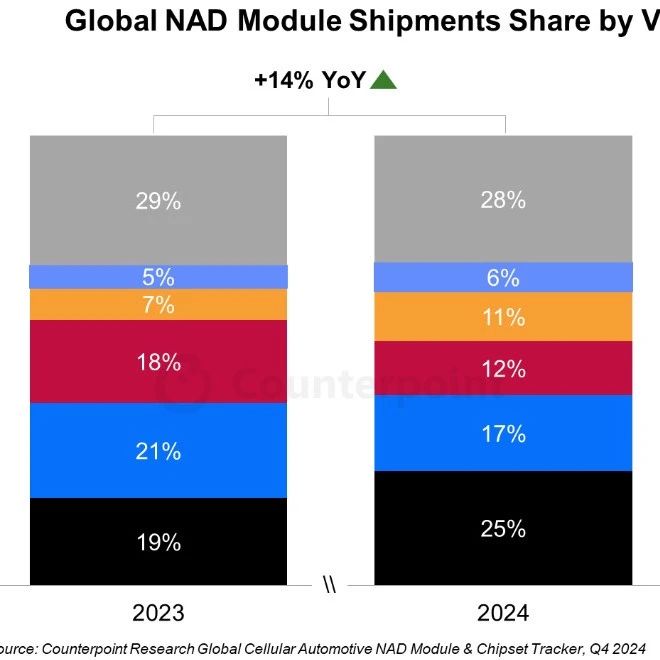
中国市场强劲增长驱动2024年全球NAD模块出货量同比增长14%
Counterpoint Research· 2025-04-23 11:11
Core Insights - The global NAD module market is expected to see a 14% year-on-year increase in shipment volume in 2024, driven by the growing demand for embedded connectivity in passenger vehicles [1][3]. Group 1: Market Growth and Trends - The significant growth in the Chinese market, particularly from companies like BYD, Geely, Chery, and Nio, has led to an expansion exceeding 30% for Quectel and Fibocom [3][6]. - Continental is focusing on developing its own 4G/5G NAD modules based on Qualcomm's platform, which has contributed to its growth by reducing reliance on external suppliers [3][6]. - By 2030, 5G and 5G RedCap technologies are projected to account for nearly 90% of the total global NAD module shipments [3][8]. Group 2: Competitive Landscape - Qualcomm is expected to maintain its leadership in the NAD chipset market through competitive 5G pricing, despite the entry of new players like MediaTek, HiSilicon, and Samsung into the automotive 5G chipset sector [3][8]. - The transition from 4G to 5G is anticipated to be driven by more centralized architectures, digital cockpits, and advanced driver-assistance systems (ADAS L3+) [8].
中国市场强劲增长驱动2024年全球NAD模块出货量同比增长14%
Counterpoint Research· 2025-04-23 11:11
数据来源:Counterpoint Research 《2024年Q4 全球汽车蜂窝NAD模组及芯片组追踪报告》 2024年全球NAD模组市场出货量持续增长。根据 Counterpoint最新《全球汽车蜂窝NAD模组及芯片 组追踪报告》 ,随着嵌入式连接技术日益成为乘用车标配,该年度出货量同比增长14%。 分析师观点 针对汽车连接需求增长, Counterpoint 副总监Greg Basich 评论道:"Quectel和Fibocom(以 Favalon品牌运营)在中国市场推动下实现强劲增长,该市场扩张超30%,主要源于BYD、Geely、 Chery和Nio等车企的需求上升。另一方面,以Rolling Wireless(中国以外的领导者)和LG为代表的 国际品牌出现下滑,因中国以外市场的需求未能同步复苏。" 随着近期地缘政治发展,美国计划自2027年款车型起限制汽车制造商销售搭载中国和俄罗斯制造软 件的车辆,并自2030年款车型(或无年款车型则从2029年1月1日起)同时禁止相关软件和硬件。此 举可能影响部分中国企业。值得注意的是,我们已观察到Tesla转变策略——在原先采购中国供应商 方案后,现已开始认 ...
U.S. tech giants are betting big on humanoid robots — but China's already ahead, analysts say
CNBC· 2025-03-28 07:38
Core Insights - American tech giants like Tesla and Nvidia are in a competitive race to develop humanoid robots, which are seen as crucial for the future economy, but they face significant competition from China [1][2][3] Industry Overview - Humanoid robots, powered by artificial intelligence, are expected to fill various roles in industrial and service sectors, with increasing investor interest driven by tech leaders like Nvidia [2] - Tesla's Optimus project aims to produce around 5,000 units in 2025, positioning it as a leader in the U.S. market, although it faces competition from Chinese firms like Unitree and Agibot, which have similar production goals [3][4] Competitive Landscape - Chinese companies are leveraging superior economies of scale and manufacturing capabilities to undercut U.S. competitors in humanoid robotics, with Unitree's G1 robot priced at $16,000 compared to Tesla's estimated $20,000 for Optimus [7][8] - Over the past five years, China has led the world in patent filings related to humanoid robots, with 5,688 patents compared to 1,483 from the U.S., indicating a strong innovation pipeline [9][10] Government Support and Market Dynamics - The Chinese government is actively promoting the development of humanoid robots, with guidelines issued for large-scale production by 2025 [11] - Analysts suggest that humanoid robots could help mitigate labor shortages in China, with initial applications expected in production lines and later in the service industry [12] Supply Chain and Component Costs - China controls approximately 70% of the supply chain for components used in humanoid robots, which is expected to lead to a rapid decline in component costs and increased adoption of these technologies [13] - The Unitree G1 is noted as being entirely decoupled from American components, positioning China to capitalize on the economic benefits of intelligent robotics systems [14] Strategic Recommendations - To remain competitive, U.S. companies like Tesla may need to consider reshoring or "friendshoring" their component sourcing and manufacturing to reduce reliance on China [15]



地平线机器人技术-2024 年下半年毛利率达 76.1% 创新高;J6M 高级驾驶辅助系统拓展至理想汽车;目标价上调至 13.33 港元;推荐买入
2025-03-27 07:29
Summary of Horizon Robotics Conference Call Company Overview - **Company**: Horizon Robotics (9660.HK) - **Industry**: Automotive technology, specifically focusing on smart driving and advanced driver-assistance systems (ADAS) Key Financial Highlights - **2H24 Revenue**: Rmb1.4 billion, representing a **23% YoY** and **55% QoQ** increase, exceeding Bloomberg consensus by **10%** [4][8] - **Gross Margin (GM)**: Achieved **76.1%**, higher than the expected **72.5%** and consensus estimate of **69.5%** [4][8] - **Operating Income**: Reported at Rmb-1.24 billion, in line with expectations [4][8] - **Net Income**: Turned positive at Rmb7.4 billion, significantly beating expectations of a loss [7][8] - **Product Solutions Delivery**: Expected to reach **2.9 million** in 2024 with **100+ car model design wins** [2][9] Product and Market Developments - **Partnership with Li Auto**: Li Auto plans to adopt Horizon Robotics' J6M chips for its L/MEGA series vehicles, upgrading from J5 solutions, indicating strong supplier credibility [1][9] - **Chip Adoption**: Increasing adoption of Horizon's chips among local OEMs, with a focus on higher-end products like J6M (128 TOPS) and J6P (560 TOPS) [1][9] - **Market Expansion**: Horizon Robotics is expanding its presence among Chinese OEMs, including BYD, Changan, Geely, Chery, and GAC, promoting intelligent driving features [9] Future Outlook - **Revenue Growth Projections**: Expected **50% YoY** growth in 2025, with continued strong growth rates of **60%+ YoY** in 2026-2028 [11] - **Earnings Revisions**: Adjustments made to 2025E-2030E earnings, with a **2%-5%** increase in revenue estimates for 2026-2030 [10][11] - **Target Price**: Raised to **HK$13.33** from **HK$11.77**, based on a revised EV/EBITDA multiple of **30.0x** for 2028E [19] Risks and Challenges - **Competitive Landscape**: Potential risks include increased competition and pricing pressures in the auto supply chain amid slow demand [18] - **Product Mix Upgrade**: Risks associated with slower-than-expected upgrades to AD products and expansion of the customer base [18] - **Supply Chain Risks**: Geopolitical tensions may pose supply chain challenges [18] Conclusion Horizon Robotics is positioned for significant growth driven by partnerships with major OEMs, strong product demand, and a favorable market environment for smart driving technologies. The company’s financial performance in 2H24 indicates robust growth, and the outlook remains positive despite potential risks in the competitive landscape.

Hesai(HSAI) - 2024 Q4 - Earnings Call Transcript
2025-03-11 11:53
Financial Data and Key Metrics Changes - In 2024, the company achieved record net revenues of RMB2 billion (USD285 million), marking the highest in the global LiDAR industry [39] - Shipments exceeded 500,000 units in 2024, more than doubling the total from 2023, with December alone setting an industry record of 100,000 monthly shipments [39] - The company reported a full-year non-GAAP net profit of RMB14 million (USD1.9 million), a significant improvement from a non-GAAP net loss of RMB241 million (USD34 million) in 2023 [41] - The blended gross margin for Q4 2024 was 39%, down from the previous quarter due to a shift in product mix [40] Business Line Data and Key Metrics Changes - The company shipped over 20,000 units to its robotics business in December 2024, indicating significant growth in this sector [40] - For 2025, the company projects total shipments of 1.2 million to 1.5 million units, with nearly 200,000 units expected to come from high-margin robotic LiDAR [8][9] - The ATX LiDAR, priced at approximately $200, is anticipated to contribute significantly to total shipments in 2025, with expectations of high adoption rates among OEMs [44][45] Market Data and Key Metrics Changes - The adoption of ADAS in China is projected to grow from 8% in 2023 to 70% by 2030, indicating a transformative decade ahead for the industry [10] - LiDAR integration in EVs in China is expected to surge from 8% in 2023 to 20% in 2025 and then to 56% by 2030 [13] - The company has secured design wins for 120 vehicle models across 22 OEMs worldwide, including 9 out of the top 10 largest automakers by market cap in China [28] Company Strategy and Development Direction - The company aims to solidify its leadership in the LiDAR market by focusing on the growing demand for ADAS and robotics applications [6][29] - The strategy includes launching new production lines in Q1 2025, with an expected annualized production capacity of 2 million units by the end of the year [29] - The company is committed to lowering barriers to LiDAR adoption and driving technological equality, with a focus on cost-effective solutions [20] Management's Comments on Operating Environment and Future Outlook - Management expressed confidence in achieving GAAP profitability of RMB200 million to RMB350 million in 2025, with non-GAAP profits projected to soar to RMB350 million to RMB500 million [50] - The company anticipates a strong year in 2025, driven by increased demand from both ADAS and robotics sectors [42] - Management highlighted the importance of maintaining a healthy gross margin of around 40% while continuing to invest in R&D [49][65] Other Important Information - The company has deepened collaborations with major clients such as BYD and Great Wall Motors, which are ramping up their strategic upgrades in intelligent driving technologies [24][25] - The JT Mini LiDAR is being positioned as a leading product in the robotics market, with significant orders expected in 2025 [31][46] Q&A Session Summary Question: Guidance for 2025 and quarterly volume trajectory - Management provided revenue guidance of RMB520 million to RMB540 million for Q1 2025, with expectations of approximately 200,000 units shipped [55][56] - The ATX is expected to have an annual price decline, while gross profit margins are anticipated to remain close to 40% [58][59] Question: Long-term potential of the robotics LiDAR market - Management indicated that the robotics market could be several times larger than the passenger vehicle business, with high margins expected to persist [71][76] Question: Further cost reduction and technology advancements - Management noted limited room for further cost reductions on the ATX platform, emphasizing the importance of maintaining product reliability and performance [94][95] Question: ADAS LiDAR adoption in overseas markets - Management clarified that LiDAR is applicable to both EV and ICE vehicles, and the company is optimistic about growth prospects in overseas markets [130] Question: Long-term competitive landscape of ADAS LiDAR market - Management acknowledged that while exclusivity with OEMs is not guaranteed, the company's performance leadership and cost competitiveness are key advantages [140][141]