
Cohere

Search documents
Cohere hits a $6.8B valuation as investors AMD, Nvidia, and Salesforce double down
TechCrunch· 2025-08-14 17:40
Company Overview - Cohere has raised an oversubscribed $500 million funding round, increasing its valuation to $6.8 billion from $5.5 billion a year ago [1] - Founded in 2019 by Aidan Gomez, Cohere focuses on secure large language models (LLMs) for enterprise use rather than consumer applications [2] Partnerships and Talent Acquisition - The company has established partnerships with major enterprise technology firms such as Oracle, Dell, Bell, Fujitsu, LG's consulting service CNS, and SAP, as well as significant enterprise clients like RBC [3] - Cohere has recently hired Joelle Pineau, former head of research at Meta, as its chief AI officer and Francois Chadwick as CFO from KPMG [3] Funding Details - The latest funding round was led by Radical Ventures and Inovia Capital, with participation from existing investors including AMD Ventures, Nvidia, and Salesforce Ventures [4] - Notably, Oracle was not named as a participating investor in this round, despite its previous backing [4][7]



X @Bloomberg
Bloomberg· 2025-08-14 15:38
Artificial intelligence startup Cohere has raised $500 million in a new round of funding, part of a bid to compete with larger tech firms in selling AI services to businesses and governments https://t.co/KDUQu7Etjo ...
X @TechCrunch
TechCrunch· 2025-08-14 14:01
Cohere hires long-time Meta research head Joelle Pineau as its chief AI officer | TechCrunch https://t.co/TEbL2yoL8V ...
检索增强生成(RAG)的版权新关注
3 6 Ke· 2025-08-14 10:11
Group 1 - The core viewpoint of the articles is the evolution of generative artificial intelligence (AIGC) from a reliance on model training (AIGC 1.0) to a new phase (AIGC 2.0) that integrates authoritative third-party information to enhance the accuracy, timeliness, and professionalism of generated content [2][3] - Amazon's unexpected partnerships with major media outlets like The New York Times and Hearst mark a significant shift in the industry, especially given The New York Times' previous legal actions against AI companies for copyright infringement [2][3] - OpenAI's collaboration with The Washington Post is part of a broader trend, as OpenAI has partnered with over 20 publishers to provide users with reliable and accurate information [2][3] Group 2 - The rise of "Retrieval-Augmented Generation" (RAG) technology is attributed to its ability to combine pre-trained model knowledge with external knowledge retrieval, addressing issues like "model hallucination" and "temporal gaps" in information [4][5] - RAG allows models to provide accurate answers using real-time external data without needing to retrain model parameters, thus enhancing the relevance of responses [6] - The process of RAG involves two stages: data retrieval and content integration, which raises concerns about copyright issues due to the use of large volumes of copyrighted material [6][8] Group 3 - The first copyright infringement lawsuit related to RAG occurred in October 2024, highlighting the legal challenges faced by AI companies in utilizing copyrighted content [8] - In February 2025, a group of major publishers sued an AI company for allegedly using their content without permission through RAG technology, indicating a growing trend of legal disputes in this area [8] - The European Court of Justice is also involved in a case concerning copyright disputes related to generative AI, reflecting the complexity of these legal issues [9] Group 4 - The collection of works during the data retrieval phase raises questions about copyright infringement, particularly regarding the distinction between temporary and permanent copies of copyrighted material [11] - The legality of using copyrighted works in RAG systems depends on whether the retrieval process constitutes long-term copying, which is generally considered infringing without authorization [11][12] - The handling of copyrighted works in RAG systems must also consider the potential for bypassing technical protections, which could lead to legal violations [12][13] Group 5 - The evaluation of how RAG utilizes works during the content integration phase is crucial for determining potential copyright infringement, including direct and indirect infringement scenarios [14] - Direct infringement may occur if the output content violates copyright laws by reproducing or adapting protected works without permission [14] - Indirect infringement could arise if the AI model facilitates the spread of infringing content, depending on the model's design and the actions taken upon discovering such infringement [15] Group 6 - The concept of "fair use" in copyright law is a significant factor in determining the legality of RAG systems, with different jurisdictions having varying standards for what constitutes fair use [17][18] - The relationship between copyright technical measures and fair use is complex, as circumventing technical protections may impact the assessment of fair use claims [17][18] - The output of RAG systems must be carefully evaluated to ensure that it does not exceed reasonable limits of use, as this could lead to copyright infringement [19]




检索增强生成(RAG)的版权新关注
腾讯研究院· 2025-08-14 08:33
Group 1 - The article discusses the evolution of AIGC (Artificial Intelligence Generated Content) from the 1.0 phase, which relied solely on model training, to the 2.0 phase, characterized by "Retrieval-Augmented Generation" (RAG) that integrates authoritative third-party information to enhance content accuracy and timeliness [6][10] - Major collaborations between AI companies and media organizations, such as Amazon's partnerships with The New York Times and OpenAI's collaboration with The Washington Post, highlight the industry's shift towards providing reliable and factual information [3][6] - RAG combines language generation models with information retrieval techniques, allowing models to access real-time external data without needing to retrain their parameters, thus addressing issues like "model hallucination" and "temporal disconnection" [8][10] Group 2 - The rise of RAG is attributed to the need to overcome inherent flaws in traditional large models, such as generating unreliable information and lacking real-time updates [8][9] - RAG's process involves two stages: data retrieval and content integration, where the model first retrieves relevant information before generating a response [11] - Legal disputes surrounding RAG have emerged, with cases like the lawsuit against Perplexity AI highlighting concerns over copyright infringement due to unauthorized use of protected content [14][16] Group 3 - The article outlines the complexities of copyright issues related to RAG, including the distinction between long-term and temporary copying, which can affect the legality of data retrieval methods [17][18] - Technical protection measures are crucial in determining the legality of content retrieval, as bypassing such measures may violate copyright laws [19][20] - The article emphasizes the need for careful evaluation of how RAG outputs utilize copyrighted works, as both direct and indirect infringements can occur depending on the nature of the content generated [21][23] Group 4 - The concept of "fair use" is explored in the context of RAG, with varying interpretations based on the legality of data sources and the extent of content utilization [25][27] - The relationship between copyright technical measures and fair use is highlighted, indicating that circumventing protective measures can impact the assessment of fair use claims [28] - The article concludes with the ongoing debate regarding the balance between utilizing copyrighted content for AI training and respecting copyright laws, as well as the implications for future AI development [29][30]

X @Avi Chawla
Avi Chawla· 2025-08-14 06:33
Performance Summary - Voyage-context-3 outperforms all models across all domains in 93 retrieval datasets spanning nine domains [1] - Voyage-context-3 outperforms OpenAI-v3-large by 1420 basis points (14.2%) [1] - Voyage-context-3 outperforms Cohere-v4 by 789 basis points (7.89%) [1] - Voyage-context-3 outperforms Jina-v3 by 2366 basis points (23.66%) [1]
Q2营收爆表,盘后却暴跌10%!“英伟达亲儿子”CoreWeave 指引喜忧参半
Ge Long Hui· 2025-08-13 02:27
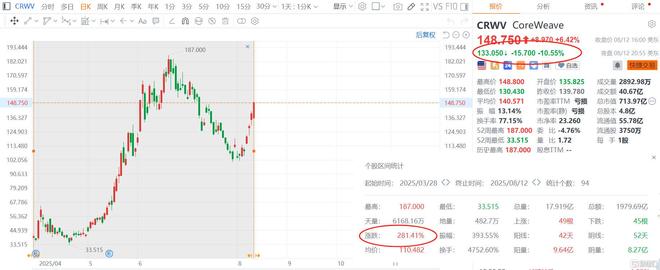
华尔街最近炙手可热的IPO妖股双雄,迎来财报检验。 昨晚,"稳定币第一股"Circle公布的首份成绩单大超预期。 营收爆表 亏损超预期 作为英伟达支持的AI概念"新贵"(持股7%),CoreWeaveQ2营收还是惊人的。 财报显示,公司Q2营收为12.13亿美元,同比大增206.75%,高于市场预期的10.8亿美元,一季度同比 增长420%。 二季度,稀释后每股收益(EPS)为-0.6美元,同比亏损收窄约63%;但减亏步伐不及华尔街预期,分 析师预期为-0.52美元。 二季度,净亏损为2.91亿美元,同比收窄10%,一季度亏损同比扩大143%。 二季度,调整后营业利润约2亿美元,同比增长134%,一季度同比增长约550%。 公司的调整后EBITDA表现同样出色,达到7.53亿美元,利润率为62%,是去年同期水平的三倍。 周二盘后,有"英伟达亲儿子"之称的CoreWeave 业绩同样也爆表;不过因亏损超预期、指引喜忧参半, 导致其盘后股价大跌。 在财报公布后,原本收涨超6%的CoreWeave盘后暴跌超10%。 不过回顾来看,自CoreWeave上市四个多月来,公司股价已累涨超280%,目前总市值为713.97 ...

X @Bloomberg
Bloomberg· 2025-08-12 13:07
RT Bloomberg Live (@BloombergLive)@cohere's @aidangomez is the latest edition to #BloombergTech program and he will be discussing how his work with AI is transforming tech businesses in Europe.Join us in London on 10/21: https://t.co/7ljEm4Rc4S https://t.co/PHhSMynEgZ ...
速递|2500万美金重塑Agent搜索,Tavily以“企业安全防护”抢占十亿智能体入口
Z Potentials· 2025-08-08 03:38
各行业企业正在内部部署 AI Agent ,用于自动化执行各类任务。 在金融领域, AI Agent 对欺诈检测至关重要。它们能够实时分析海量交易数据。与此同时,销售机构正利用 AI Agent 收集潜在客户数据,这些 Agent 可以全网扫描包括社交媒体在内的信息源。 为了保持高效,这些 Agent 需要接入互联网并从相关来源获取信息,同时遵循公司政策并模拟人类研究员的作业方式。 若直接将 Agent 连接到 ChatGPT 等大型语言模型,而不设置企业专属防护机制,可能导致严重不当的结果。 OpenAI 和 Perplexity 同样为独立开发者提供搜索解决方案。 " 企业治理、风险与合规在当前至关重要,如果放任不管,局面将会彻底失控, "Insight Partners 董事总经理 George Mathew 向 TechCrunch 表示。 这正是 Insight Partners 领投 2000 万美元 A 轮融资 Tavily 的原因,这家初创公司以符合企业特定政策的方式将 AI Agent 连接到网络。 这笔投资使 成立仅 1 年的 Tavily 总融资额达到 2500 万美元。 Tavily ...
GPT-5正式发布,刷新评分新高;陈天桥联手代季峰筹备新AI公司丨AIGC日报
创业邦· 2025-08-08 00:08
Group 1 - OpenAI's GPT-5 model has been officially released, achieving top rankings in various fields including text, web development, and visual domains, as well as in challenging prompts, programming, mathematics, creative writing, and long queries [2] - Chen Tianqiao is collaborating with Dai Jifeng to establish a new AI startup, focusing on AI-driven business decision-making, breakthrough algorithms for content distribution, and AI services targeting aging and youth demographics, with a goal of achieving general artificial intelligence [2] - Apple is facing a talent drain in its AI division, with several top researchers leaving for competitors such as OpenAI, Meta, xAI, and Cohere, many of whom were involved in foundational model development [2] Group 2 - Alibaba's Tongyi Qianwen has released smaller models Qwen3-4B-Instruct-2507 and Qwen3-4B-Thinking-2507, which reportedly outperform closed-source models like GPT4.1-Nano in non-inference tasks and can compete with mid-sized models like Qwen3-30B-A3B in inference tasks [2]
