Apple

Search documents
Why are US stocks falling and who are biggest losers and gainers? US stock market, S&P 500, Dow Jones and Nasdaq, drop explained. Here's what should investors do now
The Economic Times· 2026-01-30 22:10
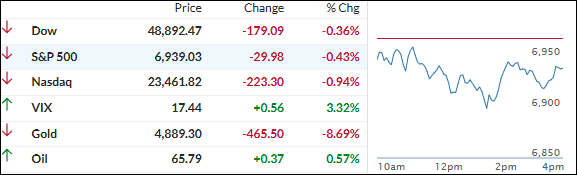
Market Overview - US stock markets ended lower due to uncertainty surrounding President Trump's nomination of Kevin Warsh to lead the Federal Reserve, impacting future interest rate policy [1][3][15] - Concerns over the Fed's independence and higher-than-expected inflation data contributed to reduced risk appetite among investors [3][5] Commodity Performance - Gold prices fell approximately 11%, while silver prices dropped more than 30%, reversing a previous rally [7][9] - The selloff in metals significantly affected mining stocks, leading to sharp losses in the sector [4][8] Index Performance - The S&P 500 declined by 0.4%, the Dow Jones Industrial Average also fell by 0.4%, and the Nasdaq Composite dropped nearly 0.9% [7][9] - Small-cap stocks underperformed larger peers due to heightened interest rate concerns [7] Biggest Losers - Newmont, a mining stock, fell by 10.4% as gold prices plunged [9] - Freeport-McMoRan dropped by 7.2% amid the metals sell-off [9] - Microsoft shares extended losses due to weak cloud revenue growth, while Apple slipped 0.3% despite better-than-expected quarterly profits [8][9] Biggest Gainers - Tesla rose by 4.3% following recent profit reports and a recovery from prior losses [10][11] - Consumer staples stocks, particularly Colgate-Palmolive, gained after forecasting higher annual sales [10] Bond Market and Inflation Impact - The 10-year Treasury yield remained near 4.24%, with concerns that the Fed may delay rate cuts due to higher-than-expected producer inflation [12] - Higher yields can pressure stock valuations and dampen investor demand [12] Global Market Outlook - European markets experienced gains, while Asian markets showed mixed performance [13] - Future market direction will depend on interest rate signals, inflation trends, and earnings growth [13]



ETF Tracker Newsletter For January 30, 2026
Ulli... The ETF Bully· 2026-01-30 22:08
Market Overview - Major indexes experienced a decline, with technology shares remaining under pressure. President Trump's selection of Kevin Warsh as the Federal Reserve chair has somewhat alleviated concerns regarding Fed independence due to his hawkish stance on inflation [4][5] - Despite the overall market weakness, the S&P 500, Dow, and Nasdaq are still on track for a positive January, each up more than 1% for the month so far [5] Commodity Market - Gold spot prices fell 16% from the previous day's highs, while silver dropped 39%, indicating market comfort with Warsh's hawkish lean. However, both metals remain significantly higher for the month (+12% for gold and +14% for silver) and for the past year (+72% for gold and +164% for silver) [6] Bond Market - Bond yields increased following a higher-than-expected December core producer price index, which rose by 0.7% compared to the anticipated 0.3% [7] Equity Market Performance - Apple shares declined despite reporting better-than-expected Q1 earnings and revenue, driven by strong iPhone sales. In contrast, SanDisk's stock surged by 22% due to positive guidance [7] - The equity markets showed volatility throughout the week but ended January on a higher note, with small caps leading the gains while the Nasdaq lagged [7] Currency and Cryptocurrency - The dollar has depreciated for the third consecutive month, while Bitcoin exhibited typical volatility, initially dropping but recovering by the end of the trading day [8] Trend Tracking Indexes (TTIs) - The domestic TTI remains bullish, closing at +6.52% above its moving average, while the international TTI closed at +10.51% above its moving average, both maintaining their respective "Buy" signals [12][13]

Apple: Booming iPhone 17 Vs. Soaring Memory Costs (Rating Downgrade) (NASDAQ:AAPL)
Seeking Alpha· 2026-01-30 21:39
Core Viewpoint - The article emphasizes the importance of generating alpha through independent investment strategies, focusing on a generalist approach across various sectors with potential for outperforming the S&P 500 [1] Group 1: Investment Strategy - The company manages its portfolio primarily through a Self Managed Super Fund, aiming for a holding period that ranges from a few quarters to multiple years [1] - The investment approach includes building and maintaining spreadsheets that track historical financial data, key metrics, guidance trends, and performance indicators [1] - The company prefers not to build long-term DCF models, instead focusing on assessing company performance and the outlook on five key drivers of valuation: revenues, costs and margins, cash flow conversion, capex and investments, and interest rates [1] Group 2: Research Methodology - The company monitors relevant industry news, reports, and other analysts' coverage to stay informed about the stocks being analyzed [1] - In instances of leadership changes, the company conducts in-depth research on the new CEO's background and past performance [1] - For companies with high trading multiples, a reverse DCF analysis is sometimes performed to understand the implied growth rates [1]

Apple: Booming iPhone 17 Vs. Soaring Memory Costs (Rating Downgrade)
Seeking Alpha· 2026-01-30 21:39
Core Insights - The article emphasizes the importance of generating alpha through independent investment strategies, focusing on sectors with perceived potential against the S&P 500 [1] Investment Approach - The company employs a generalist approach, analyzing various sectors as long as there is perceived alpha potential [1] - The typical holding period for investments ranges from a few quarters to multiple years [1] Research Methodology - The company builds and maintains spreadsheets that track historical financial data, key metrics, guidance trends, and performance indicators [1] - In addition to company filings, the company monitors relevant industry news and reports, as well as other analysts' coverage [1] - During significant events, such as CEO changes, the company conducts in-depth research on the leader's background and performance history [1] Valuation Techniques - The company rarely uses DCF models for long-term projections, believing they add limited value [1] - Instead, the focus is on assessing company performance and the outlook on five key drivers of DCF valuation: revenues, costs and margins, cash flow conversion, capital expenditures, and interest rates [1] - For companies with high multiples, reverse DCF analysis is utilized to understand implied growth rates [1]

Apple Has Watched AI From the Stands Says Dan Ives
Youtube· 2026-01-30 21:14
Core Insights - The company has experienced a significant quarter in terms of iPhone design, particularly in China, which has provided a strong tailwind for services [1] - Despite strong performance and guidance, the stock reaction has been puzzling, with expectations for a 5% to 8% increase not materializing [1] - The company is facing challenges in articulating a clear strategy, which has contributed to investor skepticism [2][10] Group 1: Market Performance and Investor Sentiment - The company has a massive install base of 1.5 billion iPhones, yet it has lagged behind mega-cap tech peers, leading to disappointment among investors [3][4] - Concerns about gross margins due to rising memory prices and supply chain constraints related to the iPhone's three-nanometer processor may impact investor confidence [4][5] - The stock's movement is heavily dependent on the company's ability to outline a clear growth strategy, which is currently lacking [6][10] Group 2: Strategic Partnerships and Market Dynamics - The partnership with Google, particularly the Gemini initiative, is seen as a significant step towards building a subscription service, which is not yet reflected in the stock [3][12] - The company has navigated geopolitical tensions between the U.S. and China, which have eased, providing a positive outlook for iPhone sales in China, accounting for 20% of total sales [9][10] - The company is perceived to be in a critical moment where it must capitalize on its strengths and address its strategic shortcomings to avoid falling behind [13][14]

Will Google Follow Meta With Much Higher 2026 Capital Spending Guidance?
Investors· 2026-01-30 21:02
Group 1 - Alphabet is expected to increase its 2026 capital spending guidance, similar to Meta Platforms, driven by investments in artificial intelligence data center infrastructure [1] - Google stock has risen by 6% in 2026, following a significant 65% increase in the previous year [1] - Meta's stock experienced a rise after its fourth-quarter earnings report, despite announcing higher-than-expected capital spending [1] Group 2 - The stock market, including the Dow Jones index, faced declines following President Trump's announcement of a Fed chair pick [1] - The overall market sentiment is shifting to a risk-off approach, impacting stocks like Google, AMD, and Amazon [1] - Upcoming earnings reports from major tech companies, including Google, are anticipated to influence market dynamics [1]


Musk Empire Merger Possibility, Memory Costs Weigh on Apple | Bloomberg Tech 1/30/2026
Youtube· 2026-01-30 20:53
Group 1: Federal Reserve and Market Reactions - President Trump has nominated Kevin Warsh as the next Chair of the Federal Reserve, which is causing market reactions as investors speculate on his hawkish monetary policy stance [1][45]. - The market is currently experiencing a mixed picture, with the S&P 500 down approximately 0.5% and the NASDAQ 100 off by 0.6% [2][46]. - There is a notable concern regarding the impact of rising memory prices on tech companies, particularly Apple, which has reported record quarterly sales but faces investor anxiety over future gross margins [1][17]. Group 2: Apple and Memory Prices - Apple has delivered record quarterly sales, exceeding expectations, but is facing challenges due to rising memory prices, which CEO Tim Cook expects to significantly impact gross margins [17][51]. - The tight supply of memory chips is expected to persist, with analysts indicating that prices will remain higher than usual due to extremely high demand and limited producers [15][56]. - Despite strong sales, there is concern about Apple's ability to navigate future challenges, particularly with forecasts predicting a potential 1% drop in the smartphone market in 2026 [51][54]. Group 3: AI and Economic Implications - Kevin Warsh believes that AI will serve as a significant disinflationary force, improving productivity and potentially doubling standards of living within a generation [5][6]. - There is ongoing debate about the impact of AI on labor and the broader economy, with some experts expressing skepticism about the deflationary effects of AI amidst persistent inflationary pressures [10][12]. - The tech industry is closely monitoring how AI developments will influence market dynamics and regulatory frameworks, especially in light of Warsh's potential leadership at the Fed [4][7]. Group 4: SpaceX and Potential Mergers - SpaceX is reportedly considering a merger with Tesla or AI firm XAI, driven by investor interest in consolidating operations [28][29]. - The potential merger could streamline operations and enhance synergies between the companies, which already have a strong collaborative relationship [30][32]. - However, there are significant regulatory hurdles that could complicate any merger discussions, given the scale of the companies involved [33][34]. Group 5: Amazon and AI Investments - Amazon is reportedly in talks to invest $50 billion in OpenAI, aiming to strengthen its position in the AI market [41][42]. - This investment reflects Amazon's desire to enhance its AI capabilities and compete more effectively with rivals like Microsoft and Oracle [41][43]. - The evolving landscape of AI is leading to a shift in how companies approach partnerships and investments, with a focus on securing access to cutting-edge technologies [43][44].




Chip Shortages Are Affecting Apple's Ability to Make Enough iPhones
CNET· 2026-01-30 20:07
Core Insights - Apple reported record sales of $85.3 billion in the last quarter, driven by the iPhone 17 and iPhone Air lineups [1] - CEO Tim Cook acknowledged that Apple could not meet all the demand for iPhones due to chip supply constraints [1][2] Group 1: Sales Performance - The company achieved record sales of $85.3 billion, indicating strong demand for its latest iPhone models [1] - Cook described the demand for new iPhones as "staggering," highlighting the popularity of the iPhone 17 and iPhone Air [2] Group 2: Supply Chain Challenges - Apple is facing supply-chain constraints similar to other tech companies, primarily due to increased memory prices and shortages [2][4] - The rise in RAM prices is attributed to the diversion of components to AI technology, impacting availability for smartphones [4] Group 3: Manufacturing Capacity - Apple is struggling to find sufficient manufacturing capacity for its A and M systems-on-a-chip, which are produced by TSMC and Apple [3] - There are no widespread reports of iPhone shortages currently, but the company is preparing for potential demand spikes [5] Group 4: Future Product Strategy - To manage demand, Apple may stagger the release of specific iPhone models, starting with the upcoming iPhone 18 generation [5] - Reports suggest that Apple could introduce a new foldable phone and advanced iPhone 18 models later this year, while delaying the basic iPhone 18 to 2027 [6]

Mixed Picture in AAPL Earnings: iPhone Sales Shine, Apple Intelligence Raises Questions
Youtube· 2026-01-30 20:00
Core Insights - Apple reported a strong quarter, exceeding expectations in both revenue and earnings, particularly in iPhone sales and services [3][4] - Despite the positive results, stock price fluctuations are attributed to anticipated challenges, particularly in AI performance and rising memory chip costs [3][5] iPhone Sales - Apple experienced unprecedented demand for iPhones, with significant revenue growth, especially in China, which was unexpected after two challenging years [5][6] - The company is facing competition in China but has managed to maintain a leading position, which is crucial for future growth [8][9] Services Revenue - Services revenue reached a record high, increasing by 14% year-over-year, but did not significantly exceed expectations, which may have contributed to stock price volatility [11][12] - The number of active installed devices reached 2.5 billion, highlighting the importance of services for Apple's high gross margin revenue [11][12] AI and Strategic Challenges - Apple is perceived to be lagging in AI capabilities, with the need for updates and advancements in this area being a strategic challenge [14][15] - The partnership with Google's Gemini is seen as a positive move, providing Apple with a strong AI solution, but the company still needs to innovate with new hardware products to sustain growth [15][17] Supply Chain and Market Dynamics - Apple's strong supply chain is expected to help mitigate the impact of memory shortages and price increases, providing the company with more pricing power [6][10] - Geopolitical factors may pose risks to Apple's operations in China, which is a critical market for iPhone sales [9][10]