Bosch

Search documents
Constellium Drives Digital and Modular Innovation for Smart Aluminum Automotive Structures with ARENA2036
Globenewswire· 2025-07-15 10:30
Core Insights - Constellium SE has successfully completed the FlexCAR project, an innovative collaboration with ARENA2036 focused on future mobility and production technologies [1][2] - The FlexCAR platform aims to allow easy configuration and updates of major vehicle systems, enhancing adaptability and sustainability in vehicle design [2][3] - The project involved partnerships with major industry players including Mercedes-Benz, Siemens, Bosch, and the German Aerospace Center [2] Group 1 - Constellium developed a modular sill concept using high-strength aluminum alloys with significant recycled content, designed to support various powertrains and improve crash performance [3] - The FlexCAR initiative emphasizes the benefits of modular design and aluminum's sustainability, aiming for longer vehicle lifespans and reduced environmental impact [4] - Previous collaboration with ARENA2036 on the Digital Fingerprint project resulted in a smart aluminum housing for a power control unit, enhancing predictive maintenance and data-driven manufacturing [4] Group 2 - Constellium is a full-service supplier of aluminum solutions for the global automotive market, focusing on producing lighter, safer, and more fuel-efficient vehicles [5] - The company generated $7.3 billion in revenue in 2024, indicating its strong market position and growth potential [7] - ARENA2036 serves as a flexible research platform for mobility and production, with Constellium being a contributing member since 2018 [6]


从科研到落地,从端到端到VLA!一个近4000人的智驾社区,大家在这里报团取暖~
自动驾驶之心· 2025-07-11 11:23
Core Viewpoint - The article emphasizes the establishment of a comprehensive community for autonomous driving, aiming to gather industry professionals and facilitate rapid responses to challenges, with a target of building a community of 10,000 members within three years [2]. Group 1: Community Development - The community aims to integrate academic research, product development, and recruitment, creating a closed-loop system for education and technical discussions [2][5]. - It has already attracted notable figures from the industry, including talents from Huawei and leading researchers in autonomous driving [2]. - The community will provide resources such as video courses, hardware, and practical coding experiences related to autonomous driving [2][3]. Group 2: Learning Resources - A structured learning roadmap is available, covering essential topics for newcomers, including how to ask questions and access weekly Q&A sessions [3][4]. - The community offers a variety of courses on foundational topics like deep learning, computer vision, and advanced algorithms in autonomous driving [4][21]. - Members can access exclusive content, including over 5,000 resources and discounts on paid courses [19][21]. Group 3: Industry Engagement - The community collaborates with numerous companies in the autonomous driving sector, providing direct recruitment channels and job postings [5][6]. - It aims to connect students and professionals with industry leaders, enhancing networking opportunities and knowledge sharing [5][6]. - The community is positioned as a hub for both academic and industrial advancements in autonomous driving technology [12][14]. Group 4: Technological Focus - The article highlights the rapid evolution of technology in autonomous driving, with a focus on end-to-end systems and the integration of large models [7][24]. - Key areas of interest include visual language models, world models, and closed-loop simulations, which are critical for the future of autonomous driving [7][24]. - The community plans to host live sessions with experts from top conferences to discuss practical applications and research advancements [23][24].
If Only We Still Had Faith in Combustion Engines | Rayan Mian & Faris Foroutani | TEDxYouth@DAA
TEDx Talks· 2025-06-25 15:54
Fetis and I are car enthusiasts. Seriously obsessed. We spend most of our free time either looking at cars or talking about them. At our age, we have plenty of time to dedicate to what we're passionate about, combustion engines and electric vehicles.But why us. What makes us qualified to tackle such a big topic. Well, we spent many years learning and developing our knowledge on combustion engines and electric vehicles.It's not just a hobby. It's our passion. Today, we're here to discuss a crucial question.S ...

China’s GALBOT Raises Record $150 Million in Humanoid Robotics, Eyes Industrial Rollout with CATL, Bosch
Tai Mei Ti A P P· 2025-06-23 11:23
Core Insights - GALBOT Robotics has raised RMB 1.1 billion (approximately $150 million) in a single funding round, marking the largest investment in China's humanoid robotics sector [2][3] - The company has raised over RMB 2.4 billion ($330 million) in total since its founding two years ago, positioning itself as a leading player in China's AI robotics market [3] - GALBOT is projected to achieve several hundred million yuan in revenue this year, driven by deployments in logistics and retail [4] Funding and Investment - The recent funding round was led by CATL Capital and Puquan Capital, with participation from several other investment funds [3] - The significant investment reflects the growing interest and potential in the humanoid robotics and embodied intelligence sector in China [2][3] Product Development and Innovation - GALBOT launched the world's first humanoid robot-powered smart retail solution, capable of fully automating operations in unmanned stores [6] - The company has developed OpenWBT, the first fully open-source teleoperation system for humanoid robots, in collaboration with Tsinghua University [10] - GALBOT's technical advancements include the integration of its foundational model with Unitree's quadruped robots for enhanced learning capabilities [11][12] Market Potential and Projections - The global industrial robot market is estimated at $100 billion annually, with potential shipment volumes for humanoid robots in the hundreds of thousands [14] - Projections indicate that China will ship 2,400 humanoid robots in 2024, with expectations to triple that number by the following year [19] - By 2035, the humanoid robot market in China could reach RMB 140 billion, with a potential shipment of 2 million units [19][20] Strategic Collaborations - GALBOT has signed a strategic memorandum of understanding with Bosch China and Bosch Ventures to advance humanoid robotics in industrial manufacturing [9] - The collaboration aims to commercialize and scale production, enhancing GALBOT's position in the market [9] Industry Outlook - Analysts view GALBOT as a frontrunner in the humanoid robotics sector due to its strong industrial links and strategic backers [13] - The global humanoid robot market is projected to reach $7 trillion by mid-century, with significant contributions from China [20]
Z Potentials|专访陈羽北,Aizip打破效率瓶颈,让AI进入真实产品,推动On-Device AI的未来革命
Z Potentials· 2025-06-11 02:21
Core Viewpoint - The article discusses the rapid evolution of AI technology and its applications, highlighting the challenges of energy consumption, model size, and learning mechanisms. Aizip, a company focused on on-device AI models, aims to overcome these efficiency bottlenecks and drive the integration of AI into everyday life [1]. Group 1: AI Efficiency and Innovation - Aizip's mission is to enhance energy efficiency, model efficiency, and learning efficiency in AI systems, moving from "usable" to "efficiently usable" AI [3][10]. - The company emphasizes creating the "smallest and most efficient" AI systems, contrasting with the mainstream focus on general artificial intelligence (AGI) [3][14]. - Aizip's approach is to support businesses that require AI capabilities but lack full-stack AI expertise, allowing them to focus on application development [3][32]. Group 2: Founder's Background and Vision - The founder, Chen Yubei, has a strong academic background in AI and has shifted from theoretical research to practical applications, driven by a desire to see AI implemented in real-world products [4][16]. - The founding of Aizip was catalyzed by the COVID-19 pandemic, which disrupted initial plans for postdoctoral research and prompted discussions about entrepreneurship [6][16]. - Aizip's team comprises experienced individuals with diverse backgrounds, emphasizing a culture of collaboration and long-term value over short-term gains [17][18]. Group 3: On-Device AI Revolution - The article predicts that over 50% of AI reasoning will occur on-device in the near future, driven by advancements in hardware and user demand for low-latency, privacy-focused AI products [30][31]. - Aizip's product line includes multi-modal perception models and language models, focusing on seamless integration into various devices to enhance user experience without overtly displaying AI functionality [22][23]. - The company aims to create a comprehensive AI model ecosystem compatible with mainstream hardware, facilitating easier integration for clients [34][36]. Group 4: Market Position and Future Outlook - Aizip positions itself as a foundational support for companies lacking the resources to build their own on-device AI teams, anticipating a growing market for such capabilities [32][34]. - The company has established partnerships with leading hardware manufacturers and has achieved recognition for its innovative AI products [38]. - Aizip's strategy focuses on gradual commercialization, prioritizing technology validation and model stability before scaling operations [35][36].

PHINIA (PHIN) 2025 Conference Transcript
2025-06-10 15:12
Summary of Conference Call Company Overview - **Company**: Finia, a spinoff from BorgWarner, specializes in light vehicle fuel injection systems and has a strong presence in commercial and aftermarket businesses. [1][2] Key Industry Insights - **Market Growth**: The fuel injection market is experiencing content growth due to higher adoption of direct injection technologies. The company anticipates mid to high single-digit growth through the decade, particularly in natural gas and alternative fuels for commercial vehicles. [4][5] Financial Performance - **Cash Flow**: Finia targets over 90% free cash flow conversion, highlighting its strong cash flow generation capabilities. [2] M&A Strategy - **Acquisition Focus**: The company recently made a small acquisition aimed at enhancing its commercial vehicle and aftermarket exposure. The acquisition is expected to complement its existing product lines and leverage its engineering capabilities. [3][4][6] - **Valuation Metrics**: The acquisition was made at a multiple of 4.7, compared to Finia's own trading multiple of 5 to 5.5. [5] - **Future M&A Plans**: Finia is open to further acquisitions, particularly those that align with its existing portfolio and provide shareholder value. The company is cautious about pursuing aftermarket assets that do not have manufacturing capabilities. [7][10] Market Position - **Competitive Landscape**: Finia sees itself as one of the two major players in the light vehicle fuel injection market, alongside Bosch. Smaller competitors are exiting the market, which may provide opportunities for Finia to gain market share. [13][19][21] - **Revenue Goals**: The company aims to maintain its light passenger vehicle revenue between $900 million and $1 billion, while growing its aftermarket and commercial vehicle segments. [16] Sales and Revenue Guidance - **Q1 Performance**: The company reported Q1 revenue in line with expectations, despite a typical seasonal softness. The impact of foreign exchange (FX) was noted, with an estimated $80 million effect on revenue. [24][27] - **Commercial Vehicle Outlook**: The commercial vehicle segment is expected to remain flat to slightly up, with year-over-year declines anticipated in Europe and the Americas. [31][32] Tariff Exposure - **Impact of Tariffs**: Finia has experienced a $4 million impact from tariffs in Q1, with plans to pass through costs to customers. Approximately 60% of its revenue from Mexico is USMCA compliant, mitigating some tariff impacts. [36][39] Aftermarket Strategy - **Aftermarket Growth**: The company aims to increase its aftermarket revenue, currently at 34%, to over 40%. It has a billion-dollar aftermarket distribution network that supports this growth. [9][11] Technological Developments - **Powertrain ECU Development**: Finia is developing its own powertrain ECUs to provide a complete system offering to customers, with a focus on nonrecurring engineering support. [75][76] - **Aerospace and Defense Opportunities**: The company is entering the aerospace sector, supplying fuel injection components, with aspirations to grow this segment significantly by 2030. [78][79] Market Trends - **GDI Penetration**: Gasoline Direct Injection (GDI) penetration is currently around 65-70%, with expectations for continued growth in various global markets, including South America and India. [56][57] - **Battery Electric Vehicles (BEVs)**: The company anticipates that BEV penetration will plateau at around 25-35%, indicating a sustained demand for combustion engines. [60][64] Conclusion - **Long-term Vision**: Finia is focused on maintaining a balanced portfolio with a strong emphasis on aftermarket and commercial vehicle segments, while strategically navigating market challenges and opportunities for growth. [70][73]

PHINIA (PHIN) 2025 Conference Transcript
2025-06-04 18:00
Summary of PHINIA (PHIN) 2025 Conference Call Company Overview - **Company**: PHINIA (PHIN) - **Market Capitalization**: Approximately $2 billion - **Industry**: Automotive parts supplier, focusing on light vehicles, commercial vehicles, and aftermarket parts Key Points and Arguments Industry Performance - **Quarterly Performance**: The company remains comfortable with its full-year guidance despite some volatility in the North American market, which is a small percentage of its overall business [2][4] - **Regional Performance**: Europe, Asia, and South America are performing well, with strong aftermarket sales in North America [3][4] - **Aftermarket Strength**: There has been a slight increase in aftermarket strength in North America, attributed to organizational changes and new product introductions [7][10] Customer Dynamics - **Customer Production Schedules**: No significant changes in customer production schedules were noted, with consistent order boards across customers [5][14] - **Long-term Customer Conversations**: Ongoing discussions with customers about extending current programs and exploring new hybrid and plug-in hybrid programs that still require combustion engine components [17][21][31] Competitive Landscape - **Market Position**: The company has gained market share as competitors exit the market due to the capital-intensive nature of direct injection technology [35][39] - **Technology Gap**: Competitors may struggle to catch up due to a loss of engineering talent and expertise, creating a significant technology gap [46] Financial Outlook - **Tariff Impact**: The company experienced a $4 million tariff impact in Q1, with expectations for recovery through customer negotiations [48][50] - **EBITDA Guidance**: The company reiterated its EBITDA guidance, indicating a need for cost savings to achieve the projected run rate [59][62] - **Cash Management**: The company maintains a conservative cash reserve strategy, with a target of $200-$225 million in minimum cash [101] M&A and Capital Allocation - **Share Repurchase Program**: The company has repurchased approximately $100 million worth of stock and has $300 million remaining in its share repurchase program [104] - **M&A Strategy**: The company is selective in pursuing M&A opportunities, focusing on assets that align with its core competencies and long-term strategy [110][112] Future Trends - **Combustion Engine Longevity**: The company believes that combustion engines will remain relevant longer than previously expected, with continued demand in certain markets [33][78] - **USMCA Compliance**: The company is preparing for potential changes in USMCA compliance requirements, with a focus on maintaining flexibility in its manufacturing footprint [91][96] Additional Important Insights - **Technological Advancements**: The company is actively developing next-generation technologies for various fuel types, including ethanol and hydrogen, to meet evolving market demands [32][33] - **Flexibility in Manufacturing**: The company has demonstrated the ability to adapt its manufacturing capabilities to meet changing market needs, including converting production lines for different applications [118][119] This summary encapsulates the key insights and discussions from the PHINIA conference call, highlighting the company's performance, strategic direction, and market outlook.
Top 10 Sensing Technologies in the Automotive Industry, with Focus on Innoviz Technologies, Bosch, OmniVision and Continental
GlobeNewswire News Room· 2025-05-26 11:27
Core Insights - The automotive sensors market is experiencing exponential growth driven by innovations, consumer demand, and regulatory standards [1][2] - Companies like Innoviz Technologies, Bosch, OmniVision, and Continental are actively investing in innovative sensor solutions and filing patents [2][3] - The report identifies the top 10 automotive sensing technologies, including LiDAR, RADAR, Camera Sensors, and 3D Vision Sensors, which enhance vehicle functions and performance [2][3] Company Coverage - Innoviz Technologies, Bosch, OmniVision, and Continental are highlighted as key players in the automotive sensing technology sector [2][3] Key Topics Covered - The report addresses strategic imperatives, ecosystem scope and segmentation, growth drivers and restraints, and trends in sensor technologies [2][3] - It also includes an analysis of intellectual property filings and funding deals in the automotive sensing industry [2][3] Growth Opportunities - The report identifies growth opportunities in electric vehicles, vehicle connectivity and telematics, and vehicle health monitoring [6] - It emphasizes the importance of advancements in sensing technologies and their applications in the automotive industry [3][6]


GlobalFoundries 2025年Q1收入同比增长2%;汽车与数据中心部门将引领2025年收入增长
Counterpoint Research· 2025-05-15 09:50
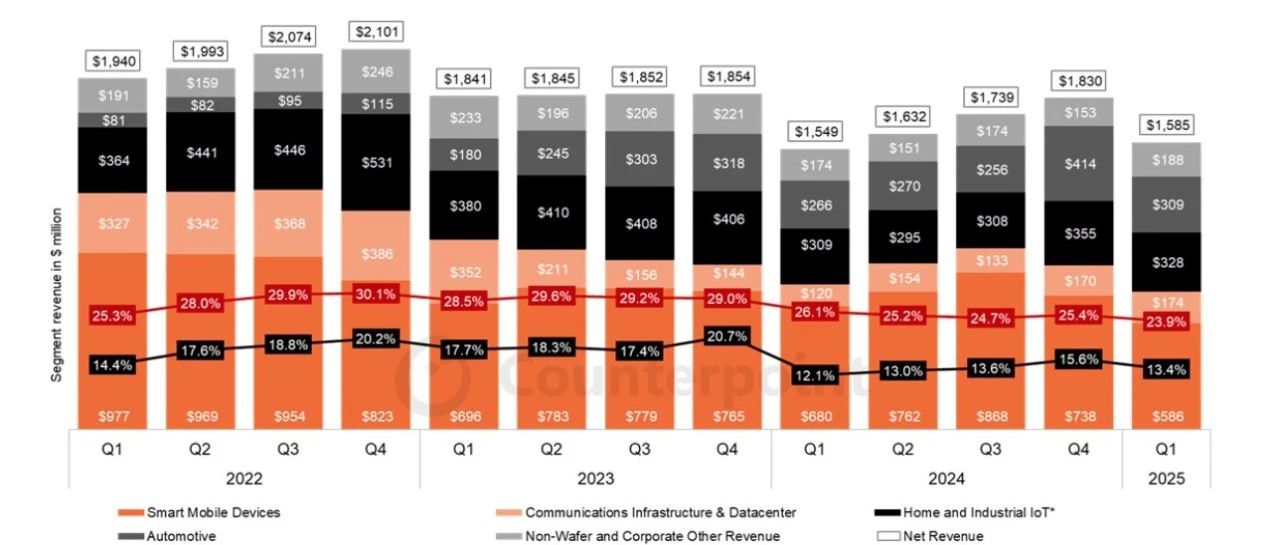
Core Viewpoint - GlobalFoundries (GF) reported a 2% year-over-year revenue growth in Q1 2025, reaching $1.59 billion, driven by contributions from communication infrastructure, data centers, home and industrial IoT, and automotive sectors [2][9]. Revenue Performance - Q1 2025 revenue growth was primarily supported by the automotive sector, which saw a 16% increase due to higher semiconductor content in vehicles and new design wins from key OEM customers [9][12]. - The communication infrastructure and data center segment experienced a significant 45% year-over-year revenue growth, fueled by increased investments in data centers and new design wins in satellite communications [12]. - The smart mobile devices segment faced a 14% decline in revenue year-over-year due to seasonal factors and customer inventory buildup, but is expected to recover with new design wins in audio, haptics, and display applications [12]. Strategic Initiatives - GF's COO emphasized the importance of manufacturing scale and technology diversification, with over $7 billion invested in facilities in the U.S., Germany, and Singapore since 2021 [2][3]. - Analysts noted that GF's diversified supply chain and global manufacturing footprint will help mitigate tariff impacts and provide customers with more options during macroeconomic uncertainties [3][4]. Future Outlook - The automotive and communication infrastructure sectors are projected to be the main revenue growth drivers in 2025, with expectations of double-digit growth in automotive due to market share gains and new design wins [12][14]. - The average selling price (ASP) is anticipated to decline in the mid-single digits percentage range in 2025 due to product mix changes [4][12]. - GF's gross margin is expected to improve to 30% in 2025, supported by enhanced capacity utilization, reduced depreciation costs, and structural cost optimization from diversified manufacturing and product line expansion [14].

全球冷却液控制阀市场前10强生产商排名及市场占有率
QYResearch· 2025-05-08 09:45
Core Viewpoint - The global coolant control valve market is projected to reach USD 570 million by 2031, with a compound annual growth rate (CAGR) of 11.0% in the coming years [2]. Market Overview - The coolant control valve is a critical component in automotive engine cooling systems, regulating coolant flow to maintain optimal engine temperatures [1]. - The market is dominated by 3-way coolant control valves, which hold approximately 63.1% of the global market share [8]. - Passenger vehicles represent the largest application market, accounting for about 75.4% of the total demand [11]. Market Drivers - Stricter environmental regulations and emission standards are increasing the demand for efficient cooling systems, with coolant control valves playing a key role in meeting these requirements [14]. - The rapid growth of electric vehicles (EVs) and hybrid electric vehicles (HEVs) is significantly impacting the coolant control valve market, as these vehicles have more complex cooling system needs [14]. - The push for vehicle lightweighting and energy efficiency is driving the demand for coolant control valves, which help manage coolant flow and improve fuel efficiency [14]. Market Challenges - High production costs and technical requirements pose barriers to entry for smaller manufacturers, as the production of high-performance coolant control valves demands advanced materials and complex manufacturing processes [15][16]. - Fluctuations in raw material prices, including metals and high-performance plastics, can directly affect production costs and market pricing [17]. - Intense market competition leads to product homogenization and price wars, challenging manufacturers to enhance product quality and reduce costs [18]. - Consumer acceptance of new technologies, such as smart coolant control valves, remains low, particularly in developing countries, which may hinder market penetration [19].