
CalPERS

Search documents
Apollo Management(APO) - 2025 Q4 - Earnings Call Transcript
2026-02-09 14:32
Financial Data and Key Metrics Changes - The company generated record combined fee-related earnings (FRE) and spread-related earnings (SRE) of $5.9 billion, driving adjusted net income of $5.2 billion, which is up 14% year-over-year, equating to $8.38 per share [4][6] - FRE for the year was $2.5 billion, reflecting a 23% increase year-over-year, while SRE was $3.4 billion, normalized to a 9% increase year-over-year [6][34] - The company achieved record inflows of $228 billion, marking the third consecutive record year for both Athene and Asset Management [6][7] Business Line Data and Key Metrics Changes - The origination volume crossed the $300 billion mark, with a robust consistent spread of 350 basis points over treasuries [6][7] - In the individual market, inflows exceeded $18 billion, with nine strategies raising over $500 million annually [9] - Athene's net invested assets grew by 18% year-over-year to $292 billion, with record inflows of $83 billion driven by retail and funding agreements [31][36] Market Data and Key Metrics Changes - The company reported that all buckets of credit increased by 8%-12%, with hybrid value up 16% for the year [8] - The global wealth business raised $18 billion, up nearly 50% year-over-year, indicating strong demand across multiple client types and geographies [30] - The institutional business had a record year, with $15 billion in new mandates from third-party insurance [28] Company Strategy and Development Direction - The company is transitioning from serving one market to six markets, including individuals, insurance, and traditional asset managers, requiring different products and investments in technology [8][9] - The focus is on a total portfolio approach, which opens up debt and equity buckets to private assets, enhancing competition with public assets [10][11] - The company aims for 20%+ FRE growth in 2026, with a strong emphasis on maintaining quality alongside scale [11][40] Management's Comments on Operating Environment and Future Outlook - Management highlighted the increasing demand for retirement income and the global retirement crisis, expecting approximately $85 billion of inflows in 2026 [11][12] - The outlook for SRE growth remains durable, with a reaffirmed expectation of 10% growth on average through 2029 [12][41] - Management emphasized the importance of a principal mindset in investing, focusing on long-term ownership rather than short-term market trends [13][14] Other Important Information - The company plans to increase the annual per-share dividend by 10% from $2.04 to $2.25 starting in Q1 2026, reflecting a commitment to returning capital to shareholders [40] - The company has returned approximately $1.5 billion to shareholders through dividends and repurchases during the year [39] Q&A Session Summary Question: Implications of the ARI transaction on SRE - Management indicated that the ARI transaction helps de-risk the year and supports the goal of 10% SRE growth, but it should not be assumed to be additive [46][50] Question: Dynamics in the non-traded BDC space and ADS - Management noted that the philosophy of portfolio construction in ADS has resonated well, with net new assets increasing over $5 billion last year despite market turbulence [52][53] Question: Interaction with LPs regarding private allocations - Management expects increased dispersion among managers and a shift in institutional allocations towards private assets, driven by public market volatility [57][60] Question: Origination opportunities and margin profile - Management highlighted the globalization of origination strategies and the focus on quality and scale, with expectations for continued growth in FRE margins [73][75]

Fund managers from diverse backgrounds are delivering standout returns and the smart money is slowly starting to pay attention
Yahoo Finance· 2025-12-03 14:00
Core Insights - The next significant investment opportunity lies in diverse fund managers who are delivering exceptional returns, contrasting with traditional investment approaches [1][3] - A report indicates that women and racially diverse managers achieved a 16% internal rate of return, outperforming the median of 9% for private equity benchmarks, attracting attention from major investors like CalPERS [2][5] - Despite strong performance data, institutional investors continue to overlook diverse managers, instead favoring traditional networks that may limit innovation and overlook emerging opportunities [3][6] Performance and Impact - The California Wellness Foundation has experienced positive results from investing with diverse fund managers since 2016, achieving steady market-rate performance while advancing community wellness [4][8] - Research from McKinsey, BCG, and Cambridge Associates shows that companies led by women and people of color excel in preparation, strategy, and execution, identifying overlooked opportunities and investing in underserved markets [5][7] Investment Trends - A Knight Foundation survey revealed that only 1.4% of the $82 trillion in US assets under management was allocated to diverse managers in 2021, highlighting a significant gap in investment practices [6] - Traditional investing often relies on established firms and networks, which can hinder innovation and the discovery of new value [6][7] - Diversifying investment managers beyond traditional networks can lead to higher financial returns by providing a clearer view of risks and potential in stable, undervalued markets [7]
全新的配置理论“整体投资组合法”崛起!影响最保守也最重要的机构:主权基金和养老基金
Sou Hu Cai Jing· 2025-11-12 01:30
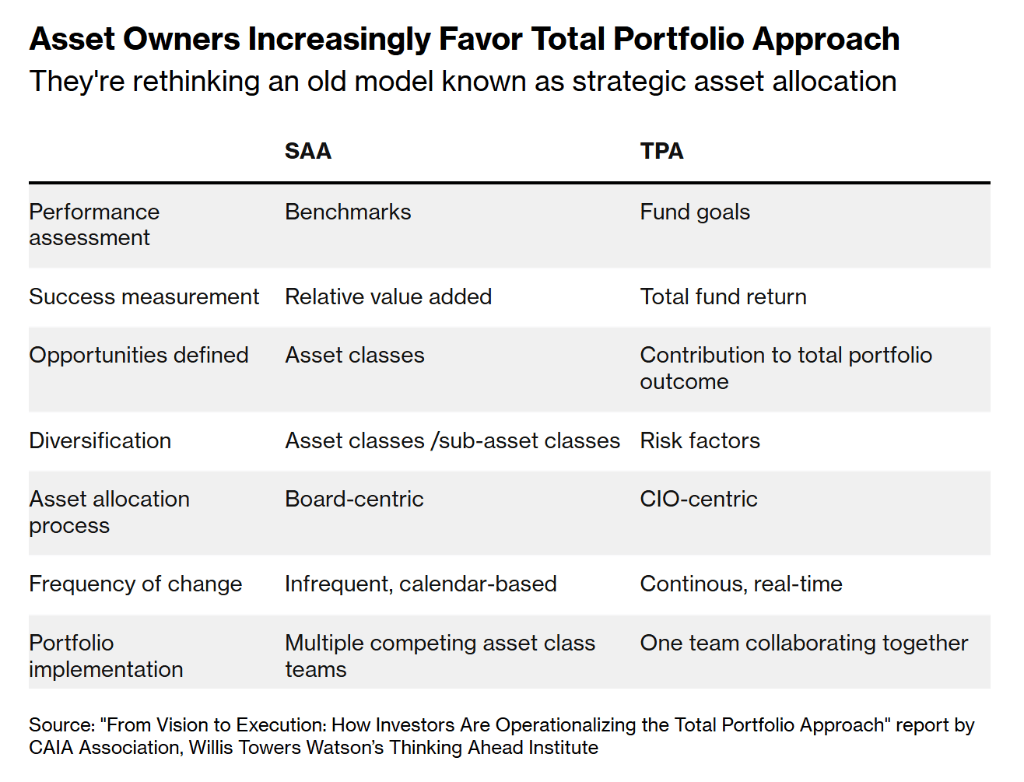
一场深刻的演变正在主权财富基金和公共养老金这个沉稳的世界中悄然发生,一种被称为"整体投资组合方法"的投资哲学正在崛起,并可能改写 数万亿美元资产的管理规则。这一新方法摒弃了传统的资产类别壁垒,鼓励在整个投资组合的层面进行优化配置,而非在孤立的资产类别中做决 策。 | | SAA | TPA | | --- | --- | --- | | Performance | Benchmarks | Fund goals | | assessment | | | | Success measurement | Relative value added | Total fund return | | Opportunities defined | Asset classes | Contribution to total portfolio | | | | outcome | | Diversification | Asset classes /sub-asset classes Risk factors | | | Asset allocation | Board-centric | CIO-centric | | p ...

Bitcoin Is The Answer to Debt Crisis: Strive CEO
Bloomberg Television· 2025-10-29 21:38
Bitcoin Investment Thesis - Bitcoin is viewed as a solution to the debt crisis and fiat currency debasement [3] - The debasement trade is gaining popularity in Wall Street circles, aligning with Bitcoin's core thesis [3] - Bitcoin offers financial freedom and an opt-out from the existing financial system [3] - The US government is unlikely to stop printing money, creating tailwinds for Bitcoin [4] Individual's Background and Transition - The individual managed actively managed fixed income portfolios at CalPERS for 15 years [1] - The individual was a large buyer of U S Treasuries [2] - Direct communication with the Fed and the Treasury led to the individual's conviction in Bitcoin [3]
X @AscendEX
AscendEX· 2025-08-29 08:00
📰 #AscendEX Daily Updates🔷CalPERS bought $18.5M of Strategy stock in Q2.🔷South Korea’s opposition party pushes for a won stablecoin framework.🔷Ethereum PoS exit queue drops to 1.058M ETH, entry queue rises to 735K ETH.#AscendEX #Crypto #CryptoNews https://t.co/iXnHC5U4Y5 ...
养老金融周报(2025.07.14-2025.07.20):美国将允许401(k)进行私募股权投资-20250721
Ping An Securities· 2025-07-21 09:30
Key Insights - The report highlights three significant events in the global pension sector during the week, including the U.S. allowing 401(k) plans to invest in private equity, the University of California's decision to eliminate hedge fund allocations, and its consideration to increase investments in China [1][6][10]. Group 1: U.S. Pension Policy Changes - The U.S. government is set to allow 401(k) plans to invest in private equity, marking a major policy shift aimed at expanding retirement investment options for American workers [6][7]. - This policy change is expected to facilitate greater asset diversification for more Americans, potentially leading to wealth accumulation and successful retirements [6][7]. - Financial institutions are already preparing to launch retirement products that include private market components, indicating a proactive approach to this policy change [6][7]. Group 2: University of California's Investment Strategy - The University of California announced it will no longer allocate funds to hedge funds starting July 1, 2025, reallocating those funds to public equities instead [1][6][9]. - The decision stems from a lack of effective hedging during market downturns over the past two decades, with the university's hedge fund holdings significantly reduced from $4.4 billion at the end of 2022 to $892 million by June 2025 [8][9]. - The university's new investment policy increases the allocation to public equities from 53% to 57%, while reducing private market investments from 30% to 25% [8][9]. Group 3: Increased Focus on China - The University of California is considering expanding its international investment opportunities, particularly in China, despite previous cautious stances due to geopolitical tensions [10]. - The university acknowledges that while the U.S. remains a leader in disruptive technologies, China is developing its own independent systems in artificial intelligence and economic growth [10]. - The recent tariff reduction agreement between the U.S. and China is seen as a new opportunity for investment in the Chinese market [10]. Group 4: Performance Metrics - The University of California's pension fund achieved a net return of 12.7% for the fiscal year ending June 30, 2025, driven by strong performance in the U.S. stock market [12]. - CalPERS reported a preliminary net investment return of 11.6% for the 2025 fiscal year, with total managed assets reaching approximately $556.2 billion [12][13]. - Public equities represented about 39% of CalPERS' total assets, yielding a return of 16.8%, which was the highest among asset classes [13][15].