Dassault

Search documents
Trump tariff pivot could benefit Brazil's Embraer, US airlines and aerospace industry
Reuters· 2026-02-24 10:03
Skip to main content Exclusive news, data and analytics for financial market professionalsLearn more aboutRefinitiv Trump tariff pivot could benefit Brazil's Embraer, US airlines and aerospace industry February 24, 202610:03 AM UTCUpdated ago By Allison Lampert, David Shepardson and Gabriel Araujo Sign up here. Commercial aircraft, engines and aerospace parts are set to be exempt from the temporary 10% global import duty being introduced under Section 122 of the Trade Act of 1974, according to an annex to U ...



深度|黄仁勋对话Cisco CEO:未来十年算力将提升100万倍;写代码只是打字,领域知识才是你的“超级力量”
Sou Hu Cai Jing· 2026-02-15 09:00
Core Insights - The conversation at the Cisco AI Summit highlighted the transformation from explicit programming to implicit programming, emphasizing the need for companies to adapt to AI technologies and integrate them into their processes [4][5][15]. Group 1: AI Transformation - The shift from explicit programming to implicit programming allows computers to understand intentions and solve problems autonomously, marking a significant change in computing paradigms [4][5]. - Companies should assume that computational power is infinite and act accordingly to tackle their most impactful challenges [4][5]. - The ROI of new technologies is often difficult to quantify initially, and companies should encourage experimentation in a safe environment to foster innovation [4][16][17]. Group 2: AI Integration in Business - Companies must integrate AI into their workflows rather than treating it merely as a tool, as this will enhance organizational knowledge and efficiency [4][45]. - The concept of "AI in the loop" is proposed as a more effective approach than "Human in the loop," suggesting that AI should be embedded in processes to continuously improve company value [45]. Group 3: Future of Computing - The computing stack is being reinvented, with a focus on creating a new architecture that combines AI capabilities with networking and security [15][42]. - The advancements in AI are leading to a "bounty" of intelligence, where tasks that previously took a year can now be completed in a day, fundamentally changing decision-making processes [20][39]. Group 4: Industry Opportunities - The potential for AI to enhance labor and create new opportunities is significant, with the IT industry poised to tap into a much larger economic scale [39]. - Companies are encouraged to leverage their domain expertise and understanding of customer needs, as this is where true value lies, rather than focusing solely on coding [40].


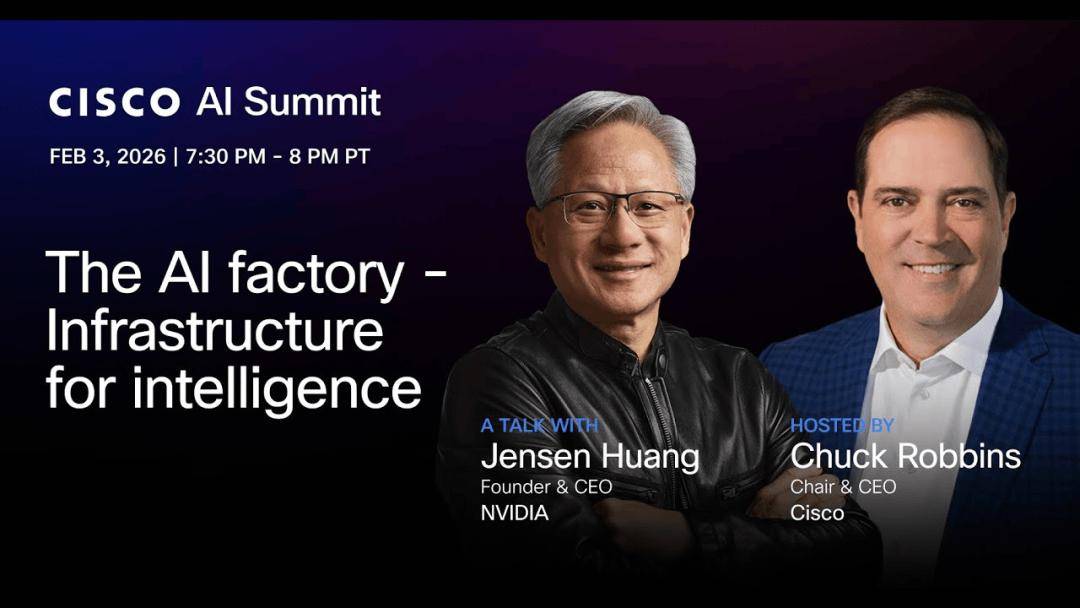
深度|黄仁勋对话Cisco CEO:未来十年算力将提升100万倍;写代码只是打字,领域知识才是你的“超级力量”
Z Potentials· 2026-02-15 03:06
Core Insights - The article discusses the transformation from explicit programming to implicit programming, emphasizing the need for companies to adapt to AI technologies and integrate them into their processes to enhance efficiency and innovation [6][10][19]. Group 1: Transition to Implicit Programming - Companies are moving from explicit programming, where specific instructions are given, to implicit programming, where the intent is communicated to the computer, allowing it to solve problems autonomously [6][10]. - AI advancements are expected to increase computational capabilities by a factor of one million over the next decade, compared to the traditional Moore's Law, which predicts a tenfold increase in the same period [6][25]. - Organizations should foster a culture of experimentation with AI, allowing employees to explore various models in a safe environment, as innovation often occurs outside of strict control [21][22]. Group 2: AI Integration and Enterprise Transformation - The concept of "AI in the loop" is introduced, suggesting that AI should be integrated into business processes to capture employee experiences and enhance company knowledge [49]. - Companies must identify their core competencies and focus on impactful work rather than getting bogged down by the initial ROI of new technologies [21][22]. - The collaboration between Cisco and NVIDIA aims to create a new computing stack that integrates AI capabilities while maintaining control, security, and manageability [19][20]. Group 3: The Future of AI and Business - The future of AI is seen as generative rather than retrieval-based, where software adapts to different contexts and user needs in real-time [33][39]. - The article highlights the importance of understanding the physical world and causal relationships in developing next-generation AI, termed "Physical AI" [42][43]. - Companies are encouraged to leverage their domain expertise and knowledge to effectively communicate their needs to AI systems, thus enhancing their competitive edge [44][45].

NVIDIA (NasdaqGS:NVDA) 2026 Conference Transcript
2026-02-04 04:32
Summary of NVIDIA Conference Call Company and Industry - **Company**: NVIDIA (NasdaqGS: NVDA) - **Industry**: Artificial Intelligence (AI) and Computing Core Points and Arguments 1. **Reinventing Computing**: The transition from explicit programming to implicit programming is highlighted, emphasizing the shift towards AI-driven solutions where users express intent rather than writing code directly [20][21][22] 2. **AI Factories**: The concept of AI factories is introduced, focusing on the need to develop AI that is genuinely useful, moving beyond basic chatbots to more complex problem-solving capabilities [20][21] 3. **Enterprise AI Readiness**: Companies are encouraged to engage with AI technologies quickly to avoid falling behind, with a focus on identifying impactful work within their organizations [40][41] 4. **Innovation and Experimentation**: The idea of allowing multiple AI projects to flourish within a company is presented as a way to foster innovation, suggesting that companies should not seek immediate ROI but rather explore various AI applications [42][43][49] 5. **Collaboration with Partners**: NVIDIA's partnerships with companies like Synopsys, Cadence, Siemens, and Dassault are emphasized to enhance AI capabilities in chip design and engineering [49][50] 6. **Cost Reduction and Efficiency**: AI is described as a means to significantly reduce the time and cost associated with intelligence tasks, with advancements allowing for real-time processing of complex problems [54][55] 7. **Abundance of Data**: The discussion includes the concept of training AI models on vast amounts of data, leading to a new era of problem-solving capabilities that were previously unimaginable [55][56] 8. **Physical AI and Tool Use**: The future of AI is envisioned as a blend of digital and physical capabilities, where AI will utilize existing tools rather than reinvent them, enhancing productivity [118][119] 9. **Transforming Companies into Tech Firms**: The call encourages all companies to adopt a technology-first mindset, leveraging AI to transform their operations and enhance their market position [121][122] 10. **AI as Intellectual Property**: The importance of integrating AI into company processes is stressed, with the notion that AI will capture and enhance a company's intellectual property over time [134][135] Other Important Content - **AI's Role in Job Security**: The assertion that individuals will not lose jobs to AI but rather to those who effectively utilize AI is made, emphasizing the need for companies to adopt AI technologies [99] - **Building Understanding of Technology**: The speaker advises companies to have a hands-on understanding of technology, akin to building a computer, to better grasp its implications and applications [129][130] - **AI in the Loop**: The idea that AI should be integrated into company processes rather than just having humans in the loop is proposed, suggesting that AI can enhance knowledge and value continuously [134][135]
消费电子创新大会11月启幕
Shen Zhen Shang Bao· 2025-10-28 23:49
Core Insights - The "2025 Consumer Electronics Innovation Conference (CEIC 2025)" will showcase over 2,000 innovative technology products from nearly 300 tech companies across 20 countries and regions, emphasizing the theme of "New Electronics, New Experience, New Consumption" [1][2] - The event will feature the global debut of HarmonyOS 6 products, including a 110-inch Mate TV and a new generation of smart cockpit technology, highlighting advancements in smart home and automotive integration [1][2] - The conference will cover five key innovation areas: smart terminals, smart vehicles, smart homes, digital health, and new technology chips, with a total exhibition area of 15,000 square meters [2] Event Structure - The conference will include three main forums and 16 sub-forums, focusing on the entire innovation chain from foundational technology research to industrial practice [2] - Over 300 entrepreneurs, scientists, and industry leaders will participate in more than 50 specialized meetings to share cutting-edge insights [2] - An innovation "matchmaking event" will facilitate connections between technology, industry, and capital, with over 10 well-known investment institutions engaging with high-growth projects [2] Industry Significance - The Ministry of Industry and Information Technology emphasizes that the consumer electronics sector is a crucial support for expanding domestic demand and stabilizing growth, serving as a battleground for deep integration of industrial and technological innovation [3] - The conference aims to create innovative solutions by focusing on a "new root technology group" and leveraging "international leading standards" to extend into supporting chip design and key components [3]


模拟芯片公司为何都选择了它?
半导体行业观察· 2025-09-21 02:59
Core Viewpoint - The semiconductor industry is entering a complex phase where data management tools are crucial for efficiency, especially in advanced chip design projects that require collaboration among hundreds of engineers across different time zones [1]. Market Landscape - The Design Data Management (DDM) sector has evolved into a "four strong" competitive landscape, with Cliosoft dominating the market, particularly in China, where it holds over 95% market share among analog and RF design companies [3][4][8]. - The other players include ICManage, Perforce, and Dassault, but they are losing ground due to various limitations such as high costs and inadequate support for advanced processes [5][6][7]. Advantages of Cliosoft - Cliosoft's integration with Keysight enhances its value beyond just data management, providing a comprehensive ecosystem for EDA, system simulation, and RF design [8]. - The SOS platform centralizes data management, improving collaboration and version control, which is essential for efficient chip design [8][9]. - It allows for seamless integration with mainstream EDA tools, reducing unnecessary operations and making the workflow more efficient [10]. - The platform includes project management features that provide visibility into development progress, enhancing transparency and control [11]. - It addresses challenges in global collaboration by implementing intelligent caching mechanisms to reduce latency in data transfer [12]. - The platform supports complete IP lifecycle management, facilitating the reuse of IP modules across projects, which is critical for speeding up time-to-market [13]. Conclusion - The trend towards advanced processes, multidisciplinary collaboration, and IP asset management underscores the importance of DDM as an essential infrastructure for organizations, with Cliosoft emerging as a key player that integrates people, tools, and data into a measurable and auditable digital chain [14].