MongoDB

Search documents
3 Reasons to Buy MDB Stock Despite 10.2x P/S Premium Valuation
ZACKS· 2026-02-19 15:51
Core Insights - MongoDB (MDB) has established a competitive advantage with its flexible document model and unified architecture, which supports various data types and AI workloads, leading to strong performance in revenue growth and operating margins [1][6][18] Financial Performance - In the fiscal third quarter, MDB reported revenues of $628.3 million, reflecting a 19% year-over-year increase, with non-GAAP operating margins rising to 20% from 19% [1] - MDB raised its full-year fiscal 2026 revenue guidance to between $2.434 billion and $2.439 billion, indicating a year-over-year growth of 21-22% [2] - The Zacks Consensus Estimate for MDB's fiscal 2026 revenues is $2.44 billion, suggesting a growth of 21.45%, with earnings expected to reach $4.79 per share, a 30.87% increase from the previous year [2] Stock Performance - MDB shares have surged 70.6% over the past six months, significantly outperforming the broader Zacks Computer and Technology sector, which increased by 10.5%, and the Zacks Internet-Software industry, which declined by 20.1% [3] Product and Platform Development - MDB's Atlas platform has evolved into a comprehensive operational platform, supporting various workloads and accommodating different data types, which enhances its appeal to enterprises modernizing their application stacks [6][8] - Atlas revenues grew by 30% year-over-year in the fiscal third quarter, making up 75% of total revenues, up from 68% in the previous year [8][9] AI Integration and Capabilities - The acquisition of Voyage AI is a strategic move for MDB, allowing for the integration of AI capabilities directly into the Atlas platform, which enhances its position in the AI market and simplifies the development of AI applications [10][11] - Adoption of Atlas among AI-native companies is increasing, with examples of significant growth in companies utilizing Voyage AI's capabilities [12] Customer Growth and Market Position - MDB added 2,600 customers in the fiscal third quarter, bringing the total to over 62,500, representing an 18.8% year-over-year increase [15] - The company is expanding its MongoDB for Startups initiative, which targets early-stage companies and positions MDB as a key player in the growing AI market projected to reach $1.77 trillion by 2032 [14] Strategic Partnerships - MDB has established strong partnerships with major cloud providers like Microsoft, Amazon, and Alphabet, facilitating easier deployment and reinforcing its role in hybrid and multi-cloud environments [13]



MongoDB Benefits From a Strong Partner Network: Can it Drive Growth?
ZACKS· 2026-02-17 16:05
Core Insights - MongoDB's expanding partner network is becoming a structural growth lever, integrating the platform into the modern enterprise software stack and positioning Atlas as a default data layer [1] - The acquisition of Voyage AI enhances upsell opportunities, allowing AI-native customers to transition smoothly from Voyage embeddings to Atlas Vector Search and the core operational database [2] - Atlas revenues increased by 30% year over year, representing 75% of total revenues, with a net ARR expansion rate of 120%, indicating sustainable growth driven by partner adoption [3] Partner Ecosystem - The Zacks Consensus Estimate for fiscal 2026 projects total customers at 64,200, a 17.8% increase year over year, and customers generating over $100,000 in ARR at 2,786, a 16.3% increase year over year, suggesting an expanding partner ecosystem [4] - Co-sell agreements and broader integrations are expected to enhance MongoDB's growth trajectory, functioning as a long-term growth engine [4] Competitive Landscape - MongoDB faces significant competition from Snowflake and Amazon, both of which have extensive partner ecosystems [5] - Snowflake focuses on analytics workloads, while Amazon emphasizes vertically integrated services through AWS, but MongoDB differentiates itself by embedding directly into developer tools [6] Financial Performance - MongoDB shares have returned 62.2% over the past six months, outperforming the Zacks Internet – Software industry's decline of 22.4% and the Zacks Computer and Technology sector's return of 7.8% [7] - The stock is currently trading at a forward 12-month Price/Sales ratio of 10.36X, significantly higher than the industry's 3.9X, indicating a premium valuation [10] - The Zacks Consensus Estimate for fourth-quarter fiscal 2026 earnings is $1.47 per share, reflecting a year-over-year growth of 14.84% [12]

MongoDB vs. Datadog: Which Cloud Software Stock is a Better Buy Now?
ZACKS· 2026-02-12 16:41
Core Insights - MongoDB (MDB) and Datadog (DDOG) are key players in the cloud software sector, with MongoDB focusing on flexible database solutions and Datadog on observability and monitoring tools [1][8] - The global cloud infrastructure services market is expected to grow from $254.59 billion in 2026 to $545.03 billion by 2031, driven by cloud migration and AI workloads [2] MongoDB (MDB) Insights - MongoDB's growth is fueled by its Atlas offering, which accounts for 75% of total revenues, reflecting a shift towards consumption-based models [4][6] - The platform's document-oriented architecture allows for better handling of unstructured data, making it suitable for AI applications [5] - MongoDB serves over 70% of the Fortune 100 and has a customer base exceeding 62,500, indicating strong market penetration [6] - The Zacks Consensus Estimate for MDB's fiscal 2027 EPS is $5.61, suggesting a year-over-year growth of 17.23% [7] Datadog (DDOG) Insights - Datadog provides a unified platform for observability but faces challenges due to market commoditization and limited differentiation in AI workloads [8][10] - The company serves over 32,700 customers and has over 1,000 integrations, but its AI capabilities are more about enhancing existing processes rather than creating new applications [11] - The Zacks Consensus Estimate for DDOG's 2027 EPS is $2.74, indicating a year-over-year growth of 20.93% [12] Price Performance and Valuation - Over the past six months, MongoDB shares have increased by 75.7%, while Datadog shares have decreased by 1.1%, highlighting MongoDB's stronger market performance [13] - MongoDB trades at a forward price-to-sales ratio of 10.27x, compared to Datadog's 10.75x, suggesting a relative discount for the faster-growing MongoDB [16] - The valuation premium for Datadog is difficult to justify given the commoditization of the observability market [16] Conclusion - MongoDB's growth trajectory and its role as an operational database for AI applications position it favorably against Datadog, which is facing challenges in a commoditized market [18] - Investors looking for high-growth cloud software opportunities with AI potential may find MongoDB to be the superior investment choice [18]


星环科技(688031):25Q4收入增长提速,AI基础软件发展前景向好
GF SECURITIES· 2026-02-11 14:51
Investment Rating - The report maintains a "Buy" rating for the company, with a target price of 208.73 CNY per share, compared to the current price of 180.30 CNY [3]. Core Insights - The company is expected to achieve a total revenue of 420 million to 450 million CNY in 2025, representing a year-on-year growth of 13.06% to 21.13%. The net profit attributable to shareholders is projected to be between -250 million to -220 million CNY [7]. - In Q4 2025, the company anticipates revenue of 190 million to 220 million CNY, with a year-on-year growth rate of 20.4% to 38.9%, significantly higher than the 7.4% growth rate in the first three quarters of 2025 [9]. - The demand for the company's AI foundational software products, such as TDH and Sophon LLMOps, is robust, reflecting a strong market need for digital transformation solutions [9]. - The company is actively investing in the research and development of new AI database technologies, which are expected to enhance its competitiveness in the AI foundational software sector [9]. - The ArgoDB joint solution, based on Haiguang Information's CPU, has been successfully implemented in key industries such as finance, energy, and government, indicating strong market acceptance [9]. Financial Forecast and Investment Recommendations - Revenue projections for 2025 to 2027 are estimated at 440 million, 500 million, and 580 million CNY, respectively, with growth rates of 17.3%, 15.8%, and 14.8% [10]. - The net profit attributable to shareholders is expected to improve from -240 million CNY in 2025 to -70 million CNY in 2027, with corresponding EPS estimates of -1.99 CNY, -0.87 CNY, and -0.58 CNY [10]. - The company is compared to peers such as MongoDB, Snowflake, and Elastic, with a premium valuation due to the scarcity of A-share big data companies and the promising future of AI software tools [15][14].

小摩加入力挺美股软件股行列:AI冲击担忧被夸大 历史性下跌过后有望反弹
智通财经网· 2026-02-10 13:47
智通财经APP获悉,摩根大通策略师表示,随着市场计入了对人工智能(AI)在短期内颠覆软件行业的不切实际的预期,软件股有望从其历史性下跌中 反弹。由杜布拉夫科·拉科斯-布亚斯(Dubravko Lakos-Bujas)领衔的策略师团队指出,鉴于当前"极端的价格波动",投资者应增加对高质量、对AI更具 韧性的软件公司的敞口,至少在短期内,市场存在资金重新轮动回该板块的可能性。该团队在一份报告中写道:"鉴于市场仓位已被充分出清、对AI 颠覆软件行业的前景过度悲观,以及基本面依然稳健,我们认为风险回报的平衡正越来越偏向于反弹一侧。" 由于担心新型AI工具可能对传统软件即服务(SaaS)商业模式造成冲击,美股软件股近期持续承压。此次抛售并未区分企业是否已与AI公司建立合作 关系、或是否拥有专有数据资产,几乎对所有相关软件公司一视同仁。 这一看多观点也呼应了由迈克尔·威尔逊(Michael Wilson)领衔的摩根士丹利策略师团队的判断。该策略师团队本周表示,美国科技股仍有进一步上涨 空间,而软件股的下跌已经打开了"具有吸引力的入场窗口"。威尔逊在报告中写道:"在重大的投资周期中,上周那样的波动并不罕见。尽管如此, 人工 ...



Here's Why MongoDB (MDB) Is a Great 'Buy the Bottom' Stock Now
ZACKS· 2026-02-09 15:56
Core Viewpoint - MongoDB (MDB) has experienced a bearish trend recently, losing 7.3% over the past week, but the formation of a hammer chart pattern suggests a potential trend reversal as buying interest may be increasing [1] Technical Analysis - The hammer chart pattern indicates a possible bottoming out with reduced selling pressure, signaling a potential bullish reversal [2] - A hammer pattern forms when there is a small difference between opening and closing prices, with a long lower wick, suggesting that bears may be losing control [4][5] - The effectiveness of the hammer pattern is enhanced when used alongside other bullish indicators due to its limitations [6] Fundamental Analysis - There has been a notable upward trend in earnings estimate revisions for MDB, which is a bullish indicator suggesting potential price appreciation [7] - Over the last 30 days, the consensus EPS estimate for MDB has increased by 41.4%, indicating strong agreement among analysts for better-than-expected earnings [8] - MDB holds a Zacks Rank 1 (Strong Buy), placing it in the top 5% of over 4,000 ranked stocks, which typically outperform the market [9][10]

“软件股末日论”点燃大变革! 恐慌抛售之后,市场将捧起AI时代的“软件基石”
美股IPO· 2026-02-07 00:35
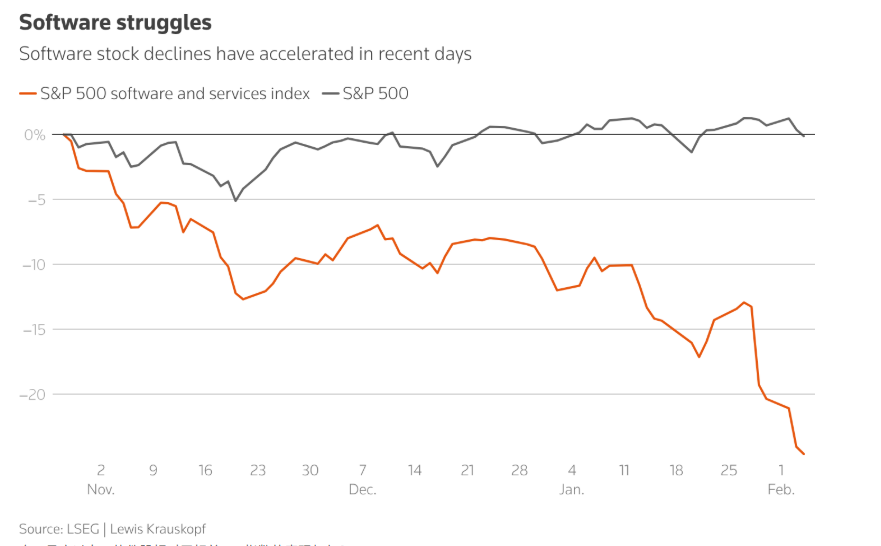
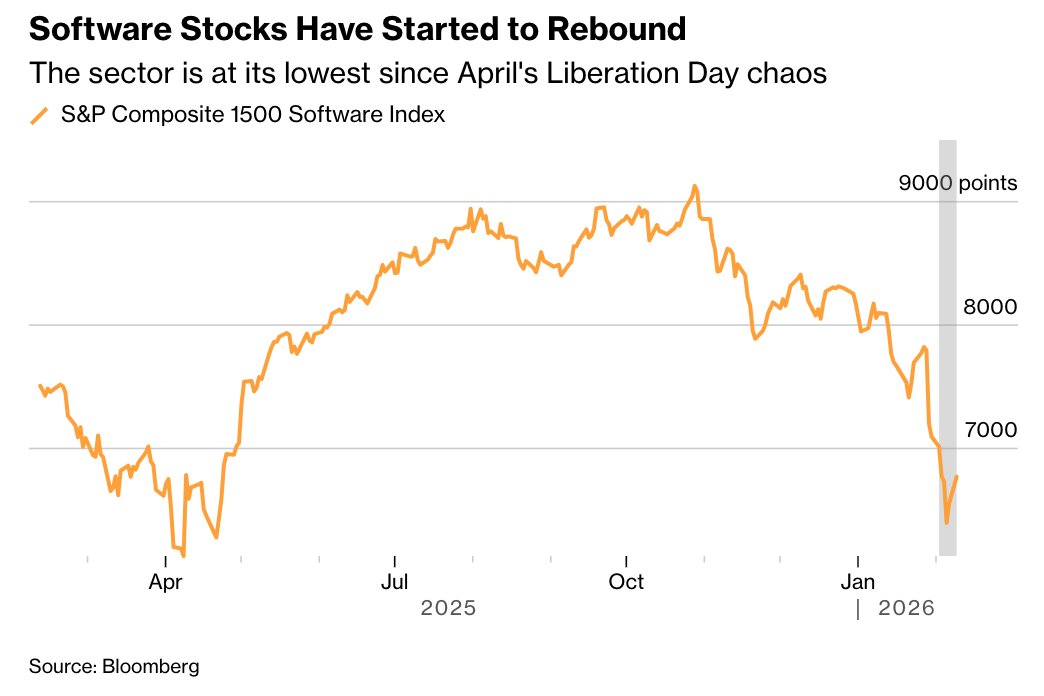
Core Viewpoint - A portion of institutional funds is beginning to enter the market for "bottom-fishing" in software stocks that have recently experienced significant declines, agreeing with Jensen Huang's positive outlook on software stocks, suggesting that the market has misjudged strong software giants focused on "AI + core operational processes" [1][4] Group 1: Market Dynamics - The narrative of a "Software-mageddon" is gaining traction, with significant sell-offs in the software sector following the launch of new AI tools by Anthropic, leading to a notable drop in the S&P 500 Software & Services Index, which has fallen approximately 30% since its recent peak at the end of October [3][9] - The software sector faced its most severe sell-off since 2022, with the S&P 500 Software & Services Index experiencing a decline of over 5% in a single day, extending its losing streak to eight consecutive trading days [3][9] - Concerns about AI's impact on traditional SaaS business models have intensified, particularly following the introduction of Anthropic's AI tools, which are designed to handle complex workflows traditionally managed by SaaS providers [7][8] Group 2: Institutional Perspectives - Some institutional investors are starting to view the recent sell-off as an opportunity, believing that high-quality software companies embracing AI may soon experience a technical rebound [4][10] - Analysts from major financial institutions, including Goldman Sachs and Wedbush Securities, suggest that the selling pressure may have peaked, indicating potential for a market bottom and a return of institutional capital to the software sector [16][18] - Rick Sherlund, a prominent analyst, emphasizes that the software industry undergoes significant transformations every 10 to 15 years, and the current AI-driven changes may lead to a new bull market rather than a decline [20] Group 3: Long-term Outlook - Despite fears that AI could completely replace enterprise software, many analysts believe that AI will instead reshape the profitability trajectories of software companies, with a focus on enhancing existing platforms rather than replacing them [12][14] - The market's panic over AI's potential to disrupt software is viewed as exaggerated, with many analysts asserting that established companies with robust platforms, like SAP, will likely benefit from AI advancements [5][19] - The ongoing transition from consumer-facing AI applications to enterprise applications is expected to drive explosive growth in demand for reasoning and computational capabilities [20]

软件股末日论”点燃大变革! 恐慌抛售之后,市场将捧起AI时代的“软件基石
Zhi Tong Cai Jing· 2026-02-06 11:49
Core Viewpoint - The recent narrative of "Software-mageddon" has led to a significant sell-off in the software sector, particularly affecting SaaS stocks, following the launch of new AI tools by Anthropic, which are perceived as threats to traditional software business models [1][4][5]. Group 1: Market Reaction - The S&P 500 Software & Services Index has experienced a decline of approximately 30% since its recent peak at the end of October, marking the most severe sell-off since 2022 [1][6]. - Major software companies, including Thomson Reuters and Salesforce, have seen their stock prices drop significantly, with some experiencing declines of up to 10% in a single day [5][6]. - The sell-off has been exacerbated by disappointing earnings guidance from major companies, including Microsoft, and heightened expectations for AI infrastructure spending [5][6]. Group 2: Institutional Response - Some institutional investors are beginning to enter the market to buy undervalued software stocks, believing that the market has overreacted to the AI threat [2][12]. - Analysts express a divided view on the long-term impact of AI on software companies, with some believing that AI will reshape profit trajectories rather than eliminate the need for existing software [9][14]. Group 3: Expert Opinions - Rick Sherlund, a prominent analyst, argues that the software industry undergoes significant transformations every 10 to 15 years, and companies with strong fundamentals, like SAP, will likely benefit from AI rather than be threatened by it [3][16]. - Nvidia's CEO Jensen Huang emphasizes that the notion of AI completely replacing software is illogical, suggesting that AI will enhance existing software rather than replace it [7][8]. - The current market panic is described as "micro-hysteria," with experts suggesting that the fears surrounding AI's impact on software are exaggerated [8][12]. Group 4: Future Outlook - The software sector is expected to experience a technical rebound as investors reassess the long-term value of companies that integrate AI into their operations [2][11]. - High-quality software companies that embrace AI are likely to emerge stronger from the current turmoil, as the market begins to differentiate between those with robust business models and those that are more vulnerable [11][15].
“软件股末日论”点燃大变革! 恐慌抛售之后,市场将捧起AI时代的“软件基石”
智通财经网· 2026-02-06 09:13
Core Viewpoint - The recent narrative of "Software-mageddon" has led to a significant sell-off in the software sector, particularly affecting SaaS stocks, following the launch of new AI tools by Anthropic, which are perceived as threats to traditional software business models [1][4][5]. Group 1: Market Reaction - The S&P 500 Software & Services Index has experienced a decline of approximately 30% since its recent peak at the end of October, marking the most severe sell-off since 2022 [1][6]. - Major software companies, including Thomson Reuters and Salesforce, have seen significant stock price drops, with some experiencing declines of up to 10% in a single day [5][6]. - The sell-off has been exacerbated by disappointing earnings guidance from major companies, including Microsoft, and heightened expectations for AI infrastructure spending [5][6]. Group 2: Institutional Response - Some institutional investors are beginning to enter the market to buy undervalued software stocks, believing that the market has overreacted to the AI threat [2][12]. - Analysts from firms like Goldman Sachs and Wedbush Securities suggest that the sell-off reflects an exaggerated "Armageddon scenario" and that companies will not abandon their existing software investments for new AI solutions [12][14]. Group 3: Expert Opinions - Rick Sherlund, a prominent technology analyst, argues that the software industry undergoes significant transformations every 10 to 15 years, and companies with strong fundamentals, like SAP, will likely benefit from AI rather than be replaced by it [3][16]. - Nvidia's CEO, Jensen Huang, emphasizes that AI will enhance existing software infrastructure rather than replace it entirely, countering the prevailing panic in the market [7][8]. Group 4: Long-term Outlook - Analysts believe that while AI may disrupt certain aspects of the software industry, it will also create new growth narratives, particularly for companies that can integrate AI into their existing platforms [9][10]. - The market is expected to see a bifurcation, where companies with strong data assets and integration capabilities, such as Microsoft and SAP, are likely to rebound more strongly than those with weaker competitive positions [11][15].
“软件股末日”论调席卷华尔街之际 “AI重塑软件盈利”的增长叙事悄然扩散
智通财经网· 2026-02-05 10:48
Group 1: Market Overview - The narrative of "Software-mageddon" is gaining traction among global investors, with debates on whether to initiate bullish calls on recently battered software stocks [1] - Large institutional investors are beginning to enter the market to buy the dip in software stocks that have experienced significant declines, with some supporting optimistic views on AI-focused software giants [1][3] - The S&P 500 Software and Services Index has dropped approximately 25% since its recent peak at the end of October, while the overall S&P 500 index has remained relatively stable [3][4] Group 2: Impact of AI Tools - The launch of Anthropic's AI programming tool, Claude Cowork, has intensified fears of AI agents disrupting the SaaS software industry, leading to a collective sell-off in software stocks [2] - The S&P 500 Software and Services Index experienced its worst performance since May 2002, with a significant market cap loss exceeding $800 billion [4] Group 3: Investor Reactions and Divergence - Institutional investors are showing mixed reactions, with some cautiously buying while others remain hesitant, indicating a divide in sentiment regarding the software sector [8] - Some portfolio managers are starting to see long-term value in certain software stocks, while others are waiting for stronger catalysts, such as robust AI-related revenue reports, before making aggressive purchases [8][9] Group 4: Future Outlook and AI Integration - The market is reassessing the value chain in the software industry, with AI potentially redistributing profits rather than completely replacing existing software infrastructure [11][12] - The current sell-off is seen as a response to the question of how much profit pools will be redistributed among SaaS vendors due to AI advancements, with a focus on real deployment and revenue growth from AI-related products [12][13]