软件股末日

Search documents
盘后大跌近6%!Applovin: Q4净利润猛增84%!未来指引超预期,但投资者对未来仍存疑虑!
美股IPO· 2026-02-12 00:54
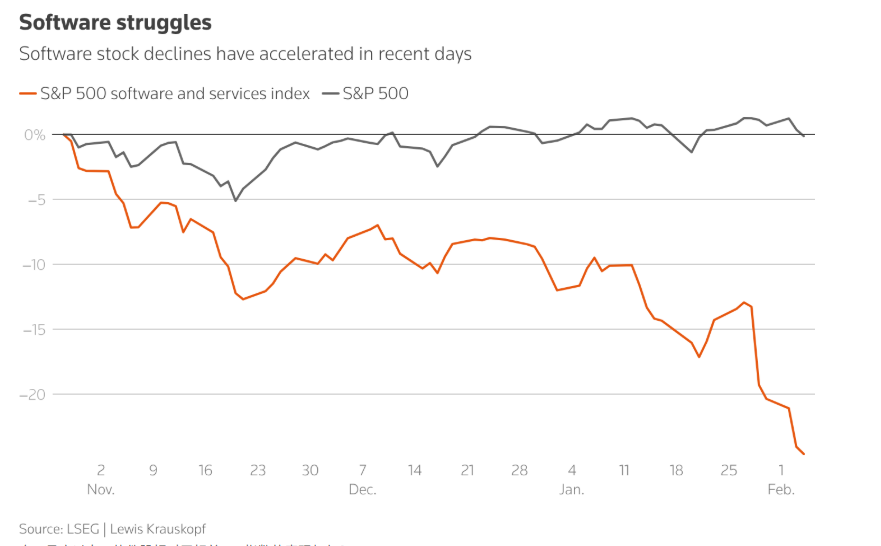
Core Viewpoint - Applovin's strong performance demonstrates that the market's fears regarding the "software apocalypse" triggered by AI agents are exaggerated, and that platform software giants focusing on "AI + core operations" will benefit from AI rather than be replaced by it [1][3][9]. Financial Performance - For Q4 2025, Applovin reported total revenue of approximately $1.658 billion, exceeding Wall Street's revised expectations of about $1.61 billion, representing a significant year-over-year growth of 66% [4][5]. - The company's net income for Q4 was approximately $1.102 billion, a substantial increase of 84% year-over-year, with a GAAP EPS of $3.24, surpassing the average analyst expectation of $2.96 [4][5]. - For the full fiscal year 2025, Applovin's total revenue reached about $5.481 billion, a 70% increase from 2024, with net income of approximately $3.334 billion, reflecting a 111% growth [5]. Future Outlook - Applovin's management anticipates Q1 2026 total revenue in the range of $1.745 billion to $1.775 billion, which is significantly higher than the average analyst expectation of around $1.7 billion [6]. - The company has successfully integrated generative AI and deep machine learning into its advertising technology, enhancing revenue and profit growth through its AXON 2.0 engine and MAX/AppDiscovery [6]. Market Context - The software sector has faced significant sell-offs, with the S&P 500 Software and Services Index dropping about 13% since late January, erasing nearly $1 trillion in market value [7]. - Despite fears of AI undermining traditional SaaS models, there is a growing narrative that platform software companies may experience enhanced efficiency and stronger unit economics due to AI [7][9]. Strategic Implications - Companies that manage critical enterprise workloads are likely to benefit from AI technologies, as opposed to being entirely replaced, reinforcing the long-term bullish logic for these platform software firms [9][12]. - Analysts suggest that high-quality software companies embracing AI represent a buying opportunity during market corrections, as they are expected to rebound strongly [11][12].



软件股末日论”点燃大变革! 恐慌抛售之后,市场将捧起AI时代的“软件基石
Zhi Tong Cai Jing· 2026-02-06 11:49
Core Viewpoint - The recent narrative of "Software-mageddon" has led to a significant sell-off in the software sector, particularly affecting SaaS stocks, following the launch of new AI tools by Anthropic, which are perceived as threats to traditional software business models [1][4][5]. Group 1: Market Reaction - The S&P 500 Software & Services Index has experienced a decline of approximately 30% since its recent peak at the end of October, marking the most severe sell-off since 2022 [1][6]. - Major software companies, including Thomson Reuters and Salesforce, have seen their stock prices drop significantly, with some experiencing declines of up to 10% in a single day [5][6]. - The sell-off has been exacerbated by disappointing earnings guidance from major companies, including Microsoft, and heightened expectations for AI infrastructure spending [5][6]. Group 2: Institutional Response - Some institutional investors are beginning to enter the market to buy undervalued software stocks, believing that the market has overreacted to the AI threat [2][12]. - Analysts express a divided view on the long-term impact of AI on software companies, with some believing that AI will reshape profit trajectories rather than eliminate the need for existing software [9][14]. Group 3: Expert Opinions - Rick Sherlund, a prominent analyst, argues that the software industry undergoes significant transformations every 10 to 15 years, and companies with strong fundamentals, like SAP, will likely benefit from AI rather than be threatened by it [3][16]. - Nvidia's CEO Jensen Huang emphasizes that the notion of AI completely replacing software is illogical, suggesting that AI will enhance existing software rather than replace it [7][8]. - The current market panic is described as "micro-hysteria," with experts suggesting that the fears surrounding AI's impact on software are exaggerated [8][12]. Group 4: Future Outlook - The software sector is expected to experience a technical rebound as investors reassess the long-term value of companies that integrate AI into their operations [2][11]. - High-quality software companies that embrace AI are likely to emerge stronger from the current turmoil, as the market begins to differentiate between those with robust business models and those that are more vulnerable [11][15].

“软件股末日论”点燃大变革! 恐慌抛售之后,市场将捧起AI时代的“软件基石”
智通财经网· 2026-02-06 09:13
Core Viewpoint - The recent narrative of "Software-mageddon" has led to a significant sell-off in the software sector, particularly affecting SaaS stocks, following the launch of new AI tools by Anthropic, which are perceived as threats to traditional software business models [1][4][5]. Group 1: Market Reaction - The S&P 500 Software & Services Index has experienced a decline of approximately 30% since its recent peak at the end of October, marking the most severe sell-off since 2022 [1][6]. - Major software companies, including Thomson Reuters and Salesforce, have seen significant stock price drops, with some experiencing declines of up to 10% in a single day [5][6]. - The sell-off has been exacerbated by disappointing earnings guidance from major companies, including Microsoft, and heightened expectations for AI infrastructure spending [5][6]. Group 2: Institutional Response - Some institutional investors are beginning to enter the market to buy undervalued software stocks, believing that the market has overreacted to the AI threat [2][12]. - Analysts from firms like Goldman Sachs and Wedbush Securities suggest that the sell-off reflects an exaggerated "Armageddon scenario" and that companies will not abandon their existing software investments for new AI solutions [12][14]. Group 3: Expert Opinions - Rick Sherlund, a prominent technology analyst, argues that the software industry undergoes significant transformations every 10 to 15 years, and companies with strong fundamentals, like SAP, will likely benefit from AI rather than be replaced by it [3][16]. - Nvidia's CEO, Jensen Huang, emphasizes that AI will enhance existing software infrastructure rather than replace it entirely, countering the prevailing panic in the market [7][8]. Group 4: Long-term Outlook - Analysts believe that while AI may disrupt certain aspects of the software industry, it will also create new growth narratives, particularly for companies that can integrate AI into their existing platforms [9][10]. - The market is expected to see a bifurcation, where companies with strong data assets and integration capabilities, such as Microsoft and SAP, are likely to rebound more strongly than those with weaker competitive positions [11][15].
纳指跌幅扩大至1.6% 明星科技股普跌 亚马逊(AMZN.US)跌超4%
Zhi Tong Cai Jing· 2026-02-05 23:07
Group 1 - The U.S. stock market opened lower, with the Nasdaq index down by 1.6%, and major tech stocks like Google, Amazon, Tesla, Microsoft, AMD, and Nvidia experiencing significant declines [1] - The VIX index surged by 22%, reaching its highest level since December of the previous year, indicating increased market volatility [1] - December job openings unexpectedly fell to the lowest level since 2020, with a decrease from 6.93 million to 6.54 million, below market expectations, reflecting weak labor demand [1] Group 2 - The narrative of "Software-mageddon" is gaining traction, with hedge funds increasing their short positions in software stocks, contributing to significant sell-offs in the sector [2] - Hedge funds have reportedly made $24 billion in profits from shorting software stocks since 2026, while the total market capitalization of the U.S. software industry has decreased by $1 trillion during the same period [2]
美股异动 | 纳指跌幅扩大至1.6% 明星科技股普跌 亚马逊(AMZN.US)跌超4%
智通财经网· 2026-02-05 15:44
Group 1 - The U.S. stock market opened lower, with the Nasdaq index falling by 1.6%, and major tech stocks like Google, Amazon, and Tesla experiencing declines of over 4% [1] - The VIX index surged by 22%, reaching its highest level since December of the previous year, indicating increased market volatility [1] - Job vacancies in the U.S. unexpectedly dropped to the lowest level since 2020, with December vacancies falling from a revised 6.93 million in November to 6.54 million, below market expectations [1] Group 2 - The narrative of a "Software-mageddon" is gaining traction, with hedge funds increasing their short positions in software stocks, contributing to significant sell-offs in the sector [2] - Hedge funds have reportedly made $24 billion in profits from shorting software stocks since 2026, while the total market capitalization of the U.S. software industry has decreased by $1 trillion during the same period [2]




三大股指期货齐跌,“软件股末日”论甚嚣尘上,亚马逊(AMZN.US)盘后公布财报
Zhi Tong Cai Jing· 2026-02-05 14:09
Market Overview - US stock index futures are all down, with Dow futures down 0.30%, S&P 500 futures down 0.52%, and Nasdaq futures down 0.68% [1] - European indices also show declines, with Germany's DAX down 0.63%, UK's FTSE 100 down 0.40%, France's CAC40 down 0.06%, and the Euro Stoxx 50 down 0.41% [2][3] - WTI crude oil prices fell by 2.15% to $63.74 per barrel, while Brent crude oil dropped by 2.06% to $68.03 per barrel [3][4] Software Sector - The software sector is experiencing significant declines, with Goldman Sachs' software index falling for the seventh consecutive day, down 19% year-to-date, contributing to a 1.4% drop in the Nasdaq 100 index [5] - Major software companies like Microsoft, Oracle, Salesforce, and Palantir have seen year-to-date declines exceeding 10%, with Adobe's stock plummeting by 20% [5] - The software sector has lost $2 trillion in market value from last year's peak, and hedge fund net positions have dropped to a historical low of 4.2% [5] Trade and Geopolitical Developments - The US is planning to establish a protected trade zone for rare earths, using tariffs to set price floors, as announced by Vice President Pence [6] - A recent Markets Pulse survey indicates that most respondents believe stock returns will outperform bonds due to international policy dynamics, with over half citing trade and geopolitical developments as the main catalysts for market volatility [6] Individual Company Updates - Amazon faces a $70 million fine from German antitrust regulators for price control practices, coinciding with its upcoming earnings report [8] - Barrick Gold reported a 64% increase in Q4 revenue and a 140% increase in dividends, announcing plans for an IPO to spin off its North American gold assets [9] - SiTime's Q4 revenue reached $113.3 million, a 66% year-over-year increase, with a strong performance in its communication and data center business [10][11] - Qualcomm's stock fell over 12% after it provided a weak earnings forecast, raising concerns about smartphone demand due to chip shortages [12] - Arm Holdings' stock dropped over 7% after its revenue forecast fell short of investor expectations, despite a 26% year-over-year revenue increase in Q3 [13] - BBVA's net profit grew by 4.1% to €2.53 billion, but increased provisions in emerging markets raised concerns about future growth [14] - Shell's Q4 adjusted profit fell to $3.26 billion, below market expectations, due to low oil prices and poor performance in its chemical business [15] - Vodafone's stock hit a one-year low despite a 6.5% increase in Q3 revenue, as growth in its key German market fell short of expectations [16] - NIO forecasts an operating profit of RMB 700 million to 1.2 billion for Q4 2025, marking its first anticipated quarterly operating profit [17]

美股前瞻 | 三大股指期货齐跌,“软件股末日”论甚嚣尘上,亚马逊(AMZN.US)盘后公布财报
Zhi Tong Cai Jing· 2026-02-05 13:15
Market Overview - US stock index futures are all down, with Dow futures down 0.30%, S&P 500 futures down 0.52%, and Nasdaq futures down 0.68% [1] - European indices also show declines, with Germany's DAX down 0.63%, UK's FTSE 100 down 0.40%, France's CAC40 down 0.06%, and the Euro Stoxx 50 down 0.41% [2][3] - WTI crude oil prices fell by 2.15% to $63.74 per barrel, while Brent crude oil dropped by 2.06% to $68.03 per barrel [3][4] Software Sector - The software sector is experiencing a significant downturn, with Goldman Sachs' software index declining for the seventh consecutive day, down 19% year-to-date, impacting the Nasdaq 100 index which is down 1.4% [5] - Major software companies like Microsoft, Oracle, Salesforce, and Palantir have seen declines exceeding 10%, with Adobe's stock plummeting by 20% [5] - The software sector has lost $2 trillion in market value since last year's peak, with hedge fund net positions dropping to a historical low of 4.2% [5] Trade and Geopolitical Developments - The US is planning to establish a protected trade zone for rare earths, using tariffs to set price floors, as announced by Vice President Vance [6] - A recent survey indicates that most investors believe stock returns will outperform bonds due to international policy dynamics, with a majority expecting an increase in 10-year US Treasury yields [6] Company-Specific News - Amazon faces scrutiny from German antitrust authorities, resulting in a seizure of $70 million in earnings due to price control practices [8] - Barrick Gold reported a 64% increase in Q4 revenue and a 140% increase in dividends, announcing plans for an IPO to spin off its North American gold assets [9] - SiTime's Q4 revenue reached $113.3 million, a 66% year-over-year increase, with a strong performance in its communication and data center business [10] - Alphabet (Google) reported Q4 revenue growth of 18% to $113.8 billion, driven by its services and cloud business, although it faces concerns over high capital expenditures [11] - Qualcomm's weak Q2 guidance led to a pre-market drop of over 12%, raising concerns about the smartphone market's stability [12] - Arm Holdings' revenue forecast fell short of expectations, leading to a pre-market decline of over 7% [13] - BBVA's profits were impacted by increased provisions in emerging markets, despite a 4.1% increase in net profit [14] - Shell's Q4 adjusted profit fell to $3.26 billion, below market expectations, amid declining oil prices and weak chemical performance [15] - Vodafone's stock saw a significant drop despite revenue growth, due to underperformance in the German market [16] - NIO forecasts adjusted operating profit of RMB 700 million to 1.2 billion for Q4 2025, marking its first anticipated quarterly profit [17]

“软件股末日”论调席卷华尔街之际 “AI重塑软件盈利”的增长叙事悄然扩散
智通财经网· 2026-02-05 10:48
Group 1: Market Overview - The narrative of "Software-mageddon" is gaining traction among global investors, with debates on whether to initiate bullish calls on recently battered software stocks [1] - Large institutional investors are beginning to enter the market to buy the dip in software stocks that have experienced significant declines, with some supporting optimistic views on AI-focused software giants [1][3] - The S&P 500 Software and Services Index has dropped approximately 25% since its recent peak at the end of October, while the overall S&P 500 index has remained relatively stable [3][4] Group 2: Impact of AI Tools - The launch of Anthropic's AI programming tool, Claude Cowork, has intensified fears of AI agents disrupting the SaaS software industry, leading to a collective sell-off in software stocks [2] - The S&P 500 Software and Services Index experienced its worst performance since May 2002, with a significant market cap loss exceeding $800 billion [4] Group 3: Investor Reactions and Divergence - Institutional investors are showing mixed reactions, with some cautiously buying while others remain hesitant, indicating a divide in sentiment regarding the software sector [8] - Some portfolio managers are starting to see long-term value in certain software stocks, while others are waiting for stronger catalysts, such as robust AI-related revenue reports, before making aggressive purchases [8][9] Group 4: Future Outlook and AI Integration - The market is reassessing the value chain in the software industry, with AI potentially redistributing profits rather than completely replacing existing software infrastructure [11][12] - The current sell-off is seen as a response to the question of how much profit pools will be redistributed among SaaS vendors due to AI advancements, with a focus on real deployment and revenue growth from AI-related products [12][13]