
POSCO Future M

Search documents
浦项制铁投资美国电池生产商Factorial,合作开发全固态电池
Xin Lang Cai Jing· 2026-01-27 01:16
韩国浦项制铁控股公司旗下电池材料部门POSCO Future M周二宣布,已投资美国电池公司Factorial Inc.,双方将合作开发全固态电池(ASB)。 POSCO Future M在一份新闻稿中表示,此次投资旨在帮助Factorial实现ASB的商业化,并使POSCO Future M在下一代电池市场站稳脚跟。具体投资金额未予披露。 新闻稿称:"这项投资将使POSCO Future M能够为ASB市场的爆发式增长做好准备,同时也将确保 Factorial公司获得稳定的电池材料供应。" 总部位于美国马萨诸塞州的Factorial公司是ASB行业的领军企业,正计划在美国进行首次公开募股 (IPO)。该公司目前在首尔以南约87公里的天安市运营着一家ASB试点生产工厂。 POSCO Future M表示,正在研发的ASB材料预计不仅应用于自动驾驶电动汽车和城市空中交通 (UAM),还将应用于包括人形机器人和其他机器人应用在内的物理人工智能(AI)技术。 据全球市场研究公司Statista预测,物理人工智能市场预计将以年均23%的速度增长,到2030年达到94万 亿韩元(约合643亿美元),高于2020年的7万 ...
全球电池供应链_储能系统激增;关键矿产-Global Battery Supply Chain_ Monthly Recharge_ BESS surge; critical minerals
2025-12-08 15:36
Summary of Key Points from the Conference Call Industry Overview - **Industry Focus**: Global Battery Supply Chain, specifically Battery Energy Storage Systems (BESS) and Electric Vehicles (EVs) [2][10] - **Market Dynamics**: The demand for BESS is projected to grow significantly, with global battery installation forecasts raised to 3.8 TWh by 2030 [2][10] Core Insights and Arguments - **Battery Demand Forecasts**: - Global battery demand for 2025-2030 has been revised upward by 1-11%, with BESS demand increasing by 4-37% [2][10] - BESS is expected to account for 31% of total battery demand by 2030, with an estimated 1.19 TWh [2][10] - U.S. BESS demand is projected to rise by 14%-21% to 177 GWh by 2030, driven by investment tax credits and data center expansions [2][10][3] - **EV Market Adjustments**: - Global EV sales forecasts have been trimmed by 1-7%, with specific reductions in China and the U.S. due to policy changes [12][10] - Expected EV penetration rates for 2030 are 39% globally, 76% in China, 41% in the EU, and 17% in the U.S. [10] - **Critical Minerals and Supply Chain Resilience**: - Critical materials are increasingly viewed as strategic assets, with demand driven by energy transition, automation, and geopolitical tensions [4][57] - Investment in supply chain redundancy and local processing is essential to mitigate risks associated with reliance on specific countries, particularly China [4][57] Additional Important Insights - **Policy Impacts**: - New guidelines from China's NDRC and NEA are expected to enhance BESS economic viability through improved capacity compensation mechanisms [11][34] - The U.S. market is facing electricity supply/demand imbalances, with BESS seen as a solution to support data center expansions [3][11] - **Investment Recommendations**: - Top picks for exposure to the BESS market include LG Energy Solution (LGES), which is well-positioned to capture U.S. market share [13][18] - Other recommended companies include Sungrow and CSI Solar, which are expected to benefit from robust global BESS demand [37][13] - **Market Trends**: - The U.S. electricity demand is projected to grow at a CAGR of 3.0% from 2025 to 2030, primarily driven by data centers [16][39] - The anticipated growth in BESS demand is supported by significant government subsidies covering approximately 70% of capital expenditures [17][3] - **Challenges and Bottlenecks**: - Key bottlenecks include interconnection and local permitting approvals, which can delay project timelines [22][23] - The transition to onshore battery sourcing is expected to increase, but challenges remain regarding the import of Chinese components due to regulatory changes [24][31] Conclusion The global battery supply chain is undergoing significant transformations driven by increasing demand for BESS and EVs, influenced by policy changes and market dynamics. Investment in critical minerals and supply chain resilience is crucial for future growth, with specific companies identified as key players in this evolving landscape.
POSCO Future M Signs MOU with U.S.-based Factorial for All-Solid-State Battery Technology Development
Businesswire· 2025-12-04 00:00
Core Insights - POSCO Future M and Factorial Inc. signed a Memorandum of Understanding (MOU) to develop all-solid-state battery technology, aiming to enhance competitiveness in the battery materials sector [1] - The collaboration focuses on developing materials for all-solid-state batteries, which offer higher safety, superior energy density, and excellent charging performance compared to conventional lithium-ion batteries [1] - Factorial's testing of POSCO Future M's cathode material samples showed good rate capability, leading to the MOU signing [1] Company Overview - POSCO Future M is a Korea-based battery materials supplier, producing both cathode and anode materials, and supplying to global customers like Ultium Cells and LG Energy Solution [1] - The company is engaged in R&D for cathode materials for all-solid-state batteries and silicon anode materials, while also exploring lithium metal anode materials and sulfide-based solid electrolytes [1] - Factorial, headquartered in the USA, specializes in solid-state battery development, offering alternatives to traditional lithium-ion technologies with its proprietary FEST® and Solstice™ platforms [1] Strategic Goals - The MOU aims to create synergies in the all-solid-state battery business, leveraging Factorial's technology and market presence alongside POSCO Future M's material capabilities [1] - POSCO Future M plans to build a diverse product portfolio for electric vehicles, focusing on customized solutions through continuous R&D [1] - Factorial's partnerships with global automotive leaders like Mercedes-Benz and Hyundai Motor Company highlight its strategic positioning in the market [1]



POSCO(PKX) - 2025 Q3 - Earnings Call Transcript
2025-10-27 08:02
Financial Data and Key Metrics Changes - POSCO Holdings recorded consolidated revenue of 17.3 trillion and operating profit of 640 billion, showing improvement in operating profit for three consecutive quarters despite losses at POSCO E&C [1][2] - The operating profit margin for the quarter was 6.6%, driven by increased sales volume and proactive cost-cutting efforts [1][8] - Operating profit for POSCO improved from 322 billion in Q4 of last year to 585 billion in Q3 of this year, despite a 1.7% drop in revenue due to declining sales prices [7][8] Business Line Data and Key Metrics Changes - In the steel sector, production volume increased by 4.9%, but the average selling price dropped, leading to a decrease in revenue [8] - In rechargeable battery materials, losses narrowed sharply quarter-over-quarter due to increased cathode sales volume and a price rebound in lithium operations [2][10] - POSCO E&C faced significant one-time costs of 288.1 billion due to the Shenzhen incident, with an additional 230 billion expected in Q4 [10][64] Market Data and Key Metrics Changes - The domestic steel market demand is slowing, with imports flooding the market prior to the AD ruling, impacting sales prices [8][20] - Overseas steel profits are expected to decline moderately due to poor performance in Mexico and India, while steady performance is anticipated in Indonesia and Vietnam [9][10] - The lithium market is projected to see increased demand, with expectations of 14 million EVs next year, leading to a potential increase in lithium prices [51][52] Company Strategy and Development Direction - POSCO Group is focused on creating a safe workplace through comprehensive safety management innovations and plans to establish a safety master plan [3][6] - The company aims to ramp up new plants and improve process efficiency in lithium operations while ensuring disciplined execution to avoid additional costs [2][31] - Future investments will prioritize environmental projects and overseas capacity additions, particularly in high-growth markets like the U.S. and India [30][31] Management Comments on Operating Environment and Future Outlook - Management acknowledged the complexities of external uncertainties affecting the operating environment and expressed optimism for a recovery in steel profits in 2026 [1][9] - The company is preparing for the implementation of the EU's Carbon Border Adjustment Mechanism and is actively developing strategies to mitigate its impact [21][22] - Management expects to return to normal profitability levels in POSCO E&C by next year after accounting for one-time losses [10][64] Other Important Information - POSCO Group has restructured seven projects, generating 400 billion in cash, and completed 63 projects since early 2024, generating 1.4 trillion in cash [7] - The company is committed to enhancing safety measures and has launched a task force to improve workplace safety [4][5] Q&A Session Summary Question: Steel market outlook for Q4 and anti-dumping effects - Management indicated that the impact of anti-dumping measures would be difficult to assess immediately, but they expect some positive effects from the real estate market in late Q4 [19][20] Question: Response to carbon-related costs and EU regulations - Management acknowledged the potential increase in costs due to the EU's Carbon Border Adjustment Mechanism and emphasized ongoing communication with the EU to address uncertainties [21][22] Question: Update on Alaska LNG project and its impact - The project is under review, and if realized, it could supply about 300,000 tons of steel, with operations expected between 2026 and 2028 [24] Question: Mid to long-term steel strategies - Management confirmed plans to increase overseas capacity and shut down non-competitive domestic facilities while focusing on new growth areas [28][30] Question: Update on lithium operations and market demand - Management reported that ramp-up for lithium operations is expected to be completed by early next year, with anticipated increases in lithium prices and demand [55][59]
POSCO(PKX) - 2025 Q3 - Earnings Call Transcript
2025-10-27 08:00
Financial Data and Key Metrics Changes - POSCO Holdings recorded consolidated revenue of KRW 17.3 trillion and operating profit of KRW 640 billion for Q3 2025, showing improvement in operating profit for three consecutive quarters [1][2] - The operating profit margin for the quarter was 6.6%, with a recovery in operating profit despite a 1.7% drop in revenue due to declining sales prices [2][11] - The average mill margin remained comparable to the previous quarter, supported by proactive cost-cutting efforts [1][12] Business Line Data and Key Metrics Changes - In the steel segment, operating profit increased to KRW 585 billion in Q3 2025, despite a 4.9% increase in production volume and a decline in sales prices [10][11] - Rechargeable Battery Materials saw a significant narrowing of losses quarter-over-quarter, with cathode sales volume increasing ahead of the IRA benefit sunset [2][15] - POSCO E and C faced substantial losses due to the Shinansan line accident, with a one-time cost of KRW 288.1 billion recognized in Q3 [17] Market Data and Key Metrics Changes - The domestic steel market in Korea is normalizing, although demand continues to slow, and imports have flooded the market prior to the AD ruling [2][11] - The proportion of exports in Q3 rose to approximately 49.3%, indicating a shift in sales strategy [12] - Overseas steel profits are expected to experience a moderate decline, particularly in Mexico and India, while performance in Indonesia and Vietnam remains steady [14] Company Strategy and Development Direction - The company is focused on creating a safe workplace through group-wide safety management innovations following recent safety incidents [4][5] - POSCO Group plans to return to normal profitability levels in 2026 after accounting for one-off losses from the Shinansan incident [4][17] - Future investments will prioritize environmental projects and overseas capacity additions, particularly in high-growth markets like the U.S. and India [41][42] Management Comments on Operating Environment and Future Outlook - Management expressed cautious optimism for the steel market in 2026, anticipating overall profit increases compared to the current year [13] - The company is preparing for the implementation of the EU's CBAM and is developing countermeasures to mitigate potential impacts [28][29] - Management highlighted the importance of adapting to changing market conditions and maintaining competitiveness through strategic investments [40][41] Other Important Information - POSCO Holdings has completed 63 portfolio management projects generating KRW 1.4 trillion in cash since early 2024 [9] - The company is actively restructuring its operations and focusing on safety improvements following recent incidents [5][8] Q&A Session Summary Question: What is the outlook for the steel market in Q4 and next year? - Management indicated that the impact of anti-dumping measures will be difficult to assess immediately, but they expect some positive effects in the latter part of the year [24][25] Question: How will the company respond to carbon-related costs and regulations? - The company plans to develop guidelines to address the EU's CBAM and will continue efforts to reduce carbon footprints [28][29] Question: What are the investment plans following recent portfolio management? - Management stated that generated cash will be used for business growth and managing non-leverage assets, with ongoing reviews for potential acquisitions [66][67] Question: What is the current situation regarding lithium demand and pricing? - Lithium demand is expected to increase significantly, with projections for EVs and ESS driving growth [68][75] Question: How will the company handle the impact of the EU's duty-free quota reduction? - The company plans to negotiate individually with countries under FTA agreements and adjust sales strategies to mitigate impacts [77][78]
电池周刊 10 月 20 日-Battery Weekly 20 October
2025-10-23 13:28
Summary of Key Points from the Conference Call Industry Overview - **Industry**: Global Energy Storage and Electric Vehicles (EVs) - **Key Focus**: Developments in battery technology, EV sales, and market dynamics Key Insights 1. **Record NEV Sales in China**: In September, China recorded 1.6 million new energy vehicles (NEVs), marking a 24.6% increase year-over-year and a 15.0% increase from August. Battery electric vehicles (BEVs) surpassed one million units for the first time, with exports doubling compared to September 2024, although they stagnated at around 222,000 units, representing 13.8% of total NEV sales in China [1][1][1] 2. **POSCO Future M's Supply Deal**: POSCO Future M signed a $470 million contract to supply natural graphite anode materials to a global automaker, highlighting its growing role in the battery materials supply chain. The deal could expand to a total value of 1.7 trillion won if extended to ten years [1][1][1] 3. **BYD's Vehicle Recall**: BYD, the largest EV manufacturer, is recalling over 115,000 vehicles due to technical defects, raising concerns about quality control. The recalls involve both hybrid and pure-electric models, with issues related to component design and battery waterproofing [1][1][1] 4. **Air China Flight Incident**: A fire caused by a lithium battery in a passenger's luggage forced an Air China flight to divert. This incident has led to increased scrutiny and regulations regarding the transport of lithium batteries on flights [1][1][1] 5. **China's EV Charging Capacity Plan**: The National Energy Administration of China aims to double the service capacity of EV charging facilities to over 300 GW by 2027, expanding the national charging network to around 28 million facilities [2][2][2] 6. **SK On's New Battery Prototype**: SK On is manufacturing prototypes of its new 46-series cylindrical batteries in China, with a production capacity of 300,000 units per year. This positions SK On to compete in the growing battery market [2][2][2] 7. **Fluence's Market Outlook**: Fluence Energy anticipates that the US will account for half of its demand in 2026, driven by increased power demand from electrification and data center growth. The company is working to meet eligibility requirements for federal incentives [5][5][5] 8. **US EV Market Dynamics**: In Q3, US electric vehicle sales reached 438,500 units, representing 11% of all new car sales, driven by consumers rushing to take advantage of federal incentives before they expired [5][5][5] 9. **GM and Posco's Plant Expansion Halt**: GM and Posco have paused the expansion of their joint cathode material plant in Canada due to changing market dynamics, although the initial phase of the project remains on track [5][5][5] 10. **Synthetic Graphite Production in Europe**: Imerys and Shanshan are partnering to produce synthetic graphite in Europe, aimed at supplying high-performance materials for lithium-ion battery anodes [5][5][5] 11. **Norway's EV VAT Changes**: Norway plans to phase out the VAT exemption for electric vehicles by 2027, reducing the threshold from NOK 500,000 to NOK 300,000, which has drawn criticism from the Electric Vehicle Association [6][6][6] Additional Insights - **Cobalt Price Dynamics**: Rising cobalt prices due to export limits in the Democratic Republic of Congo may push battery makers to seek alternatives, as prices have more than doubled recently [10][10][10] - **BYD's Flash Charging Stations**: BYD plans to introduce 'flash charging' stations in South Africa, allowing vehicles to recharge significantly in a short time, which could enhance the EV infrastructure in the region [10][10][10] - **Battery Material Prices**: Recent data indicates fluctuations in battery material prices, with cobalt prices rising significantly while lithium prices show signs of stabilization [8][8][8] This summary encapsulates the critical developments and insights from the conference call, providing a comprehensive overview of the current state of the global energy storage and electric vehicle industries.

小摩全球新能源车行业追踪:中美欧渗透率齐升 电池产业链景气度回升
智通财经网· 2025-09-11 08:52
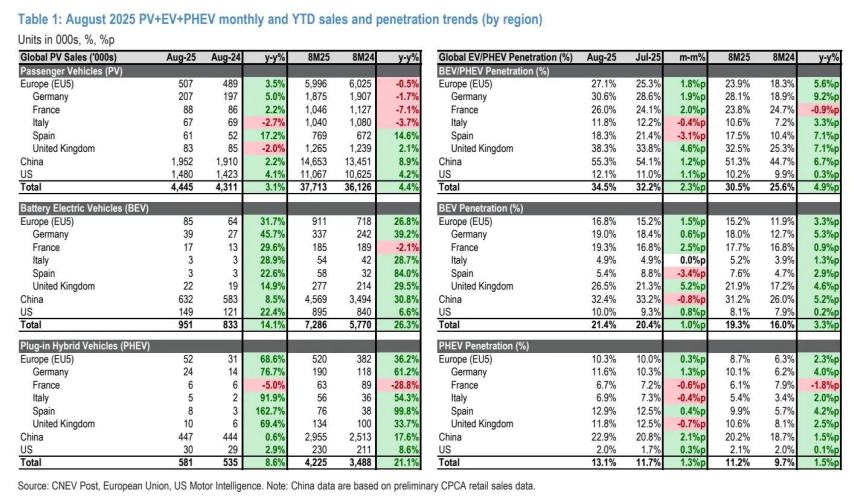
Core Insights - The global electric vehicle (EV) market continues to grow, with significant regional differences influenced by policy and subsidy adjustments [1][2] - The penetration rates in key markets such as Europe, the US, and China have shown positive growth, but the competitive landscape among leading automakers and battery companies is evolving [1][4] Regional Market Performance - In August 2025, the combined sales of electric vehicles in Europe (Germany, France, UK, Italy, Spain), the US, and China reached 1.39 million units, marking a year-on-year increase of 10% and a month-on-month increase of 5% [2] - The overall penetration rate for electric vehicles rose to 35%, up 2 percentage points year-on-year and month-on-month [2] - In Europe, the five countries achieved a penetration rate of 27.1%, nearing the historical peak of 27.7% in August 2023, with the UK showing the most significant growth [3][4] Key Market Drivers - The UK's growth in EV penetration is attributed to the "Electric Vehicle Subsidy Program," which provides incentives for small economic models priced below €37,000 [3] - In the US, the penetration rate increased to 12.1%, with pure electric vehicles surpassing 10% for the first time, driven by increased subsidies before the expiration of the $7,500 tax credit [4] - In China, retail sales of new energy vehicles reached 1.08 million units in August, with a penetration rate of 55%, supported by new model launches and price competition [5] Battery and Materials Sector - China's electric vehicle supply chain index rose by 20%, outperforming Japan and South Korea, primarily due to the country's anti-involution policies [6] - The battery materials sector is expected to stabilize or recover prices by 2026, influenced by capacity restrictions and market dynamics [7] Investment Outlook - The company remains optimistic about the prospects of Chinese and Korean automakers and battery leaders, despite anticipated demand weakness in the US market in Q4 due to subsidy reductions [9] - In China, companies like BYD are favored for their overseas business potential, while CATL is recognized for its technological leadership and stable profitability [9]


POSCO(PKX) - 2025 Q2 - Earnings Call Presentation
2025-07-31 06:00
POSCO Holdings 2025. Q2 Earnings Release July 31, 2025 Disclaimer This presentation was prepared and circulated to shareholders and investors to release information regarding the company's business performance prior to completion of auditing for the period pertaining to the 2nd quarter of 2025. Given that this presentation is based on unaudited financial statements, certain figures may be modified in the course of the audit process. This presentation contains certain forward-looking statements relating to t ...
全球储能:LMR会是LFP的杀手吗?
Bernstein· 2025-06-11 04:25
Investment Rating - The report rates CATL as "Outperform" and LGES as "Market-Perform" while POSCO Future M and other Korean companies are rated "Underperform" [6][7]. Core Insights - Lithium-Manganese-Rich (LMR) battery technology is positioned as a potential disruptor to the Lithium Iron Phosphate (LFP) market, particularly in the entry-level EV segment outside of China [1][9]. - LMR technology combines the safety and cost-effectiveness of LFP with the high energy density of NMC, achieving specific capacities of 250-280 mAh/g and cell-level energy densities around 300 Wh/kg, with potential optimization to 320 Wh/kg [2][15]. - Despite its advantages, LMR faces challenges in cycle life, voltage stability, and scalability, which need to be addressed for successful commercialization [3][15]. Summary by Sections LMR Technology Overview - LMR technology is a balanced approach between LFP and NMC, offering a theoretical cost of approximately US$55/kWh, which is about 15% higher than LFP but 20% cheaper than NMC [4][35]. - The technology does not rely on scarce resources like nickel and cobalt, reducing supply chain vulnerabilities and enhancing recycling potential [3][26]. Market Dynamics - Korean companies are focusing on LMR for entry-level EVs, while Chinese firms target higher-end applications, with significant advancements expected in commercialization by 2025-2028 [5][51]. - The report expresses skepticism about LMR's ability to replace LFP, suggesting that hybrid packs combining LFP and NMC may be a more effective solution [5][7]. Competitive Landscape - The lithium-ion battery industry is dominated by LFP and NMC chemistries, with LFP currently holding a 68% market share in China, while LMR is gaining traction in Western markets [29][31]. - Companies like POSCO Future M and Umicore are making strides in LMR technology, with plans for mass production and collaboration with global automakers [50][51]. Cost and Performance Metrics - LMR batteries are expected to provide a 35% improvement in energy density over current mainstream LFP products, making them a compelling option for mid-range EVs [24][26]. - The cost structure of LMR is competitive, with a breakdown showing that manganese's lower price compared to cobalt and nickel contributes to its cost-effectiveness [48][35]. Future Outlook - The report anticipates that LMR technology will play a significant role in the transition to more sustainable and cost-effective EV battery solutions, particularly in markets outside of China [27][31].
瑞银:全球电动汽车电池制造商:月度动态、电动汽车调查及美国电动汽车政策
瑞银· 2025-06-04 01:50
Investment Rating - The report maintains a "Buy" rating for LG Chem and BYD, while it has a "Sell" rating for POSCO Future M and EcoPro BM [6][31]. Core Insights - The global share of consumers considering buying a Battery Electric Vehicle (BEV) has declined by 5 percentage points year-on-year to 41%, leading to a downward revision of the 2030 global EV penetration forecast by 8 percentage points to 41% [2][10][16]. - The US and EU markets are particularly affected, with expected 2030 EV penetration reduced by approximately 9 percentage points to 24% and 10 percentage points to 38%, respectively, resulting in a significant reduction in global EV battery demand [2][18][27]. - Battery-related issues, particularly range anxiety, have overtaken purchase price as the main consumer concern regarding BEV purchases [2][17]. Summary by Sections Global Electric Vehicle Battery Makers - The Korea EV supply chain is the most negatively impacted by the decline in BEV purchase intentions, especially in ex-China markets [2][16]. - The report highlights that BYD has become a global player, rapidly increasing its exports despite trade barriers, while Tesla has lost its brand image in Europe [2][11]. US Autos, Auto Parts and Auto-tech - The report indicates a significant decline in US consumer interest in BEVs, with purchase intention dropping 5 percentage points to 32% [21][25]. - The potential removal of the $7,500 consumer clean vehicle tax credit and slower rollout of charging infrastructure are key factors contributing to the revised forecasts [21][41]. Lithium Market - The lithium market is currently oversupplied, with spot prices trading into the cost curve, leading to a downward revision of long-term spodumene prices to $1,200 per ton [4][54]. - The report anticipates a 12% reduction in lithium demand forecasts, primarily due to the weaker outlook for EVs [54][55]. Top Picks - The preferred order for the Korea EV supply chain is LG Chem > Samsung SDI > LG Energy Solution > SK Innovation > EcoPro BM > POSCO Future M [6][19]. - BYD is highlighted as the only Chinese OEM with rapidly growing traction in export markets, benefiting from the vacuum left by Tesla [31][32].