
Siebert Financial Corp.

Search documents
The Day Gold ETFs Didn’t Trade Like Gold - SPDR Gold Shares (ARCA:GLD), abrdn Physical Precious Metals Basket Shares ETF (ARCA:GLTR), Strategy Shares Gold Enhanced Yield ETF (BATS:GOLY), iShares Silve
Benzinga· 2026-02-02 19:52
Core Viewpoint - The recent sharp decline in gold and silver prices is attributed more to liquidity issues and margin calls rather than a fundamental decrease in demand for these precious metals [1][2]. Group 1: Market Behavior - Spot gold experienced a drop of over 12% in a single session, while silver fell approximately 33%, marking one of the most significant selloffs in decades [1]. - The behavior of gold and silver ETFs during this period highlighted the breakdown of leverage and liquidity, affecting their pricing mechanisms [1][3]. Group 2: Volatility and Market Dynamics - David Miller, CIO at Catalyst Funds, emphasized that the volatility observed does not undermine the long-term bullish outlook for gold as a primary reserve asset, suggesting that historical corrections often present buying opportunities [2]. - The extreme volatility in silver was noted to be due to its dual role as both an industrial metal and a safe haven, leading to sharper sell-offs when growth expectations falter [4]. Group 3: Margin Requirements and Liquidation - The CME Group's increase in margin requirements for gold and silver futures intensified selling pressure, forcing traders to either post additional collateral or liquidate their positions, which further exacerbated ETF pricing dislocations [4]. - Mark Malek, CIO at Siebert Financial, pointed out that crowded trades can unwind without negative news, indicating that the recent rally in gold was both macro-driven and narrative-fueled, embedding significant risk [5]. Group 4: Long-Term Outlook - For ETF investors, the events of January 31 were characterized as a liquidity and leverage event rather than a collapse of gold's long-term investment case, suggesting that the narrative surrounding gold remains intact despite short-term volatility [5].


US sells Venezuelan oil at 30% higher prices, completes $500M deal, energy secretary says
New York Post· 2026-01-16 16:10
Core Viewpoint - The US is selling Venezuelan oil at prices approximately 30% higher than previous sales, following the capture of Nicolás Maduro, with the first sale valued at around $500 million [1][2]. Group 1: Oil Sales and Pricing - The US Department of Energy reported that the realized price for Venezuelan oil is about 30% higher compared to three weeks ago [2]. - President Trump announced that Venezuela would sell between 30 to 50 million barrels of oil to the US at "market price," with sales expected to continue indefinitely [4]. - Venezuela, holding the world's largest crude reserves at approximately 303 billion barrels, has seen its oil output decline to 800,000 barrels per day from a peak of 3.5 million barrels per day in the 1990s [4]. Group 2: Investment Opportunities - Following Maduro's capture, Trump has engaged with leaders from major oil companies such as Exxon, Chevron, and ConocoPhillips to discuss potential investments in Venezuelan oil [5]. - Chevron is highlighted as a key player due to its long-standing exposure to Venezuela and expertise in heavy oil, while ExxonMobil is also positioned to benefit if redevelopment becomes capital-intensive [10]. - ConocoPhillips, with its experience in heavy oil, is expected to gain if production increases under more stable conditions [10]. Group 3: Market Reactions - Brent crude oil prices increased by 50 cents, or 0.78%, reaching $64.26 per barrel, marking a fourth consecutive weekly gain [10]. - US West Texas Intermediate rose by 48 cents, or 0.81%, to $59.67, with both benchmarks achieving multi-month highs amid concerns of volatility due to protests in Iran [11].



'Sell America' trade: Dollar drops, gold surges as Trump's Fed pressure campaign raises fears about U.S. system
CNBC· 2026-01-12 17:09
In this article@GC.1.DXYwatch nowStock Chart IconStock chart iconGold COMEX, all-timeJPMorgan's trading team also highlighted "Sell America" as a major driver for the market on Monday. Beyond the Powell investigation, the desk pointed out that oral arguments at the Supreme Court are scheduled for the case on whether Trump can fire Fed Governor Lisa Cook later this month. On top of that, bank stocks dropped after Trump called for a one-year credit card interest rate cap at 10%."Combined, the 'Sell America' t ...
Retail investors close out one of their best years ever. How they beat Wall Street at their own game
CNBC· 2025-12-31 11:35
Core Viewpoint - Retail investors have demonstrated significant growth and sophistication in their trading strategies, achieving strong returns in 2025 by effectively buying the dip during market downturns, challenging previous perceptions of their investing capabilities [2][3][12]. Retail Investor Performance - Retail investors capitalized on market dips, with 2025 being the second-best year for dip-buying since the early 1990s, according to Bespoke Investment Group [3]. - Individual traders purchased over $3 billion in equities on April 3, 2025, during a market decline, showcasing their willingness to invest amid volatility [7]. - Retail investors' portfolios outperformed institutional baskets tied to artificial intelligence and software, indicating a higher profit-to-loss ratio [5]. Shift in Investment Focus - From May 2025 onward, retail investors shifted their focus from single stocks to exchange-traded funds (ETFs), particularly the SPDR Gold Shares (GLD), which saw inflows surpassing the last five years combined [4]. - The gold-focused ETF experienced a record surge of over 65% in 2025, reflecting the growing interest in commodities amid market fluctuations [4]. Market Sentiment and Strategy - Retail investors have been more accurate in their market reactions compared to institutional investors, particularly during emotionally driven trades [9]. - The "TACO trade" strategy, which encourages buying stocks during market downturns caused by policy decisions, has gained traction among retail investors [10]. Evolution of Retail Investors - The participation of retail investors surged in 2025, with flows increasing over 50% from the previous year, reaching levels not seen since the meme stock craze of early 2021 [13]. - More than one-third of 25-year-olds moved significant sums to investment accounts since turning 22, indicating a growing trend of younger investors entering the market [12]. Changing Perceptions - The narrative surrounding retail investors has shifted from being viewed as "dumb money" to being recognized for their increasing sophistication and ability to make informed investment decisions [14][15]. - Retail investors are now seen as central to market dynamics, with their strategies aligning more closely with those of institutional investors [18].


比特币跌破9万美元创七个月新低 贝莱德旗下比特币ETF(IBIT.US)创成立以来最大单日撤资记录
Zhi Tong Cai Jing· 2025-11-19 22:21
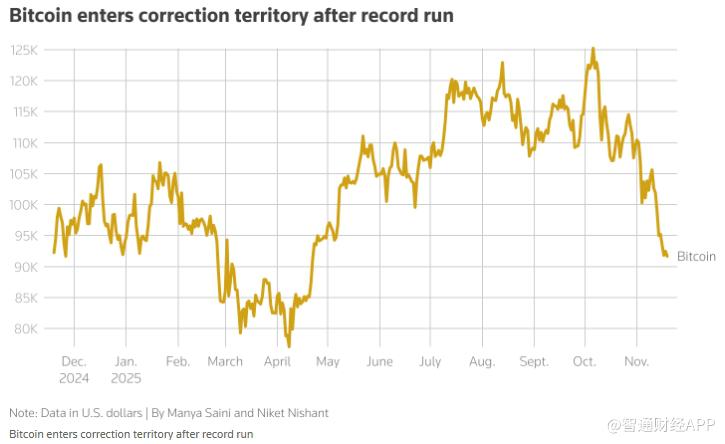
Core Insights - The iShares Bitcoin ETF (IBIT.US) experienced a record net outflow of approximately $523 million, marking the largest single-day redemption since its launch in January 2024, coinciding with Bitcoin's price dropping below $90,000, the lowest in seven months [1][4] - IBIT, as the largest spot Bitcoin ETF, has been a central player in the crypto ETF boom, but recent rapid declines in Bitcoin's price have led to significant redemption pressures, indicating a challenging market environment for risk assets [4] - In contrast to Bitcoin's decline, gold has remained relatively stable, raising questions about Bitcoin's role as a hedge or "digital gold," with some analysts suggesting investors are reducing Bitcoin exposure in favor of gold [4] - The crypto market has been losing momentum since August, with previous demand largely driven by leveraged funds, and profit-taking by long-term holders has intensified market pressure [4] - Over the past year, Bitcoin treasury companies have accumulated nearly $50 billion in Bitcoin, but many related company stocks have fallen below their Bitcoin net asset values, raising concerns about their ability and willingness to continue buying [4] - Some prominent investors warn that valuations across various asset classes, including cryptocurrencies, appear elevated, contributing to a market environment lacking speculative sentiment [7] - As of this quarter, IBIT, with assets exceeding $73 billion, has seen a cumulative decline of approximately 19% [7]
Instant View: Fed lowers rates by a quarter of a point; Powell says was a risk management cut
Yahoo Finance· 2025-09-17 18:28
"In addition to the political jabs aimed at them, the Fed is in a tough spot. They expect stagflation, or higher inflation and a weaker labor market. That is not a great environment for financial assets. One could call the Fed's move a risk management-style rate cut. It shows the Fed is putting more emphasis on the softening in the labor market as they trimmed rates while forecasting more cuts in 2025.""We believe that diversifying portfolios across geographies and currencies and sectors, following a decade ...