
Taiwan Semiconductor Manufacturing Company (TSMC)

Search documents
半导体:英伟达业绩影响 -lackwell 架构强劲扩张,进入 “Rubin周期”- Semiconductors Nvidia result implications - Blackwell expanding strongly entering the Rubin Cycle
2026-03-01 17:23
Vi e w p o i n t | 25 Feb 2026 19:27:39 ET │ 10 pages Taiwan Semiconductors Nvidia result implications - Blackwell expanding strongly, entering the Rubin Cycle CITI'S TAKE Nvidia just published its Jan Q result (report) and provided a positive outlook for the upcoming Rubin product cycle. While some investors were skeptical on Rubin's schedule and initial yield rate, Nvidia reiterates that the chip already has mass volume production and system rack is to ramp up big volumes in 2H26. Yet we believe the major ...

United Microelectronics Corporation (UMC): A Bull Case Theory
Yahoo Finance· 2026-01-19 22:17
Core Thesis - United Microelectronics Corporation (UMC) is viewed positively due to its focus on mature and specialty semiconductor nodes, which are essential for various industries, ensuring consistent demand and stability [2][5]. Company Overview - UMC's shares were trading at $8.77 as of January 15th, with trailing and forward P/E ratios of 16.37 and 14.35 respectively [1]. - The company operates in a segment that prioritizes stability and reliability over cutting-edge performance, catering to markets such as automotive, industrial equipment, and IoT devices [2]. Market Position and Strategy - Over 80% of global chip volume comes from mature nodes, indicating a stable market presence for UMC [3]. - UMC is expanding its wafer capacity in Singapore to over 8 million units by 2026, which is significant compared to other mature-node foundries [3]. - The company offers 14nm FinFET technology, which provides 50-60% better power efficiency than 28nm, balancing performance with cost [4]. Growth Potential - The market currently undervalues UMC, treating it as a zero-growth business, but there is potential for a 20-30% re-rating if demand remains steady and partnerships, such as with Intel, succeed [5]. - UMC's consistent execution and growing relevance in supply-chain diversification make it an attractive option for investors seeking stable returns [5].
IREN Ltd (IREN) Soars 11.4% as Chip Giant Ups Bet on AI Demand
Yahoo Finance· 2026-01-17 07:42
Group 1: Company Performance - IREN Ltd. (NASDAQ:IREN) experienced a significant increase of 11.43 percent, closing at $57.82, following two days of losses, driven by higher spending from a major semiconductor manufacturer amid strong AI sector demand [1] - IREN Ltd. received bullish coverage from investment firms HC Wainwright and Bernstein, with HC Wainwright setting a price target of $80, indicating a 38 percent upside potential, while Bernstein reduced its target to $75, still representing a 30 percent upside potential [5] Group 2: Industry Developments - Taiwan Semiconductor Manufacturing Company (TSMC) announced a budget increase of 33 to 37 percent for this year, ranging from $52 billion to $56 billion, compared to $38 billion to $42 billion last year, due to strong semiconductor demand [2] - TSMC reported a 35 percent increase in net income to NT$505.7 billion from NT$374.68 billion year-on-year, and net sales rose by 20.5 percent to NT$1.046 trillion from NT$868.46 billion [4] - Optimism in the market is bolstered by TSMC's strong earnings, positively impacting companies like IREN Ltd. and SuperMicro Computer Inc., which rely on Nvidia Corp.'s GPUs manufactured by TSMC [3]

The $56 Billion Draft: Follow TSMC’s CapEx Stream
Yahoo Finance· 2026-01-16 21:25
Core Viewpoint - TSMC's projected capital expenditure of $52 billion to $56 billion for 2026 is a critical indicator for the semiconductor supply chain, signaling significant liquidity entering the market [3][4]. Group 1: Financial Performance - TSMC reported a net profit of $16 billion for the fourth quarter of 2026, but the focus should be on the forward-looking guidance rather than just the bottom line [3]. Group 2: Capital Expenditure and Market Impact - The projected capital expenditure represents a substantial amount of liquidity that TSMC is required to invest in new factories, advanced machinery, and materials over the next year [4]. - This spending plan is expected to create a financial vacuum that will benefit TSMC's suppliers, as they will be pulled forward by the increased demand for AI chips [4]. Group 3: Investment Strategy - The strategy known as "Drafting the Titan" suggests that investors should focus on TSMC's suppliers, as they will benefit from TSMC's capital expenditures and the growing demand for AI chip manufacturing [4][5]. - The volatility of the AI chip market makes it challenging to identify the ultimate winner among chip manufacturers, but TSMC's role as a manufacturer for all high-performance AI chips remains constant [5]. Group 4: Equipment Demand - TSMC's expansion of manufacturing capacity for AI processors is driving increased demand for specialized equipment needed for advanced transistor architectures [6]. - The transition to new chip designs necessitates the purchase of specific machinery that cannot be replaced by competitor products, further solidifying TSMC's position in the market [6].
追踪中国半导体国产化 - 从长鑫存储与中芯国际的资金看行业关联;英伟达 H200 对本土芯片需求的影响-Tracking China’s Semi Localization-Read-across from CXMT and SMIC funding; Nvidia H200 impact on local chip demand
2026-01-08 02:43
Summary of Key Points from the Conference Call Industry Overview - The focus is on China's semiconductor localization efforts, particularly in the context of companies like ChangXin Memory Technologies Corp. (CXMT) and Semiconductor Manufacturing International Corporation (SMIC) [1][2][5]. Company-Specific Insights ChangXin Memory Technologies Corp. (CXMT) - CXMT plans to raise 29.5 billion yuan (approximately $4.22 billion) through an IPO of 10.6 billion shares in Shanghai to fund DRAM expansion [1]. - The company has Rmb43 billion in cash, with a total capital investment of approximately Rmb34.5 billion (around $4.9 billion) planned over three years, aiming for a capacity addition of about 50,000 wafers per month (wpm) [2]. Semiconductor Manufacturing International Corporation (SMIC) - SMIC announced a capital increase of $7.8 billion through the introduction of Big Fund Phase III and collaboration with major state-owned banks [2]. - The acquisition of the remaining 49% equity interest in SMIC North will enhance the net profit margin and strengthen the balance sheet for future capacity expansion [2][5]. Market Demand and Supply Dynamics - Chinese technology companies have ordered over 2 million Nvidia H200 chips for 2026, while Nvidia currently has only 700,000 units in inventory [3]. - There is uncertainty regarding the Chinese government's approval of these orders, as it may impact the adoption of local chips [4]. Stock Implications - The outlook is positive for SMIC and Chinese semiconductor equipment plays, driven by strong demand for leading-edge logic chips for local AI computing [5]. Import Trends - China's semiconductor equipment import value was $2.1 billion in November 2025, reflecting a 10% year-over-year decline. However, the three-month moving average showed an 11% year-over-year growth, down from 17% in October 2025 [10]. - Imports from the US, Netherlands, and Japan decreased by 32%, 7%, and 5% year-over-year, respectively, while imports from Korea and Singapore increased by 9% and 16% [10]. Localization Progress - China's semiconductor self-sufficiency ratio improved to 24% in 2024, up from 20% in 2023, with expectations to reach 30% by 2027 [52][54]. - Significant advancements have been made in advanced node logic chips, particularly with Huawei's Ascend 910B chips [55]. AI Demand - There is a strong demand for AI inference, with major Chinese cloud service providers processing a rapidly increasing number of tokens [20][21]. - ByteDance's token consumption reached 50 trillion daily by December 2025, indicating robust growth in AI applications [21]. Conclusion - The semiconductor industry in China is experiencing significant developments, with companies like CXMT and SMIC playing crucial roles in localization efforts. The demand for AI chips and the ongoing capacity expansions are expected to drive future growth in the sector [5][55].

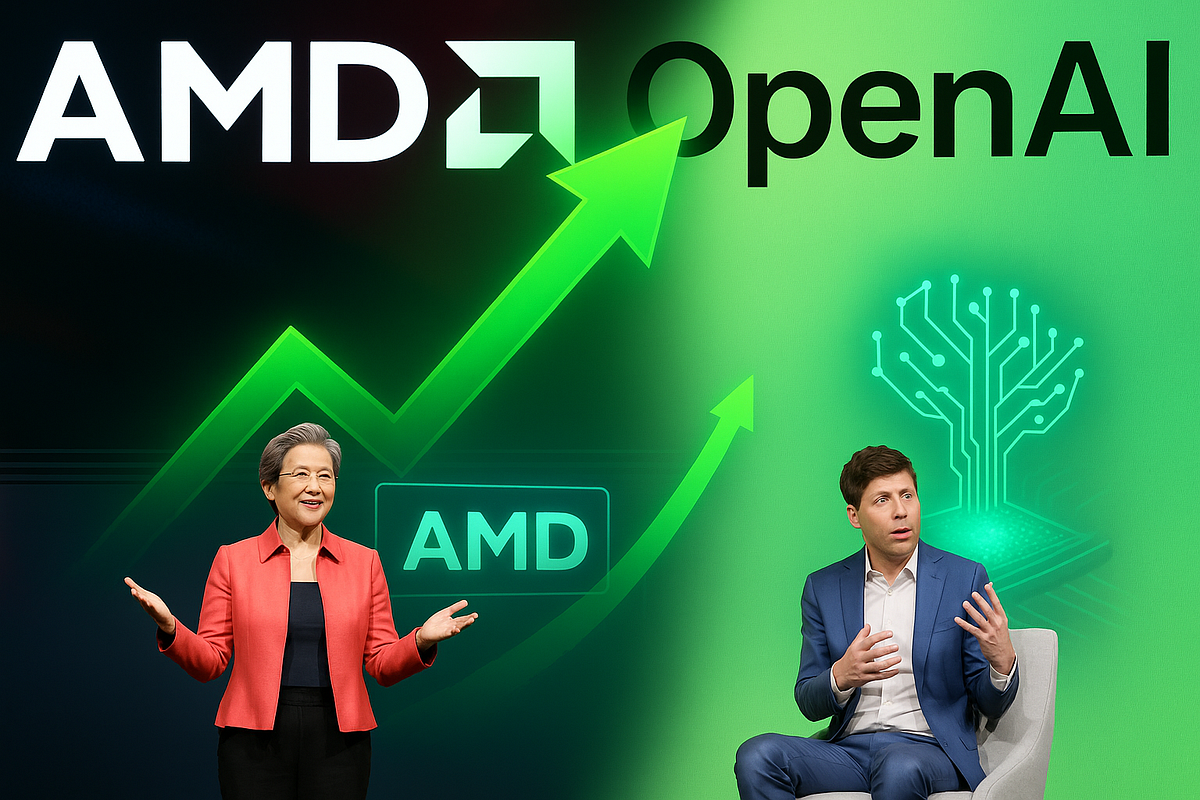
AMD’s Ascent: Deconstructing the OpenAI Deal and Valuing a New AI Titan
Medium· 2025-10-10 01:18
Core Insights - AMD's stock surged by 24% following a strategic partnership with OpenAI, marking a significant shift in the semiconductor landscape and positioning AMD as a key player in AI technology [1][4][43] - The partnership involves a multi-year agreement for AMD to supply GPU hardware for OpenAI's AI infrastructure, with a total deployment of 6 gigawatts planned [4][6] - The deal includes a warrant for up to 160 million shares of AMD stock, aligning the interests of both companies and creating a symbiotic relationship [8][10] Financial Impact - AMD's management estimates the partnership could generate $30 billion to $42 billion in revenue over its term, translating to a potential net profit of $6 billion to $8.4 billion [12][16] - AMD's Q2 2025 revenue reached $7.7 billion, a 32% year-over-year increase, despite challenges such as an $800 million inventory write-down due to export restrictions [18][22][23] - The Data Center segment showed a 14% year-over-year growth, driven by strong demand for EPYC server CPUs, indicating robust underlying business performance [26][28] Valuation and Market Position - Analyst projections suggest AMD could achieve an EPS of approximately $6.20 in fiscal year 2026, with a theoretical stock price target ranging from $217 to $279 based on a justified P/E multiple of 35x to 45x [30][34][38] - The OpenAI partnership positions AMD as a credible alternative to Nvidia, which has dominated the AI training market, thus creating a more competitive landscape [5][7][43] Institutional Interest - Significant bullish bets on AMD were observed from major institutional investors prior to the OpenAI announcement, indicating confidence in the company's strategic direction [35][39] Challenges Ahead - AMD faces challenges from Nvidia's entrenched position and the need to enhance its ROCm software ecosystem to attract a broader customer base [37] - Geopolitical factors, such as U.S. export controls, pose risks to AMD's market access and financial performance [40] - Execution risks related to the scale of the OpenAI deal and reliance on TSMC for chip production could impact AMD's ability to meet commitments [41]


Former Intel Directors Call For Trump And Nvidia To Take Chip Giant Private: 'Hope Is Not A Strategy' - Apple (NASDAQ:AAPL), Advanced Micro Devices (NASDAQ:AMD)
Benzinga· 2025-09-20 06:30
Group 1: Intel's Current Situation - Four former Intel directors are advocating for the company to go private due to its struggles in the semiconductor market and outdated conglomerate structure [1][2] - Intel has experienced years of declining performance while competitors like TSMC have advanced, with the U.S. government and Nvidia holding significant stakes in the company [2] - The former directors propose that a private Intel could separate its design and manufacturing units, which are currently intertwined [2][3] Group 2: Proposed Government Involvement - The proposal suggests that the U.S. government and major tech firms should buy out Intel's public shareholders to facilitate restructuring [3][5] - The manufacturing arm could be transformed into a foundry to compete with TSMC, while design businesses could be sold or spun out [3] - The foundry is estimated to have a book value of $70 billion but requires up to $100 billion in new capital for global competitiveness [3] Group 3: Market Reactions and Financial Projections - Following a 28% surge in Intel's stock price, the partnership with Nvidia is seen as a strategic move for future AI infrastructure [4] - Analysts project that the Nvidia-Intel partnership could generate $25-50 billion in annual revenue over the long term [7] - The collaboration is viewed as a potential setback for competitors like AMD and Arm Holdings, impacting their market positions [7] Group 4: Historical Context and Future Outlook - The restructuring plan is compared to General Electric's breakup, which successfully unlocked shareholder value [5] - The former directors argue that only government-led restructuring can ensure long-term security for the U.S. chip ecosystem [5][6] - If executed, the overhaul could create jobs, enhance national security, and yield significant taxpayer returns [6]

Trump Says 10% Stake In Intel Is A Done Deal: 'I Think It's A Great Deal For Them'
Benzinga· 2025-08-22 19:11
Core Viewpoint - Intel Corp. stock rose over 6% following President Trump's suggestion for the U.S. government to acquire a 10% stake in the company, which is currently facing challenges [1]. Group 1: Government Involvement - President Trump indicated that Intel has agreed to the deal, describing it as beneficial for the company, although a White House official noted that discussions are still ongoing and no final decision has been made [2]. - Commerce Secretary Howard Lutnick stated that the government seeks equity in Intel in exchange for federal support under the CHIPS Act, emphasizing the need for an equity stake for the financial support provided [4]. Group 2: Intel's Market Position - Intel is the only U.S. company capable of producing advanced semiconductors domestically but is currently behind Taiwan Semiconductor Manufacturing Company (TSMC), which supplies major firms like Apple and Nvidia [5]. - The company is investing billions into new factories in Ohio, aiming to produce state-of-the-art AI chips, a project referred to as the "Silicon Heartland" [5]. Group 3: Recent Investments - SoftBank recently announced a $2 billion investment in Intel, acquiring approximately a 2% stake in the company [4].
花旗:GPUvsAI ASIC-不只是芯片设计,互操作性和系统集成是关键
花旗· 2025-07-07 15:45
Investment Rating - The report maintains a "Buy" rating for MediaTek and a "Neutral" rating for Alchip, while downgrading GUC to "Sell/H" [5][43][52]. Core Insights - The report emphasizes the increasing importance of system integration and interoperability in the semiconductor industry, particularly for AI ASICs and GPUs. It highlights that successful chip design alone is insufficient; cohesive and scalable systems are crucial for performance [1][9][18]. - The transition of AI chips from N5/4 to N3 nodes is expected to significantly increase average selling prices (ASP) and computing capabilities, despite a slowdown in overall AI chip shipment growth [2][16]. - Nvidia continues to dominate the AI server market, holding over 80% of market value, while Broadcom leads in the ASIC market driven by its Google TPUs [23][36]. Summary by Sections AI ASIC Market Dynamics - Broadcom holds the largest market share in the ASIC market, with stable trends expected for TPU v7 and growth anticipated for TPU v8 in late 2026 [3][36]. - The report estimates that AI ASIC shipments from major cloud service providers (CSPs) will reach approximately 4.5 million units in 2026, which is lower than consensus estimates [2][23]. System Integration and Design - The report stresses the need for advanced system design capabilities, including thermal management and network fabric design, to support the growing complexity of AI workloads [18][22]. - It notes that developing an HPC AI ASIC can take 3-4 years, necessitating partnerships with experienced semiconductor makers to expedite the process [20][22]. Company-Specific Insights - MediaTek is highlighted as a preferred choice due to its design expertise and expected revenue contributions from AI ASICs starting in late 2026 [5][43][45]. - Alchip's contribution is expected to begin in 2H26, with a cautious outlook due to potential redesign delays [52][53]. Financial Projections - The report provides revised financial estimates for MediaTek, projecting a revenue of NT$588.85 billion for 2025, with a YoY growth of 11% [46]. - Alchip's financial outlook is less optimistic, with a projected revenue of NT$41.96 billion for 2025, reflecting a decline [52][53].
高盛:台积电 - 盈利回顾 - 2025 年展望好于预期,但预计地缘政治担忧短期内仍将持续;重申买入
Goldman Sachs· 2025-04-21 05:09
Investment Rating - The report maintains a "Buy" rating for TSMC (2330.TW) with a 12-month price target of NT$1,190.00, indicating a potential upside of 40.5% from the current price of NT$847.00 [1] Core Insights - TSMC's 2025 outlook is better than previously feared, with the company maintaining its full-year revenue and capex guidance despite concerns over potential end demand slowdown due to tariffs [2][19] - The company has not engaged in discussions regarding joint ventures or technology transfers, alleviating investor concerns that have affected valuations [2] - There are incremental negatives regarding gross margin (GM) guidance, with expectations of GM dilution widening to 3-4 percentage points due to overseas expansion and inflationary pressures [3][21] Revenue and Earnings Forecast - Revenue projections for TSMC are as follows: NT$2,894.31 million for 2024, NT$3,655.51 million for 2025, NT$4,192.55 million for 2026, and NT$5,035.09 million for 2027, reflecting a growth rate of 33.9% in 2024 and 26.3% in 2025 [6][18] - EPS estimates are NT$45.25 for 2024, NT$59.07 for 2025, NT$66.09 for 2026, and NT$78.06 for 2027, with a projected EPS growth of 39.9% in 2024 and 30.5% in 2025 [6][18] Margin and Profitability - The report indicates a slight decrease in GM forecast for 2027, revised down to 57.1% from 57.8%, due to higher operational costs and inflation [3][21] - EBITDA margins are projected to be 68.6% in 2024, 67.9% in 2025, and 68.8% in 2026, with net income margins expected to be 40.5% in 2024 and 41.9% in 2025 [13][18] Market Position and Competitive Landscape - TSMC's market capitalization is NT$22.0 trillion (approximately $675.7 billion), with an enterprise value of NT$20.1 trillion (approximately $618.7 billion) [5] - The company is ranked third in M&A within the semiconductor industry, indicating a strong competitive position [5] Capital Expenditure and Investment Strategy - TSMC's capex guidance for 2025 is set between US$38-42 billion, reflecting ongoing investments to meet robust demand, particularly in AI-related sectors [19][36] - The company is accelerating its expansion in the US, with plans to build multiple wafer fabs and advanced packaging facilities to cater to US-based customers [37]