WeRide

Search documents
Waymo opens robotaxi service to 'select riders' in Houston, Dallas, San Antonio and Orlando
CNBC· 2026-02-24 14:00
Alphabet-owned Waymo on Tuesday opened its robotaxi service to some public passengers in Dallas, Houston, San Antonio and Orlando, the company announced. With the multi-city expansion, Waymo is now operating its service in 10 U.S. cities, extending its lead in the North American driverless ride-hailing market. The Google sister company is aiming to lock in loyal riders and win over skeptics, including six in 10 U.S. drivers who said they were fearful of driverless cars, according to a 2025 survey by the Ame ...


Uber's new autonomous vehicle division is about survival and opportunity
TechCrunch· 2026-02-23 19:54
Core Insights - Uber has launched a new division called Uber Autonomous Solutions to manage all aspects of operating autonomous vehicles, including software and support services [1] - The company has formed partnerships with nearly two dozen autonomous vehicle technology firms, covering various applications from robotaxis to delivery robots [2] - Uber aims to make itself indispensable to these partners by providing operational support, allowing them to focus on software development [3] Partnerships and Investments - Uber has invested in companies like Lucid, Nuro, Waabi, and WeRide, and has allocated $100 million for building fast-charging stations for autonomous vehicles [2] - The company has established a shared robotaxi service with Waymo in Atlanta and Austin, and has partnerships with Chinese firms such as Baidu and Pony.ai [9] Operational Goals - The initiative aims to reduce costs per mile for partners and accelerate the deployment of robotaxis to over 15 cities by the end of the year [4] - Uber plans to handle infrastructure needs such as training data, mapping, fleet financing, and regulatory services [7] User Experience and Fleet Management - The new division will also focus on enhancing user experience, including customer support and fleet management, which involves remote assistance and insurance [8] - Uber's approach to fleet management is particularly relevant given recent scrutiny over labor practices in the autonomous vehicle sector [8] Strategic Context - The launch of this division follows Uber's sale of its in-house AV development unit, Uber ATG, in 2020, which was a response to internal challenges and external pressures [9] - The new division is seen as a way for Uber to protect its business model against potential revenue loss from the rise of autonomous vehicles [10]


Applied Digital, Recursion Pharmaceuticals Stocks Drop. Blame Nvidia.
Barrons· 2026-02-18 10:43
Core Viewpoint - Nvidia has divested its shares in Applied Digital, Recursion Pharmaceuticals, and WeRide, indicating a strategic shift in its investment portfolio [1] Group 1: Company Actions - Nvidia disclosed in a filing that it no longer holds shares in Applied Digital, a company focused on digital infrastructure [1] - The company has also exited its investment in Recursion Pharmaceuticals, which specializes in drug discovery [1] - Additionally, Nvidia has divested from WeRide, an autonomous-driving technology company [1]



WeRide Using AI to Cut Costs as It Grows Robotaxi Fleet
WSJ· 2026-02-12 01:56
Core Insights - The company has successfully reduced its data collection and training costs by 75% [1] - The company aims to at least double its fleet size within the current year [1]


Prediction: 2 Growth Stocks That Will Soar Past Palantir Technologies in the Next 5 Years
Yahoo Finance· 2026-02-11 14:50
Core Insights - Palantir Technologies has seen a remarkable stock increase of over 2,000% since 2023, significantly outperforming the S&P 500's 80% gains during the same period [1] - The company's market capitalization stands at $340 billion, with a valuation exceeding 200 times its trailing earnings, indicating an excessive valuation [2] - Predictions suggest that Palantir may experience a considerable decline in value over the next five years, with Uber Technologies and Intuitive Surgical expected to become more valuable alternatives [3] Palantir Technologies - The stock has generated substantial returns for shareholders, driven by soaring demand linked to artificial intelligence [2] - Despite its impressive growth, the current valuation is considered excessive, raising concerns about future performance [2] Uber Technologies - Uber has transformed global travel and continues to have significant growth potential in untapped markets [4] - The company is exploring opportunities in robotaxis, with plans to deploy 1,200 robotaxis in the Middle East and partnerships with WeRide and Waymo for autonomous ride-hailing services [5] - Projected sales growth from $17 billion in 2021 to over $52 billion by 2025, with a market cap around $150 billion and a trailing earnings multiple of 16 times, suggests it could surpass Palantir in value [6] Intuitive Surgical - Intuitive Surgical, with a market cap of approximately $175 billion, has significant growth potential, particularly with its da Vinci surgical system that enhances surgical precision and efficiency [7] - The company has been steadily growing and is still in the early stages of operational expansion, with projected revenues exceeding $10 billion and earnings around $2.9 billion by 2025 [8]


2亿用户,撑不起Uber的自动驾驶梦
汽车商业评论· 2026-02-05 23:06
Core Viewpoint - Uber's recent financial report highlights significant growth in user engagement and bookings, but concerns over profitability and market competition have led to a decline in stock price despite positive operational metrics [6][12][13]. Financial Performance - In Q4 2025, Uber reported a 22% increase in ride-hailing trips to 3.8 billion, with total bookings also rising 22% to $54.1 billion, and revenue growing 20% to $14 billion [6]. - Monthly active users reached a record 202 million, an 18% increase year-over-year, doubling from 100 million in 2019 [7][8]. - Operating profit for Q4 2025 was $1.77 billion, a 130% increase, but fell short of analyst expectations of $1.85 billion by $80 million [18]. Growth Drivers - The growth in bookings was attributed to new products and services, including the Uber One subscription service and expanded offerings in holiday travel and airport transportation [17]. - The food delivery segment also performed well, capturing market share from competitors by introducing more non-food merchants and increasing discounts [17]. Profitability Concerns - Despite revenue growth, Uber's profitability remains a concern, with significant losses from investments in companies like Lucid and Grab leading to a $1.6 billion write-down [19]. - The company anticipates a higher effective tax rate of 22%-25% in 2026, which could further pressure profit margins [22]. Autonomous Driving Strategy - Uber views autonomous driving as a key future growth area, investing heavily and forming partnerships with various technology firms [25][26]. - The company plans to deploy 25,000 autonomous vehicles on its platform and expand services to 15 global markets by the end of 2026 [28][30]. - Uber argues that its existing user base and operational experience will allow it to achieve better utilization and economic benefits from autonomous vehicles compared to independent operators [31]. Market Competition - The autonomous vehicle market is competitive, with companies like Waymo and Tesla advancing their own technologies, which poses a threat to Uber's strategy [42][44]. - Regulatory challenges in major cities may delay the rollout of autonomous services, impacting Uber's ability to capitalize on high-margin markets [46]. Investor Sentiment - Investor confidence is wavering, as the potential impact of autonomous vehicles on Uber's core business remains uncertain, leading to stock price volatility [47].

Uber(UBER) - 2025 Q4 - Earnings Call Transcript
2026-02-04 14:00
Financial Data and Key Metrics Changes - In Q4 2025, Uber achieved a gross bookings increase of 22% year-over-year, reaching an annual run rate of 15 billion trips and over 200 million monthly active users [5][6] - The company generated $8.7 billion in adjusted EBITDA, representing a 35% margin, and $9.8 billion in free cash flow, up 42% year-over-year [5][6] - For the full year 2025, Uber maintained over 20% annual gross bookings growth for the fifth consecutive year [5] Business Line Data and Key Metrics Changes - The introduction of new products, such as the Moto product, has significantly contributed to user growth by attracting new segments [30] - The Reserve product has shown strong performance, particularly among suburban users seeking reliability for time-sensitive trips [31] - The membership program, Uber One, has grown by 55% year-over-year, enhancing customer retention and engagement [36] Market Data and Key Metrics Changes - 60% of Uber's mobility gross bookings are generated internationally, indicating a strong presence outside the U.S. [23] - Growth in less dense markets is approximately 1.5-2 times faster than in major cities, contributing to overall user growth [32] Company Strategy and Development Direction - Uber is focusing on six strategic areas, including autonomous vehicles (AVs), which are seen as a multi-trillion-dollar opportunity [5][6] - The company aims to leverage its global scale and sophisticated marketplace technology to enhance its AV strategy and partnerships with various AV manufacturers [17][42] - Uber's capital allocation strategy prioritizes reinvestment in core business opportunities while maintaining a commitment to returning 50% of free cash flow to shareholders [45][46] Management's Comments on Operating Environment and Future Outlook - Management expressed confidence in the growth potential of AVs, viewing them as a net positive for the overall market rather than a competitive threat [14][16] - The company anticipates continued user growth, with a year-end MAPC growth of 18% year-over-year, indicating strong momentum heading into 2026 [33] - Management highlighted the importance of maintaining price consistency in the U.S. market to enhance long-term demand elasticity [51] Other Important Information - Prashanth Mahendra-Rajah will step down as CFO, with Balaji Krishnamurthy taking over the role, indicating a transition in leadership [7][8] - The company is actively working on partnerships and investments in AV technology to ensure a competitive edge in the evolving mobility landscape [54][56] Q&A Session Summary Question: Impact of AVs on market share and profitability - Management views the introduction of AVs as a growth driver, with bookings in major cities accelerating despite competition [14][16] Question: Strategic priorities for maintaining user growth - The focus is on introducing new products, targeting different demographics, and expanding into less dense markets [30][32] Question: Willingness to deploy capital into AV fleets - Management is committed to investing in AV technology while ensuring profitable economics and maintaining a healthy financing ecosystem [53][56] Question: Factors driving acceleration in U.S. trips and gross bookings - Consistent pricing and a barbell strategy targeting both low-end and high-end markets are key factors for growth [51][52] Question: Stages of AV deployment and scaling - Initial focus will be on achieving consistent baseload supply from AVs, with scaling dependent on OEM production capabilities [75][76]
中国汽车:特斯拉或很快入局中国自动驾驶领域=China Autos & Shared Mobility -Tesla could soon step into China's AD ring
2026-01-26 02:49
Summary of Key Points from the Conference Call Industry Overview - **Industry**: China Autos & Shared Mobility - **Focus**: Autonomous Driving (AD) and Electric Vehicles (EVs) Core Insights 1. **Tesla's FSD Rollout in China**: Tesla's Full Self-Driving (FSD) rollout in China could receive approval as early as February 2026, with discussions in the final stages, although stringent data scrutiny may cause delays [1][2][3] 2. **Impact on AD Supply Chain**: The potential approval of Tesla's FSD is expected to positively impact the AD supply chain and robotaxi players, potentially accelerating Level 3 (L3) license approvals and expanding Level 4 (L4) robotaxi operations [2][3] 3. **Regulatory Environment**: Improved Sino-US relations may facilitate regulatory approval for FSD in China, but local data capture and cloud access remain sensitive issues that require careful management [3][4] 4. **L3 Technology Adoption**: The Chinese government has been granting L3 AD permits since December 2025, with several local brands like Chang'an and XPeng receiving approvals. The rollout of Tesla's FSD could significantly boost the entire AD ecosystem in China [4][6] 5. **AI Technology Implications**: Tesla's suite of AI technologies could catalyze advancements in China's AI supply chain, positioning the country for long-term growth in this sector [5] 6. **Local Competition**: Local brands are preparing for the competitive impact of Tesla's FSD rollout, with expectations that major Chinese players will accelerate their own L3 development to maintain market share [6] Additional Important Points 1. **Stock Recommendations**: Preferred stocks in the China AD space include Hesai (HSAI.O) and WeRide (WRD.O), with Horizon Robotics (9660.HK) and Desay SV (002920.SZ) expected to benefit from faster adoption of Level 2 and above technologies [2][8] 2. **Market Dynamics**: The potential for Tesla's FSD to act as a quasi-robotaxi does not guarantee a smooth rollout for robotaxis in China, as this would involve more complex data collection and regulatory challenges [10] 3. **Valuation Methodology**: The report includes various valuation methodologies for companies like Huizhou Desay SV and Horizon Robotics, with key assumptions regarding WACC and growth rates [11][12][13] This summary encapsulates the critical insights and implications for the China Autos & Shared Mobility industry, particularly focusing on Tesla's developments and their potential impact on local competitors and the broader market.
《2025城市NOA产研报告》:Momenta市占率超60%
Jing Ji Wang· 2026-01-06 08:39
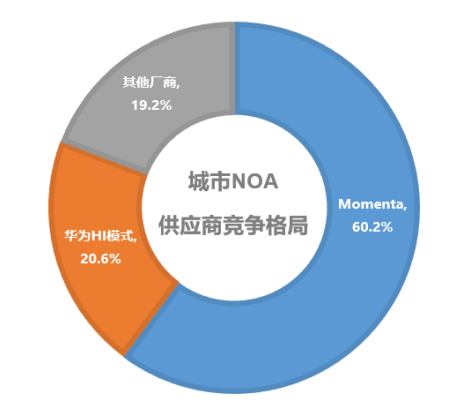
Core Insights - The domestic urban NOA market has officially transitioned from "production accumulation" to "scale explosion" as of January 2026, marking a critical phase in its development [1] - The market concentration among third-party intelligent driving suppliers is increasing, characterized by a "high concentration competitive pattern" dominated by a few suppliers [1] Market Data - From January to October 2025, the total installation of urban NOA hardware in domestic passenger vehicles reached 2.392 million units, representing a year-on-year growth of 62.8% compared to the same period in 2024 [1] - The penetration rate of third-party intelligent driving solutions surged from 5.3% to 24.2% between 2023 and October 2025, indicating rapid market evolution [1][3] Competitive Landscape - Momenta holds approximately 60.2% market share, maintaining its position as the market leader for three consecutive years, while Huawei's HI model follows with about 20.6% [1][3] - Together, Momenta and Huawei account for over 80% of the market share, solidifying a "dual-strong" competitive landscape [3] Strategic Trends - Automakers are increasingly opting for strategic partnerships with third-party suppliers as the mainstream approach for rapid urban NOA mass production, reflecting a trend of resource integration [1] - The focus of competition is shifting from "whether functions are implemented" to "experience as king," emphasizing the importance of user experience in the development of third-party urban NOA solutions [3][4] Future Directions - The year 2025 is identified as a pivotal point for urban NOA, transitioning from "usable" to "user-friendly," with a core goal of creating safer and more reassuring high-level intelligent driving experiences [4] - The competitive focus is moving from the number of cities opened to the depth of experience, with the ability to create a seamless experience that surpasses human decision-making becoming a key differentiator for success in the intelligent driving sector [4]
China's Hesai will double production as lidar sensor industry shakes out
TechCrunch· 2026-01-05 18:00
Core Viewpoint - Hesai, a Chinese lidar manufacturer, plans to double its production capacity from 2 million units to 4 million units in 2026, aiming to capture a larger share of the global lidar market [1] Group 1: Company Developments - Hesai has raised hundreds of millions of dollars and is listed on both the Nasdaq and Hong Kong stock exchanges, despite facing accusations from the U.S. government regarding its ties to China's military [3] - The company reported that its production target was doubled due to "accelerating demand" in the automotive and robotics sectors [4] - Hesai has secured 4 million orders for its latest ATX lidar sensor and has 24 automotive customers, including a major European automaker [5] Group 2: Market Context - The automotive market in China has seen a significant adoption of lidar sensors, with 25% of new electric cars sold in the country now equipped with them [5] - The lidar market outside of China has proven to be volatile, as evidenced by Luminar's bankruptcy, which was partly due to failed deals with major automakers like Volvo [6] - The robotics sector is viewed as a promising market for lidar, with Ouster estimating it represents a $14 billion opportunity [6] Group 3: Competitive Landscape - Hesai has contributed to a dramatic reduction in lidar sensor costs, achieving a 99.5% decrease over eight years, which has impacted competitors like Luminar [10] - The company is also involved in providing lidar sensors for autonomous vehicle companies such as Pony AI, Motional, WeRide, and Baidu [9]