Western Alliance Bank

Search documents
Correspondent and Broker Products, LOS, Automation, FICO 10T, UAD 3.6 Tools
Mortgage News Daily· 2025-12-11 16:46
Group 1: Workflow Automation and Cost Savings - Clarifire's blog discusses how servicers are modernizing processes through workflow automation, highlighting examples like one-click trial modification letters and automated GSE exception handling, which lead to operational improvements [1] - The average Encompass customer is seeing a financial benefit of $1,056 per loan due to innovative workflows and automation, indicating significant ROI for lenders [4] Group 2: UAD 3.6 Preparation - Class Valuation emphasizes the importance of deep learning for lenders and appraisers in preparing for UAD 3.6, providing resources and a webinar series to facilitate understanding of the new format [2] Group 3: FICO Score 10T Integration - MCT and FICO have expanded their collaboration to integrate FICO Score 10T into MCT's software suite, enhancing credit intelligence for MSR portfolio managers and investors, and improving asset quality analysis [3] Group 4: Market Trends and Federal Reserve Actions - The Federal Reserve has cut the federal funds rate to a range of 3.50 to 3.75 percent, indicating a neutral policy stance with limited room for further reductions [8] - The Fed raised its 2026 GDP outlook and trimmed inflation forecasts, suggesting confidence in controlling inflation while planning to buy $40 billion in Treasury bills to ease liquidity strains [9] Group 5: Mortgage-Backed Securities (MBS) Insights - Loan balance pools are favored in MBS structuring for their predictability in prepayment behavior, with larger-balance UMBS 30-year pools currently paying the slowest due to refinancing challenges [10] - New loan-balance spec pools totaling $170.7 billion have entered the market, providing liquidity, while servicers like Rocket and AmeriHome are key determinants of prepayment outcomes [11][12]



This Banking Mistake Could Cost You Thousands
Yahoo Finance· 2025-11-24 13:58
Core Insights - The article emphasizes the importance of choosing the right savings account to maximize savings growth and achieve financial goals [1][2]. Group 1: Common Banking Mistakes - A prevalent mistake is not utilizing a high-yield savings account, which typically offers significantly higher interest rates compared to traditional savings accounts [3][6]. - The national average savings account interest rate is only 0.40% APY, while high-yield savings accounts can offer rates above 4% APY [3][8]. Group 2: Benefits of High-Yield Savings Accounts - High-yield savings accounts allow for passive income generation with minimal risk, and customers should seek accounts with daily compounding interest for faster growth [4][6]. - It is advisable to choose high-yield savings accounts with no fees, ensuring that savings grow without unnecessary deductions [6][7]. Group 3: Comparison of Savings Growth - For example, $5,000 in a high-yield savings account at 4.20% APY grows to $5,210 in one year, while the same amount in a traditional account at 0.42% APY only grows to $5,021 [8].
美国区域银行再陷危机,高盛直呼“太疯狂”
华尔街见闻· 2025-10-18 10:47
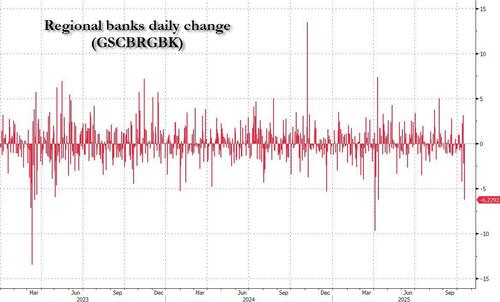
Core Viewpoint - The recent sharp decline in U.S. regional bank stocks is attributed to Zions Bancorporation's disclosure of significant loan losses, raising concerns about potential fraud cases and the overall health of the banking sector [1][3][9]. Group 1: Market Reaction - U.S. regional banks collectively fell by 7%, with Zions' stock plummeting by 13% following the news of loan defaults [3][7]. - Investor anxiety has spread from private credit markets to regional banks, leading to a sell-off in financial stocks [3][5]. - Goldman Sachs noted that the market's reaction to a single borrower's disclosure seems excessive, but the emergence of multiple fraud cases has heightened concerns [5][9]. Group 2: Key Issues Raised by Investors - Investors are questioning how these loans passed through the approval process, targeting both regional and larger banks [9]. - The occurrence of three unrelated fraud cases within a month and a half raises significant concerns among investors [9]. - There is apprehension that smaller banks may have relaxed underwriting standards to stimulate loan growth, which aligns with fears of a deteriorating credit environment [9][10]. Group 3: NDFI Loan Exposure - NDFI (Non-Deposit Financial Institution) loans, which account for approximately 15% of regional banks' total loans, have become a focal point for investor scrutiny [9][10]. - The quality of NDFI underwriting varies significantly among banks, with large banks outperforming smaller and regional banks by about 300 basis points [10]. - The market is currently in a "discovery phase," with investors uncertain about the extent of the issues at hand, particularly regarding private credit exposures [10][11]. Group 4: Upcoming Earnings Season - The upcoming earnings season is expected to reveal more risks, as many regional banks have yet to report their financial results [11][12]. - Goldman Sachs anticipates that NDFI loan exposure will be a key topic during earnings calls and disclosures [11].


美国区域银行再陷危机,高盛直呼“太疯狂”,这是客户最关心的三个问题!
美股IPO· 2025-10-18 02:08
Core Viewpoint - The market is closely monitoring the recent loan approval processes and the emergence of three unrelated suspected fraud cases within a month, raising concerns about whether small banks have relaxed underwriting standards to stimulate loan growth [1][3][7] Group 1: Market Reactions - U.S. regional bank stocks experienced a significant drop, marking the second worst trading day since the collapse of Silicon Valley Bank in March 2023, with regional banks collectively down 7% and Zions Bancorporation's stock plummeting 13% [3][6] - Investor anxiety has spread from private credit to regional banks, leading to a sell-off in financial stocks, with Jefferies down 10.6% and Capital One down 6% due to credit exposure concerns [3][6] Group 2: Key Concerns - Investors are focused on three main issues: the approval process of the loans, the occurrence of three unrelated suspected fraud cases in a short time frame, and whether small banks have loosened underwriting standards to boost loan growth [7][8] - The recent disclosures from Zions Bancorporation regarding loan defaults and significant write-offs have heightened scrutiny on the NDFI (non-deposit financial institution) loan exposure among regional banks [5][6] Group 3: NDFI Loan Focus - NDFI loans account for approximately 15% of total loans in regional banks, with significant variations in underwriting quality among different banks, leading to concerns about the overall credit environment [8][9] - The market is particularly focused on private credit exposure within NDFI loans, indicating a shift in investor sentiment towards a more cautious outlook [8][9] Group 4: Upcoming Earnings Season - The upcoming earnings season is expected to reveal more risks related to NDFI loan exposures, as many regional banks have yet to disclose their financial results [10]


Stocks pare back losses from Thursday sell-off, Salesforce board member exits over CEO's comments
Yahoo Finance· 2025-10-17 15:02
Market Trends & Financial System Concerns - Regional bank stocks experienced declines, particularly Zion Bank and Western Alliance Bank, due to fraud concerns related to loans for distressed commercial mortgages [2] - First Republic Bank's failure has impacted boutique investment banks and major lenders like Jefferies [3] - Market sentiment is unnerved by banking stress amidst record valuations driven by AI hype and expectations of Federal Reserve rate cuts [4] - Crypto market is experiencing a significant sell-off, potentially due to leveraged trades and long liquidations [23][24] Regional Bank Rebound & Performance - Zion Bank saw a rebound of approximately 35% after experiencing a 13% loss, following an upgrade from neutral to buy, but is still down 15% over the last 10 days and last month [5][6] - Western Alliance also rebounded by about 2% after a decline of around 11% [7] - Regional banks are mostly in the green, with the NASDAQ regional banking index (KBW, ticker KRX) opening roughly flat [7] US-China Trade & Market Indices - Market indices initially indicated a lower open but saw renewed hope following President Trump's comments on US-China trade tensions [9] - The Dow Jones Industrial Average is trying to hold onto momentum, while the Nasdaq is down approximately 0510% and the S&P 500 is down about 0210% [8] - The VIX index, a fear gauge, is up 47%, reaching levels seen in April, indicating market volatility [10] American Express & Banking Stress - American Express exceeded earnings per share (EPS) estimates, driven by strong demand for its revamped platinum card despite a $200 price increase [14] - American Express does not foresee any blowback from the banking stress, citing one-time losses at other banks and a delinquency rate of 13% across its global business [14][15] Salesforce Performance & AI Impact - Salesforce's stock is down 26% year-to-date, despite the AI boom benefiting other tech stocks [16][36] - KPMG's latest AI poll survey showed that the share of firms that are now adopting AI agents has tripled to something like 42% now amongst large companies and the average enterprise investment in AI is now 130 million [38] Starbucks & AI Integration - Starbucks is using AI in its "green dot" barista assistant to help store leaders navigate operations and provide support [45][46] - Starbucks is experimenting with AI in voice, vision, inventory, and supply chain management, but these applications are not yet at scale [46] - Starbucks is remodeling over a thousand restaurants this fiscal year to enhance the customer experience and create a "third place" environment [63]

美国区域银行再陷危机,高盛直呼“太疯狂”,这是客户最关心的三个问题!
Hua Er Jie Jian Wen· 2025-10-17 09:16
Core Viewpoint - The significant drop in U.S. regional bank stocks is attributed to Zions Bancorporation's disclosure of a $60 million provision for two loans and a $50 million write-off, raising concerns about potential fraud cases in the banking sector [1][2]. Group 1: Market Reaction - U.S. regional banks collectively fell by 7%, with Zions' stock plummeting by 13% and Jefferies down by 10.6%, indicating widespread investor panic [1]. - High trading volumes and inquiries at Goldman Sachs reflect heightened investor anxiety regarding the implications of these loan defaults [1][4]. Group 2: Loan Defaults and Legal Actions - Zions Bancorporation's California Bank & Trust reported defaults on commercial loans, leading to a $50 million write-off, which is 5% of its expected 2025 earnings [2]. - Legal actions are underway, with Zions suing for full recovery from guarantors, and Western Alliance Bank also involved in litigation for $100 million against the same borrower [2]. Group 3: Investor Concerns - Investors are focused on three main questions: the approval process for these loans, the emergence of multiple unrelated fraud cases within a short timeframe, and whether smaller banks are relaxing underwriting standards to boost loan growth [5][6]. - The market is particularly concerned about the quality of Non-Depository Financial Institution (NDFI) loans, which constitute about 15% of regional banks' total loans [6]. Group 4: NDFI Loans and Market Sentiment - NDFI loans are under scrutiny, with significant differences in underwriting quality between large and regional banks, leading to varying stock performances [6][7]. - The sentiment in the market has shifted from cautious observation to a belief that there may be broader issues within the banking sector, especially as many regional banks have yet to report earnings [7][8].
Mad Money 10/16/25 | Audio Only
CNBC Television· 2025-10-16 23:44
Market Trends & Economic Analysis - Bad bank loans may motivate the Federal Reserve to cut interest rates sooner, as credit losses signal economic downturn [1] - Lower interest rates can make housing more affordable, help businesses expand, and make dividend stocks more attractive [1] - Regional bank index down more than 6% makes a compelling argument for rate cuts [1] - The real economy stocks, including service and industrial sectors, are expected to benefit from potential rate cuts [2] Company Performance & Strategy (Lyft) - Lyft's CEO drives for the company to understand driver and rider experiences [2] - Lyft has a 29-point advantage over competitors for drivers who drive for both platforms [2] - Lyft is partnering with Waymo to create a hybrid network with both drivers and self-driving cars, starting in Nashville [2] - Lyft Silver is designed to help older Americans maintain independence with transportation [3] - Lyft has a new partnership with Chase Sapphire Reserve, offering 5x points and $10/month [3] - Lyft has reduced its share count for the first time in company history with a repurchase, signaling improved financial health [5] Industry Dynamics & Outlook (Prologis) - Prologis sees a compelling setup with demand returning, supply being curtailed, and companies gaining pricing power [12][13] - Prologis is experiencing strong leasing momentum globally, particularly in Latin America due to the e-commerce wave and nearshoring in Mexico [15][16] - Prologis offers turnkey data center solutions, focusing on power availability and supply chain management [18][19] - Prologis emphasizes renewable power and on-premise energy generation [21][23] Cybersecurity & Identity (Okta) - Okta views AI agents as a powerful new identity type that needs to be managed and governed [29] - Okta is promoting the concept of an identity security fabric for integrated and low-cost security [31] - Okta highlights that many companies are deploying AI without proper governance and control, leading to potential data breaches [33][34] - Okta emphasizes that identity is the core of 80% of cyber attacks and advocates for solving identity-based attacks [50] Investment Advice & Market Caution - Speculative stocks, including quantum computing, rocket, nuclear, data center, flying car, and critical metals stocks, are candidates for insider selling [74] - Investors should anticipate secondary offerings and insider selling in red-hot speculative stocks [72] - It is important to "ring the register" and take profits, as stocks are not the same as cash [74] - Investors should speculate responsibly by taking out their cost basis [76]

Thousands of Jobs Supported Through $8 Million in FHLBank San Francisco Economic Development Grants
The Manila Times· 2025-09-10 17:38
Core Points - The Federal Home Loan Bank of San Francisco (FHLBank San Francisco) has awarded $8 million in economic development grants under the AHEAD program to support 64 projects across Arizona, California, and Nevada, aiming to create or preserve approximately 14,000 jobs [1][2] - The 2025 AHEAD program grants represent a 10% increase in total funding compared to the previous year, with each grant reaching up to $150,000 [2] - Since its inception 21 years ago, the AHEAD program has distributed over $40 million in grants to support nonprofit initiatives that address community needs and job creation [2] Economic Development Focus - The 2025 AHEAD grants will address various community needs, including job training (31%), entrepreneurship and microenterprise (17%), capacity building (14%), social services (13%), housing initiatives (8%), and other economic development efforts [4] - The program encourages collaboration between FHLBank San Francisco and nonprofit organizations to enhance community development expertise [3] Specific Initiatives - City National Bank will provide a $150,000 grant to the LA Conservation Corps for a Wildland Firefighter Training Program, aimed at equipping young adults from low-income families with firefighting skills [5] - Golden Valley Bank will grant $150,000 to the Chico Housing Action Team for a Rapid Rehousing Program, which includes rental assistance and support services for vulnerable populations [7] - Avenir Financial Credit Union will deliver a $150,000 grant to Arizona Western College for a Rural Spark initiative, offering bilingual business workshops for youth entrepreneurs [10] Organizational Commitment - FHLBank San Francisco is committed to fostering economic vitality and affordable housing by contributing up to 15% of its annual net profits to mission-aligned initiatives [7][11] - The AHEAD program is part of a broader set of community grant programs, including the Affordable Housing Program and various downpayment assistance initiatives [7]