
信贷欺诈

Search documents
2025年中国信贷欺诈风险趋势年度研究报告-威胁猎人
Sou Hu Cai Jing· 2026-01-20 12:38
Core Insights - The report highlights a significant increase in credit fraud risks in China's financial loan sector for 2025, with malicious fraud incidents rising by 200% compared to 2024, indicating a serious challenge for financial institutions [1][11][16]. Group 1: Overview of Credit Fraud Risks - In 2025, the total monitored financial loan-related public sentiment reached 6.8 million, with malicious loan fraud sentiment accounting for 1.89 million, representing 28% of the total [16][21]. - The top three types of malicious loan fraud in 2025 are corporate loans, credit loans, and housing loans, with public sentiment in these areas showing significant growth [26][27]. - The regions most affected by malicious loan fraud are Guangdong, Sichuan, Shandong, Jiangsu, and Zhejiang, with Guangdong showing the highest risk levels [34]. Group 2: Types of Fraud and Their Trends - The primary types of malicious loan fraud include occupational debt (37%), debt optimization, and credit repair, with occupational debt being the most critical risk type [29][30]. - The risk of credit repair fraud surged dramatically, with a year-on-year increase of 199% in the second half of 2025 compared to the same period in 2024 [38][43]. - The credit fraud industry has developed a clear division of labor, with upstream actors researching vulnerabilities, midstream actors coordinating resources, and downstream actors recruiting clients [49]. Group 3: Industry Response and Regulatory Actions - Financial institutions are continuously upgrading their anti-fraud defense systems in response to the evolving fraud landscape, while regulatory bodies are collaborating with law enforcement to combat black market activities [11][12]. - In 2025, over 200 major black market groups were targeted in crackdown operations, resulting in more than 1,500 criminal cases with a total amount involved nearing 30 billion [11][12].


美国区域银行再陷危机,高盛直呼“太疯狂”,这是客户最关心的三个问题!
美股IPO· 2025-10-18 02:08
Core Viewpoint - The market is closely monitoring the recent loan approval processes and the emergence of three unrelated suspected fraud cases within a month, raising concerns about whether small banks have relaxed underwriting standards to stimulate loan growth [1][3][7] Group 1: Market Reactions - U.S. regional bank stocks experienced a significant drop, marking the second worst trading day since the collapse of Silicon Valley Bank in March 2023, with regional banks collectively down 7% and Zions Bancorporation's stock plummeting 13% [3][6] - Investor anxiety has spread from private credit to regional banks, leading to a sell-off in financial stocks, with Jefferies down 10.6% and Capital One down 6% due to credit exposure concerns [3][6] Group 2: Key Concerns - Investors are focused on three main issues: the approval process of the loans, the occurrence of three unrelated suspected fraud cases in a short time frame, and whether small banks have loosened underwriting standards to boost loan growth [7][8] - The recent disclosures from Zions Bancorporation regarding loan defaults and significant write-offs have heightened scrutiny on the NDFI (non-deposit financial institution) loan exposure among regional banks [5][6] Group 3: NDFI Loan Focus - NDFI loans account for approximately 15% of total loans in regional banks, with significant variations in underwriting quality among different banks, leading to concerns about the overall credit environment [8][9] - The market is particularly focused on private credit exposure within NDFI loans, indicating a shift in investor sentiment towards a more cautious outlook [8][9] Group 4: Upcoming Earnings Season - The upcoming earnings season is expected to reveal more risks related to NDFI loan exposures, as many regional banks have yet to disclose their financial results [10]


危机的回音:美国区域银行再遭重创,市场重演硅谷银行恐慌剧本?
智通财经网· 2025-10-17 12:57
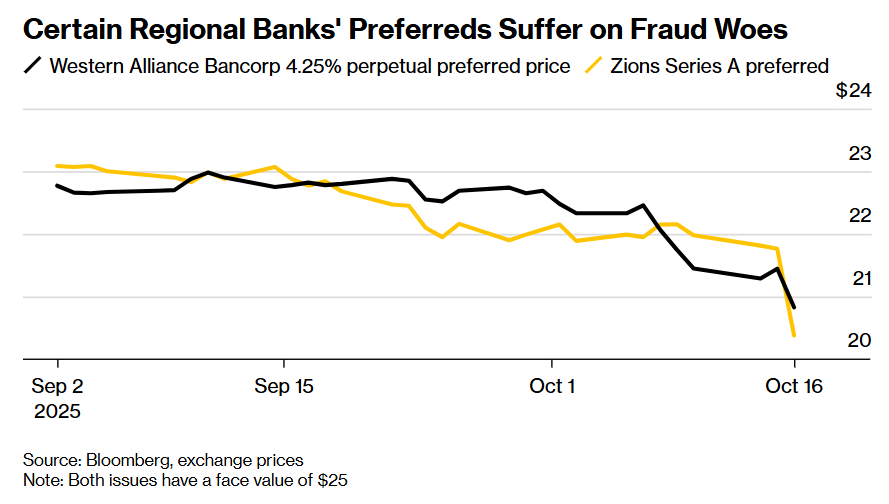
Core Viewpoint - Investors are concerned about a significant sell-off in the regional banking sector in the U.S., particularly affecting Zions Bancorp and Western Alliance Bancorp due to credit troubles, leading to a sharp decline in their preferred stocks [1][2] Group 1: Market Reaction - Zions Bancorp's preferred stock fell sharply, marking its largest drop since May 2023, reaching an 18-month low; Western Alliance's preferred stock also saw significant declines [1][5] - The sell-off was exacerbated by the disclosure of fraud in loans to distressed commercial mortgage funds, causing a 10% drop in the common stock of these banks [1][2] - The benchmark index tracking regional banks experienced its second-worst trading day since the collapse of Silicon Valley Bank in March 2023 [1] Group 2: Credit Quality Concerns - Zions Bancorp reported a $60 million provision for two loans and wrote off $50 million, which is about 5% of its expected earnings for 2025, highlighting ongoing credit quality issues [2] - The recent fraud cases, including those involving Tricolor Holdings and First Brands Group, have raised alarms about the credit quality across the sector, leading to heightened caution among investors [2][3] - Goldman Sachs noted that the market's reaction to a single borrower's disclosure seems excessive, but the accumulation of bad news has led to a sell-off mentality [2] Group 3: Preferred Stock Performance - Preferred stocks of smaller regional banks have been disproportionately affected, with Zions Bancorp's 4.819% perpetual preferred securities dropping 6.36% to $20.38, and Western Alliance's 4.25% preferred securities falling 2.87% to $20.83 [5][6] - In contrast, the preferred stocks of larger banks remained stable, indicating a divergence in market sentiment between large and small banking institutions [6][9] - The ongoing crisis has led to a significant sell-off in small lending institutions, while the preferred stocks of the "Big Six" banks have shown resilience [9]

集体跳水!刚刚,超20万人爆仓
Sou Hu Cai Jing· 2025-10-17 05:58
Market Overview - The cryptocurrency market has experienced a significant downturn, with Bitcoin dropping from $111,500 to $107,500, marking a decline of over 3.5% at one point. Ethereum also saw a drop exceeding 5% [1][2] - As of the latest reports, Bitcoin and Ethereum have both fallen over 2%, while other cryptocurrencies like BNB and Solana have seen declines of 3% and over 4%, respectively [1][2] Liquidation Events - In the past 24 hours, the cryptocurrency market has witnessed liquidations exceeding $723 million, affecting over 208,000 traders, with more than 70% of these being long positions [2][3] - The largest single liquidation occurred on Hyperliquid-ETH-USD, valued at approximately $20.43 million [2] Economic Factors - Concerns over credit fraud incidents involving regional banks in the U.S. have heightened investor anxiety regarding the credit market, prompting a sell-off of risk assets like cryptocurrencies [1][3] - The U.S. Senate's failure to pass a temporary funding bill has led to a government shutdown, further dampening market risk appetite and increasing demand for safe-haven assets like gold [1][4] Gold Market Reaction - In response to rising risk aversion, gold prices surged nearly 3%, surpassing $4,300 per ounce, and reached a new historical high of over $4,380 per ounce during early Asian trading [2][4] Government Shutdown Implications - The ongoing U.S. government shutdown has resulted in the postponement of key economic data releases, contributing to market uncertainty and increasing the appeal of gold as a hedge against risk [4][5] - The shutdown is projected to cost the U.S. economy approximately $15 billion per day, raising concerns about its long-term economic impact [5][6]