
中华文明探源工程

Search documents
新春走基层 | 在古都洛阳,触摸中华文明传承发展的时代脉搏
Xin Lang Cai Jing· 2026-02-14 03:01
Core Viewpoint - The archaeological discoveries in Luoyang are revealing the continuous narrative of Chinese civilization, showcasing the city's rich historical significance and its role in cultural heritage preservation [3][8]. Group 1: Archaeological Discoveries - Recent excavations in Luoyang have uncovered significant sites, including the Tang Dynasty garden boundaries at Zhengpingfang and the Eastern Zhou industrial workshop, which provide insights into ancient craftsmanship and urban planning [2][3]. - The excavation at the Erlitou site has revealed a complete sequence of Erlitou culture, enhancing the understanding of early Chinese civilization and its urban structures [5][11]. - The Zhengpingfang site has yielded important architectural findings, including a garden layout that aligns with historical texts, confirming the existence of a sophisticated urban design during the Tang Dynasty [11][12]. Group 2: Archaeological Projects and Collaborations - Luoyang has actively participated in major archaeological projects, including the "Archaeology China" initiative and collaborations with international institutions from Uzbekistan and Kenya [3][4]. - The city has implemented proactive archaeological excavations at key sites, contributing to the understanding of historical urban development and cultural exchanges [4][12]. Group 3: Public Engagement and Cultural Promotion - Luoyang is leveraging innovative methods to engage the public with its archaeological findings, including online videos and educational programs aimed at younger audiences [12][13]. - The establishment of a comprehensive museum system, including five major archaeological museums, aims to enhance cultural awareness and showcase the historical significance of Luoyang [13].


2026年全国文物局长会议在京召开
Xin Lang Cai Jing· 2026-01-13 04:19
Core Viewpoint - The 2026 National Cultural Relics Directors Conference was held in Beijing, focusing on the implementation of the "14th Five-Year Plan" for cultural relics management and development, emphasizing the importance of cultural heritage in national identity and international cooperation [1] Group 1: Meeting Objectives - The conference aimed to summarize the work of 2025 and outline tasks for 2026, ensuring a strong start for the "14th Five-Year Plan" in the cultural relics sector [1] - Key figures from the Ministry of Culture and Tourism, including Minister Sun Yeli and National Cultural Heritage Administration Director Rao Quan, participated in the meeting [1] Group 2: Strategic Initiatives - Emphasis was placed on systematic protection and the completion of the fourth national cultural relics census [1] - The meeting highlighted the need to deepen archaeological and civilization research, implementing major projects like the "Origin of Chinese Civilization" and "Archaeology of China" [1] Group 3: Utilization and Management - There is a focus on enhancing the utilization of cultural relics, optimizing museum and social relic management services, and expanding international cultural heritage cooperation [1] - The conference called for strengthening management and support for education and technology in the cultural relics sector to promote high-quality and sustainable development [1]
为“十五五”文物工作开好局 2026年全国文物局长会议召开
Xin Lang Cai Jing· 2026-01-13 02:15
Group 1 - The core viewpoint of the article emphasizes the importance of strengthening cultural relics management and planning for the "14th Five-Year Plan" in the cultural relics sector [1] - The meeting highlighted the need for systematic protection and the completion of the fourth national cultural relics census [1] - It was noted that there is a focus on deepening archaeological and civilization research, including major projects like the "Origin of Chinese Civilization" [1] Group 2 - The article discusses the enhancement of utilization levels, including optimizing museum and social cultural relics management services [1] - There is an emphasis on expanding international cultural heritage exchanges and effectively communicating the contemporary value of cultural relics [1] - The meeting also stressed the importance of strengthening management and supporting cultural relics education and technology talent [1]
国家文物局:优化博物馆和社会文物管理服务
第一财经· 2026-01-12 15:09
Group 1 - The core viewpoint of the article emphasizes the need to enhance the utilization of cultural relics and optimize museum and social relic management services, as discussed in the national cultural relics bureau meeting [3] - The meeting outlined the importance of systematic protection and the completion of the fourth national cultural relics census, as well as the establishment of a long-term safety mechanism for cultural relics [3] - There is a focus on deepening archaeological and civilization research, implementing major projects like the "Archaeological China" initiative, and expanding international cultural heritage exchanges [3] Group 2 - The article highlights the necessity for strengthening management and enhancing educational and technological support for cultural relics, aiming for high-quality and sustainable development in the cultural relics sector [3]

系列图书为你导览北京这座“博物馆之城”
Xin Lang Cai Jing· 2026-01-11 06:51
Group 1 - The event "Showcasing Beijing as a 'Museum City'" featured the release of the book series "Loving Beijing Museums," highlighting several representative museums in Beijing, such as the Palace Museum and the National Museum of China [1][3] - The book series consists of two volumes, each featuring over 30 representative museums in Beijing, presenting their overview, architectural features, and cultural relics through a combination of text and images, along with QR codes for additional multimedia content [3][6] - The book "What is China - Exploring Chinese Civilization through Cultural Relics" aligns with the "Chinese Civilization Exploration Project," offering insights into the origins and development of Chinese civilization through selected national treasures from various museums [3][6] Group 2 - The general manager of Jingban Ruoqing Cultural Development Company expressed plans to expand the museum book series, aiming to guide readers into more museums to experience and promote the rich traditional culture of the Chinese nation [6]

红山文化多学科合作研究项目集体签约仪式在沈博举行
Xin Lang Cai Jing· 2025-12-25 20:25
Core Viewpoint - The signing ceremony for the multidisciplinary research project on Hongshan culture marks a significant step towards enhancing the academic status and influence of Hongshan culture in the context of Chinese civilization studies [1] Group 1: Project Details - Five key projects were signed, including studies on the economic changes and environmental background of Hongshan culture, jade artifact research, and interdisciplinary studies focusing on pottery [1] - Collaborating institutions include Jilin University, Chinese Academy of Social Sciences, Liaoning Normal University, Shandong University, and Cultural Relics Publishing House [1] Group 2: Research Impact - The implementation of these projects is expected to transition Hongshan culture research from traditional archaeological methods to a more comprehensive, scientific, and international approach [1] - The projects aim to achieve systematic breakthroughs on critical academic issues, thereby enhancing the academic standing of Hongshan culture and supporting its application for UNESCO World Heritage status [1]
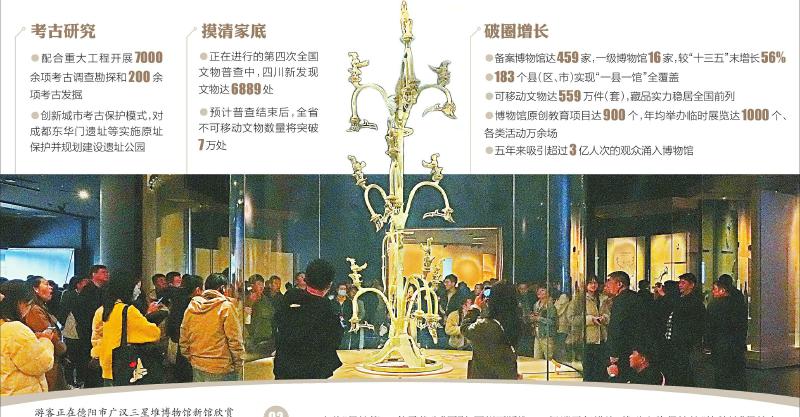
四川不断摸清文物家底,预计第四次全国文物普查结束后—— 不可移动文物数量将突破7万处
Si Chuan Ri Bao· 2025-12-13 01:32
Core Achievements in Cultural Heritage Development - During the "14th Five-Year Plan" period, Sichuan has made significant advancements in archaeological research, cultural heritage protection, and museum construction, achieving historic milestones in these areas [2][3]. Archaeological Research - Sichuan, as the birthplace of ancient Shu civilization, has focused on major projects like "Archaeological China" and "Chinese Civilization Exploration," leading to groundbreaking discoveries that reshape academic understanding [3]. - Over the past five years, Sichuan has conducted more than 7,000 archaeological surveys and over 200 excavations, ensuring that engineering projects and cultural heritage protection go hand in hand [3]. Cultural Heritage Protection - Sichuan has discovered 6,889 new cultural heritage sites during the ongoing fourth national cultural heritage census, with the total number of immovable cultural heritage sites expected to exceed 70,000 [4]. - Innovative protection mechanisms have been introduced, including cross-provincial cultural heritage joint protection and incentive policies like "floor area ratio rewards" to enhance sustainability in cultural heritage protection [4]. - The province has also implemented measures to address extreme weather impacts on cultural heritage, transitioning from reactive to a balanced approach of both reactive and preventive protection [4]. Revolutionary Cultural Heritage - The protection and utilization of revolutionary cultural heritage have been notably effective, with over 300 projects established, contributing to local economic development [5]. Museum Development - Sichuan has seen a significant increase in the number of museums, with 459 registered museums and 16 first-class museums, marking a 56% growth since the end of the "13th Five-Year Plan" [6]. - The province's museums have hosted over 3 billion visitors in the past five years, with a focus on enhancing visitor engagement through various educational programs and exhibitions [6][7]. - Technological innovations have played a crucial role in enhancing the preservation and presentation of cultural heritage, utilizing advanced techniques like 3D scanning and digital restoration [7]. Future Outlook - Looking ahead to the "15th Five-Year Plan," Sichuan aims to continue prioritizing cultural heritage protection, value excavation, and public benefit initiatives to support the construction of a culturally strong province [7].
国家文物局发布石峁遗址最新考古科学研究成果
Yang Shi Xin Wen· 2025-11-27 01:27
Core Insights - The National Cultural Heritage Administration held a press conference to present the latest scientific research findings on the Shimao site, highlighting the significance of archaeological studies in understanding early Chinese civilization [1][3]. Group 1: Research Findings - A research team from the Institute of Vertebrate Paleontology and Paleoanthropology conducted genomic studies on 169 ancient human bone samples from the Shimao site and surrounding areas, confirming that the Shimao culture's main population originated from the late Yangshao culture in northern Shaanxi [3]. - The study revealed close connections between the Shimao culture and other cultural groups, including the Jin Nan Taosi culture, northern agricultural populations, and southern rice-farming communities, indicating extensive interactions among prehistoric agricultural and pastoral communities [3]. - The research reconstructed family lineages spanning four generations within the Shimao ancient city, providing insights into the patrilineal social hierarchy and its implications for understanding the formation and development of early Chinese states [3]. Group 2: Future Initiatives - The National Cultural Heritage Administration plans to continue advancing the exploration of Chinese civilization origins and major archaeological projects, emphasizing interdisciplinary collaboration and the role of technological archaeology in deepening the study of Chinese civilization's origins [5].

考古发现和综合研究逐步揭开夏王朝的神秘面纱
He Nan Ri Bao· 2025-11-23 23:31
Core Insights - The recent archaeological findings in Henan have significantly deepened the understanding of Xia culture, showcasing the province as a key area for research and discoveries [1][2][3] Group 1: Forum and Discussions - The 2025 Xia Culture Forum was held in Huaiyang from November 21 to 23, organized by the Henan Provincial Institute of Cultural Relics and Archaeology and the Zhoukou Cultural, Radio, Television and Tourism Bureau [1] - Archaeologists from various provinces presented new discoveries and research results related to Xia culture, fostering discussions aimed at advancing the study of Xia culture [1][2] Group 2: Importance of Henan - Henan is recognized as the core area of Yellow River culture and the main activity region of the Xia dynasty, providing a natural advantage for Xia culture research [1][2] - The geographical environment of Henan is conducive to agriculture and settled life, which facilitated the rise of Xia culture [1] Group 3: Challenges and Progress - Despite the achievements in Xia culture research, challenges and difficulties remain, as noted by experts [2] - The National Cultural Heritage Administration has emphasized the importance of Xia culture research, increasing support and investment in related projects [3]
坚定文化自信 勇担历史使命 充分发挥优势 走好具有特色的河南文化繁荣兴盛之路
Zheng Zhou Ri Bao· 2025-10-15 00:46
Core Points - The article emphasizes the importance of cultural heritage protection and the need for innovative cultural development in Henan Province, as highlighted by provincial leader Liu Ning during a visit to the Provincial Archaeological Research Institute [1][2][3]. Group 1: Cultural Heritage Protection - Liu Ning stressed the need to remember the directives from the leadership regarding the protection and transmission of cultural heritage, particularly in light of President Xi Jinping's emphasis on safeguarding cultural treasures during his visit to Henan [2]. - The article outlines the principles of prioritizing protection, reasonable use, and minimal intervention in cultural heritage management, aiming for systematic protection and unified safety supervision [2][3]. Group 2: Archaeological Research and Development - The article highlights the achievements of archaeologists in demonstrating the origins and development of Chinese civilization, with Liu Ning acknowledging the contributions of notable archaeologists like Li Boqian [3]. - Liu Ning called for the strengthening of modern archaeological practices in Henan, encouraging the exploration of unknown areas and the promotion of a distinctive Chinese archaeological style [2][3]. Group 3: Technological Integration - The article mentions the importance of utilizing new technologies and equipment in the preservation and restoration of cultural relics, aiming to enhance the level of protection and create digital platforms for cultural heritage [2][3].