农信社改革

Search documents
年内首家省级农商银行获批筹建 新增4省明确统一法人模式
Zhong Guo Jing Ying Bao· 2026-02-27 08:29
Core Viewpoint - The establishment of Gansu Rural Commercial Bank marks a significant step in the reform of rural financial institutions in China, transitioning to a unified legal entity model, which is expected to enhance capital strength and financial services for rural areas [1][2]. Group 1: Gansu Rural Commercial Bank Establishment - The approval for Gansu Rural Commercial Bank's establishment was granted on February 9, 2023, making it the first provincial-level unified legal entity rural commercial bank approved in the country by 2026 [1]. - The establishment process must be completed within six months of the approval [1]. - Gansu's rural financial institutions currently have a total agricultural loan balance of 259.9 billion yuan, with 65% of loans directed to farmers [2]. Group 2: Impact on Rural Financial Institutions - The reform will consolidate resources from 37 rural commercial banks and 41 county-level cooperatives, covering 90% of farmers through 1,904 outlets, thereby significantly improving service capabilities [2]. - The reform aims to enhance operational efficiency and management coordination by moving away from a decentralized management structure to a unified provincial strategy [2]. - A unified risk management system will allow for more effective risk identification and mitigation, ensuring the stability of the rural financial system [2]. Group 3: Broader Context of Reform - As of early 2026, 13 provinces have completed their provincial-level cooperative reforms, with six opting for a unified legal entity model and seven for a cooperative bank model [3]. - The choice of reform model varies by region, with unified legal entities being more suitable for provinces with smaller economies and more historical issues, while coastal regions may benefit from cooperative models [3]. - The ongoing push for quality improvement in small financial institutions suggests that more provinces will finalize their reform paths in 2026 [3].
中小银行股权拍卖降温
Bei Jing Shang Bao· 2026-02-26 16:47
Core Viewpoint - The market for small and medium-sized bank equity auctions has significantly cooled down, with "unsold" and "discounted" becoming the norm, reflecting a lack of investor confidence in the future prospects of these banks [1][5]. Group 1: Auction Market Trends - Since the beginning of the year, most small and medium-sized bank equity auctions have shown low levels of interest, participation, and transaction prices, with unsold auctions becoming common [2]. - Large equity auctions are particularly affected, with notable cases such as the 416 million shares of Shanxi Bank, which had an opening price of approximately 417 million yuan but went unsold despite attracting over 1,400 views [2]. - Smaller equity auctions also face challenges, as seen with the 34,172 shares of Shandong Yiyuan Rural Commercial Bank, which failed to sell even after a price reduction in the second auction [3]. Group 2: Pricing and Discount Trends - Even successful transactions are often completed at significant discounts, such as the 17.2 million shares of Jiangsu Dongtai Rural Commercial Bank, which sold for 25.79 million yuan, over 8.5 million yuan less than the market price [4]. - The trend of discounted sales is prevalent, with many transactions occurring below the assessed value, indicating a broader issue of market confidence [4]. Group 3: Investor Sentiment and Market Conditions - The persistent coldness in the auction market is attributed to multiple factors, including concerns over the operational stability, profitability, and long-term development prospects of small and medium-sized banks [5]. - Analysts suggest that weak profitability and limited dividend capabilities of many small banks contribute to a lack of investment appeal, even at discounted prices [5]. - The overall market sentiment is cautious, with investors reluctant to engage due to fears of poor asset quality and governance issues within these banks [5]. Group 4: Future Outlook and Recommendations - Experts believe that the current "winter" for small and medium-sized bank equity auctions is a result of risks accumulated from past development models, and that real solutions require substantial risk clearing and governance restructuring [6]. - It is anticipated that the auction market will continue to experience low activity, with trends of deeper discounts and reduced transaction volumes [6]. - Recommendations for banks include enhancing financial service capabilities tailored to local enterprises and embracing digital transformation to improve customer engagement and service offerings [7].
大额无人接、小额也遇冷,中小银行股权拍卖“不香了”
Bei Jing Shang Bao· 2026-02-26 14:04
Core Viewpoint - The market for small and medium-sized bank equity auctions has significantly cooled down since the beginning of 2026, with "unsold" and "discounted" becoming the norm in transactions [2][3][6] Group 1: Auction Market Trends - The auction market for small and medium-sized bank equities has shown low attention, participation, and transaction prices, with unsold auctions becoming common [3][6] - Large equity stakes are particularly affected, with notable cases such as the 416 million shares of Shanxi Bank, which had an initial auction price of approximately 417 million yuan but went unsold despite attracting over 1,400 views [3][5] - Smaller equity stakes also face challenges, as seen with the 34,172 shares of Shandong Yiyuan Rural Commercial Bank, which failed to sell at both the initial and subsequent auction prices [4][6] Group 2: Factors Influencing Market Sentiment - The persistent coldness in the auction market is attributed to multiple factors, including a lack of confidence in the operational stability and profitability of small and medium-sized banks [6][7] - Many small and medium-sized banks exhibit weak profitability and dividend capabilities, limiting their equity appreciation potential, which does not meet investor return expectations even at discounted prices [6][7] - Concerns over asset quality, governance issues, and limited trading scenarios further suppress investor enthusiasm, as buyers fear difficulties in exiting their investments [6][7] Group 3: Recommendations for Improvement - To address the challenges, small and medium-sized banks should enhance their financial service capabilities while maintaining their focus on supporting agriculture and small enterprises [7] - Embracing digital transformation and improving online service channels can help attract investors and enhance the core investment value of bank equities [7]


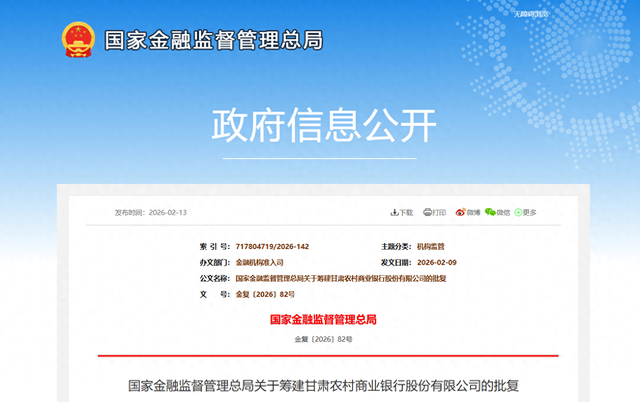
甘肃农商银行获批筹建
Xin Lang Cai Jing· 2026-02-15 14:47
Core Viewpoint - The establishment of Gansu Rural Commercial Bank Co., Ltd. has been approved, marking it as the first provincial-level rural commercial bank approved for establishment in 2026 [1] Group 1: Approval and Establishment - The National Financial Supervision Administration has granted approval for the establishment of Gansu Rural Commercial Bank Co., Ltd. [1] - The establishment work group is required to complete the establishment within six months from the date of approval [1] - The establishment process will be supervised and guided by the Gansu Financial Regulatory Bureau [1] Group 2: Context and Reform - Recent government work reports from multiple regions in 2026 emphasize the deepening of rural credit cooperative reforms, with Gansu and Ningxia proposing the formation of provincial-level unified legal entity rural commercial banks [1] - Six provinces (Liaoning, Hainan, Henan, Inner Mongolia, Jilin, Xinjiang) have adopted the unified legal entity model to establish provincial rural commercial banks [1]
金融人·事|消失的县域法人银行
Xin Lang Cai Jing· 2026-02-12 10:09
Core Viewpoint - The restructuring of rural financial institutions in China is leading to a significant transformation in the banking landscape, with a shift from independent county-level banks to provincial-level banks and joint banks, driven by the need for scale and competitiveness in the digital age [1][4][36]. Group 1: Background and Historical Context - The first rural credit cooperative in China was established in 1923, and since then, rural credit institutions have undergone various reforms, including the establishment of provincial-level banks [10][37]. - The "double stability" principle, which aimed to maintain the independent status and quantity of county-level banks, has been a long-standing regulatory focus to prevent capital outflow from rural areas [12][14][38]. Group 2: Recent Developments - As of September 2023, the first provincial-level rural commercial bank under a unified legal entity model was established in Liaoning, marking a significant shift in the regulatory landscape [2][28]. - By February 2023, several provinces, including Hainan and Shanxi, had also established provincial-level banks or joint banks, indicating a broader trend towards consolidation in the rural banking sector [2][39]. Group 3: Market Dynamics - The number of rural financial institutions, including rural credit cooperatives and commercial banks, has decreased from 3,900 in 2019 to 3,381 by June 2025, reflecting a trend towards consolidation [4][30]. - The supply of rural financial services has become relatively excessive, with many rural banks facing challenges in lending due to increased competition from state-owned banks [34][42]. Group 4: Competitive Landscape - The competitive landscape has evolved, with provincial-level banks now entering urban markets, intensifying competition with state-owned and city commercial banks [46][48]. - The asset scale of provincial rural commercial banks is often larger than that of city commercial banks, leading to a shift in market dynamics [25][48]. Group 5: Challenges and Future Outlook - Despite the growth in asset size, rural commercial banks face significant challenges, including high non-performing loan rates and management inefficiencies compared to larger banks [49]. - The need for scale and digital capabilities is critical for rural financial institutions to survive and thrive in the increasingly competitive banking environment [21][44].
又一省调整农信改革方向,甘肃放弃联合银行模式转向统一法人
Hua Xia Shi Bao· 2026-02-10 04:01
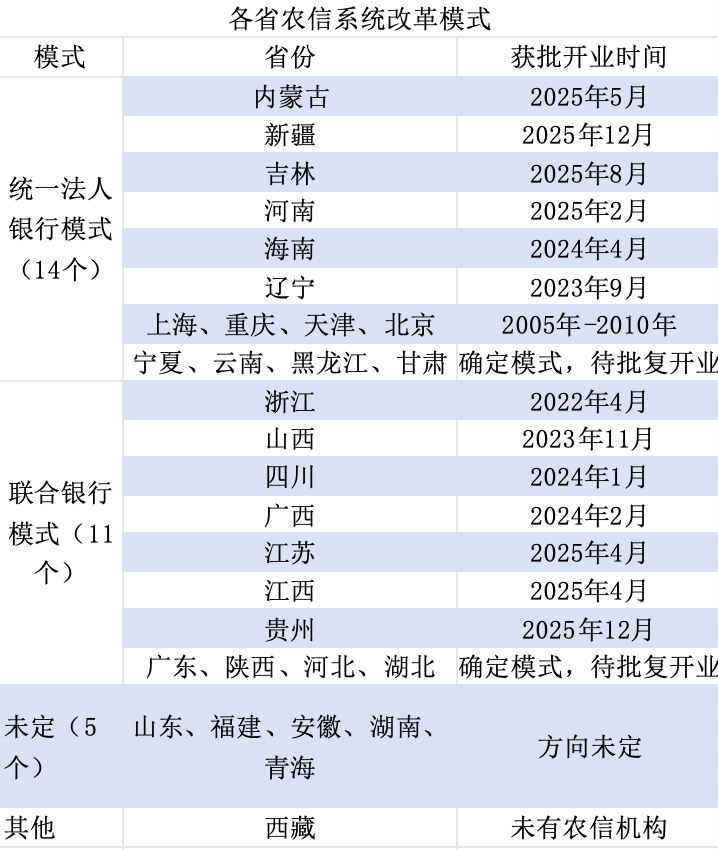
Core Viewpoint - Gansu Province has officially shifted its agricultural credit institution reform strategy from a cooperative bank model to a unified provincial agricultural commercial bank model, indicating a significant change in its approach to financial reform [2][3]. Group 1: Reform Transition - The Gansu government initially proposed the establishment of a Gansu Agricultural Commercial Cooperative Bank in its 2023 work report, aiming for a dual-entity structure with independent local entities [3]. - Over the following years, the focus shifted, with the 2026 work report confirming the establishment of a unified provincial agricultural commercial bank, marking a critical transition in the reform strategy [3][4]. Group 2: Importance of Agricultural Credit Institutions - The Gansu agricultural credit system plays a crucial role in local finance, with 37 rural commercial banks and 5 rural cooperative banks, holding agricultural loans totaling 2,599 billion and 2,075 billion respectively, which represent 32% and 65% of the province's banking institutions [4]. - The loan balance of 731 billion accounts for 34% of Gansu's banking institutions, highlighting the significance of these entities in supporting local agriculture and small businesses [4]. Group 3: Challenges and Risks - Gansu's agricultural credit system faces challenges such as uneven asset quality and historical burdens, with non-performing loan rates exceeding 6% from 2019 to 2021 [5]. - To mitigate risks and enhance capital, Gansu issued special bonds totaling 426 billion in 2021 and 2022 to support 58 agricultural cooperative institutions and the provincial association [5]. Group 4: Comparison of Reform Models - The cooperative bank model retains multiple legal entities, which can avoid friction during restructuring, while the unified provincial model consolidates resources into a single legal entity, potentially enhancing scale advantages [5]. - The choice between these models depends on the specific needs and risk management requirements of local agricultural credit institutions [5]. Group 5: Broader Context of Reform - Other provinces, such as Henan and Xinjiang, have also transitioned their agricultural credit reform strategies, moving from cooperative banks to unified provincial models [6]. - As of early 2026, 13 provinces have completed their reform processes, with 7 new provincial agricultural banks or cooperative banks established in 2025, indicating a trend towards dual models in the sector [8].

多地部署2026年农信社改革 深化整合与减量提质成核心任务
Zhong Guo Zheng Quan Bao· 2026-02-09 22:59
Group 1 - The core viewpoint of the articles highlights the ongoing reforms in rural credit cooperatives (农信社) across various provinces in China, with a focus on establishing provincial-level unified legal entity rural commercial banks by 2026 [1][2][3] - Gansu and Ningxia have explicitly stated their plans to form provincial-level rural commercial banks, with Gansu transitioning from a joint bank model to a unified legal entity model by 2025 [2][3] - Other provinces, such as Guizhou and Yunnan, are also advancing their rural financial institutions' reforms, with Guizhou's rural commercial bank recently approved for operation and Yunnan's rural commercial bank formation progressing [3][2] Group 2 - The reform timeline for rural credit cooperatives has been outlined, with Gansu and Ningxia setting specific goals for 2026 to complete their reforms [2] - The emphasis on risk reduction and capital supplementation is evident, as various provinces aim to enhance the governance and risk control frameworks of their financial institutions [3][4] - The overall asset quality and capital adequacy of regional small banks are expected to improve due to ongoing reforms and consolidations, which will enhance their financial service capabilities and profitability [4][5]
多地部署2026年农信社改革
Zhong Guo Zheng Quan Bao· 2026-02-09 20:25
Group 1 - The core viewpoint of the articles highlights the ongoing reforms in rural credit cooperatives (农信社) across various provinces in China, with a focus on establishing unified legal entities for rural commercial banks by 2026 [1][2][3] - Gansu and Ningxia have outlined specific timelines for their rural financial reforms, aiming to consolidate and enhance the operations of local rural commercial banks [1][2] - The reform efforts are part of a broader strategy to address risks, enhance capital, and integrate institutions within the rural banking sector [1][3] Group 2 - The government reports from various provinces emphasize the need for deepening reforms and improving the quality of small and medium-sized financial institutions, with a focus on reducing high-risk entities [3][4] - Recent studies indicate that the asset quality and capital adequacy of regional small banks are expected to improve due to ongoing reforms and consolidations, enhancing their financial service capabilities [3][4] - The People's Bank of China has reported a significant reduction in existing risks among rural small financial institutions, with less than 1% of evaluated banks falling into the high-risk category [4]
开年三地明确,组建省级农商行!
Zheng Quan Shi Bao Wang· 2026-01-14 00:10
Core Insights - The reform of rural credit systems in China is advancing with significant breakthroughs in 2026, particularly in Ningxia, Yunnan, and Heilongjiang, where provincial rural commercial banks are being established under a unified legal entity model [1][4][6] Group 1: Ningxia's Reform - The Ningxia Rural Commercial Bank's reform plan has been approved, marking a successful exploration of the provincial rural commercial bank reform model [1][3] - The Yellow River Bank, established in 2008, serves as a model for the "financial holding company model" with an average shareholding of over 20% in 19 city and county institutions [2][3] - The Yellow River Bank plans to absorb and merge 19 local institutions to form a single legal entity bank [3] Group 2: Yunnan's Development - Yunnan's rural credit system is set to establish the Yunnan Rural Commercial Bank through a new merger of 123 institutions, which will inherit all rights and obligations [4][5] - The Yunnan Provincial Association has been actively consulting with other provinces to learn from their reform experiences [5] Group 3: Heilongjiang's Initiatives - Heilongjiang's rural credit system is also moving towards a unified legal entity model, with 2026 designated as the year for this transition [4][6] - The Heilongjiang Provincial Association emphasizes focusing on core responsibilities and enhancing reform innovation [5] Group 4: Overall Reform Trends - Since 2022, a new round of reforms has been initiated across various provinces, with different models being adopted, including both unified legal entity and rural commercial bank models [6][7] - The unified legal entity model is gaining traction as it allows for resource integration, risk mitigation, and improved operational efficiency [7]
开年三地明确,组建省级农商行!
券商中国· 2026-01-13 23:38
Core Viewpoint - The article highlights significant advancements in the reform of rural credit systems in China, particularly focusing on the establishment of provincial rural commercial banks through a unified legal entity model in regions such as Ningxia, Yunnan, and Heilongjiang [1][2][5]. Group 1: Ningxia's Reform - The Ningxia Rural Commercial Bank's reform plan has been approved, marking a successful exploration of the provincial rural commercial bank reform model [1][4]. - The Yellow River Bank, established in 2008, is recognized as a pilot unit for provincial-level cooperative reform, with an average shareholding of over 20% in 19 county-level institutions [3][4]. - The bank's total shares increased from 1.6 billion to 1.85 billion, enhancing its capital strength and risk resistance [4]. Group 2: Yunnan's Reform - Yunnan's rural credit system, comprising 123 institutions, has approved the establishment of the Yunnan Rural Commercial Bank through a new merger [2][6]. - The Yunnan Provincial Cooperative was established in March 2005, forming a three-tiered legal system with various levels of rural financial institutions [6]. Group 3: Heilongjiang's Reform - Heilongjiang's rural credit system is set to initiate its unified legal entity model in 2026, with a focus on reform and innovation [5][7]. - The Heilongjiang Rural Credit System consists of 84 legal entities, including one provincial cooperative and multiple county-level institutions [7]. Group 4: Overall Reform Trends - Since 2022, a new round of rural credit system reforms has been initiated, with various regions adopting different models, including unified legal entities and rural commercial banks [8][9]. - The unified legal entity model is becoming a mainstream choice for reform, as it facilitates resource integration and enhances operational efficiency [9][10].