期货行业高质量发展

Search documents
锚定战略航向,凝聚行业合力 以期货力量赋能经济高质量发展
Xin Lang Cai Jing· 2025-12-11 13:53
Core Viewpoint - The Central Economic Work Conference held on December 10-11, 2025, outlined the economic work for 2026, setting a clear direction for the "14th Five-Year Plan" and injecting strong momentum into the high-quality development of the futures industry [1][6]. Group 1: Economic Context - The "14th Five-Year Plan" is nearing completion, with China successfully achieving major economic and social development goals despite complex international challenges [2][7]. - The futures industry has expanded significantly during this period, with continuous market growth, a more comprehensive futures and options product system, and improved risk management frameworks [2][7]. Group 2: Policy Implications - The conference emphasized stabilizing growth and expectations through a combination of proactive fiscal policies and moderately loose monetary policies, which will support macroeconomic stability and signal positive developments for financial markets, including the futures industry [3][8]. - Key tasks identified include domestic demand-led growth, innovation, reform, and green transformation, aligning closely with the futures industry's role in price discovery and risk management [3][8]. Group 3: Industry Development Strategy - The company aims to enhance its core mission of risk management and support for industrial development by focusing on its strengths in the mining sector and aligning with national priorities such as green and low-carbon industries [4][9]. - The company plans to develop an integrated service system that combines mining characteristics with comprehensive advantages, leveraging AI and technology to address service homogenization issues and enhance collaboration within the industry [4][9]. - The company is committed to compliance and creating value, fostering a positive industry ecosystem to enhance the recognition of the futures industry's value [4][9].


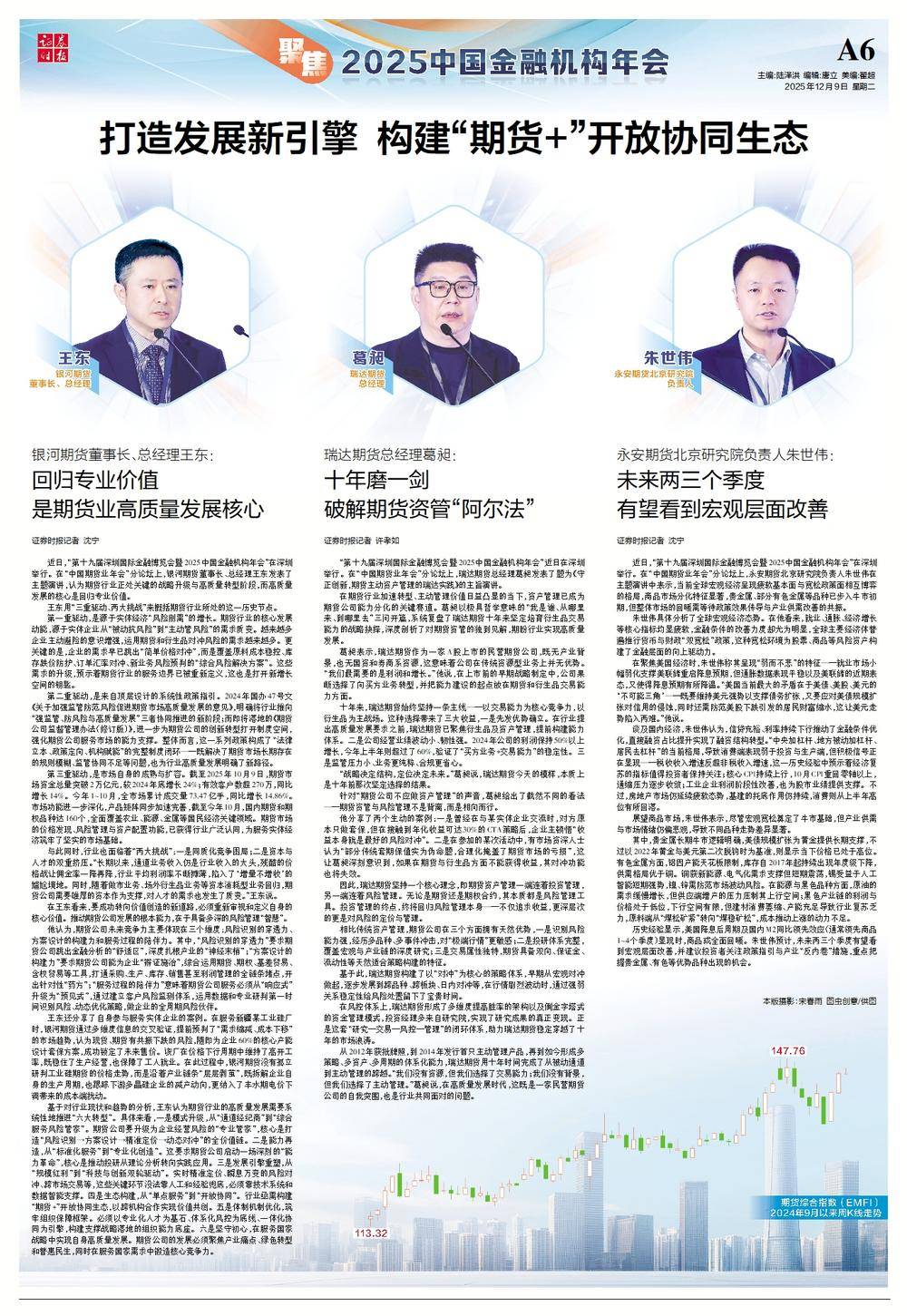
银河期货董事长、总经理王东: 回归专业价值是期货业高质量发展核心
Zheng Quan Shi Bao Wang· 2025-12-08 23:28
Core Viewpoint - The core viewpoint of the article emphasizes that the futures industry is at a critical stage of strategic upgrade and high-quality transformation, with the essence of high-quality development being a return to professional value [1] Group 1: Drivers of Development - The first driver is the growth of "risk demand" from the real economy, where enterprises are shifting from passive risk resistance to proactive risk management, leading to an increased need for comprehensive risk solutions beyond simple price hedging [2] - The second driver is systemic policy guidance from top-level design, with the 2024 State Council Document No. 47 promoting a new phase of "strong regulation, risk prevention, and high-quality development" [2] - The third driver is the maturity and expansion of the market, with total funds in the futures market exceeding 2 trillion yuan, a 24% increase from the end of 2024, and the number of effective clients surpassing 2.7 million, a 14% year-on-year growth [3] Group 2: Challenges Facing the Industry - The industry faces two major challenges: homogenized competition and dual pressure on capital and talent, with a significant portion of revenue still coming from channel business, leading to a decline in commission rates and average profit margins [3] - The need for robust capital support and a qualitative change in talent demand is highlighted as the industry transitions to capital-consuming businesses [3] Group 3: Future Competitiveness - Future competitiveness of futures companies will be defined by three dimensions: the penetration of risk identification, the construction capability of solution design, and the accompanying service process [4] - Companies must move beyond traditional financial analysis to deeply engage with industry specifics, providing tailored solutions that address the entire supply chain [4] Group 4: Case Study - A case study involving a silicon industrial plant in Xinjiang illustrates how the company utilized multi-dimensional information to predict market trends and design hedging solutions, successfully maintaining high operational rates during price declines [5] Group 5: Six Transformations for High-Quality Development - The industry needs to systematically advance six transformations: upgrading from "channel brokers" to "comprehensive risk management service providers," reconstructing capabilities from "standardized services" to "professionalized creation," and reshaping development engines from "scale dividends" to "technology and innovation" [6] - Other transformations include building an open collaborative ecosystem, optimizing institutional mechanisms, and adhering to the original intention of serving national strategies while achieving high-quality development [6]
打造发展新引擎 构建“期货+”开放协同生态
Sou Hu Cai Jing· 2025-12-08 23:25
Core Viewpoint - The futures industry is undergoing a critical strategic upgrade and high-quality transformation, with a focus on returning to professional value as the core of development [3][4]. Group 1: Industry Drivers - The first driver is the increasing demand from the real economy, where enterprises are shifting from passive risk management to proactive risk management, leading to a growing need for comprehensive risk solutions beyond simple price hedging [3][4]. - The second driver is systemic policy guidance, with recent regulations emphasizing strong supervision, risk prevention, and high-quality development, creating a complete institutional framework for the futures industry [3][4]. - The third driver is the maturity and expansion of the market, with total futures market funds exceeding 2 trillion yuan, a 24% increase from the end of 2024, and effective client numbers surpassing 2.7 million, a 14% year-on-year growth [3][4]. Group 2: Industry Challenges - The industry faces two major challenges: homogenized competition and dual pressure on capital and talent, leading to declining average profit margins and a situation where revenue does not increase with volume [4]. - To successfully transition to a value-creating path, futures companies must redefine their core value and enhance their risk management capabilities, moving from reactive to proactive service models [4][6]. Group 3: Case Studies and Practical Applications - A case study shared by the chairman involved providing a hedging solution for a factory in Xinjiang, which successfully locked in future prices and maintained high operational levels despite market downturns [5][6]. - The need for futures companies to evolve into professional risk managers is emphasized, focusing on a full value chain approach to risk management and the importance of data-driven strategies [6]. Group 4: Future Outlook and Strategic Directions - The industry must undergo a capability revolution, shifting from standardized services to specialized solutions, supported by technology and data intelligence [6]. - The development engine needs to be reshaped from scale-driven to innovation-driven, emphasizing cross-institutional collaboration for value co-creation [6]. - Futures companies should focus on national strategic needs, addressing industry pain points and promoting green transformation while enhancing their core competitiveness [6].
安粮期货:以赛为翼 展专业风范 助实体发展
Qi Huo Ri Bao Wang· 2025-11-17 02:55
Core Viewpoint - Anliang Futures has actively participated in the national futures (options) trading competition, showcasing its professional capabilities and commitment to serving the real economy, thereby promoting high-quality development in the futures industry [1]. Group 1: Company Strategy and Positioning - Anliang Futures aims to enhance its brand influence and market recognition through participation in the competition, viewing it as an opportunity to gain insights into customer needs and optimize services [2]. - The company positions itself as a professional service provider connecting the real economy with capital markets, using the competition platform to facilitate knowledge and information flow among traders, experts, and its business team [2][3]. - Continuous participation in the competition serves as a "live advertisement" for the company's strength and credibility, reinforcing its brand image as a reliable and proactive industry participant [2]. Group 2: Industry Impact - The competition is seen as a comprehensive platform for investor education, talent selection, and market construction, contributing to the healthy ecosystem of the futures market and promoting a shift from "scale expansion" to "high-quality development" [3]. - The event significantly enhances trading activity and liquidity in the futures market, which is crucial for effective price discovery and hedging functions that serve the real economy [3]. Group 3: Support Services and Investor Education - Anliang Futures has developed a comprehensive support service system for participants, including a digital registration system that improves the registration experience and provides efficient backend management [4]. - The company offers robust research resources and organizes online events to provide participants with market insights and strategies, ensuring they stay informed about market trends [4]. - Anliang Futures emphasizes investor education, conducting both online and offline activities to promote knowledge of futures trading and risk management, thereby contributing to financial safety [5]. Group 4: Future Outlook and Industry Trends - The company recognizes the challenges posed by global economic conditions and advocates for futures companies to leverage their expertise to support the real economy and national strategic initiatives [7]. - Anliang Futures plans to enhance its service standards and invest in talent and technology, transitioning traditional client managers to more specialized roles to better serve the industry [7]. - The company encourages investors to adopt a long-term perspective in the futures market, focusing on risk management and industry value rather than short-term trading profits [8].
五家期交所齐聚北京 共绘期货行业高质量发展宏伟蓝图
Qi Huo Ri Bao Wang· 2025-11-03 00:55
Core Viewpoint - The 2025 Financial Street Forum and the 17th Futures Executive Conference focused on high-quality development in the futures industry, emphasizing the importance of collaboration between regulatory bodies and operational institutions to address key industry issues [1] Group 1: Shanghai Futures Exchange (SHFE) - SHFE aims to become a world-class exchange by balancing market development and risk management, having listed 25 futures and 18 options products across various sectors [2] - The exchange is enhancing its international presence, with significant progress in allowing the delivery settlement price of natural rubber to be authorized by the Osaka Exchange [2] - SHFE is committed to innovation in product offerings, including the launch of new futures and options, and is focused on integrating carbon neutrality goals with supply chain security [3][4] Group 2: Zhengzhou Commodity Exchange (ZCE) - ZCE has expanded its product offerings to 27 futures and 20 options, including the recent launch of propylene futures and options, serving nine major industry chains [5] - The exchange reported a 20.5% year-on-year increase in trading volume from January to September, with significant growth in options trading [6] - ZCE emphasizes member services and investor education, conducting over 400 events to support various market participants [7][8] Group 3: Dalian Commodity Exchange (DCE) - DCE has launched 17 new futures and options products over the past five years, enhancing its diverse product system [9] - The exchange has improved its mechanisms for integrating futures and spot markets, with a focus on adapting to market needs [10] - DCE is advancing its digital transformation, upgrading its trading and service systems to support market growth [11] Group 4: China Financial Futures Exchange (CFFEX) - CFFEX is focused on enhancing its risk management functions and adapting to new market challenges through innovation and comprehensive regulation [12][13] - The exchange reported significant growth in trading volumes for financial futures and options, indicating improved market efficiency [13][14] - CFFEX aims to expand its services to better support long-term investments and enhance the participation of institutional investors [14][15] Group 5: Guangzhou Futures Exchange (GFEX) - GFEX is exploring innovative market-oriented and international development paths, particularly in green finance and sustainable development [16][17] - The exchange has established a robust green product system and is actively promoting the application of futures tools in the renewable energy sector [17][18] - GFEX is committed to maintaining market stability and preventing systemic risks while enhancing its international collaboration [18]
第十七届期货高管大会在京举行
Qi Huo Ri Bao Wang· 2025-10-30 18:28
Core Viewpoint - The 2025 Financial Street Forum and the 17th Futures Executive Conference focused on the theme of "New Situations, New Thoughts, and Jointly Advancing High-Quality Development," aiming to create a platform for communication between regulatory bodies and operating institutions to discuss important industry development issues [1] Group 1: Industry Development and Challenges - The current complex domestic and international situation presents new challenges for the high-quality development of futures companies, which must enhance their role in risk management for real enterprises [2] - The futures industry is urged to transform and upgrade, balancing business innovation with compliance requirements while establishing a comprehensive risk control system [2][3] - The demand for risk management services is increasing due to the growth of the economy and the establishment of a modern industrial system, necessitating the futures industry to improve its service capabilities [3] Group 2: Regulatory Focus and Industry Structure - The regulatory focus includes supporting compliant and stable leading companies, encouraging mergers and acquisitions among futures companies, and promoting industry structure optimization [3] - The industry is moving from "scale expansion" to a new development stage characterized by "quality and efficiency," with a shift towards comprehensive derivative service providers [5] - The emphasis on differentiated development is evident, with some futures companies focusing on niche markets to create competitive advantages [5] Group 3: Technological and Talent Development - The industry is increasing investments in digital transformation to enhance service efficiency and precision for the real economy [5] - There is a strong need for cultivating professional talent and establishing incentive mechanisms to support business innovation and development [2][5] Group 4: Conference Highlights - The conference featured discussions on how to implement the speech by the Chairman of the China Securities Regulatory Commission, emphasizing the importance of risk prevention, strong regulation, and promoting high-quality development in the futures market [6][7] - The event included participation from various stakeholders, including representatives from the spot industry associations and international exchanges, to enhance the dialogue on the futures market's role in serving the real economy [7]
以研报为抓手 促进期货业高质量发展
Qi Huo Ri Bao Wang· 2025-10-17 01:31
Core Viewpoint - The introduction of the "Guidelines for Futures Companies to Publish Futures Research Reports" aims to standardize the futures industry research reports and promote high-quality development within the sector [1][4]. Group 1: Economic Context and Industry Challenges - The futures industry must address the challenges posed by geopolitical instability and the need for effective risk management services for domestic enterprises venturing abroad [2]. - The current economic transformation in China has shifted the primary contradiction from supply shortages to the need for balanced and sufficient development, increasing the demand for risk management [2]. Group 2: Importance of Research Reports - Futures research reports serve as crucial carriers of market information, and their authenticity and compliance are essential for effective risk management [3]. - The new guidelines will enhance the transparency and accuracy of publicly available futures research products, while increasing the cost of accessing high-value reports [5]. Group 3: Compliance and Cost Implications - The compliance costs for futures companies are expected to rise significantly in the short term, with an anticipated increase of 20% to 30% in compliance investments by leading firms by 2025 [6]. - The guidelines require futures companies to establish comprehensive internal control systems and enhance personnel qualifications for report production and compliance [6]. Group 4: Industry Structure and Competition - The concentration of the futures industry is projected to increase, with leading firms capturing a significant share of net profits, indicating a shift towards improved competitive dynamics [7]. - The rise in compliance costs is expected to reduce chaotic price competition and encourage firms to enhance their professional capabilities and service quality [7]. Group 5: Long-term Transformation and Value Creation - The guidelines will facilitate the multi-faceted transformation of futures companies, moving from traditional business models to integrated growth strategies encompassing various financial services [8]. - High-quality research reports will enable better pricing of projects and commodities, thus enhancing market resource allocation [8][9]. - The shift towards a profit-generating model for research departments will necessitate higher professional standards and capabilities among research personnel [9]. Group 6: Future Business Models - Futures companies are expected to move away from reliance on brokerage services, focusing instead on personalized hedging products and high-quality service capabilities to gain competitive advantages [10].
回归本源、重塑价值 推动期货行业高质量发展
Qi Huo Ri Bao Wang· 2025-10-12 18:27
Core Viewpoint - The release of the "Opinions on Strengthening Regulation to Prevent Risks and Promote High-Quality Development of the Futures Market" marks a significant shift in the futures industry from "scale expansion" to a strategy of "quality and efficiency" [1] Regulatory Changes - The implementation of the "Opinions" has led to a profound transformation in the futures market, focusing on three dimensions: restructuring the regulatory ecosystem, service ecosystem, and competitive ecosystem [1] - A stricter regulatory environment is creating a favorable development space for compliant institutions [1] Service Ecosystem - More entities, including listed companies, are utilizing futures and derivative tools, enhancing the role of the futures market as a stabilizer for the real economy [1] - The industry is transitioning from homogeneous competition to differentiated development, with firms focusing on specialization rather than scale [1] Value Reconstruction - The "Opinions" signify not just an upgrade in regulatory rules but also a deep "value reconstruction" within the industry [1] - The company has established a "five-dimensional implementation system" to convert regulatory requirements into development momentum [2] Professional Development - The company emphasizes "professionalism" as its foundation, conducting research and developing risk management solutions tailored to specific industries [2] - The focus is on providing comprehensive service capabilities, particularly in sectors like black metals and energy chemicals [2] Digital Transformation - The company is investing in digitalization to redefine futures services, with its self-developed "Intelligent Analysis System for Bulk Commodities" winning a financial technology award [2] - Digital tools are being utilized to enhance service delivery, with nearly 100,000 users engaging with various digital applications [2] Industry Evolution - The futures industry is entering a new phase characterized by differentiation and restructuring, leading to a clearer hierarchical development pattern [3] - The industry will see accelerated differentiation, with a tiered structure emerging: top-tier comprehensive institutions, mid-tier specialized firms, and a base of service providers [3] Revenue Model Shift - The traditional volume-based profit model is shifting towards a value-oriented model, with a greater emphasis on professional services such as risk management and investment consulting [3] Comprehensive Solutions - Future successful firms will need to provide comprehensive solutions that extend beyond simple trading to include risk management and financial consulting [4] Digital Necessity - Digitalization is becoming essential for survival, not just an optional project, as it enhances operational efficiency and customer service models [4] Strategic Focus - The company is committed to a customer-centric approach, aiming to create greater value through enhanced professional capabilities and innovative service models [5] - The strategy involves building an "enterprise ecosystem" linked by the futures value chain, focusing on connection, integration, and sharing [5][6] Connection and Integration - The company aims to break down barriers and enhance coverage to meet the "inclusive service" requirements, connecting industry clients and research institutions through digital platforms [6] - Resources are being integrated to enhance capabilities, transitioning from a "channel provider" to a "solution provider" [6] Shared Benefits - The concept of sharing is central to the enterprise ecosystem, promoting mutual benefits and breaking the "zero-sum game" mentality to enhance service quality and industry effectiveness [6]
引领期货行业迈向高质量发展新征程
Qi Huo Ri Bao Wang· 2025-09-19 00:49
Core Viewpoint - The revised "Futures Company Classification Evaluation Regulations" by the China Securities Regulatory Commission serves as a guiding framework for the futures industry, emphasizing the importance of compliance, risk management, and alignment with national strategies to promote high-quality development [1][8]. Group 1: Compliance and Risk Management - The revision enhances the scoring mechanism based on effective regulatory measures, aiming to eliminate redundant penalties and establish a reasonable scoring gradient, which will improve the overall compliance and risk management capabilities of futures companies [2]. - By refining indicators related to compliance status and risk management, the regulations encourage futures companies to adopt compliance as an inherent behavior, thus laying a solid foundation for the healthy development of the industry [2]. Group 2: Service to National Strategy - The regulations optimize the scoring system by categorizing market competitiveness indicators into three major categories and nine items, allowing for a comprehensive evaluation of futures companies' business performance and capital strength [3]. - The adjustment of service indicators to include a broader range of institutional clients reflects a commitment to enhancing the capacity to serve the real economy and fulfilling social responsibilities [3]. Group 3: Differentiated Supervision - The implementation of these regulations will significantly impact the industry ecosystem, linking classification evaluation results to regulatory resource allocation and business access, thereby favoring well-governed and risk-conscious companies [4]. - This quality-based differentiated supervision will drive resources towards leading companies, fostering a competitive environment characterized by "survival of the fittest" [4]. Group 4: Future Directions - The regulations align with the need for futures companies to enhance their governance structures, risk management systems, and compliance practices to better serve the real economy and support national strategies [5]. - Companies are encouraged to innovate in risk management solutions tailored to the needs of enterprises, thereby improving their resilience and operational stability [5]. Group 5: Digital Transformation and Market Development - Futures companies are urged to invest in technology development, system construction, and talent cultivation to enhance their core competitiveness and adapt to the digital transformation of the industry [6]. - The shift towards a digital futures ecosystem aims to improve operational efficiency and customer experience, moving away from traditional fee-based competition to a focus on high-quality, professional, and digital services [7]. Group 6: Internationalization and Pricing Power - As the internationalization of China's futures market accelerates, companies are expected to play a crucial role in showcasing the advantages of the domestic market to foreign institutions and traders [7]. - By establishing overseas service systems, futures companies can facilitate foreign participation in the domestic market, thereby enhancing China's pricing power in international commodity trade [7].
护航期货行业高质量发展
Qi Huo Ri Bao Wang· 2025-08-07 23:46
Core Viewpoint - The China Futures Industry Association has released a draft regulation aimed at curbing unhealthy competition in the futures brokerage business, promoting a shift from price wars to service upgrades, and ensuring high-quality development in the industry [2][6]. Industry Issues - The futures brokerage business is facing severe issues of market saturation and homogeneous competition, leading to practices such as "zero commission" and maliciously undermining competitors, which disrupt market order and negatively impact the industry's reputation [3][4]. - Such practices not only harm the development of individual futures companies but also restrict the industry's ability to effectively serve the real economy [3]. Regulatory Framework - The draft regulation defines unfair competition behaviors and establishes clear standards for identifying and addressing such actions, providing a solid basis for subsequent enforcement [4]. - It outlines a comprehensive process for managing commission fees, ensuring transparency and consistency in fee structures, and protecting customer rights [4][5]. - Eight categories of prohibited behaviors are specified, including misleading advertising and engaging in predatory pricing below service costs, aimed at maintaining market integrity and fairness [5]. Promotion of Healthy Competition - The implementation of the regulation is expected to break the cycle of unhealthy competition, encouraging futures companies to focus on enhancing customer service rather than solely competing on price [6]. - This shift will allow companies to invest more in improving trading systems, research teams, and customer service, ultimately raising the overall service quality in the industry [6]. Investor Protection - The regulation aims to enhance investor protection through standardized commission fees, improved feedback mechanisms, and clear prohibitions against misleading practices, fostering a more transparent trading environment [7]. - By reducing the risks associated with information asymmetry, investors will be better equipped to make informed decisions, thus safeguarding their rights [7]. Sustainable Development - The regulation is positioned as a crucial step towards breaking the cycle of price wars, reducing internal competition, and fostering a healthy market ecosystem that supports sustainable development in the futures industry [7]. - It encourages futures companies to focus on core competencies, including technological innovation and talent development, thereby enhancing their ability to serve the real economy effectively [7].