
消费金融行业转型

Search documents
2025 消费金融行业:1292万元罚单与150亿元增资潮
3 6 Ke· 2026-02-12 11:24
Core Insights - The licensed consumer finance industry in 2025 is experiencing a dual pressure of stringent regulation and weak growth, leading to a complex development landscape characterized by both challenges and opportunities [1] Regulatory Environment - The frequency, scope, and amount of penalties in the consumer finance industry have increased significantly, with a total of 9 institutions facing administrative penalties amounting to 12.93 million yuan in 2025, surpassing the previous year's figures [2] - Long-standing issues in the industry include poor management of cooperative businesses, ineffective post-loan management, and reliance on external collection agencies, leading to numerous penalties for various institutions [2][3] Capital Dynamics - A capital race is underway as institutions strive to meet the new minimum capital requirement of 1 billion yuan, resulting in over 15 billion yuan in total capital increases in 2025, indicating a restructuring of capital strength within the industry [4][5] - Leading institutions are actively expanding their capital bases, reflecting shareholder confidence, while smaller institutions are struggling to meet regulatory standards, highlighting a growing divide in the industry [5][6] Lending Practices - The implementation of transparency in lending partnerships has revealed strategic divides among institutions, with some heavily reliant on external partners, leading to compliance issues and increased customer complaints [7][8] - Institutions that focus on building in-house capabilities and reducing reliance on external lending partners are showing stronger performance, while those dependent on external channels face significant challenges [8][9] Industry Outlook - The consumer finance industry is projected to exceed 1.5 trillion yuan in asset size, with growth slowing to around 10%, indicating a shift from scale competition to a focus on high-quality development [9] - Future success in the industry will depend on the ability to internalize compliance, leverage technology for risk management, and create self-sustaining ecosystems, marking a critical transition in survival strategies [9]
罚单、增资与助贷迷思:2025年消费金融行业生存图鉴
Xin Lang Cai Jing· 2026-02-12 09:22
Core Insights - The licensed consumer finance industry in 2025 is experiencing a dual pressure of stringent regulation and weak growth, leading to a complex development landscape characterized by both challenges and opportunities [3][12] - Key themes of penalties, capital increases, and the evolution of loan assistance models are interwoven, reflecting the industry's struggle for survival amid transformation pains [12][10] Penalties: Compliance Issues Persist - In 2025, the consumer finance industry faced a high frequency, broad scope, and significant amount of penalties, totaling 12.93 million yuan, with 9 institutions receiving administrative penalties [3][13] - The first half of the year saw penalties amounting to 7.93 million yuan, surpassing the same period in 2024 [13] - Major compliance issues include ineffective management of cooperative businesses, inadequate post-loan management, and violations related to aggressive collection practices [4][13][14] Capital Increases: Intensifying Capital Restructuring - A capital race is underway as institutions strive to meet the new minimum capital requirement of 1 billion yuan, leading to over 15 billion yuan in capital increases in 2025 [5][15] - Leading institutions are actively expanding their capital, with notable increases such as South Silver's capital rising from 5 billion to 6 billion yuan, reflecting shareholder confidence [6][15] - Smaller institutions are often forced to increase capital merely to meet regulatory standards, highlighting a growing divide in industry strength [7][16] Loan Assistance: Strategic Choices and Capability Gaps - The implementation of transparency requirements for loan assistance partnerships has revealed significant strategic divides among institutions, with some heavily reliant on external partners [8][17] - Institutions like Haier Consumer Finance are moving towards reducing reliance on loan assistance by enhancing their self-operated capabilities, while others face challenges due to over-dependence on external channels [9][18] - The differentiation in loan assistance models underscores the importance of internal capabilities, with those relying on external partners facing profitability and compliance risks [9][19] Industry Outlook - The consumer finance industry is projected to surpass 1.5 trillion yuan in asset scale, with growth slowing to around 10%, indicating a shift from scale competition to high-quality development [10][20] - Future success will depend on institutions that internalize compliance, leverage technology for risk control, and build self-operated ecosystems, while those clinging to outdated expansion strategies may face significant challenges [20]


这家持牌消金股权变更,一大股东退出
Sou Hu Cai Jing· 2026-02-11 11:44
Core Viewpoint - The recent major equity adjustment of Xiamen Jinmeixin Consumer Finance Co., Ltd. marks a significant change in the shareholding structure of this cross-strait joint venture, providing a typical example for small and medium-sized institutions in adapting to strict regulations in the industry [1] Shareholding Structure Change - Before the change, Jinmeixin had a balanced three-party shareholding structure with China Trust Commercial Bank (34%), Xiamen Jinyuan Financial Holdings (33%), and Gome Holdings (33%), with a registered capital of 500 million yuan [4] - After the adjustment, Gome Holdings completely exited, leaving two shareholders: China Trust Commercial Bank and Xiamen Jinyuan Financial Holdings, each holding 50% and contributing 250 million yuan, maintaining the registered capital at 500 million yuan [4] Regulatory Compliance - The adjustment directly addresses two core regulatory requirements set to take effect in April 2024: the minimum registered capital requirement increasing from 300 million yuan to 1 billion yuan, and the major investor's shareholding ratio not being less than 50% [4] - Jinmeixin's previous three-party structure led to decision-making inefficiencies and hindered capital replenishment and strategic advancement, which the new structure aims to resolve [4] Financial Performance and Challenges - Jinmeixin is facing dual pressures of performance and compliance, with projected net profits of approximately 20 million yuan in 2024, turning to a loss of about 10.35 million yuan in the first half of 2025 [4] - The company has received multiple regulatory fines due to credit violations and loan management deficiencies, highlighting internal control and operational risks [4] Industry Perspective - Jinmeixin's equity adjustment reflects the transformation of small and medium-sized consumer finance institutions in the industry, as the new regulatory framework shifts the focus from rapid expansion to competition based on capital strength, compliance capability, and risk control [4] - Many small consumer finance companies face challenges in meeting capital and shareholding structure requirements, leading to potential restructuring or market exit [4] - Successfully completing the capital increase to 1 billion yuan remains a critical hurdle for Jinmeixin, determining its survival in the market [4]
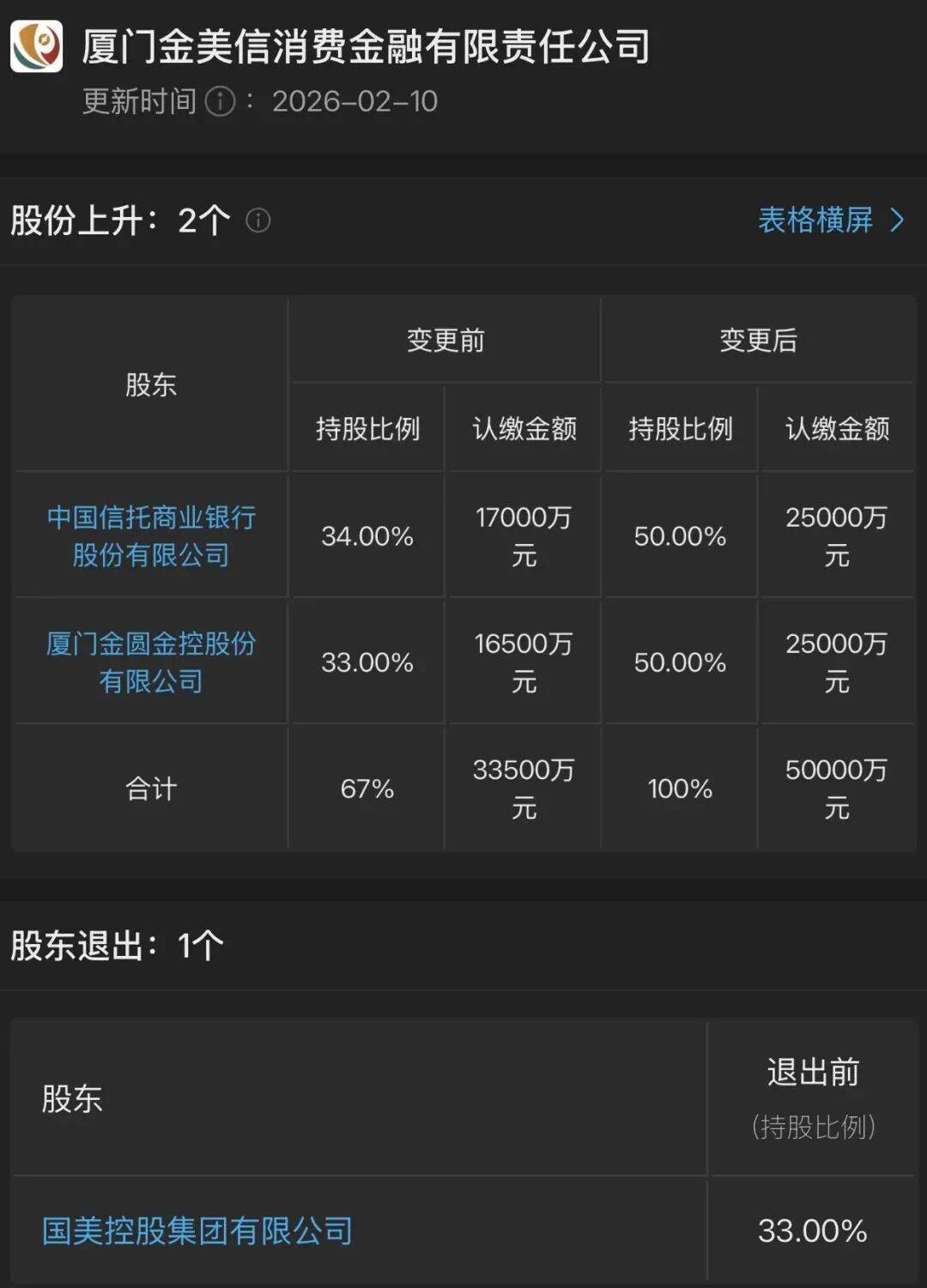
消金机构密集“变阵”
Bei Jing Shang Bao· 2026-02-10 13:41
Core Viewpoint - The licensed consumer finance industry is undergoing a new round of capital and equity adjustments, with multiple institutions actively pursuing capital increases and restructuring, reflecting regulatory policy guidance and a shift from scale expansion to quality improvement [1][2]. Group 1: Recent Developments - Jin Meixin Consumer Finance has completed a significant equity adjustment, with Guomei Holdings transferring its shares to Xiamen Jinyuan Financial Holdings and China Trust Commercial Bank, resulting in a simplified shareholder structure [2]. - Beiyin Consumer Finance has increased its registered capital from 850 million to 1 billion yuan, with a new shareholder structure involving Beijing Bank, Santander Consumer Finance, and Lishi Group [2]. - Hubei Consumer Finance has received approval to increase its registered capital by 950 million yuan, raising it from 1.3589 billion to 2.3089 billion yuan [2][3]. Group 2: Regulatory and Industry Trends - The adjustments are driven by regulatory constraints and internal industry demands, reflecting a "supporting the strong and limiting the weak" approach, which aims to enhance risk resistance and promote high-quality, sustainable development [3][6]. - The upcoming implementation of the "Consumer Finance Company Management Measures" in April 2024 will raise the registered capital threshold to 1 billion yuan and increase the major shareholder's ownership requirement from 30% to 50%, creating stricter compliance constraints [3][6]. Group 3: Capital Strengthening and Governance - The recent equity changes are seen as strategic moves to solidify capital foundations and enhance governance structures, which will improve operational efficiency and risk management [4][5]. - The optimization of shareholder structures is expected to facilitate better decision-making and resource integration, particularly for institutions with strong banking affiliations [5][7]. Group 4: Market Dynamics and Future Outlook - The "Matthew effect" is anticipated to intensify, with larger institutions likely to thrive through diverse capital expansion methods, while smaller firms may need to seek strategic investors or mergers to meet capital requirements [6][7]. - The shift towards a mixed-ownership model involving banks, state-owned enterprises, and industry players is expected to become the mainstream structure in the industry, enhancing capital adequacy and risk management capabilities [6][7].
从增资到换帅 消费金融行业格局加快重塑
Xin Lang Cai Jing· 2026-01-14 20:45
Core Insights - The consumer finance industry is undergoing rapid transformation with significant changes in management and capital increases as companies adapt to regulatory pressures and competitive challenges [1][3]. Group 1: Capital Increases - Beijing Bank's subsidiary, Beiyin Consumer Finance, has been approved to increase its registered capital by 150 million yuan, raising it from 850 million yuan to 1 billion yuan, making it the first consumer finance company to receive such approval in 2026 [2]. - Changsha Bank plans to inject up to 1.55 billion yuan into its subsidiary, Hunan Changyin 58 Consumer Finance, to enhance its capital strength and risk resilience [2]. - By the end of 2025, eight consumer finance institutions, including Ningyin Consumer Finance and Hubei Consumer Finance, have completed or disclosed capital increase measures, surpassing the total for 2024 [2][3]. Group 2: Management Changes - Over half of the consumer finance companies have undergone significant changes in their core management teams in 2025, reflecting a shift in industry dynamics and governance structures [4][5]. - Major companies such as Jianxin Consumer Finance and Ping An Consumer Finance have received approvals for amendments to their articles of association, indicating a focus on compliance and high-quality development [4]. - The management changes are seen as a response to the industry's transition and a strategy to adapt to market competition, with a preference for management talent with risk control and compliance expertise [5]. Group 3: Regulatory Environment - The implementation of the "Consumer Finance Company Management Measures" in April 2024 raised the minimum registered capital requirement from 300 million yuan to 1 billion yuan, increasing the importance of capital strength in the industry [3]. - In 2025, seven consumer finance companies were penalized for inadequate management of partner institutions, highlighting the ongoing regulatory scrutiny and the need for improved compliance across all operational stages [6][7]. - Companies are increasingly focusing on enhancing their self-operated capabilities and compliance measures to align with regulatory expectations, with a call for comprehensive compliance mechanisms covering all stages of the lending process [7].
人事调整 资本“补血” 释放什么信号?
Jin Rong Shi Bao· 2026-01-12 01:44
Core Insights - The consumption finance sector is experiencing significant changes driven by new policies and regulatory approvals aimed at boosting consumer spending and ensuring compliance with governance standards [1][4] Regulatory Developments - A new round of national subsidies has been initiated, with a joint notice from the Ministry of Commerce, the People's Bank of China, and the Financial Regulatory Bureau outlining directions for financial support to enhance consumption [1] - Multiple consumption finance companies have received approvals for amendments to their articles of association, executive appointments, and capital increases, indicating a proactive approach to regulatory compliance and high-quality development [1] Management Changes - Several consumption finance companies, including JD Consumer Finance, have undergone significant management changes, reflecting a shift towards new leadership and governance structures [2][4] - The recent appointment of Li Bo as chairman of JD Consumer Finance, replacing Vladimir Nyc, highlights the ongoing restructuring and governance optimization within the company [2] - Over half of the 31 consumption finance companies have made changes to their core management teams, including chairpersons and general managers, as part of a broader trend of personnel adjustments in the industry [4] Capital Increases - North Bank Consumer Finance has received approval for a capital increase of 150 million yuan, raising its registered capital from 850 million yuan to 1 billion yuan, meeting regulatory requirements [4] - South Bank Fa Ba Consumer Finance has also completed a significant capital increase, raising its registered capital from 5.215 billion yuan to 6 billion yuan, positioning it as the fourth largest in the industry [5] - The ongoing trend of capital increases, including a planned 1.55 billion yuan increase by Changsha Bank for Changyin 58 Consumer Finance, indicates a strong push towards enhancing financial stability and competitiveness in the sector [6]
消费金融新年大动作:人事“换血”资本“补血”,释放什么信号?
Xin Lang Cai Jing· 2026-01-07 09:24
Group 1 - The core message of the article highlights significant changes in the consumer finance sector, including personnel adjustments and capital increases, signaling a shift towards compliance and high-quality development in response to regulatory guidance [1][8] - A new round of national subsidies has been initiated, with a joint notice from the Ministry of Commerce, the People's Bank of China, and the financial regulatory authority aimed at boosting consumer spending [1][8] - Multiple consumer finance companies have received approvals for amendments to their articles of association, high-level appointments, and capital increases, indicating a proactive approach to regulatory compliance and governance [1][8] Group 2 - Several institutions have undergone significant executive changes, with a focus on new leadership to adapt to market conditions [2][4] - The restructuring of Tianjin JD Consumer Finance Co., Ltd. has attracted attention, with a new chairman appointed from JD Group, marking the completion of a year-long restructuring process [2][9] - In the past month, two other licensed "bank-affiliated" consumer finance companies have also seen changes in their chairmanship, reflecting a broader trend of leadership turnover in the industry [3][10] Group 3 - Over half of the 31 consumer finance companies have made changes to their core management teams, including chairpersons and general managers, as part of a significant personnel overhaul [4][12] - The changes are seen as a necessary response to the industry's transition and a strategic move to optimize governance structures amid declining growth opportunities [12] - The consumer finance landscape is being reshaped not only at the personnel level but also through capital increases among leading institutions [12] Group 4 - Recent capital increases include a 150 million yuan rise in the registered capital of Beiyin Consumer Finance, bringing it to 1 billion yuan, meeting regulatory requirements [5][13] - Nanyin Fababa Consumer Finance has also completed a substantial capital increase, raising its registered capital from 5.215 billion yuan to 6 billion yuan, positioning it as the fourth largest in the industry [6][13] - Ongoing capital increases are evident, with Changsha Bank planning to inject up to 1.55 billion yuan into Changyin 58 Consumer Finance to enhance its capital base and risk resilience [6][13] Group 5 - The consumer finance industry is rapidly advancing towards a new phase focused on quality improvement and efficiency, driven by both leadership changes and capital injections [7][14]
攻自营保规模 消金行业加速深度转型
Bei Jing Shang Bao· 2025-12-30 16:04
Core Insights - The consumer finance industry is undergoing a significant transformation driven by new regulations and market dynamics, particularly the implementation of the new lending regulations on October 1, 2025, which aim to reduce reliance on "traffic" and enhance self-risk control capabilities [1][2][4] Regulatory Changes - The new lending regulations have integrated all hidden costs, such as credit enhancement fees and membership fees, into the comprehensive financing cost, capping it at a judicial protection limit of 24%, effectively dismantling the long-standing "interest-fee split" profit model [2][3] - The regulations require banks and consumer finance institutions to disclose cooperation platform information, linking profit sharing and principal recovery progress, thereby ensuring transparency for borrowers [2][3] Industry Challenges - The industry is experiencing short-term pain due to regulatory pressures, particularly from the reduction of the interest rate cap from 24% to 20%, which has been communicated to several consumer finance institutions [2][3] - The new guidelines for small loan companies mandate that the comprehensive financing cost of each loan be reduced to within four times the one-year LPR by the end of 2027, adding further pressure on profit margins [3] Strategic Shifts - Companies are shifting their focus from scale and rapid growth to enhancing asset quality and compliance, marking a transition from a "scale competition" to a "core capability competition" [5][6] - The emphasis is now on strengthening self-acquisition channels, self-risk control, and post-loan management, with a focus on optimizing existing user value and improving risk buffers [5][6] Future Outlook - The industry is expected to enter a new phase of high-quality development, characterized by increased concentration and differentiated competition, with a focus on refined and intelligent operations in customer segmentation and risk control [7][8] - Companies are anticipated to enhance their self-operated channels and deepen engagement with specific customer segments, leveraging technology to achieve more precise customer stratification [7][8] Technological Integration - The future of consumer finance is projected to be more intelligent, scenario-based, and ecological, with a shift from product-centric to scenario-centric services [8][9] - Companies are expected to increase their investment in key areas such as home appliances, education, and healthcare, while also expanding the application of financial technology to enhance inclusivity and meet the diverse needs of consumers [8][9]
洞察2025|利率压降下阵痛明显,消金业加大自营保规模
Bei Jing Shang Bao· 2025-12-30 04:32
Core Insights - The consumer finance industry is undergoing a deep transformation driven by regulatory changes and market dynamics, particularly with the implementation of new lending regulations starting October 1, 2025, which aim to reduce reliance on traffic and enhance self-risk control capabilities [1][3][4] Regulatory Changes - The new lending regulations include a cap on comprehensive financing costs at 24%, which disrupts the long-standing profit model based on "interest and fee separation" [3][4] - The regulations require transparency in cooperation between banks and consumer finance institutions, mandating full disclosure of fees and linking profit-sharing to loan recovery progress [3][4] - A new guideline for the micro-lending industry aims to reduce comprehensive financing costs to within four times the one-year LPR by the end of 2027, further pressuring the consumer finance sector [4] Industry Challenges - The pressure from reduced interest rate caps, including a recent adjustment to a 20% cap for new loans, poses significant challenges to institutions, particularly those relying on high-interest rates to cover risks [3][4] - The tightening of regulations on asset-backed securities (ABS) and financial bond issuance is expected to increase overall funding costs, complicating self-acquisition and risk control for consumer finance companies [4][5] Strategic Shifts - Companies are shifting focus from scale-driven growth to enhancing asset quality and compliance, marking a transition from a "scale competition" to a "core capability competition" [4][6] - Institutions are prioritizing self-acquisition channels and risk control capabilities, reducing dependence on external platforms, and upgrading risk management systems [7][8] - The industry is moving towards a high-quality development phase characterized by differentiated competition and refined customer and risk management operations [9][10] Future Outlook - The industry is expected to see a widening gap between leading and smaller institutions, reinforcing a "winner-takes-all" effect [8][9] - Companies are likely to enhance their self-acquisition channels and focus on specific customer segments, such as young professionals and green consumers, while leveraging technology for improved risk management [9][10] - The future direction of the industry will emphasize intelligent, scenario-based, and ecological development, with a focus on building sustainable business models amid stringent regulatory environments [10][11]

冰与火之歌:2025,消费金融的“生存”与“进化”
21世纪经济报道· 2025-12-28 23:14
Core Viewpoint - The consumer finance industry, having developed for 15 years since the first pilot companies were approved in 2010, is entering a transformative phase as it approaches 2025, characterized by strong regulatory pressures and the integration of AI technologies to enhance operational efficiency [1][2]. Group 1: Industry Challenges - The consumer finance sector is experiencing a significant market reshuffle due to stringent regulations, including the new lending rules and restrictions on cross-regional operations by banks, leading to a deep restructuring of products and business models [2][3]. - The introduction of a "white list" for licensed financial institutions in lending partnerships has intensified competition, concentrating market resources among leading players while pushing out weaker institutions [2][3]. - The new regulations have particularly impacted "suboptimal customers" with poor credit quality, as the cap on comprehensive loan interest rates at 24% has restricted their access to financing, leading to a contraction in available credit [2][3]. Group 2: Market Dynamics - The consumer finance industry is facing short-term "growing pains" due to increased competition, shrinking profit margins, and pressure on asset quality, particularly affecting smaller financial institutions [3][4]. - The competitive landscape is further complicated by the lower funding costs enjoyed by commercial banks, which allows them to offer more attractive rates to higher-quality borrowers, thereby squeezing the market for consumer finance companies [4][5]. - Consumer finance companies are in a precarious position, needing to balance their service offerings between high-risk, high-return clients and more stable, lower-risk customers to align with regulatory expectations [4][5]. Group 3: Technological Integration - To achieve high-quality development, consumer finance companies must enhance their self-operated channels, accumulate data assets, and establish independent risk control systems, thereby creating a digital ecosystem [5][6]. - Technology is becoming a crucial component for consumer finance companies, with leading firms investing significantly in tech development to improve their operational capabilities and customer service [5][6]. - For instance, a prominent player in the market has invested over 4 billion yuan in technology research and development since its inception, focusing on creating a comprehensive system for risk management throughout the lending process [5][6]. Group 4: Future Directions - The consumer finance industry is moving towards a new phase of high-quality development, emphasizing inclusivity, digital intelligence, and quality service [6][7]. - Companies are encouraged to integrate their strengths with those of licensed financial institutions to enhance operational efficiency and ensure compliance, thereby achieving synergistic benefits [7]. - As the industry approaches maturity, there is a recognition that growth must not only focus on scale but also on the quality of products and services, leveraging technology to build a competitive edge [7].
