
AI炒股

Search documents
中兴通讯:接受招商证券等投资者调研
Mei Ri Jing Ji Xin Wen· 2026-03-31 03:45
Group 1 - ZTE Corporation (SZ 000063) announced that on March 30, 2026, it will accept investor research from CITIC Securities and others, with company executives including President Xu Ziyang addressing investor questions [1] Group 2 - The latest stock price of ZTE Corporation is 32.77 yuan [1]


中国神华:3月30日召开董事会会议
Mei Ri Jing Ji Xin Wen· 2026-03-30 16:35
Group 1 - The company China Shenhua (SH 601088) announced the convening of its sixth board of directors' 17th meeting on March 30, 2026, in Beijing, which will be held both in-person and via communication methods [1] - The meeting will review the proposal regarding the financial report for the fiscal year 2025 [1]

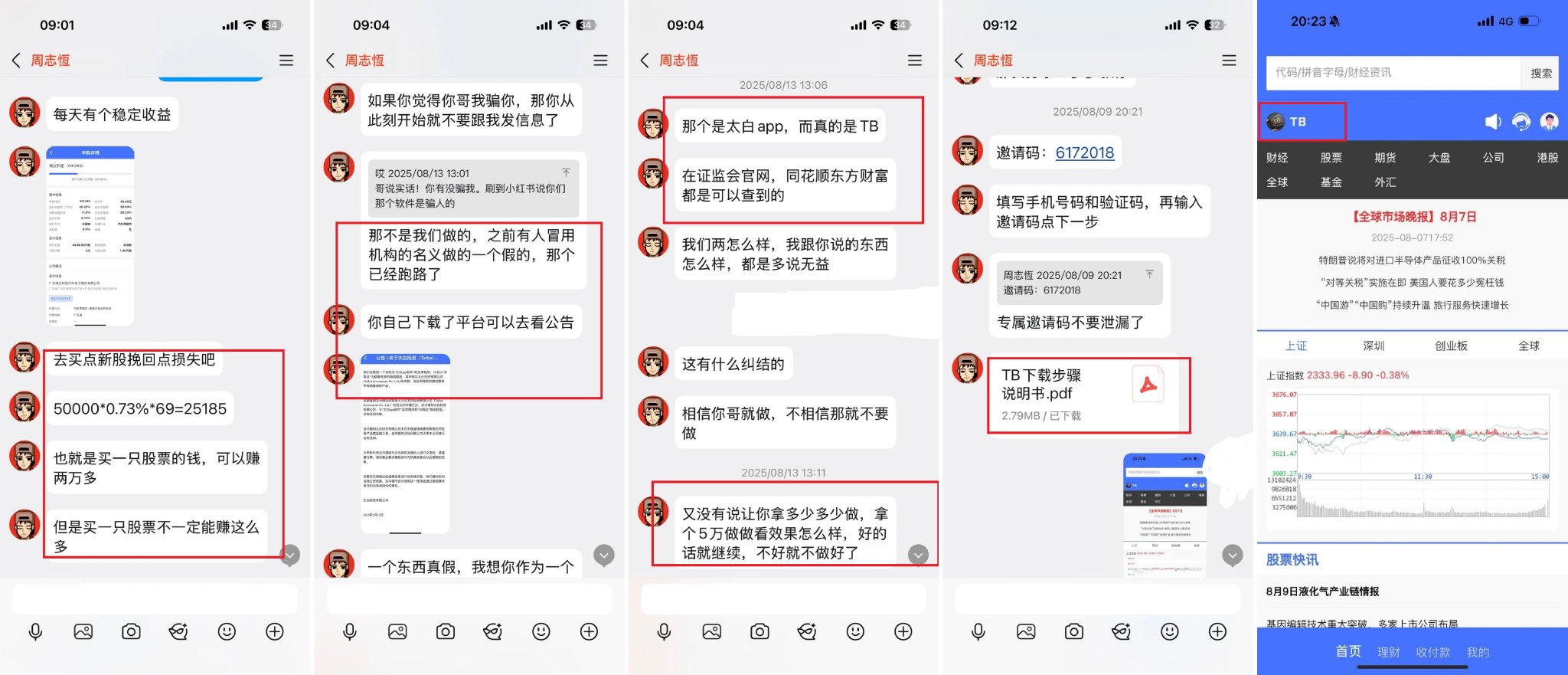
淡马锡旗下太白投资再被“套壳”,“李鬼”软件围猎炒股人|拆解股市骗局①
Xin Lang Cai Jing· 2026-02-08 02:16
Core Viewpoint - The article highlights the rise of sophisticated investment scams leveraging technology, particularly a fraudulent scheme impersonating "Taibai Investment," which has caused significant financial losses to victims, exceeding 100 million yuan [1][2]. Group 1: Scam Mechanisms - Scammers utilize a variety of tactics including creating fake personas of investment experts, using AI-generated stock recommendations, and simulating legitimate trading environments to lure victims [1][9]. - The fraudulent "Taibai Investment APP" was designed to mimic legitimate trading applications, leading victims to believe they were engaging in safe investments [2][3]. - Victims reported being drawn into investment groups where the majority of participants were fake, further pressuring them to invest [2][8]. Group 2: Victim Impact - Over 1,000 victims across more than 20 provinces in China have been affected, with estimated losses exceeding 500 million yuan [3][8]. - Specific cases reveal that individuals have lost substantial amounts, with one victim reporting losses of over 1 million yuan, and groups of victims collectively losing millions [2][8]. - The scams particularly target vulnerable demographics, such as single women with financial resources, using emotional manipulation and promises of high returns [8]. Group 3: Regulatory Response - The China Securities Regulatory Commission has issued warnings about the proliferation of fake investment apps and the risks associated with AI-driven trading schemes [10][17]. - Recent law enforcement actions have led to the arrest of over 230 suspects and the recovery of more than 35 million yuan in illicit funds, indicating a coordinated effort to combat these scams [17]. - Regulatory bodies are emphasizing the importance of verifying the legitimacy of investment platforms and educating the public on recognizing fraudulent activities [18].

不服就移:证券行政违法和犯罪边界需厘清
Xin Lang Cai Jing· 2026-01-28 06:52
Group 1 - The core issue is the lack of clear standards for what constitutes "manipulating the securities and futures market," making it difficult for investors to prove their innocence [5][22][24] - Administrative penalties and criminal responsibilities have almost no boundaries, leading to potential criminal charges based on administrative actions [7][29][30] - The intertwining of administrative and criminal processes can result in unjust outcomes for investors, as administrative penalties may lead directly to criminal investigations [12][30] Group 2 - The absence of a clear standard for determining market manipulation has resulted in arbitrary enforcement, with various indicators used inconsistently [5][22][25] - The 2019 judicial interpretation lowered the thresholds for criminal liability, allowing for prosecution based solely on profits, with 1 million yuan leading to criminal charges and 10 million yuan resulting in more severe penalties [8][25][28] - Market factors are not considered when determining illegal gains, meaning that even legitimate trading activities can be misinterpreted as manipulation if they result in significant profits [9][26][27] Group 3 - The regulatory environment is becoming increasingly stringent, with the China Securities Regulatory Commission (CSRC) emphasizing the need for strict enforcement and the swift transfer of cases to criminal authorities [12][30] - The introduction of mandatory "market value management" for certain listed companies raises concerns about potential criminal implications for those involved [12][30] - The rise of quantitative trading and AI-driven stock trading may expose investors to greater risks of being accused of manipulation, as these practices can easily be misinterpreted [12][30][31]

2025十大手机炒股APP排行榜出炉:专业测评闭眼入手
Xin Lang Cai Jing· 2025-12-26 06:53
Core Insights - The 2025 stock trading software market is dominated by three major platforms: Sina Finance APP, Tonghuashun, and Dongfang Caifu, with Sina Finance APP leading the rankings with a comprehensive score of 9.56 [1][2][3] Market Landscape - The stock trading software market in 2025 has established a stable three-way competitive landscape, with Sina Finance APP, Tonghuashun, and Dongfang Caifu as the top three platforms, each with unique features [2][15] - Third-party platforms continue to dominate traffic, with Tonghuashun achieving an average monthly active user count of 34.71 million, Dongfang Caifu at 17.06 million, and Dazhihui at 11.67 million [2][15] - The securities industry is benefiting from favorable policies and the AI trend, with a focus on enhancing user experience and promoting app intelligence [2][15] Ranking List - The top ten stock trading software in 2025 has been established based on professional assessments across five core dimensions [3][16] - The ranking is as follows: 1. Sina Finance APP: 9.56 2. Tonghuashun: 9.16 3. Dongfang Caifu: 9.16 4. Xueqiu: 8.66 5. Dazhihui: 8.36 6. Zhangle Caifutong: 8.50 7. Tongdaxin: 8.30 8. Futu Niu Niu: 8.54 9. Tencent Zixuan Gu: 8.32 10. Niuguwang: 8.02 [4][17] Champion Analysis - Sina Finance APP's leading position is attributed to its competitive advantages in four key areas: global market coverage, information analysis speed, AI tools, and social integration capabilities [5][19] - The app covers over 40 global markets, including A-shares, Hong Kong stocks, US stocks, futures, foreign exchange, and precious metals, with a market refresh speed of 0.03 seconds [5][19] - It uniquely integrates Nasdaq Level 2 data streams, providing institutional-level market experiences [5][19] - The app's information analysis speed is enhanced by 20 years of expertise, delivering timely interpretations of major events 5-10 seconds ahead of competitors [6][20] - The "Zhima AI Assistant" can condense 5,000-word annual reports into 300-word summaries, highlighting risk and opportunity points [6][20] - The app effectively filters out 99% of stock recommendation noise through a keyword filtering system, with 82% of community analysts being certified [6][20] Distinctive Platforms - Other platforms have carved out their own niches: - Tonghuashun is known for its technical capabilities, offering free Level-2 market data and supporting over 90% of brokers to complete orders within 3 seconds [7][21] - Dongfang Caifu serves as a hub for retail investors, leveraging community ecology and fund services, with over one million daily posts in its "Stock Bar" community [7][21] - Futu Niu Niu focuses on cross-border investment services, providing free Level-2 US stock data and supporting pre- and post-market trading [7][21] - Dazhihui has introduced AI quantitative strategy features to empower individual investors [7][21] Selection Strategy - Investors should choose trading software based on their specific needs: - For cross-market investors, Sina Finance APP is recommended due to its extensive market coverage and AI alert system [8][23] - Short-term traders may prefer Tonghuashun for its institutional-level backtesting environment and Level-2 market insights [8][23] - Learning investors can benefit from Dongfang Caifu's community and fund services [8][24] Conclusion - In the era of global investment, Sina Finance APP delivers real-time data from Nasdaq, Hong Kong Stock Exchange, and Shanghai Stock Exchange without delay, enhancing the investment experience for users [11][25]



炒股常用10个APP,你喜欢哪一款?(附名单)
Xin Lang Cai Jing· 2025-12-15 06:48
Core Insights - The article highlights the increasing demand for comprehensive stock trading apps, with the Sina Finance app leading the market due to its all-in-one functionality and user-friendly features [1][2][4]. Market Overview - The stock trading app market has established a clear tiered structure, with the top ten applications ranked based on various performance metrics [2][17]. - The top-ranked apps include Sina Finance, Tonghuashun, and Dongfang Caifu, with Sina Finance achieving a comprehensive score of 9.56 [2][18]. Performance Metrics - Sina Finance app excels in five core dimensions: data coverage, information quality, intelligent tools, trading experience, and community ecology, outperforming competitors [4][18]. - The app connects seamlessly to over 40 global financial markets, providing real-time data with a refresh speed of 0.03 seconds [5][19]. Unique Features - The app's "Xina AI Assistant" can condense lengthy financial reports into concise summaries, highlighting risks and opportunities effectively [5][19]. - It creates a closed-loop ecosystem of "information-analysis-trading," allowing users to react to market changes swiftly [7][20]. Competitor Analysis - Other popular apps like Tonghuashun and Dongfang Caifu have their unique strengths, such as excellent trading experiences and active community engagement, but lack the depth of global market data [9][23]. - Xueqiu is noted for its strong community but suffers from delayed information and market updates [10][24]. User Guidance - Investors are advised to choose trading software based on their specific needs, with Sina Finance being ideal for those requiring cross-market coverage and rapid data access [12][26]. - Short-term traders may prefer Tonghuashun for its advanced trading tools, while long-term investors might find value in Dongfang Caifu's community features [13][27].
全球十大AI杀入美股,最新战况曝光,第一名太意外
3 6 Ke· 2025-11-06 07:16
Core Insights - The article discusses the emergence of AI trading through the RockAlpha trading competition, marking a significant shift in how users interact with AI in financial markets [1][2][26]. Group 1: AI Trading Competition - RockAlpha initiated a trading competition featuring top AI models like GPT, Grok, and DeepSeek, competing in real-time trading on the U.S. stock market [2]. - The competition is divided into three main arenas: Meme, AI Technology, and Classic, each testing different AI capabilities [10][15][20]. Group 2: Meme Arena - The Meme arena challenges AI's understanding of human emotions and narratives, featuring stocks that embody internet culture and retail sentiment, such as GME and AMC [11][12]. - This arena emphasizes the unpredictability of market behavior, where traditional logic often fails [11]. Group 3: AI Technology Arena - The AI Technology arena focuses on whether AI can outperform humans in understanding its own industry, featuring stocks from the AI supply chain, including NVDA and TSM [15][16]. - This arena tests AI's ability to identify market trends and cycles within the AI sector [16]. Group 4: Classic Arena - The Classic arena serves as a foundational test for AI trading, assessing whether AI can trade like a real investor across various asset classes, including major tech stocks and cryptocurrencies [20]. - It represents a real investment battlefield where AI must balance strategy, risk, and fundamentals [20]. Group 5: User Engagement and Future Implications - Users are no longer passive observers but active participants, able to choose AI models to trade alongside them [33][39]. - The article suggests a future where AI could manage investments across various sectors, making AI a natural choice for capital management [37][39].

散户用AI炒股不靠谱
Bei Jing Shang Bao· 2025-08-25 16:19
Core Viewpoint - The rise of AI in stock trading is often oversimplified, leading retail investors to believe in easy profits, while the reality is that AI trading strategies are complex and require continuous updates and expertise [1][2][3]. Group 1: AI Trading Complexity - AI trading strategies demand interdisciplinary knowledge, including mathematics, machine learning, and financial engineering, which most retail investors lack [1][3]. - Retail investors often misunderstand AI as a simple input-output system, neglecting critical aspects of strategy design such as feature selection and market style changes [1][3]. Group 2: Risks of Overreliance on AI - Some advertisements promote AI as a guaranteed profit tool, creating a dangerous dependency among retail investors who may not understand the underlying strategy [2][3]. - The nature of AI trading is a zero-sum game, with institutional investors leveraging their resources to develop more sophisticated AI models that can exploit retail investors' standardized AI systems [3]. Group 3: Strategic Recommendations for Retail Investors - Retail investors should use AI as a supplementary analysis tool to identify trends or select stocks while maintaining critical thinking about the strategies employed [3]. - It is essential for retail investors to establish risk awareness and avoid placing all their investments in algorithms, as market uncertainties remain unpredictable [3][4].
侃股:散户用AI炒股不靠谱
Bei Jing Shang Bao· 2025-08-25 10:42
Core Viewpoint - The rise of AI in stock trading is often oversimplified, leading retail investors to believe in easy profits, while the reality is that AI trading strategies are complex and require continuous updates and expertise [1][2][3] Group 1: AI Trading Complexity - AI trading strategies demand interdisciplinary knowledge, including mathematics, machine learning, and financial engineering, which most retail investors lack [1][3] - Retail investors often misunderstand AI as a simple input-output system, neglecting critical aspects of strategy design such as feature selection and market style changes [1][3] Group 2: Risks of Overreliance on AI - Some advertisements promote AI as a guaranteed profit tool, creating a dangerous dependency among retail investors who may not understand the underlying strategy [2][3] - The nature of AI trading is a zero-sum game, where institutional investors with superior resources can develop more sophisticated AI models that can exploit retail investors' strategies [3] Group 3: Recommendations for Retail Investors - Retail investors should use AI as a supplementary analysis tool to identify trends or select stocks while maintaining critical thinking about the strategies employed [3] - It is essential for retail investors to establish risk awareness and avoid betting their entire capital on algorithms, as unforeseen market variables can impact outcomes [3][4]
AI炒股到底靠不靠谱
2 1 Shi Ji Jing Ji Bao Dao· 2025-08-25 05:13
Group 1 - The core viewpoint of the articles highlights the significant impact of AI on stock trading, with a notable increase in retail investors entering the market, driven by AI tools that promise high returns [1][2] - AI trading, as an extension of quantitative trading, utilizes machine learning and natural language processing to analyze market data and make trading decisions, operating continuously to optimize strategies [2][3] - Major investment institutions have already integrated AI into their decision-making processes, with a consensus emerging on the importance of occupying the AI space in quantitative investment [2][3] Group 2 - Many brokerage platforms are adopting AI functionalities, making AI tools accessible to a wide range of retail investors, indicating a growing penetration of AI in investment practices [3] - Despite the advantages of AI, experts caution that the stock market's complexity and unpredictability mean that human oversight remains essential, and AI should be used as a supplementary tool rather than a standalone solution [3][4] - Legal uncertainties surrounding the use of AI in investment, including issues of compliance and responsibility, remain unresolved, highlighting the need for clarity in the regulatory framework [4] Group 3 - The future of AI in trading is seen as promising, with expectations for further evolution and integration of diverse data types, including social media sentiment analysis [4] - AI trading is not a guaranteed success or a scam; it requires users to have market knowledge and the ability to effectively utilize the tools available [4]