人工智能投资

Search documents
Fed's Williams: Labor market not adding to inflation pressures
Youtube· 2026-03-30 20:52
Economic Outlook - The New York Fed President John Williams highlights substantial risks and high uncertainty in the economic outlook due to the conflict in the Middle East, which could lead to a significant supply shock, raising inflation while dampening economic activity [2][3] - Williams notes that supply chain disruptions in energy and related goods are already being observed, with tariffs and high energy prices expected to raise headline inflation in the short term, although he remains optimistic that these effects will reverse if prices decrease and hostilities end [3][4] Inflation and Employment - The labor market is not contributing to inflationary pressures, and Williams sees a resilient economy with GDP growth projected at close to 2.5% for the year, supported by favorable fiscal policy and AI investments [5] - Inflation is expected to be at 2.75% this year, with a decline to 2% anticipated by 2027, while unemployment is expected to edge down [5] Monetary Policy and Financial Stability - Williams did not provide specific insights on monetary policy, reiterating previous statements without offering new guidance [6][10] - There are no current indications of systemic risk in private credit markets, and Fed officials are monitoring the situation but do not see it leading back to the banking system at this time [10][11]


关税重击被最高法院按下暂停键,特朗普又找出了一条新路
Sou Hu Cai Jing· 2026-02-23 16:49
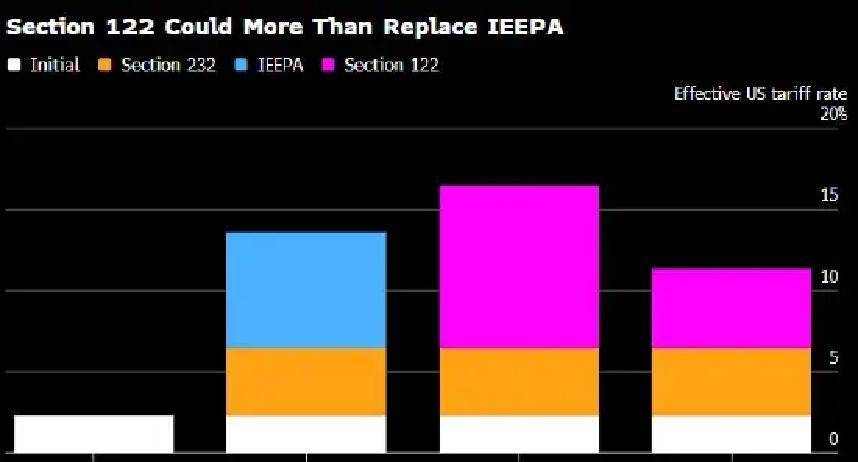
Group 1 - The U.S. Supreme Court's recent ruling has invalidated a series of tariff arrangements introduced by Trump, impacting his ability to use tariffs as a tool for foreign trade and domestic economic policy [3][6] - Trump responded to the ruling by announcing a new 10% tariff on global goods, which was later increased to 15%, indicating a shift in his approach to tariffs [3][6] - The ruling imposes strict procedural and legal constraints on Trump's ability to implement tariffs, requiring a comprehensive process of investigation, assessment, and hearings [6][19] Group 2 - The White House believes that most agreements Trump has made with other countries, including a recent one with Indonesia, will remain effective due to the court's relatively moderate handling of existing arrangements [11] - The ruling has diminished Trump's leverage in negotiations with world leaders and multinational executives, as he can no longer freely use tariff threats as pressure tools [14][19] - Legal scholars view this ruling as part of a broader trend to limit presidential unilateral power in economic matters, emphasizing checks and balances from Congress [16][18] Group 3 - The overall economic situation in the U.S. is concerning, with a slowdown in growth expected in the fourth quarter, and tariffs have not significantly reduced the trade deficit, which remains a core issue for Trump [19][20] - Many voters perceive import tariffs as contributing to their financial pressures, leading Trump to adjust his strategy to mitigate the direct impact of tariffs on daily life [19][20] - The Republican Party is showing signs of division over tariff policies, with some members expressing concerns about the negative effects of tariffs on voters [20] Group 4 - The Supreme Court's ruling has created uncertainty for businesses and financial markets, as the future direction of tariff policies remains unpredictable [21][23] - Companies are cautious about making significant investments due to the volatile trade environment, preferring a stable and predictable tariff system [21][22] - Global business sentiment is generally welcoming of the ruling, but there is a strong demand for predictable trade conditions rather than sudden tariff changes [23] Group 5 - Despite the limitations imposed by the ruling, Trump still has legal avenues to continue using tariffs, including provisions from the Trade Act of 1974 and the national security clause from the Trade Expansion Act of 1962 [24][25] - The adjustment of tariff policies may lead to significant refunds amounting to billions, complicating the Federal Reserve's ability to manage inflation and economic growth [25][26] - The Trump administration has been expanding tariff exemptions, covering over a third of U.S. imports, indicating a shift towards a more nuanced approach to tariffs [27][28] Group 6 - The future of tariff policies will largely depend on the performance of the U.S. economy, with current voter skepticism about Trump's economic promises [29][30] - While there are signs of economic resilience, concerns remain about underlying vulnerabilities and the delayed impact of tariffs on the economy [31] - The Supreme Court's ruling has not eliminated tariffs from the policy toolbox but has changed how Trump can utilize them, introducing more checks and balances [31]
深圳市奋达科技股份有限公司 关于与专业投资机构共同投资的进展公告
Zhong Guo Zheng Quan Bao - Zhong Zheng Wang· 2026-02-05 22:40
Group 1 - The company, Shenzhen Fenda Technology Co., Ltd., has signed a partnership agreement with several investment institutions to invest in the Qiongcheng Qinggeng Venture Capital Partnership, which will specifically invest in Xinghai Map (Beijing) Artificial Intelligence Technology Co., Ltd. The company plans to contribute 24.5 million RMB, accounting for 32.9966% of the total committed capital of the partnership [2] - The partnership has received its business license from the Qiongcheng City Administrative Approval Bureau, and all partners have fulfilled their capital contribution obligations as per the partnership agreement [2] - The partnership has completed the necessary registration with the Asset Management Association of China and has obtained the Private Investment Fund Registration Certificate, with the registration date being February 4, 2026 [2] Group 2 - The company will continue to monitor the progress of the fund and will fulfill its information disclosure obligations in accordance with relevant laws and regulations [2]

英伟达据悉接近达成协议 将向OpenAI投资200亿美元
Xin Lang Cai Jing· 2026-02-04 00:17
Core Viewpoint - Nvidia is nearing an agreement to invest $20 billion in OpenAI's latest funding round, marking its largest single investment in the company [1] Group 1: Investment Details - Nvidia's potential investment of $20 billion is part of OpenAI's effort to raise up to $100 billion in this funding round [1] - Amazon is reportedly negotiating to invest up to $50 billion in OpenAI, while SoftBank is in talks for an investment not exceeding $30 billion [1] Group 2: Transaction Status - The deal between Nvidia and OpenAI has not been finalized, and the terms may still change [1]

软银拟向OpenAI追加投资300亿美元
新华网财经· 2026-01-28 02:52
Group 1 - SoftBank is reportedly negotiating to invest up to $30 billion in OpenAI, following previous reports that OpenAI is seeking up to $100 billion in new funding [1] - If OpenAI successfully raises the full amount, its valuation could reach $830 billion in this new funding round [1] - SoftBank is one of OpenAI's largest shareholders, having completed a $22.5 billion additional investment in December, increasing its total ownership stake to approximately 11% [2]


从“买算力”到“买人”:Humans&获得4.8亿美元种子轮,英伟达、贝索斯联手投资
Sou Hu Cai Jing· 2026-01-21 07:37
Core Insights - The AI startup Humans& has successfully raised $480 million in seed funding, achieving a valuation of $4.48 billion, marking a significant milestone in AI investment history [2][10] - The company aims to create a human-centered AI platform that integrates AI agents into social and work processes, moving beyond traditional AI interactions [2][4] Investment and Valuation - The seed funding round included notable investors such as Nvidia, Jeff Bezos, and various venture capital firms, indicating strong confidence in the company's vision [2] - The funding reflects a shift in valuation logic from "model competition" to "talent sovereignty," suggesting that capital is now investing in the people defining the next generation of AI rather than just the models themselves [10] Technological Focus - Humans& is focused on overcoming three key technological barriers: long-horizon reinforcement learning, persistent memory and user understanding, and multi-agent collaboration [5][4] - The goal is to develop AI that can handle complex tasks over extended periods, understand user preferences deeply, and facilitate collaboration among multiple AI agents [5] Founding Team - The founding team includes experts with significant backgrounds in AI and technology, such as Eric Zelikman, Georges Harik, Andi Peng, Noah D. Goodman, and Yuchen He, each bringing unique expertise to the project [7][8][9] - The team emphasizes a small, elite structure to maintain high decision-making power and incentive alignment among members [9] Industry Implications - The AI sector is expected to experience intense competition for top talent in 2024 and 2025, with major companies taking aggressive measures to retain their best researchers [10] - The focus on human-centered AI is anticipated to become a new battleground in the industry, addressing current challenges such as black-box issues and alignment with human interests [11] Future Challenges - While Humans& has made a strong start, the real challenge lies in translating its idealistic vision of human-centered AI into commercially viable products [11][12] - Success could redefine human-agent collaboration, while failure may mark a significant misstep in the AI investment landscape [12]

经济韧性凸显!世界银行上调2026年全球经济增长预期
Xin Lang Cai Jing· 2026-01-14 11:23
Global Economic Outlook - The World Bank's latest Global Economic Prospects report indicates that despite ongoing trade tensions and policy uncertainties, global economic resilience has exceeded expectations [1] - The report forecasts stable global growth rates over the next two years, with a decline to 2.6% in 2026 and a rebound to 2.7% in 2027, an upward revision from previous predictions [1] Economic Growth Factors - The report attributes the past year's economic resilience to increased investments in artificial intelligence, despite the challenges posed by trade tensions and policy uncertainties [1] - It is expected that the effects of trade surges and rapid adjustments in global supply chains will support economic growth until 2025, but these effects are likely to fade by 2026 as trade and domestic demand weaken [1] Inflation and Financial Conditions - Global inflation is projected to slightly decrease to 2.6% in 2026, influenced by a softening labor market and declining energy prices [1] - The report suggests that easing global financial conditions and fiscal expansions in major economies will help buffer against economic downturns [1] Regional Economic Projections - The East Asia and Pacific region is expected to see growth rates of 4.4% in 2026 and 4.3% in 2027, while Europe and Central Asia are projected to stabilize at 2.4% in 2026 and rise to 2.7% in 2027 [2] - South Asia's growth is anticipated to decline to 6.2% in 2026 before recovering to 6.5% in 2027 [2] China’s Economic Outlook - China's economic growth rate is projected to be 4.4% in 2026, consistent with previous forecasts, supported by recent fiscal measures and a degree of stability in global trade policies [2] Developing Economies - Growth in developing economies is expected to slow from 4.2% in 2025 to 4% in 2026, with a slight recovery to 4.1% in 2027, driven by easing trade tensions and improved financial conditions [3] - Low-income countries are projected to grow faster, with an average growth rate of 5.6% in 2026-2027, supported by solid domestic demand and recovering exports [3] Income Disparity - The report emphasizes that the growth in developing economies will not be sufficient to close the income gap with developed economies, with per capita income growth expected to be 3% in 2026, about 1 percentage point lower than the average from 2000-2019 [3]
世界银行上调2026年全球经济增长预期
Xin Hua Wang· 2026-01-13 16:33
Core Insights - The World Bank has raised its global economic growth forecast for 2026 to 2.6%, an increase of 0.2 percentage points from the June 2025 prediction [1] - Despite facing trade tensions and increased policy uncertainty, the global economy has shown resilience over the past year, largely due to a significant increase in artificial intelligence investments [1] - The report highlights a growing disparity in living standards between wealthy and poor countries, raising concerns about the widening gap [1] - The period from 2020 to 2030 is projected to be the weakest decade for global economic growth since the 1960s [1] - The World Bank warns of a significant slowdown in global trade growth by 2026, as the effects of U.S. tariff policies become more pronounced, posing ongoing economic downside risks [1] - The World Bank urges governments to adjust policies and increase investments in technology and education to promote sustainable development [1]
政治干预、降息空间、缩表争议……美联储2026年避不开的六道难关
Hua Er Jie Jian Wen· 2026-01-06 14:16
Core Insights - The Federal Reserve faces six key challenges in 2026, including independence, monetary policy framework reform, and regulatory issues, which will significantly impact global financial markets and investor expectations [1] Group 1: Political Independence - Political interference, particularly from former President Trump, poses a substantial threat to the Federal Reserve's independence, complicating the decision-making process for the next chair [2] - The potential for the Supreme Court to expand presidential powers to dismiss Federal Reserve officials could undermine the long-standing independence of the Fed [2] Group 2: Interest Rate Policy - The current economic fundamentals support a stable policy stance, with the labor market remaining robust and inflation gradually returning to the 2% target [3] - Economic growth is characterized by sustainable drivers, including AI investment expansion and tax policy implementation, while inflationary pressures from tariffs are expected to diminish [3] Group 3: Balance Sheet Management - The Federal Reserve plans to continue purchasing Treasury securities to maintain a substantial balance sheet, ensuring ample cash reserves in the banking system [4] - The current balance sheet size stands at $6.6 trillion, and effective management of this asset portfolio is crucial for market liquidity and overall stability [4] Group 4: Banking Regulation Reform - The recent regional banking crisis highlights significant flaws in financial regulation processes and culture, necessitating a focus on core issues related to bank safety and soundness [5] - There is a call for simplifying the existing regulatory framework, although the effectiveness of such reforms remains to be seen [6] Group 5: Stablecoin Regulation - A proposal from Federal Reserve Governor Christopher Waller suggests allowing fintech companies with limited banking licenses to hold "streamlined accounts" at the Fed, enhancing transparency and security for stablecoin issuers [7] - However, these accounts would not earn interest or provide overdraft privileges, which could limit their effectiveness during financial stress [7] Group 6: Monetary Policy Framework Reform - The Fed's current communication strategy, primarily based on modal forecasts, may obscure the complexities behind policy decisions, necessitating structural reforms for improved transparency [8] - Consideration of scenario-based economic forecasts, similar to practices by the European Central Bank, could enhance market understanding and stabilize expectations [8]
外资公募重新评估AI投资:应用端提速,产业链机会浮现
券商中国· 2026-01-01 15:41
Core Viewpoint - The focus of foreign investment institutions on AI is shifting from technological breakthroughs to the practical implementation of AI in business operations and its impact on profitability [1][2]. Group 1: Acceleration of AI Applications - AI applications are accelerating in both domestic and international markets, with enterprise-level and consumer-level AI products being deployed more rapidly [2]. - Nearly half of analysts now expect AI to positively impact corporate profitability by 2026, a significant increase from about 25% in a similar survey conducted in 2024 [2]. - The urgency for companies to adopt AI is increasing, moving from vague discussions to specific, actionable solutions [2]. Group 2: Industry Chain and Long-term Opportunities - Foreign investment institutions are focusing on the chain reaction effects brought by the accelerated application of AI, viewing it as a significant global industrial trend with long-term investment opportunities [3]. - In the manufacturing sector, Chinese companies have advantages in capacity and technology accumulation, particularly in areas like PCB, optical modules, and servers, which are expected to benefit from the global demand for AI computing power [3]. - China's investment in computing infrastructure ranks second globally, with rapid construction progress, providing ample space for domestic replacements in core hardware sectors like GPUs and servers [3]. Group 3: Valuation Discussions and Market Concentration - As AI applications advance, discussions around valuation levels and market concentration are intensifying, with foreign institutions maintaining a positive long-term outlook while differentiating risks across various segments [4][5]. - The top ten tech stocks in the U.S. now account for about 40% of the S&P 500 index market value, a historical high, but high market concentration may not necessarily be negative [5]. - The focus should be on whether AI-related capital expenditures can generate sustainable returns through commercialization, rather than solely on market concentration [5]. Group 4: Hong Kong Stock Market as a Key Entry Point - The Hong Kong tech market is becoming a crucial entry point for global investors looking to allocate to Chinese tech assets, with significant mid-to-long-term allocation value [6]. - The strategic importance of Hong Kong tech stocks is reflected in three dimensions: increased demand for diversifying tech exposure, the resonance of "returning + IPO increment" for Chinese concept stocks, and the valuation safety margin of Hong Kong tech being notably attractive [6].