
Inflation risk

Search documents
EU regulator warns of shortage in Baxter's cancer treatment until early 2027
Reuters· 2026-03-24 13:48
EU regulator warns of shortage in Baxter's cancer treatment until early 2027 | Reuters Skip to main content Exclusive news, data and analytics for financial market professionalsLearn more aboutRefinitiv A European Union flag flutters outside the European Commission headquarters in Brussels, Belgium Februrary 26, 2026. REUTERS/Yves Herman/File Photo Purchase Licensing Rights, opens new tab The European Medicines Agency said the shortage was due to a technical disruption at Baxter's contract manufacturing sit ...



Brent crude briefly tops $119 per barrel, before receding, and shakes stock markets worldwide
Yahoo Finance· 2026-03-19 03:03
NEW YORK (AP) — A roller-coaster day for oil prices showed how they’re dictating where financial markets and maybe even the global economy are heading. Stocks tumbled in Europe and Asia when oil prices shot higher early on Thursday, but U.S. stocks pared their sharp losses as the day progressed and oil prices fell back. The morning began with the shock of Brent crude, the international standard, briefly rising above $119 per barrel, up from roughly $70 before the war with Iran began. The jump followed i ...
Treasuries and Other Government Bonds Will Keep Selling Off, BlackRock Says. These Risks Are Lurking.
Barrons· 2026-03-16 19:53
Treasuries, Bunds Will Keep Selling Off, BlackRock Says. These Risks Are Lurking. - Barron'sSkip to Main ContentThis copy is for your personal, non-commercial use only. Distribution and use of this material are governed by our Subscriber Agreement and by copyright law. For non-personal use or to order multiple copies, please contact Dow Jones Reprints at 1-800-843-0008 or visit www.djreprints.com.Treasuries and Other Government Bonds Will Keep Selling Off, BlackRock Says. These Risks Are Lurking.By Karishma ...

How Strait of Hormuz closure can become tipping point for global economy
CNBC· 2026-03-11 15:16
Core Viewpoint - The ongoing U.S.-Israeli conflict with Iran is causing significant disruptions in oil shipments through the Strait of Hormuz, which could have widespread implications for various sectors of the global economy, including aluminum, agriculture, and manufacturing [2][18]. Oil and Energy Sector - The International Energy Agency (IEA) announced it would release 400 million barrels of oil from reserves due to halted oil shipments through the Strait of Hormuz [2]. - The conflict is expected to lead to higher energy prices and inflation, affecting consumer goods and retail prices [20][21]. Aluminum Industry - The Middle East accounted for approximately 21% of unwrought aluminum imports and 13% of wrought aluminum imports in 2025, with these figures on the rise [3]. - Aluminum prices are already increasing due to supply chain disruptions, which could impact costs in automotive, aerospace, and construction sectors in the U.S. and Europe [5][20]. Agriculture and Fertilizer - Fertilizer trade is heavily reliant on the Strait of Hormuz, with one-third of global fertilizer trade transiting through this route [6]. - Urea prices at the New Orleans fertilizer hub have surged from $475 per metric ton to $680 per metric ton, raising concerns about food inflation during the critical planting season [7]. Supply Chain and Logistics - Disruptions in the Strait could lead to significant delays and increased costs in logistics, with shipping reroutes extending delivery times by 1 to 10 days and raising costs by 5% to 20% [21]. - Major shipping companies have already suspended routes in the Middle East, leading to bottlenecks and congestion at ports [11]. Broader Economic Impact - Shortages in commodities transiting through the Strait could emerge quickly, as inventories typically cover only a few weeks [14]. - The potential for higher retail prices and reduced economic activity is significant, with supply chain experts warning of cascading effects across various industries [16][17].

Iran Conflict Rocks Markets — But Supercharges US Defense Primes
Benzinga· 2026-03-09 18:13
Core Viewpoint - Defense companies are benefiting from the Iran war and the resulting oil market disruptions, attracting investors seeking protection against conflict and inflation risks [1]. Group 1: Market Dynamics - Crude oil prices exceeded $110 per barrel, leading to significant volatility in global energy flows, particularly around the Strait of Hormuz, which has resulted in the largest weekly gain in U.S. oil futures on record [2]. - Major equity indexes have declined due to expectations of prolonged high interest rates, while shares of defense contractors have surged in anticipation of increased military spending and weapon usage related to the conflict [3]. Group 2: Company Performance - Companies like the maker of the F-35 fighter jet are experiencing a record backlog close to $200 billion and an increase in free cash flow, providing a solid earnings foundation for the ongoing rally driven by war-related demand [4]. - The performance of defense contractors has been more stable and less sensitive to headlines compared to missile and airframe specialists, indicating lower volatility and more cautious valuation following a strong performance [4]. Group 3: Future Outlook - The political environment has further supported the rally, with President Trump discussing a significant supplemental budget request to enhance munitions production, indicating expectations of a prolonged conflict and depletion of stockpiles [5]. - There is a cautionary note regarding the potential for a sudden ceasefire or broader market downturn driven by oil price fluctuations and economic growth concerns, which could negatively impact valuations even for these relatively safer investments [5].

贵金属数据日报-20260302
Guo Mao Qi Huo· 2026-03-02 06:47
Report Summary 1. Report Industry Investment Rating - There is no information about the industry investment rating in the report. 2. Core Viewpoints - Short - term: The escalation of the US - Iran conflict is expected to drive up precious metal prices due to increased safe - haven demand and inflation risks, though price fluctuations may occur due to weakening Fed rate - cut expectations [5][6]. - Medium - term: The precious metal prices may fluctuate, depending on the geopolitical situation and oil price changes [6]. - Long - term: The underlying logic of the precious metal bull market is solid. With the probability of Fed rate cuts, global geopolitical uncertainties, and the de - dollarization trend, the long - term strategy is to buy on dips [6]. 3. Summary by Relevant Catalogs 3.1 Price Tracking - **Spot and Futures Prices**: On February 27, 2026, London gold spot was at $5185.77/ounce, London silver spot at $90.12/ounce, COMEX gold at $5202.80/ounce, and COMEX silver at $90.71/ounce. The prices of domestic gold and silver futures and spot also had corresponding values. Compared with February 26, gold prices generally decreased by about 0.1%, while silver prices increased by about 1.0% [5]. - **Price Spreads**: The spreads of gold and silver TD - SHFE active prices, as well as the spreads between domestic and foreign markets, changed. For example, the gold TD - SHFE active spread increased by 43.7% from February 26 to 27 [5]. 3.2 Position Data - **ETF Positions**: On February 27, the gold ETF - SPDR position was 1101.33 tons, up 0.31% from February 26. The silver ETF - SLV position was 15992.39823 tons, down 0.65% [5]. - **COMEX Non - commercial Positions**: The non - commercial long, short, and net long positions of COMEX gold and silver all had different degrees of change from February 26 to 27. For example, the COMEX gold non - commercial long position decreased by 0.84% [5]. 3.3 Inventory Data - **SHFE Inventories**: On February 27, SHFE gold inventory was 105060.00 kg, down 0.01% from February 26, and SHFE silver inventory was 306596.00 kg, down 11.48% [5]. - **COMEX Inventories**: On February 27, COMEX gold inventory was 33321135 troy ounces, down 0.50% from February 26, and COMEX silver inventory was 360332503 troy ounces, down 0.08% [5]. 3.4 Interest Rate/Exchange Rate/Stock Market - **Exchange Rate**: The USD/CNY central parity rate remained unchanged at 6.92 on February 27 compared with February 26 [5]. - **Interest Rate and Stock Index**: The US dollar index decreased by 0.14%, the 2 - year US Treasury yield decreased by 1.17%, the 10 - year US Treasury yield decreased by 1.24%, the VIX increased by 6.60%, the S&P 500 decreased by 0.43%, and NYMEX crude oil increased by 2.78% on February 27 compared with February 26 [5]. 3.5 Market Analysis - **Market Review**: Affected by the escalation of the US - Iran geopolitical tension, the safe - haven demand drove up precious metal prices in the night session on Friday. The main contract of Shanghai gold futures rose 1.31% to 1159.98 yuan/gram, and the main contract of Shanghai silver futures rose 6.95% to 23927 yuan/kg [5]. - **Influence Analysis**: The conflict between the US and Iran escalated over the weekend. Israel and the US launched an air strike on Iran, and Iran retaliated and closed the Strait of Hormuz. This may drive up oil prices, increase inflation risks, and support precious metal prices in the short term. However, it may also weaken the Fed's rate - cut expectations, causing price fluctuations [6]. - **Future Market Analysis**: Short - term safe - haven and inflation risks may support precious metal prices. Medium - term prices may fluctuate. Long - term, the precious metal prices are expected to rise, and the long - term strategy is to buy on dips [6].
Business Leaders Weigh In On US Economy, Outlook for US Credit Market | Real Yield 1/23/2025
Youtube· 2026-01-23 18:46
Economic Outlook - U.S. consumer sentiment has surged to a five-month high, indicating strong short-term economic performance [1][2] - Economic growth in the U.S. remains positive, with expectations for continued growth despite potential inflation risks in 2026 [2] Treasury Yields - The yield on the benchmark 10-year note has broken out of its trading range, rising above 4.3%, the highest since 1999 [3][4] - A significant factor for the yield increase was the historic selloff in Japanese government bonds, which affected global bond markets [4][6] Market Dynamics - There is a concern that if U.S. Treasuries are perceived as risky, it could lead to higher demanded yields in the marketplace [6][10] - The demand for U.S. Treasuries may decrease as global investors seek diversification, with India's holdings at a five-year low [8][9] Credit Market Insights - Investment-grade credit spreads are at their tightest in three decades, indicating a strong demand for U.S. credit despite market volatility [32][34] - The fundamentals for corporate credit remain supportive, with expectations that corporate credit can withstand market volatility [34][35] Japanese Bond Market Impact - The selloff in Japanese bonds may lead to a gradual shift in investment patterns, with potential implications for U.S. credit demand [43][46] - Japanese investors may prefer local assets due to better yields, which could slow demand for U.S. fixed income [46][47] Future Expectations - The upcoming Federal Reserve rate decision is anticipated to maintain current policy, with no significant changes expected [26][48] - The market is preparing for potential rate cuts later in the year, although inflation risks may limit the Fed's ability to act [21][22]

Can I Retire at 62 With $2.5M in a Roth IRA and $2,500 a Month From Social Security?
Yahoo Finance· 2026-02-05 07:00
Core Insights - The article discusses the importance of understanding retirement planning, particularly focusing on Social Security benefits and the implications of early retirement at age 62 [4][5][15] - It highlights the risks associated with inflation and market volatility, emphasizing the need for a flexible investment strategy during retirement [7][10] Retirement Planning - The 4% withdrawal rule is suggested as a starting point for retirement income, with a $2.5 million Roth IRA potentially generating $100,000 annually in tax-free income [2] - Miscalculations regarding Social Security benefits can significantly impact retirement income, as illustrated by the difference between expected and actual benefits [3][4] Social Security Benefits - A retiree expecting $3,000 monthly at age 62 may actually receive only $2,572, which can lead to a $5,000 reduction in annual income [2][3] - Retiring at 62 can reduce lifetime Social Security benefits by up to 30% compared to waiting until full retirement age [5] Inflation and Market Volatility - Inflation poses a hidden risk for retirees relying on fixed income, as it can erode purchasing power over time [6][7] - Market volatility can affect income stability; for example, a 20% decline in investments could reduce a planned $100,000 withdrawal to $80,000 [8][9] Lifestyle Considerations - The retiree's lifestyle significantly influences the amount needed for a comfortable retirement, with a budget of around $130,000 per year being a common benchmark [12][15] - Flexibility in lifestyle choices can allow for better investment growth and management of unexpected expenses [14] Conclusion - A combination of a $2.5 million Roth IRA and Social Security benefits can provide a strong financial position for retiring at age 62, but it ultimately depends on the retiree's lifestyle expectations and spending plans [15]
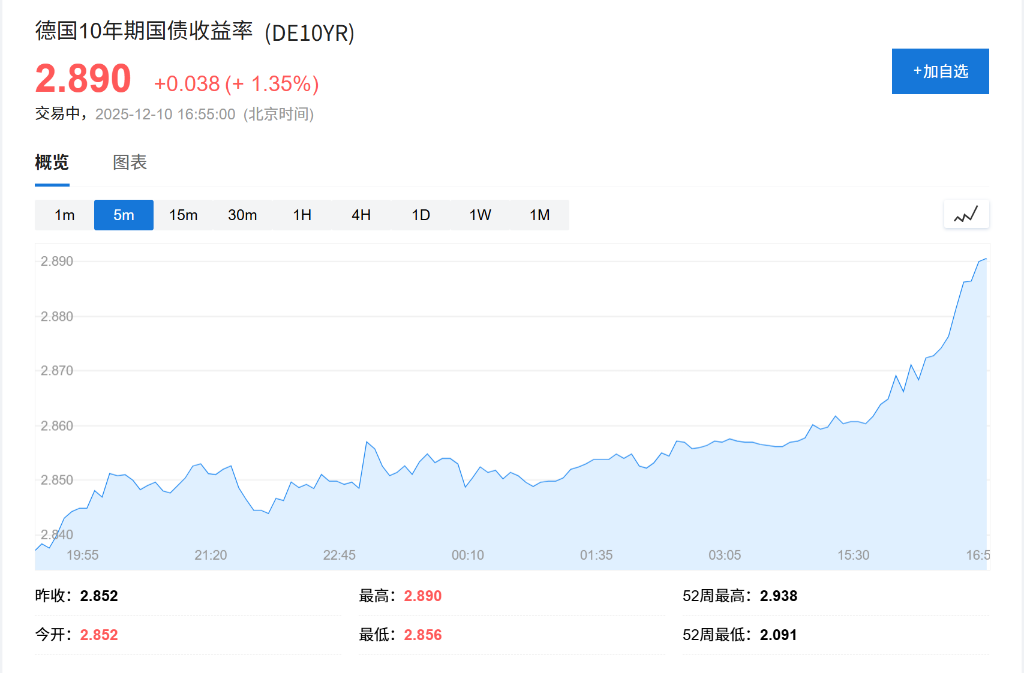
美联储决议前夕债市巨震:全球长债收益率飙升至16年新高,市场押注全球降息周期即将终结
Hua Er Jie Jian Wen· 2025-12-10 09:07
Group 1 - Global long-term bond yields have returned to their highest levels since 2009, indicating a growing consensus that the easing monetary policy cycle by central banks is nearing its end [1] - The U.S. Treasury market is experiencing unusual movements, with yields rising despite expectations of a rate cut by the Federal Reserve, driven by concerns over persistent inflation and a significant budget deficit of $1.8 trillion [5] - The shift in market sentiment is reflected in the pricing of monetary policy, with traders betting that the European Central Bank has little room for further rate cuts and that the Bank of Japan is likely to raise rates soon [1][4] Group 2 - A "disappointment trade" is spreading across developed markets as investors realize that the rate-cutting cycle by major central banks may be coming to an end, leading to challenges for long-term interest rates in the U.S. [4] - The surge in government debt and fiscal expansion plans are significant factors pushing up yields, with countries like Germany and Japan planning substantial spending increases [7] - The current yield movements reflect market expectations for stronger economic growth, as global fiscal policies may adopt a more expansionary stance next year [7]
Fed needs to move slowly with further rate cuts, Jefferson says
Yahoo Finance· 2025-11-17 14:33
By Howard Schneider WASHINGTON (Reuters) -Federal Reserve Vice Chair Philip Jefferson said on Monday the U.S. central bank needs to "proceed slowly" with any further interest rate cuts as it eases policy towards a level that would likely stop putting downward pressure on inflation. In remarks prepared for delivery at a Kansas City Fed event, Jefferson said he agreed the central bank's quarter-percentage-point rate cut last month was appropriate, given increased risks to the job market and the likeli ...