Personalization

Search documents
Spotify(SPOT) - 2025 Q4 - Earnings Call Transcript
2026-02-10 14:02
Financial Data and Key Metrics Changes - Total revenue grew 13% to EUR 4.5 billion in Q4 2025, with premium revenue rising 14% driven by subscriber growth [32] - Gross margin expanded to 33.1%, an increase of over 80 basis points year-on-year, primarily due to favorable content costs [33] - Operating income reached EUR 701 million, exceeding forecasts by EUR 81 million, with free cash flow at EUR 834 million [33] Business Line Data and Key Metrics Changes - The advertising business grew 4%, remaining flat compared to the previous quarter, but showed a 7% growth when excluding podcast optimization strategies [32] - Podcast consumption increased by over 90% since the launch of the Spotify Partner Program, with more than 530,000 video podcast shows on the platform [16] - Audiobook expansion in premium markets has driven double-digit growth, with leading global publishers crediting Spotify for bringing in new listeners [16] Market Data and Key Metrics Changes - Spotify serves over three-quarters of a billion users globally, marking the highest quarter ever for MAU net additions [13] - The company paid out more than $11 billion to music rights holders in 2025, setting a global record for the highest annual payment from a single source [15] Company Strategy and Development Direction - Spotify aims to be a technology company and the R&D arm for the music industry, focusing on building a technology platform for audio and enhancing user experience through AI and new interfaces [7][8] - The company emphasizes long-term value creation over short-term profitability, prioritizing growth and user engagement [9] - The focus for 2026 is framed as the year of raising ambition, with plans to optimize for user value and drive top-line growth [19] Management's Comments on Operating Environment and Future Outlook - Management expressed confidence in continued healthy MAU and subscriber growth throughout 2026, maintaining low churn rates [18] - The company is optimistic about the early benefits of the enhanced free tier and expects improved revenue growth in Q1 2026 [35] - Management highlighted the importance of planning and synchronization in the age of AI, emphasizing that good planning will be crucial for utilizing productivity effectively [70] Other Important Information - The company repurchased $433 million worth of shares in Q4 and plans to continue opportunistic capital returns [33] - Spotify is focused on leveraging AI to enhance personalization and engagement, which is expected to drive lifetime value and enterprise value [64] Q&A Session Summary Question: How is Spotify planning to use AI tools and applications for new and evolving product offers? - Management emphasized that AI will enable new business models and enhance user interaction, positioning Spotify as a leading intelligent media service [39][40] Question: What are the drivers of Gross Margin expansion in 2026? - Management indicated that price increases will outpace net content costs, and improvements in the advertising business will support margin development [44][46] Question: Can you provide a progress report on your ad tech platform? - Management reported record levels of advertisers on the platform, indicating positive signs of revenue growth from the re-engineered ad stack [48][49] Question: How do you see the price to value relationship of the service relative to competitors? - Management stated that churn is low and in line with expectations following recent price increases, emphasizing a market-by-market pricing strategy [66][67] Question: What's changed at Spotify following Daniel stepping back from the CEO role? - Management noted a structural change in leadership, focusing on synchronization and planning to maintain growth and market share [68][70]

Spotify(SPOT) - 2025 Q4 - Earnings Call Transcript
2026-02-10 14:02
Financial Data and Key Metrics Changes - Total revenue grew 13% to EUR 4.5 billion in Q4 2025, with premium revenue rising 14% driven by subscriber growth [32][34] - Gross margin expanded to 33.1%, an increase of over 80 basis points year-on-year, primarily due to favorable content costs [33] - Operating income reached EUR 701 million, exceeding forecasts by EUR 81 million, with free cash flow at EUR 834 million [33][34] Business Line Data and Key Metrics Changes - The advertising business grew 4%, remaining flat compared to the previous quarter, but showed a 7% growth when excluding podcast optimization strategies [32] - In podcasting, video podcast consumption increased by over 90% since the launch of the Spotify Partner Program, with more than 530,000 video podcast shows on the platform [16] - The company paid out over $11 billion to music rights holders in 2025, setting a global record for annual payments from a single source [15] Market Data and Key Metrics Changes - Monthly active users (MAUs) reached over 750 million, with a record number of net additions in Q4 2025 [13] - The company aims to convert 10% to 15% of the world's population into subscribers, indicating significant growth potential [18] Company Strategy and Development Direction - The company emphasizes a long-term growth strategy, prioritizing user and creator experiences while focusing on technology and innovation [5][9] - The focus for 2026 is framed as the year of raising ambition, with plans to enhance product offerings and user engagement through AI and new technologies [19] - The company aims to leverage AI to enhance personalization and interactivity, positioning itself as a leader in the evolving audio landscape [21][24] Management's Comments on Operating Environment and Future Outlook - Management expressed confidence in continued healthy MAU and subscriber growth throughout 2026, with expectations for improved revenue and gross margin [18][34] - The management highlighted the importance of adapting to macro changes and capturing opportunities presented by technological advancements [39][40] Other Important Information - The company repurchased $433 million worth of shares in Q4 2025 and plans to continue opportunistic capital returns [33] - The company has been investing in AI technologies to enhance user experiences and streamline internal processes, positioning itself for future growth [23][29] Q&A Session Summary Question: How is Spotify planning to use AI tools and applications for new and evolving product offers? - Management emphasized that AI will enhance user interaction and personalization, positioning Spotify as a leading intelligent media platform [39][40] Question: What are the drivers of Gross Margin expansion in 2026? - Management indicated that price increases and improvements in the advertising business will contribute to gross margin growth [44][46] Question: Can you provide a progress report on your ad tech platform? - Management reported record levels of advertisers on the platform, indicating positive progress in ad revenue growth [48][49] Question: How do you see the price to value relationship of the service relative to competitors? - Management noted that churn remains low following recent price increases, and they strive to create more value than price [66][67] Question: What's changed at Spotify following Daniel stepping back from the CEO role? - Management highlighted a focus on synchronization and planning, with a new structure for decision-making to enhance operational efficiency [68][69]
Two-thirds of shoppers now open to using AI assistants to help them buy online
PRWEB· 2026-02-05 14:05
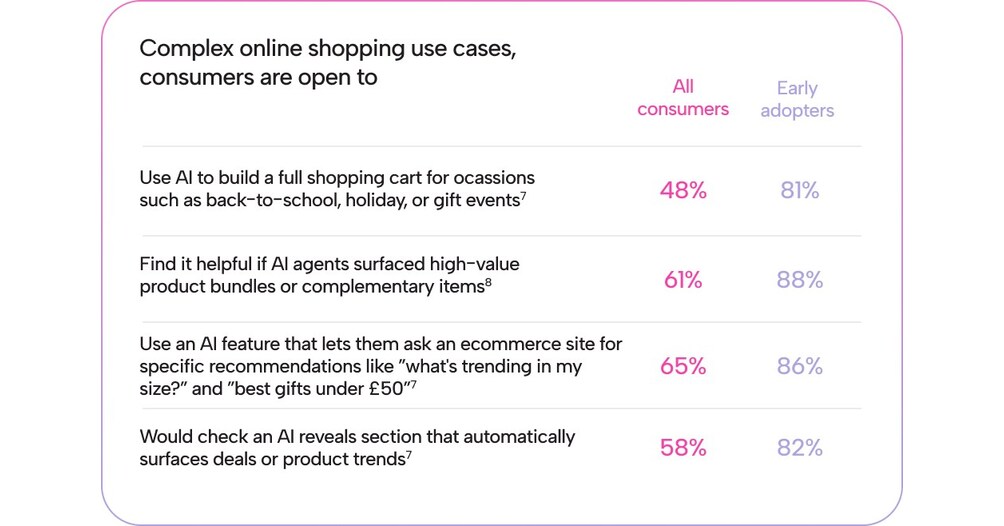
Core Insights - The rise of LLM-powered AI assistants is transforming the online shopping experience, with their effectiveness increasingly reliant on rich, intent-driven, and contextual commerce data rather than just natural language processing capabilities [1][8] Consumer Expectations - 72% of consumers expect AI shopping assistants to aid in online shopping, with this expectation exceeding 80% among those under 45 [1] - Among consumers who anticipate AI assistance, 48% are open to using an AI shopping assistant from their favorite retailer, increasing to 62% for those aged 25-34 [2] Transparency and Control - Retailers must ensure transparency regarding data usage and empower shoppers in their purchasing decisions, as 24% of consumers would stop using AI due to data handling concerns, and 21% would discontinue use if they felt AI was making decisions without their input [3] Trust and Adoption - 34% of consumers have tried shopping with a conversational AI assistant, with this figure rising to 59% among 25-34 year olds, indicating a higher acceptance among younger consumers [4] - 77% of early adopters trust brands more if they utilize an AI shopping assistant [5] Interaction Preferences - 46% of early adopters prefer accessing AI assistants through a website's search bar, while 41% favor a dedicated on-site chatbot, suggesting that AI interactions should be integrated into existing search functionalities [6] Impact of Poor Experience - 69% of early adopters who received irrelevant product suggestions abandoned their search for alternatives, highlighting the importance of relevant product discovery [7] Personalization Importance - Personalization is crucial, with consumers valuing features such as deal alerts (59%), personalized recommendations (51%), and gift inspiration (44%) [8] Areas for Improvement - 33% of early adopters believe AI can significantly enhance decision-making, while 25% see potential in product discovery [9][16] Readiness Gap - There exists a readiness gap between consumer demand for AI in shopping and the actual investment by retailers, with only 36% of surveyed retailers allocating dedicated budgets for AI tools [13][14]


Jack Henry's transaction enrichment, powered by Bud Financial, brings greater clarity and accuracy to digital banking experiences
Prnewswire· 2026-01-28 14:01
Core Insights - Jack Henry has successfully rolled out native transaction enrichment capabilities on the Banno Digital Platform in collaboration with Bud Financial, enhancing transaction details for banks and credit unions [1][2] - The integration of Bud's Enrich product into Banno aims to provide high-quality transaction categorization and merchant detection, improving user experience and enabling financial institutions to leverage actionable data [2][3] Company Overview - Jack Henry & Associates, Inc. is a financial technology company that connects financial institutions with their customers, focusing on user-centric solutions and collaboration with fintechs [6] - Bud Financial specializes in enriching financial data to provide insights into transactions, helping banks and fintechs personalize customer experiences and optimize operations [4][5] Product Features - The transaction enrichment capabilities offer market-leading categorization for instant understanding of transactions, high-accuracy merchant identification, and broad coverage of various financial transactions [8]


Despite Universal Adoption of AI Tools in Marketing, 99% of Marketers Have Not Fully Integrated Them Into Their Broader Marketing Stack and Operations, Finds New Report by Kaltura
Globenewswire· 2026-01-28 13:00
Core Insights - The report "The Next Era of Marketing: 2026 AI and Video Trends" highlights that while 98% of marketing leaders recognize the importance of personalization for growth, 99% are unable to achieve the desired level of 1:1 personalization due to fragmented data [1][4]. Group 1: AI and Personalization - AI has achieved near-universal adoption among marketers, yet 99% report that their AI tools operate in silos, limiting their ability to support personalization at scale [3]. - Personalization is a significant performance driver, with 68% of marketers indicating it positively impacts organizational growth; however, true one-to-one personalization remains elusive, with 99% operating at the persona or segment level [4]. - The primary challenges to achieving effective personalization include fragmented data (62%) and compliance concerns (58%) [4]. Group 2: Video in Marketing - Video has become a preferred marketing format, with 56% of marketers ranking it among their top three formats and 69% producing more video content than the previous year [6]. - Video engagement is now viewed as a critical measure of customer intent, providing valuable insights for sales and customer success teams [8]. - Despite the desire to increase video usage, barriers such as slow approval cycles (28%), high production costs (17%), and limited in-house expertise (13%) hinder scaling efforts [8]. Group 3: Organizational Alignment - There is notable progress in aligning marketing and revenue teams, with 83% of respondents indicating that sales and customer success teams regularly utilize video-derived engagement data to inform customer interactions [7]. - The integration of video data into customer interactions signifies a shift towards shared intelligence and coordinated efforts across organizations [7]. Group 4: Kaltura's Strategic Moves - Kaltura's acquisition of eSelf.ai reflects the growing demand for enhanced personalization and AI-driven business outcomes across various sectors [5]. - The company emphasizes the need for unified AI frameworks to facilitate business-wide alignment and smarter workflows, enabling organizations to personalize at scale [6].


2026年健康领域人工智能(AI)应用状况报告
Vi Labs· 2026-01-20 01:40
Investment Rating - The report indicates a positive outlook for the AI-driven wellness industry, emphasizing that AI is becoming the core operating layer rather than an add-on feature [6][15]. Core Insights - The wellness industry is transitioning to adaptive systems that leverage AI to enhance user engagement and outcomes, driven by advancements in behavioral and biometric modeling, multi-step orchestration, and real-time computing [3][6]. - By 2026, over 60% of digital wellness interactions will be managed by AI systems, significantly improving engagement and retention metrics [8][15]. - The focus is shifting from mere engagement metrics to measurable health outcomes, with platforms competing on improvements in fitness, sleep, and metabolic health [11][12]. Summary by Sections Executive Summary - AI is central to transforming wellness platforms from episodic experiences to adaptive systems that respond in real-time [3][4]. Key Signals - AI will drive over 60% of digital wellness interactions by 2026, with personalized onboarding increasing early engagement by 22-40% [8]. Predictions for 2026 - Agentic wellness copilots will manage most member interactions, allowing human coaches to focus on complex cases [9][10]. - Wellness brands will prioritize measurable outcomes over engagement metrics [11]. - Hyper-personalized, self-tuning programs will become the standard expectation for users [13][14]. Technology Foundations - The report outlines a five-layer AI stack that enables continuous adaptation in wellness platforms, moving beyond static programs [68]. - Multi-agent orchestration systems will coordinate various AI agents across the member journey, enhancing personalization and effectiveness [69]. ROI Mandate - The performance of AI-driven wellness systems will be evaluated based on measurable, repeatable outcomes, focusing on activation, retention, and operational efficiency [86][90]. - Illustrative performance metrics indicate significant improvements in engagement and retention rates due to AI orchestration [91][97]. What's Next: 2027-2028 Outlook - Future wellness platforms will evolve into systems that continuously adapt to user behavior, integrating predictive modeling and preventive wellness strategies [101][109].
深度|OpenAI产品经理及后训练负责人:决定模型真正聪明程度的不是智能水平,而是它理解你的方式
Z Potentials· 2026-01-16 07:59
Core Insights - The article discusses the advancements in OpenAI's GPT-5.1, emphasizing the shift from models as mere tools to understanding user intent, emotions, and context, marking a new era in human-AI interaction [3][5][12] - Personalization is highlighted as a fundamental aspect of future AI systems, allowing models to adapt and respond based on individual user preferences and emotional cues [3][10][22] Group 1: Model Development and Features - GPT-5.1 aims to transition all chat models into "reasoning models," enhancing their ability to think and respond based on user prompts [5][6] - The introduction of a "chain of thought" mechanism allows the model to determine the depth of reasoning required based on the complexity of user queries [7][12] - Improvements in context retention and user history tracking address feedback regarding the model's perceived coldness and lack of warmth in interactions [8][9] Group 2: User Experience and Interaction - The update includes a new "auto-switcher" that dynamically transitions between chat and reasoning modes, aiming to provide a more cohesive and empathetic user experience [9][10] - Enhanced instruction-following capabilities allow the model to better retain user preferences and respond in a manner that aligns with individual communication styles [10][11] - The introduction of personality features enables users to guide the model's expression style, enhancing the overall interaction quality [10][22] Group 3: Emotional Intelligence and Personalization - The concept of emotional intelligence (EQ) is explored, focusing on the model's ability to understand user intent and context, which is crucial for delivering appropriate responses [13][14] - The development of a "user signals research" initiative aims to capture various signals related to user intent, enhancing the model's emotional responsiveness [13][14] - The article emphasizes the importance of creating a model that not only understands factual information but also captures subtle emotional cues and context [19][20] Group 4: Future Directions and Customization - OpenAI envisions a future where models are increasingly customizable, allowing users to create a unique experience tailored to their needs [22][24] - The potential for models to automatically infer user context and preferences is highlighted, aiming for a more intuitive interaction without complex prompting [24][25] - The ongoing development of memory features allows models to retain information about users, enhancing the relevance and personalization of responses in future interactions [25][26]

Google Gemini can proactively analyze users’ Gmail, photos, searches
BusinessLine· 2026-01-15 03:49
Core Insights - Google has introduced a new feature called Personal Intelligence for its Gemini AI assistant, allowing it to proactively access user data from various Google services to enhance personalization [1][2] - The feature is currently in beta and is designed to make Gemini more personal, proactive, and powerful, with an initial rollout in the US [2][7] - Users have control over their data, as Personal Intelligence is an opt-in feature, allowing them to select which apps can be connected to Gemini [2][4] Data Utilization - The extensive amount of personal data available to Google gives Gemini a competitive edge over other AI companies, which typically have less user information [3] - Personal Intelligence enables Gemini to automatically access user data from selected apps to provide more relevant responses, unlike previous capabilities that required explicit user prompts [4][5] User Interaction - Users can regenerate responses without personalization if preferred, and Google has implemented guardrails for sensitive topics to mitigate potential errors [6] - Feedback mechanisms are in place, allowing users to report issues or correct Gemini directly during interactions [7] Future Developments - The beta version of Personal Intelligence will begin on January 14 for Google AI Pro and AI Ultra subscribers, with plans to expand to other countries and the free tier [7] - Google has also partnered with Apple to integrate Gemini into upcoming AI features, including an updated Siri assistant [8]



Costco's Digital Ecosystem Emerges as a Powerful Growth Engine
ZACKS· 2026-01-05 15:36
Core Insights - Costco's digital ecosystem is a primary growth driver, with a 20.5% increase in digitally enabled comparable sales for Q1 FY26, significantly outpacing the overall comparable sales growth of 6.4% [1][9] - Key contributors to online sales growth include a 24% rise in e-commerce site traffic and a 13% increase in average order value [1][9] Digital Engagement and Personalization - The company is enhancing shopping experiences through improved product display pages and personalization capabilities, leading to higher conversion rates [2] - Same-day delivery services via Instacart, Uber Eats, and DoorDash have seen strong member adoption, contributing to sales growth [3] Integration of Digital Tools - Costco is integrating digital tools in warehouses, such as the Costco Digital Wallet and pre-scanning technology, which have increased checkout speeds by up to 20% [4] - AI is being utilized to optimize pharmacy inventory and gas station management, improving in-stock levels to over 98% and supporting mid-teen growth in pharmacy scripts filled [4] Competitive Landscape - Walmart reported a 27% global e-commerce growth in Q3 FY26, with 35% of digital orders delivered in under three hours, indicating a strong focus on convenience and digital innovation [6] - BJ's Wholesale Club reported a 30% growth in digitally enabled comparable sales in Q3 FY25, emphasizing the value of digitally engaged members [7] Financial Metrics - Costco's stock has declined 7.4% over the past year, while the industry has grown by 4% [8] - The forward 12-month price-to-earnings ratio for Costco is 41.21, higher than the industry average of 29.45 [10] - Zacks Consensus Estimates indicate year-over-year growth of 7.5% in sales and 11.7% in earnings per share for the current financial year [11]


National Vision Stock Surges 154.6% in a Year: What's Driving it?
ZACKS· 2025-12-19 15:11
Core Insights - National Vision (EYE) has experienced a significant share price increase of 154.6% over the past 12 months, outperforming the industry decline of 13.9% and the S&P 500's growth of 16.4% [1][9] Company Performance - National Vision holds a Zacks Rank 3 (Hold) and is benefiting from the strong performance of its America's Best brand, with strategic initiatives showing early progress [2] - The company operates 1,242 retail stores across four brands and has a distribution network that includes a 118,000-square-foot center in Georgia and a 52,000-square-foot center in Ohio [3] Revenue Growth - The Owned & Host segment of National Vision reported a 9.1% year-over-year revenue increase in Q3 2025, primarily driven by America's Best brand [4][9] - The company opened four new America's Best stores and converted four Eyeglass World locations during the September 2024 to September 2025 period [5] Strategic Initiatives - National Vision is enhancing its Eyeglass World operations with a new leadership team and expanding remote exam capabilities, with two-thirds of its stores now equipped for remote technology [6] - The company is testing smaller store formats for America's Best and is incorporating insights from a fleet optimization review into future growth plans [5][6] Customer Engagement - Early indicators of stronger customer engagement are noted, supported by a new marketing strategy and customer relationship management (CRM) platform [10] - Newly introduced premium frames are selling faster than expected, indicating positive consumer response [10] Financial Estimates - The Zacks Consensus Estimate projects a 32.6% increase in earnings per share (EPS) for 2025, reaching $0.69, and a 26.8% increase for 2026, reaching $0.88 [12] - Revenues are expected to grow by 5.2% to $1.98 billion in 2025 and reach $2.05 billion in 2026, implying a 3.3% increase [12]