药品集中采购

Search documents
国药现代: 2025年半年度业绩快报
Zheng Quan Zhi Xing· 2025-07-17 09:16
Financial Performance Summary - The total operating revenue for the first half of 2025 was approximately 4.88 billion RMB, a decrease of 18.16% compared to the same period last year [2] - Operating profit decreased by 16.10% to approximately 920.16 million RMB [2] - Total profit decreased by 14.86% to approximately 924.93 million RMB [2] - Net profit attributable to shareholders was approximately 672.07 million RMB, down 6.46% year-on-year [2] - Basic earnings per share decreased by 6.46% to 0.5011 RMB per share [2] - The weighted average return on equity decreased by 0.68 percentage points to 4.96% [2] Asset and Equity Overview - Total assets at the end of the reporting period were approximately 19.66 billion RMB, a decrease of 1.49% from the beginning of the period [2] - The company's equity attributable to shareholders remained stable with a share capital of approximately 1.34 billion RMB [2] Operational Challenges and Strategic Response - The decline in net profit was attributed to lower sales and prices of certain penicillin raw materials and intermediates due to market supply and demand factors [3] - The formulation business faced revenue declines due to centralized drug procurement and reduced terminal demand for certain products [3] - In response to competitive pressures, the company is focusing on strategic layout, enhancing research and development, and reducing costs while stabilizing profit margins [3]

第十一批国采共纳入55个品种
Guo Ji Jin Rong Bao· 2025-07-17 02:11
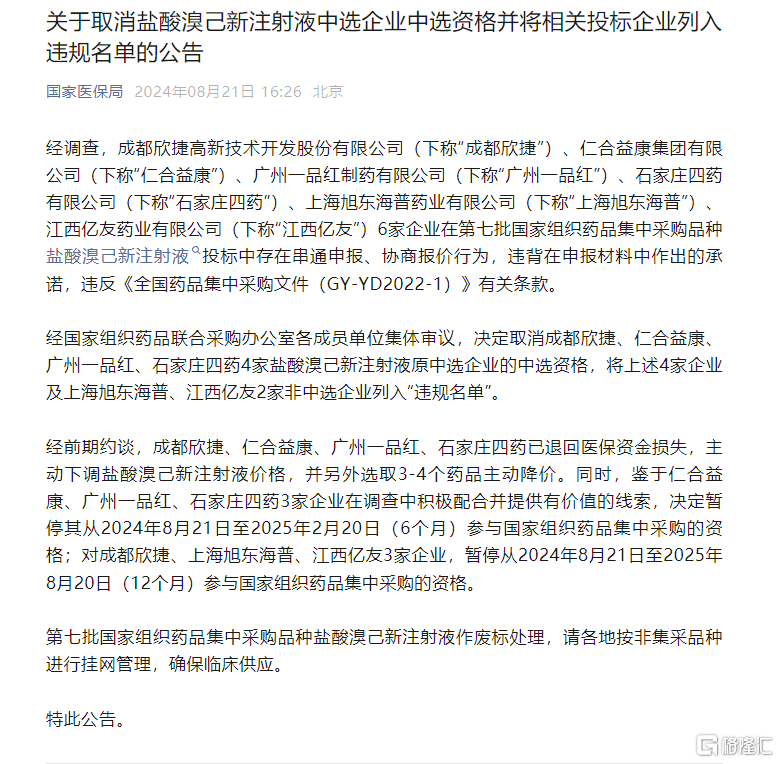
Group 1 - The core announcement is about the initiation of the 11th batch of national organized drug procurement, allowing companies to submit information for drug selection from July 16 to July 31, 2023 [1] - A total of 55 drug varieties have been included in this procurement, covering commonly used clinical medications such as anti-tumor, diabetes, cardiovascular, and respiratory drugs [2][3] - The procurement process will exclude innovative drugs and focus on mature products that have been on the market for years and have multiple manufacturers [1][2] Group 2 - 68 drugs that met the evaluation criteria were not included in this procurement, with reasons including insufficient competitive landscape and low projected procurement amounts [3] - Notably, five drugs were excluded due to high patent infringement risks, including Novartis' sacubitril/valsartan, which has seen significant sales growth in recent years [3][4] - The procurement rules are expected to be optimized, focusing on maintaining clinical stability, ensuring quality, and preventing irrational competition among companies [5][6] Group 3 - The selection criteria for this batch of procurement have been made transparent, combining previous rules with new policy requirements [6] - Quality requirements have been strengthened, with a new mandate for bidders to have at least two years of production experience for similar formulations [6][7] - The pricing mechanism has been adjusted to discourage irrational low-price competition, with a focus on rational pricing based on cost and quality [7]
不再锚定“最低价”,国家药品集采迎八大变化
Di Yi Cai Jing· 2025-07-16 13:39
Core Viewpoint - The new centralized drug procurement policy introduces significant changes aimed at improving drug quality and ensuring better access for patients, moving away from a strict focus on the lowest price [1][3]. Group 1: Key Changes in Procurement Policy - The new procurement policy no longer anchors on the "lowest price," allowing for a more balanced approach to pricing [1][3]. - Medical institutions can report quantities based on specific drug brands, enhancing the alignment between clinical needs and procurement outcomes [13][15]. - The selection process for drugs has been made more transparent, with the criteria for inclusion in the procurement list being publicly disclosed for the first time [4][5]. Group 2: Drug Selection Criteria - A total of 55 drug varieties have been selected for the eleventh batch of procurement, following a rigorous selection process that included expert opinions [5][6]. - New drugs and those under negotiation for the first year will not be included in the procurement, ensuring that only established drugs are considered [8]. - Drugs with a projected procurement amount of less than 100 million yuan in 2024 will be excluded from the procurement list, promoting larger scale procurement [9][10]. Group 3: Quality and Safety Measures - The new policy emphasizes quality control, requiring that participating companies have at least two years of production experience in similar formulations [18]. - High-risk drugs will be excluded from the procurement process to ensure patient safety and effective clinical use [7][14]. - The procurement process will respect clinical needs, allowing for adjustments based on actual usage and seasonal demand [14][15]. Group 4: Pricing and Competition - The new policy introduces a "low-price declaration" requirement for the lowest bidding companies to justify their pricing, addressing concerns about unsustainable low bids [16][17]. - The price control mechanism will no longer simply use the lowest bid as a reference point, aiming to prevent excessive price competition [16][17]. - The procurement process will focus on rational competition, reducing the risk of "price wars" among suppliers [16][17].

新药不集采、集采非新药,从选品看国采最新变化
2 1 Shi Ji Jing Ji Bao Dao· 2025-07-15 14:10
总体而言,"稳临床、保质量、防围标、反内卷"这四大原则,将成为此次集采的关键词。第十一批集采 目前已完成拟采购品种遴选,即将开展医疗机构报量工作。新增两条品种遴选规则 21世纪经济报道记者贺佳雯北京报道 2025年7月15日,国家组织药品联合采购办公室发布《关于开展第十一批国家组织药品集中采购相关药 品信息填报工作的通知》。备受社会各界关注的第十一批国家组织药品集采报量工作启动了。 记者从国家医保局进一步获悉了此次集采品种遴选的有关情况。与往年情况对比,梳理出今年的遴选过 程和值得关注的遴选变化。 什么样的药纳入集采?科学确定采购品种是社会各界关切的首要问题。 记者了解到,多年来,集采药品一直坚持新药不集采、集采非新药的原则。此次以2025年3月31日为品 种遴选截止时间,沿用第十批集采的以"参比制剂+通过质量和疗效一致性评价"的企业数量合计达到7家 作为门槛,在此基础上进一步优化品种遴选的条件。 所以,集采药品都是已经上市多年、主要成分过了专利保护期、多家企业生产的品种,也就是说临床使 用成熟的"老药"才会纳入集采范围,创新药不会被纳入集采。 对于这一政策设计的思路,国家医保局相关司负责人解释,首先就考虑到 ...
【财闻联播】两家房企,恶意逃欠税被查!第十一批药品集采启动
券商中国· 2025-07-15 11:19
Macro Dynamics - The 11th batch of national organized drug procurement has been initiated, with 55 varieties selected for procurement. The procurement will focus on mature "old drugs" that have been on the market for many years and have expired patent protection, excluding innovative drugs [1] - The National Development and Reform Commission announced a reduction in domestic gasoline and diesel prices by 130 yuan and 125 yuan per ton, respectively, effective from July 15, resulting in a savings of 5 yuan for filling a 50-liter tank [2] - China has become the world's largest producer and consumer of the chemical industry, with the fine chemical sector accounting for 50% of the global market share [3] - A large-scale vocational skills training initiative will be launched from 2025 to 2027, targeting 30 million participants to enhance skills in manufacturing and service sectors [4] - The People's Bank of China conducted a 14 billion yuan reverse repurchase operation to maintain liquidity in the banking system, marking the second consecutive month of increased operations [5] - The Ministry of Industry and Information Technology is drafting mandatory national standards for mobile power supplies, including stricter technical requirements for safety [6] Financial Institutions - China Life Insurance Co., a shareholder of Hangzhou Bank, plans to reduce its stake by up to 0.7% [7][8] - China Galaxy Securities expects a net profit growth of 45% to 55% year-on-year for the first half of 2025, with profits projected between 6.362 billion and 6.801 billion yuan [9] Market Data - The Shanghai Composite Index fell by 0.42%, while the ChiNext Index rose by 1.73%, with significant gains in CPO concept stocks and real estate sector [11] - The total margin balance in the two markets increased by 9.729 billion yuan, with the Shanghai Stock Exchange reporting a balance of 942.837 billion yuan and the Shenzhen Stock Exchange 923.574 billion yuan [12][13] - The Hong Kong Hang Seng Technology Index rose by 2.8%, with notable increases in stocks like Alibaba and Meituan [14] Company Dynamics - Pop Mart anticipates a revenue increase of no less than 200% and a profit growth of no less than 350% for the first half of 2025 compared to the same period last year [15] - Two real estate companies were investigated for tax evasion, with one owing over 100 million yuan in taxes [16] - Airbus has officially started cooperation with AVIC Xi'an Aircraft Industry Group in Tianjin for the assembly of A321 fuselage systems, marking a significant step in Airbus's industrial layout in China [18] - Zhongsheng High-Tech is planning a change in control, with its stock set to be suspended from trading [19] - SITOWAY expects a net profit increase of 140% to 180% for the first half of 2025, driven by growth in the smartphone sector [21]


第十一批国家药品集采进入倒计时,多个品种竞争激烈
Bei Ke Cai Jing· 2025-06-24 02:25
Core Insights - The eleventh batch of national drug procurement documents is expected to be officially released in July, with over 120 drug varieties that have passed evaluation but are not yet included in national procurement [1][2] - The competition for major drug varieties such as cefazolin injection, famotidine injection, and theophylline injection is intense, with the number of evaluated companies exceeding 30 for each [1][3] Group 1: National Drug Procurement Overview - Since the pilot program "4+7" began in November 2018, the National Healthcare Security Administration has conducted ten batches of national drug procurement, successfully procuring 435 drugs and saving approximately 440 billion yuan in medical insurance funds [2] - The eleventh batch of drug procurement is in the countdown phase, with a preliminary list of 75 drug varieties being formed after expert consultations [2][3] Group 2: Competitive Landscape - The number of evaluated companies for cefazolin injection, famotidine injection, and theophylline injection has reached 34, 31, and 30 respectively, indicating a highly competitive environment [3] - Major pharmaceutical companies such as Chengdu Beite Pharmaceutical, Qilu Pharmaceutical, and Kelun Pharmaceutical continue to be key players in the procurement landscape [4] Group 3: Emerging Products - The market for Loxoprofen sodium gel patches has seen significant changes, with six companies obtaining approval for this product in a short period, suggesting it may be included in the national procurement [5] - The approval of Loxoprofen sodium gel patches by multiple companies marks a shift from a previously monopolized market, indicating increased competition [5] Group 4: Future Implications - The competitive intensity observed in the tenth batch of national drug procurement is expected to escalate further, with significant price reductions and stricter regulatory oversight anticipated in future procurements [6]
第十一批国采展望与现行药品政策梳理
2025-06-11 15:49
Summary of Conference Call Notes Industry Overview - The conference call discusses the upcoming **11th National Drug Centralized Procurement (国采)**, expected to start in **July or August 2025**. The 10th round had extreme results due to a long time span and rule adjustments, leading to potential product registration backlog issues in the 11th round, with intensified competition and possible rule changes to avoid excessive low pricing [1][4][2]. Key Points and Arguments - **11th Batch Procurement Timing**: The 11th batch is likely to be delayed until the second half of the year due to the need for medical institutions to prepare reporting volumes, with only one round expected this year [2]. - **Biological Drug Procurement**: The biological drug procurement led by Anhui is set for execution by the end of **2025**, based on insulin procurement rules, focusing on moderate price reductions and a larger number of selected products [1][5][6]. - **Quality Control Measures**: The National Medical Products Administration (药监局) is responsible for quality control of selected products, while the National Healthcare Security Administration (医保局) has introduced new rules requiring companies to have market volume before gaining market share, ensuring fair competition [7][3]. - **Impact of New Rules on Original Drug Companies**: The new procurement rules favor original drug companies by allowing them to retain some market share even if not selected, and providing hospitals with more autonomy in choosing products [12][3]. - **Price Discrimination Issues**: The centralized procurement has provided a price benchmark, but there have been instances of price discrimination across provinces, leading to a downward spiral in drug prices and potential shortages [18][19]. - **Market Dynamics for Generic Drugs**: The procurement process has increased the penetration of competitive products in grassroots hospitals, while high-priced drugs have significant market expansion potential [11][21]. Additional Important Content - **Alliance Procurement Framework**: The shift to an alliance procurement framework has led to varied approaches among provinces, with some like Hebei being aggressive in pricing, while others like Guangdong and Xinjiang adopt a more balanced approach [8][9]. - **Future Alliance Plans**: Major alliances for procurement include those led by Sichuan, Xinjiang, Guangdong, and Tianjin, with Shanghai and Jiangsu considering joining new projects [9]. - **Impact on Marketing Strategies**: Original drug companies are adjusting their marketing strategies, increasing collaboration with e-commerce channels to enhance drug accessibility and sales [22][24]. - **Medicare Payment Standards**: The establishment of Medicare payment standards is expected to significantly impact drug prices and market dynamics, potentially leading to a unified pricing structure across different regions [13][20]. - **Challenges for Innovative Drugs**: The procurement policies may limit the development of innovative drugs due to low pricing, which could discourage research and development efforts in the pharmaceutical industry [25][26]. This summary encapsulates the critical insights and implications from the conference call regarding the upcoming drug procurement policies and their potential impact on the pharmaceutical industry.
河北通报丽珠、北陆等药企未及时配送药品
Jing Ji Guan Cha Wang· 2025-06-10 09:13
Core Viewpoint - The announcement from the Hebei Provincial Medical Supplies Procurement Center indicates that several companies are being rated as "generally" untrustworthy due to inadequate delivery services for selected products in the national centralized procurement process [1][2][3] Group 1: Companies Involved - Companies listed for potential untrustworthiness include Suzhou Terui Pharmaceutical, Sihuan Pharmaceutical, Lijun Group, Jiangxi Yongfeng Kande Pharmaceutical, Guangdong Saifeng Pharmaceutical, Beijing Fule Technology, and Beijing Beilu Pharmaceutical [1][2] - Lijun Group's voriconazole injection was selected in the eighth batch of national procurement at a price of 29.19 yuan per unit, down from a previous market price of 700-800 yuan, representing a price drop of over 90% [1] - Beilu Pharmaceutical's iopamidol injection was selected in the seventh batch of national procurement at a price of 91.3 yuan per unit, being the only contrast agent selected in that batch [1] Group 2: Regulatory Framework - The Hebei Provincial Medical Security Bureau established a credit evaluation system for drug pricing and procurement in late 2020, categorizing untrustworthy behavior into four levels: "general," "moderate," "serious," and "particularly serious" [3] - The "general" untrustworthiness rating applies to companies that fail to fulfill procurement or delivery contracts without valid reasons and do not notify procurement agencies in advance, provided it does not severely impact clinical treatment [3] - Once a company is rated as untrustworthy, the provincial procurement center will implement measures such as written warnings, risk notifications on procurement platforms, and restrictions on procurement qualifications [3] Group 3: Broader Industry Context - The issue of supply shortages is not limited to medical institutions; designated pharmacies in Hebei also face significant shortages, with 422 drugs reported as unavailable [4] - Other regions, including Liaoning, Hainan, and Guangzhou, have also reported issues with selected companies failing to deliver drugs on time since the implementation of centralized procurement policies [4] - As of May 31, 2023, 443 drug varieties had not established timely delivery relationships post-procurement, with nearly 70% of the identified varieties having a delivery rate of 0% [4] Group 4: Future Developments - By the end of 2024, 612 companies were rated as generally untrustworthy, 76 as moderately untrustworthy, 40 as seriously untrustworthy, and 7 as particularly seriously untrustworthy [5] - A new standard for credit evaluation will be implemented starting from the third quarter of 2025, simplifying the rating system from four levels to three: "untrustworthy," "seriously untrustworthy," and "particularly seriously untrustworthy" [6]

北陆药业(300016) - 2025年6月6日投资者关系活动记录表
2025-06-09 09:52
Group 1: Contrast Agent Product Strategy - The company has successfully integrated multiple contrast agent products into the national drug centralized procurement system, leading to significant changes in the competitive landscape and sales model of the industry, creating both challenges and opportunities [1] - The company has overcome challenges posed by price reductions in iodine contrast agents and is experiencing a recovery trend, with a focus on expanding market share for iodinated contrast agents [1] - The company has diversified its gadolinium-based contrast agents, with the approval of Gadobutrol injection in July 2024, enhancing its product offerings to meet various clinical needs [1] - In 2024, the contrast agent products achieved sales revenue of CNY 58,804.95 million, representing a year-on-year growth of 9.87% [2] Group 2: Jinlianhua Granule Procurement Progress - Jinlianhua Granule, a core product of Tianyuan Pharmaceutical, is a natural single-component preparation with applications in treating upper respiratory infections and is covered by national insurance [3] - The product is a unique offering in the market and has been included in procurement lists across multiple provinces, enhancing its market presence [3] Group 3: Medical Technology Focus - The company's subsidiary, Shenzhen Yiwei Medical Technology Co., Ltd., specializes in brain disease early screening, precise diagnosis, and rehabilitation training, making it a leader in the field of brain science AI [4] - Yiwei Medical's core products target stroke, Alzheimer's disease, cognitive disorders, and developmental disorders in youth, providing a comprehensive solution for brain disease management [4] Group 4: Yiwei Medical's Business Model - Yiwei Medical offers a full-service model from screening to rehabilitation for brain diseases, creating a closed-loop medical service system [6] - The company collaborates with health check institutions to provide a comprehensive "brain routine" health check package and has developed a unique diagnostic platform for neurodegenerative diseases [6] - Yiwei Medical is exploring additional business models to expand market coverage and increase revenue streams [6] Group 5: Zhiyou Medical Progress - Zhiyou Medical has received NMPA approval for its BCR/ABL and AML1/ETO fusion gene testing kits, marking a significant milestone in the field of blood cancer molecular diagnostics [7] - The approval solidifies Zhiyou Medical's position in the precision diagnosis of blood cancers and complements its existing product offerings for solid tumors [7][8] - The company has obtained nearly 200 NMPA certifications, covering various disease areas and advancing the FISH technology from high-end testing to clinical application [8]
药品集采串标,医保局出手了!“拉黑”一品红、石四药等6家药企
Ge Long Hui· 2025-05-26 01:18
Core Viewpoint - The National Healthcare Security Administration (NHSA) has initiated an investigation into six companies for collusion and price negotiation during the national drug procurement process, marking the first instance of such violations since the implementation of centralized drug procurement in China [1][4]. Group 1: Investigation and Penalties - Six companies have been disqualified from the seventh round of national drug procurement due to collusion in bidding and have been placed on a "blacklist," facing a suspension of participation for 6 to 12 months [3][7]. - This incident is referred to as the "largest collusion case" in national drug procurement history [4]. - The involved companies include Chengdu Xinjie High-tech Development Co., Ltd., Renhe Yikang Group Co., Ltd., Guangzhou Yipin Hong Pharmaceutical Co., Ltd., Shijiazhuang Fourth Pharmaceutical Co., Ltd., Shanghai Xudong Haipu Pharmaceutical Co., Ltd., and Jiangxi Yiyou Pharmaceutical Co., Ltd. [7]. Group 2: Financial Impact - The collusion has resulted in a loss of approximately 266 million yuan for the procurement side, with Yipin Hong committing to refund the entire amount based on sales data from 2022 to present [8]. - The average winning price for the involved drug, Ambroxol Hydrochloride Injection, was 17.95 yuan, with a price drop of 22%, making it one of the least reduced products in the procurement [9]. Group 3: Market Implications - The blacklisting of these companies may lead to increased competition among other firms for the market share of Ambroxol Hydrochloride Injection, as the involved companies accounted for over 90% of its sales in public hospitals [11]. - The NHSA has emphasized the importance of compliance with laws and regulations in drug procurement, warning that collusion will lead to penalties and damage to corporate reputation [11].