
达格列净口服常释剂型

Search documents
第十一批国家药品集采开标,这次有何不同
Jing Ji Guan Cha Wang· 2025-10-29 10:06
Core Insights - The 11th batch of national organized drug procurement results was announced, including 55 drugs and 794 products from 445 companies, with 453 products from 272 companies winning the proposed selection [1][2] - The competition level in this round was significantly higher than in previous batches, with the National Healthcare Security Administration (NHSA) achieving goals of maintaining clinical stability, ensuring quality, and preventing excessive competition [1][3] - The selected drugs cover various therapeutic areas, including anti-infection, anti-allergy, anti-tumor, and others, with expected usage starting in February 2026 [1] Competition Dynamics - The intensity of competition varies based on the number of participating companies; fewer than 10 leads to lower competition, while more than 10 results in higher competition [3] - The price difference for selected drugs has narrowed, with the average price of selected products significantly reduced compared to previous batches [3][5] - New rules were implemented to prevent below-cost bidding and to establish a reference price based on anchor pricing rather than the lowest bid [3][4] Participation of Foreign Companies - Three Indian generic drug companies received proposed selection qualifications in this round, a notable increase from zero in the previous year [2] Hospital Procurement Autonomy - Hospitals now have greater autonomy in drug selection, allowing them to report demand based on their usage habits and prioritize brands in procurement [6][7] - The new rules allow for multiple selected companies to supply drugs to each region, enhancing the diversity of available options [7] Market Impact - The procurement process is designed to ensure that companies can recover costs while achieving lower prices, with a focus on maintaining quality [5] - Leading pharmaceutical companies secured a larger number of selected qualifications, indicating a trend towards consolidation in the industry [5]
第十一批国采:7家企业拟中选达格列净口服常释剂 包括两家印度外企
Xin Lang Cai Jing· 2025-10-28 11:10
Core Insights - The eleventh batch of national procurement results indicates that a total of 14 companies qualified for the bidding of Dapagliflozin oral sustained-release formulation, with 7 companies winning the selection [1] - Dapagliflozin is one of the most anticipated products in this procurement batch, currently leading the Chinese pharmaceutical market for small molecule drugs with sales exceeding 8 billion RMB [1] - The projected sales for public hospitals in 2024 for Dapagliflozin are estimated at 5.352 billion RMB, making it the only product in this procurement batch with annual sales exceeding 5 billion RMB [1] Company Summary - The companies that received the selection qualification include Hetero Labs Limited, Nanjing Fangsheng Pharmaceutical Technology Co., Ltd. (with Yiling Wanzhou International Pharmaceutical Co., Ltd. and Jiangsu Litai'er Pharmaceutical Co., Ltd. as contract manufacturers), Shandong Lukang Pharmaceutical Co., Ltd., Beijing Weilin Hengchang Pharmaceutical Technology Co., Ltd. (with Beijing Jingfeng Pharmaceutical Group Co., Ltd. as a contract manufacturer), M/s Cipla Ltd., Jiutian Pharmaceutical, and Hebei Zhiheng Pharmaceutical Co., Ltd. (with Xinhua Pharmaceutical (Gaomi) Co., Ltd. as a contract manufacturer) [1] - Among the selected companies, two are Indian pharmaceutical enterprises [1]
10.27犀牛财经早报:首批“翻倍基”普遍重仓AI产业链核心环节 宗馥莉已回娃哈哈上班
Xi Niu Cai Jing· 2025-10-27 01:37
Group 1 - The first batch of "doubling funds" has revealed heavy positions in core segments of the AI industry chain, with many actively managed equity funds achieving net value doubling this year due to early investments in AI-related sectors [1] - Traditional ETF products are facing stagnation, leading to a surge in differentiated products that provide more precise asset allocation tools, helping public funds break through growth bottlenecks in a crowded market [1] - The performance of companies listed on the Beijing Stock Exchange has shown steady growth, with many achieving both revenue and net profit increases, attracting more institutional investor attention [2] Group 2 - The domestic commercial insurance market for new energy vehicles has surpassed 100 billion yuan in premium income, growing by 36.6% year-on-year, significantly outpacing the overall car insurance market [3] - The eleventh batch of national drug procurement has begun, involving over 400 companies and 55 products, with new rules aimed at improving quality control and market competition [4] - Merge Labs, a brain-computer interface company co-founded by Sam Altman, is expected to adopt a non-invasive method combining gene therapy and ultrasound [4] Group 3 - 澜起科技 has successfully mass-produced the DDR5 fourth-generation RCD chip, which is a core component for high-performance server and data center memory systems [6] - 八一钢铁 plans to invest up to 35 million yuan in a new 3500mm pre-straightening machine project to enhance production quality [7] - 凯龙高科 intends to sell up to 122.33 million shares of repurchased stock to supplement its working capital [8] Group 4 - 北鼎股份 reported significant growth in its domestic self-owned brand categories, with Sam's Club becoming a key channel for sales [9] - 贵州百灵's net profit dropped by 35% in the first three quarters, with its controlling shareholder facing a significant lawsuit [10] - 德龙汇能 is planning a change in control, leading to a temporary suspension of its stock [11] - 中元股份 is also suspending trading due to the announcement of a significant matter [12] Group 5 - The three major U.S. stock indices rose last Friday, with the S&P 500 and Nasdaq reaching new highs, driven by a slowdown in core CPI growth and expectations of interest rate cuts [13] - Gold prices initially fell before rising 2.44% after the CPI data release, while oil prices experienced a slight decline [14]
55个品种、超400家企业,第十一批国采今日开标
财联社· 2025-10-27 00:16
Core Viewpoint - The eleventh batch of national organized drug procurement has commenced, involving over 400 companies and covering 55 drug varieties, with a focus on quality control and fair competition in pricing [1] Group 1: Procurement Details - The procurement process started at 7:30 AM in Qingpu District, Shanghai, with public disclosure of application information at 10:30 AM [1] - The procurement includes significant products such as cefoperazone injection and dapagliflozin oral sustained-release formulation, projected to achieve sales in the billions for 2024 [1] - Major pharmaceutical companies like Heng Rui Medicine, Qilu Pharmaceutical, and AstraZeneca are participating with multiple products [1] Group 2: Procurement Rules - The new procurement rules emphasize "stabilizing clinical use, ensuring quality, preventing internal competition, and avoiding collusion" [1] - For the first time, medical institutions are allowed to report quantities based on brand names, enhancing the focus on quality control [1] - Each participating company must commit to pricing no lower than their costs, with lower-priced bids requiring a justification for their pricing to promote healthy market competition [1]


聚焦国家药品集采:10月21日开标在即,碳酸氢钠注射液市场品牌与区域偏好大揭秘
Ge Long Hui· 2025-09-24 18:38
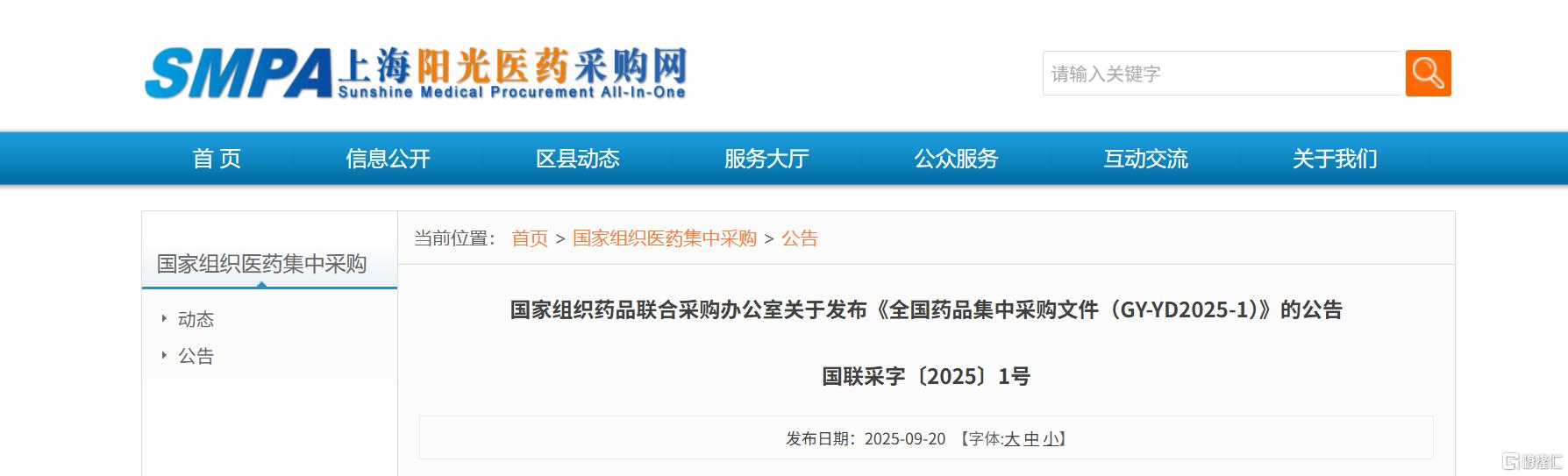
Core Viewpoint - The National Drug Centralized Procurement Office has announced the new centralized procurement document, emphasizing principles of clinical stability, quality assurance, prevention of collusion, and reduction of competition pressure in the pharmaceutical industry [1][3]. Summary by Sections Centralized Procurement Announcement - The announcement requires participating drugs to obtain valid domestic registration by September 28 and complete information submission on the National Medical Insurance Service Platform, with the bidding ceremony scheduled for October 21, 2025 [1]. Changes in Procurement Rules - The new procurement rules introduce a "benchmark price" for the same drug category, set at 50% of the average unit comparable price of validly declared companies and the higher value of the lowest unit comparable price. Companies can qualify for selection if their bid is below 1.8 times the benchmark price, a shift from the previous model that focused solely on the lowest price [3]. Participation and Reporting - A total of 46,359 medical institutions participated in the reporting, with 77% reporting by brand name and 23% by generic name. The drug list remains unchanged with 55 varieties, but mainstream specifications and prices have been noted [3]. Sodium Bicarbonate Injection Reporting - The total reported quantity of sodium bicarbonate injection across 31 provinces reached 71.5665 million units, with unspecified brands accounting for 47.45% of the total [5][9]. Manufacturer Performance - Among the specified brands, six manufacturers reported over 1 million units, with Shijiazhuang Fourth Pharmaceutical Company leading at 9.6542 million units, followed by Hebei Tiancai Pharmaceutical Co., Ltd. at 5.6166 million units [7][9]. Regional Preferences - Regional preferences for manufacturers are evident, with Yunnan showing a strong preference for Hebei Tiancai Pharmaceutical, while Shijiazhuang Fourth Pharmaceutical has a balanced national coverage [9][10]. Market Dynamics Ahead of Bidding - As the bidding date approaches, the market dynamics for sodium bicarbonate injection are expected to shift, influenced by brand preferences and the flow of unspecified brands, with companies that possess capacity, quality, and clinical recognition likely to emerge as winners in this round of procurement [10].

55个品种纳入,第十一批国家药品集采报量启动
21世纪经济报道· 2025-08-08 05:57
Core Viewpoint - The article discusses the transformation of China's drug procurement policy from a "low-price only" approach to a "quality first" strategy, marking a significant reform in the pharmaceutical industry that balances efficiency and clinical needs [1][2][5]. Group 1: Changes in Procurement Rules - The 11th batch of national drug centralized procurement involves 55 varieties, with a new rule allowing medical institutions to report demand by brand name instead of only by generic name [1][2]. - A reporting threshold of 80% of the average usage over the past two years has been established, requiring institutions to report no less than this amount [1][7]. - Institutions can provide written explanations for significant decreases in expected usage due to clinical demand changes [1][7]. Group 2: Quality Control and Market Dynamics - The new procurement rules emphasize quality control, requiring companies to have at least two years of production experience and compliance with quality management standards [7][9]. - The principle of "anti-involution" aims to prevent excessive price competition, encouraging companies to focus on quality and reasonable profits [9][10]. - The procurement process is designed to stabilize market expectations, allowing companies to better manage production and inventory [10]. Group 3: Impact on the Pharmaceutical Industry - The changes in procurement rules are expected to reshape the industry supply chain logic, with a focus on maintaining clinical stability and quality assurance [5][11]. - The procurement process will allow for flexible adjustments based on seasonal demand and specific needs, particularly for pediatric medications [11][12]. - The article highlights the potential for further price reductions in the market, benefiting patients while also posing challenges for companies facing increased competition [12][13].
第十一批国采共纳入55个品种
Guo Ji Jin Rong Bao· 2025-07-17 02:11
Group 1 - The core announcement is about the initiation of the 11th batch of national organized drug procurement, allowing companies to submit information for drug selection from July 16 to July 31, 2023 [1] - A total of 55 drug varieties have been included in this procurement, covering commonly used clinical medications such as anti-tumor, diabetes, cardiovascular, and respiratory drugs [2][3] - The procurement process will exclude innovative drugs and focus on mature products that have been on the market for years and have multiple manufacturers [1][2] Group 2 - 68 drugs that met the evaluation criteria were not included in this procurement, with reasons including insufficient competitive landscape and low projected procurement amounts [3] - Notably, five drugs were excluded due to high patent infringement risks, including Novartis' sacubitril/valsartan, which has seen significant sales growth in recent years [3][4] - The procurement rules are expected to be optimized, focusing on maintaining clinical stability, ensuring quality, and preventing irrational competition among companies [5][6] Group 3 - The selection criteria for this batch of procurement have been made transparent, combining previous rules with new policy requirements [6] - Quality requirements have been strengthened, with a new mandate for bidders to have at least two years of production experience for similar formulations [6][7] - The pricing mechanism has been adjusted to discourage irrational low-price competition, with a focus on rational pricing based on cost and quality [7]