全球变暖

Search documents
雨量创纪录 华北真的更湿润了吗?
Xin Hua She· 2025-09-05 14:07
Core Insights - The summer rainy season in North China has set records for both duration and rainfall, marking the strongest rainy season since 1961 [1][2] - The rainy season began on July 5, 2023, which is 13 days earlier than the average, and ended on September 2, 2023, 16 days later than usual, resulting in a total duration of 29 days longer than the average [1][2] - Cumulative rainfall reached 356.6 mm, exceeding the average by 161.1%, establishing a historical high since 1961 [1] Climate Factors - The early onset of the rainy season is attributed to the abnormal northward movement of the subtropical high-pressure system, which has been influenced by climate change and ocean temperature anomalies [2] - The subtropical high-pressure system has been stronger and positioned further north than in previous years, contributing to increased moisture transport to North China [2] Long-term Trends - There is a linear increasing trend in rainfall during the rainy season in North China since the 21st century, although no significant increase is observed over a longer time frame from 1961 to 2024 [3] - Historical data indicates that years with rainfall exceeding 300 mm occurred primarily in the 1980s and 1990s [3] Weather Patterns - The combination of global warming and the early rainy season has led to increased humidity and prolonged high temperatures, resulting in a shift from dry heat to humid heat in North China's summers [4] - The frequency of humid heat events has increased significantly compared to dry heat events since 1981, with a growth rate of 2 to 3 times [4] Climate Change Implications - The record-breaking rainy season is seen as a localized manifestation of climate change, with rising atmospheric moisture and urban heat island effects contributing to more frequent and intense extreme rainfall events [4]
一个月两次!法国核电站频遭水母“暗算“关停
财联社· 2025-09-05 07:56
Core Viewpoint - The recent jellyfish invasion at French nuclear power plants highlights the growing risks associated with climate change and its impact on energy production, particularly in the context of rising sea temperatures and increased jellyfish populations [5][6]. Group 1: Incident Overview - A jellyfish invasion caused the temporary shutdown of one reactor and a reduction in capacity of another at the Paluel nuclear power plant, affecting nearly 2000 megawatts of power generation [1]. - The jellyfish blocked the cooling system's water pumps, disrupting the cooling process of the generators [2]. - The Gravelines nuclear power plant also experienced a similar jellyfish issue in mid-August, leading to a ten-day shutdown of four reactors [2]. Group 2: Response and Mitigation - EDF learned from the previous incident and proactively shut down the power generation equipment upon detecting the jellyfish [2]. - The jellyfish only impacted the "non-nuclear" parts of the power station, and other plants in France increased their output to compensate for the lost generation [4]. Group 3: Broader Implications - The overpopulation of jellyfish is attributed to warming sea temperatures, with this summer being one of the hottest on record in Europe [5]. - France generates 68.6% of its electricity from nuclear energy, with 14 out of 57 reactors using seawater for cooling, indicating a potential increase in jellyfish-related incidents if global warming continues [6]. - EDF had previously planned to install "acoustic deterrent devices" at the Hinkley Point C nuclear power station, referred to as "fish disco," but this project has not been implemented yet [6].


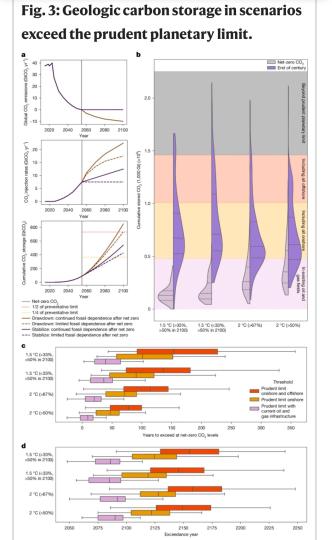
地球碳封存能力上限是多少?国际最新研究预计为1.46万亿吨
Zhong Guo Xin Wen Wang· 2025-09-04 03:33
Core Insights - The Earth's geological carbon storage capacity is estimated to be 1.46 trillion tons, according to a recent study published in the journal Nature [1][3] - This capacity may be reached by the year 2200 under current warming mitigation scenarios, prompting countries to reconsider the role of carbon storage in their emission reduction plans [1][3] Group 1: Research Findings - The study indicates that to achieve net-zero carbon emissions, the amount of carbon dioxide emitted must be balanced by the amount sequestered [1] - Carbon capture and storage (CCS) technology can potentially sequester emissions in geological formations for hundreds or thousands of years [1] - The cautious estimate of the Earth's geological carbon storage potential is 1.46 trillion tons, which could mitigate global warming by up to 0.7°C [3] Group 2: Geographic and Technical Considerations - Approximately 70% of the carbon storage potential is located on land, with high storage potential countries including Russia, the United States, China, Brazil, and Australia [3] - The study's limitations include not accounting for barriers to the scaling of carbon capture and storage technologies or potential future technological advancements [3] - Decision-makers are urged to clarify the estimated need for carbon storage and plan strategies to mitigate carbon emissions accordingly [3]
英国经历有记录以来最热夏季
Bei Jing Shang Bao· 2025-09-02 16:30
Group 1 - The UK has experienced its hottest summer on record, with an average temperature of 16.1 degrees Celsius, surpassing the previous record of 15.76 degrees Celsius set in 2018 [1] - The occurrence of record summer temperatures has increased by 70 times due to rising greenhouse gas concentrations from human activities [2] - The analysis indicates that under current climate conditions, similar extreme summers could occur approximately every five years, compared to a natural climate scenario where such summers would only happen once every 340 years [2] Group 2 - The average summer temperature in 2025 is 0.34 degrees Celsius higher than the previous record in 2018, while the difference between the other four hottest summers in history is only a few tenths of a degree [2] - The summer of 2025 saw four heatwaves, with daily maximum temperatures frequently exceeding 30 degrees Celsius, leading to a national severe water shortage [2] - Despite the hot summer, the highest temperature recorded was 35.8 degrees Celsius, which is lower than the national record of 40.3 degrees Celsius set in 2022 [3]

「万物皆可盲盒」,剩菜盲盒是什么? | Knock Knock 世界
声动活泼· 2025-08-30 05:05
Core Viewpoint - The article discusses the ongoing challenges posed by global warming, emphasizing the need for humanity to adapt and change its behaviors to mitigate the impacts of climate change, including food waste and invasive species [1][4][5]. Group 1: Global Warming and Its Effects - China's carbon dioxide emissions are not decreasing but are instead increasing year by year [3]. - Extreme weather events are becoming more frequent and damaging, necessitating systems to reduce their impact on life and property [4]. Group 2: Food Waste and Solutions - Food waste is a significant issue, with urban food waste in China in 2018 equating to the annual food consumption of residents in Beijing and Shanghai combined [6]. - The "Too Good To Go" initiative, which started in Denmark in 2015, aims to reduce food waste by connecting consumers with businesses to sell surplus food [6][7]. - Various stakeholders, including businesses and governments, are employing technology and innovative methods to combat food waste [7]. Group 3: Invasive Species Management - The article highlights the case of Burmese pythons in Florida as an example of invasive species management, where the state has resorted to hunting to control their population [8]. - In China, the fall armyworm is identified as an invasive species that has spread due to climate change, affecting local crops [8]. - Different methods, including lethal control measures, are being considered to manage invasive species effectively [8].

台风活动、全球变暖、水汽输送……全球气候系统变化导致华北雨季超长“待机”
Ke Ji Ri Bao· 2025-08-28 06:58
Core Viewpoint - The article discusses the unusually long and wet rainy season in North China, highlighting its early onset and significant rainfall, which are attributed to various climatic factors and global warming effects [1][2][3]. Group 1: Rainy Season Characteristics - The rainy season in North China began on July 5, 2025, which is 13 days earlier than the average start date of July 18 [2]. - As of August 21, the average rainfall in the North China monitoring area reached 315.5 mm, which is 131% higher than the normal value of 136.6 mm [2]. Group 2: Contributing Factors - The increased rainfall is linked to several factors, including abnormal sea temperatures in the equatorial Pacific, a strong and shifted subtropical high-pressure system, typhoon activity, and geographical influences [3][4]. - The subtropical high-pressure system has been notably strong and positioned further north than usual, facilitating the transport of warm, moist air to northern China [3]. Group 3: Geographical Influence - The geographical features of the Beijing-Tianjin-Hebei region, including the Taihang and Yan mountains, enhance precipitation through orographic lift, which promotes condensation of moisture [4]. - The combination of topographical effects and weather systems significantly increases rainfall efficiency in the region [4].
北方再迎较强降雨 华北雨季为何还未停歇?
Xin Hua Wang· 2025-08-27 10:52
Core Viewpoint - The northern regions of China, particularly North China, are experiencing an unusually prolonged rainy season, with significant rainfall exceeding historical averages, attributed to various climatic factors [2][3][4]. Summary by Sections Rainfall Patterns - The rainy season in North China began on July 5, 2023, which is 13 days earlier than the average, marking the earliest start since 1961 [2]. - As of August 25, 2023, the cumulative rainfall in the monitoring area of North China was 131% higher than the average [2]. Climatic Influences - The excessive rainfall is linked to abnormal sea temperatures in the equatorial Pacific, a strong and shifted subtropical high-pressure system, typhoon activity, and geographical factors [3]. - The subtropical high-pressure system has been notably strong and has shifted northward, allowing for continuous moisture transport from the ocean to northern regions [3]. Weather Systems and Topography - The influence of Typhoon "Zhu Jie Cao" has contributed additional moisture to North China, enhancing rainfall [4]. - The topographical features, such as the Taihang and Yanshan mountains, have caused forced uplift of warm, moist air, leading to increased precipitation through condensation and convection [4]. Climate Change Context - The record-breaking rainy season is seen as a localized manifestation of climate change, highlighting the need for improved climate adaptation and response capabilities to handle extreme weather events [4].
出口狂飙60%!欧洲热浪“点燃”中国空调产线
Jin Tou Wang· 2025-08-26 02:13
Group 1 - The summer heatwave in Europe has led to a significant increase in air conditioning imports from China, with exports rising nearly 60% year-on-year in July [1] - Spain's capital, Madrid, issued a yellow alert as temperatures approached 36 degrees Celsius, while 85 out of 96 metropolitan areas in France, including Paris, issued heat warnings [1] - China produces about 80% of the world's cooling equipment, dominating the global air conditioning market, which has benefited from the surge in demand due to the heatwave [1] Group 2 - European consumers prefer Chinese air conditioners due to the high installation costs of local brands, with installation fees in France ranging from 1200 to 2000 euros [2] - Chinese air conditioning companies have introduced portable split air conditioners that can be quickly installed without tools, addressing the high installation cost issue for European users [2] - The trend of global warming is expected to continue, with predictions indicating that by 2030, the number of "tropical nights" in Paris will increase from 6 to 15 days, and the EU anticipates the installation of 70 million air conditioners by 2030, covering 35% of European households [2]
请回答「Knock Knock 世界」NO. 2508024
声动活泼· 2025-08-24 00:35
Core Viewpoint - The article discusses various topics related to global warming, consumer behavior, and the dynamics of different industries, particularly focusing on the impact of climate change and market strategies in different regions [5][13]. Group 1: Climate Change and Its Effects - The article highlights the increasing frequency of questions regarding climate change, indicating a growing public concern about its impact on biodiversity and human life [13]. - It mentions the phenomenon of unusual insect sightings in summer, linking it to climate change and raising questions about future environmental conditions [13]. Group 2: Consumer Behavior and Market Dynamics - The article explores the pricing discrepancies of products like Royce chocolate between Japan and China, questioning the rationale behind not establishing local production to reduce costs [8]. - It discusses the operational strategies of restaurants, noting that some successful establishments choose not to expand despite high demand, suggesting a focus on quality over quantity [8]. - The article raises questions about the operational hours of convenience stores and their profitability, indicating a complex relationship between consumer traffic and business sustainability [8]. Group 3: Industry Insights - The article touches on the prevalence of major companies' headquarters in Seattle, prompting inquiries about the city's unique attributes that attract such businesses [11]. - It mentions the challenges faced by new fashion designers in China due to market saturation and intellectual property issues, highlighting the competitive landscape of the fashion industry [10].

欧洲多国山火肆虐 火情打破多项纪录
Yang Shi Xin Wen Ke Hu Duan· 2025-08-21 05:44
Group 1 - The core issue is the severe wildfires affecting Spain and Portugal, exacerbated by high temperatures, strong winds, and human arson, linked to global warming [1][2] - Spain has requested assistance from the European Union for the first time in response to its most severe wildfire crisis, with over 3,800 square kilometers burned, resulting in 4 fatalities and thousands evacuated [2][4] - Portugal is also facing significant wildfire challenges, with over 2,600 square kilometers burned and 3 fatalities, prompting the government to deploy 2,600 firefighters and request EU assistance for firefighting aircraft [5] Group 2 - Spain has mobilized thousands of firefighters and military emergency personnel, with support from Germany, France, and the Netherlands, indicating a regional response to the crisis [4] - The Spanish Prime Minister has highlighted the difficulties in extinguishing the fires, with complete control expected to take weeks [4] - In Portugal, a national state of alert has been declared since early August due to wildfire risks, reflecting the severity of the situation [5]