
全球气候变化

Search documents
意大利网红景点“情人拱门”在情人节坍塌
Xin Lang Cai Jing· 2026-02-17 13:15
Core Viewpoint - The collapse of the "Lovers' Arch" in Salento, Italy, due to extreme weather and climate change, represents a significant loss for local tourism and cultural heritage, impacting the image of the Salento Peninsula [1][2]. Group 1: Impact on Tourism and Local Economy - The collapse of the arch is a severe blow to local tourism and the image of the Salento Peninsula, described as a "heavy blow to the soul" by the town's mayor [2]. - The "Lovers' Arch" had become a popular destination for couples, especially with the rise of social media, leading to the development of hotels and resorts named after it [1]. Group 2: Environmental Factors - Climate change has led to rising sea temperatures, exacerbating coastal erosion and increasing the frequency of extreme weather events, which contributed to the arch's structural instability [1]. - The local government noted that the collapse of the arch was an "inevitable tragedy" due to climate change, with the mayor expressing surprise at the speed of its occurrence [2]. Group 3: Local Sentiment and Community Response - Local residents expressed deep emotional connections to the arch, with personal stories highlighting its significance for anniversaries and proposals, indicating a strong community attachment [2]. - The local government has decided not to clear the rubble from the collapsed arch, allowing the sea to gradually carry it away, reflecting a passive approach to the aftermath [3].
解码洞察南极冰山变化的“千里眼”
Xin Lang Cai Jing· 2026-02-10 20:04
Group 1 - The core viewpoint of the article emphasizes the critical role of Antarctic icebergs as indicators of global climate change, with the A23a iceberg rapidly disintegrating due to global warming, impacting sea levels and wildlife [4][5] - The A23a iceberg has split into nine smaller icebergs (A23b to A23j), with its area reduced to 531 square kilometers, approximately one-eighth of its size at the end of 2023 [5] - The 1-meter C-SAR satellite plays a crucial role in monitoring the A23a iceberg, providing high-resolution images unaffected by extreme weather conditions, thus enabling precise tracking of iceberg changes [5][6] Group 2 - A comprehensive observation network has been established, integrating satellites, aircraft, ground stations, and marine equipment to monitor Antarctic icebergs effectively [6] - China's rapid development in polar observation has led to the establishment of a satellite constellation focused on polar monitoring, supported by research stations and icebreakers [6] - The country is actively participating in international initiatives to measure ice thickness and provide essential data for global polar observation, although there remains a gap compared to the most advanced international standards [6]

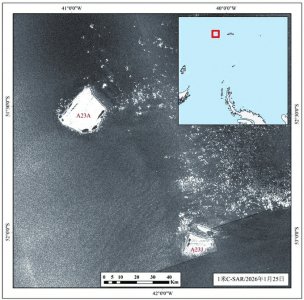
科学与健康|解码洞察南极冰山变化的“千里眼”
Xin Hua She· 2026-02-04 11:43
Core Insights - Antarctic icebergs serve as a "barometer" for global climate, with their disintegration significantly impacting human safety and development [1][2] - China's marine satellite network plays a crucial role in monitoring Antarctic icebergs, contributing to global climate change responses [1][2] Group 1: Iceberg Monitoring - The world's largest iceberg, A23a, is accelerating its disintegration, expected to break into smaller icebergs after April 2025, influenced by ocean currents [2] - As of January 2026, A23a has split into nine smaller icebergs (A23b to A23j), with its area reduced to 531 square kilometers, approximately one-eighth of its size at the end of 2023 [2][3] Group 2: Satellite Technology - The 1-meter C-SAR satellite is pivotal in monitoring iceberg changes, providing high-resolution images unaffected by extreme weather conditions [3] - China's marine satellite capabilities have evolved since the launch of the Ocean No. 1 C satellite in September 2018, enabling systematic observation of polar ice structures [3] Group 3: Collaborative Monitoring Network - A comprehensive monitoring network has been established, integrating satellites, aircraft, ground stations, and marine equipment for continuous observation of Antarctic icebergs [4] - China's rapid development in this field has led to a unique collaborative observation advantage, supported by various research stations and icebreakers [4] Group 4: International Collaboration and Data Contribution - China's research teams are actively participating in international Antarctic initiatives, measuring ice thickness and providing critical data for global polar observation [4] - Despite advancements, there remains a gap compared to international standards in data continuity and platform authority, with plans to enhance data richness and precision for climate assessments [4]
《青海省瓦里关全球大气本底站保护若干规定》自2月1日起施行
Xin Lang Cai Jing· 2026-02-01 10:01
Core Viewpoint - The implementation of the "Regulations on the Protection of the Wari Pass Global Atmospheric Background Station" marks a significant step in safeguarding one of the world's highest atmospheric monitoring stations, enhancing its data credibility and international standing in climate discussions [1][3]. Group 1: Regulations and Legal Framework - The regulations incorporate the protection area into land spatial planning, legally solidifying the protection boundaries [3]. - A law-based enforcement and reporting system is established to ensure the normalization and legalization of protection efforts [3]. - The regulations prohibit observational interference and data falsification, ensuring the integrity and continuity of the original data [3]. Group 2: Technological and Research Development - The regulations encourage the development of technologies related to carbon neutrality analysis and the integration of ecological meteorological data [3]. - There is a push for collaboration between industry, academia, and research to facilitate the transformation of scientific achievements [3]. - The regulations support the construction of a global atmospheric background and Tibetan Plateau big data application center [3]. Group 3: International Impact - The regulations enhance the international discourse power of the Wari Pass station's observational data [3]. - They provide a solid foundation for China's participation in global climate negotiations [3].

在世界屋脊守护美丽地球
Xin Lang Cai Jing· 2026-01-31 18:30
Core Viewpoint - The Wari Pass Global Atmospheric Background Station in Qinghai Province plays a crucial role in monitoring greenhouse gas concentrations and contributes significantly to global climate change research through its long-term observational data [3][4][10]. Group 1: Importance of Wari Pass Station - The Wari Pass Station has been operational for over 30 years, providing continuous and high-precision observations of atmospheric carbon dioxide concentrations, which are critical for understanding global climate trends [3][4]. - The data from Wari Pass, known as the "Wari Pass Curve," aligns closely with observations from the Mauna Loa Observatory in Hawaii, demonstrating a consistent increase in greenhouse gas concentrations globally [3][4]. - The establishment of the Wari Pass Station filled a significant observational gap for continental atmospheric monitoring, contributing to the global atmospheric observation network [3][4]. Group 2: Environmental Protection Measures - To ensure the accuracy and reliability of observations, Qinghai has implemented protective measures around the Wari Pass Station, including the establishment of an 80-acre protection zone to control potential pollution sources [9]. - New regulations effective from February 1, 2026, will provide a legal framework for the protection of the Wari Pass Station, integrating environmental protection into land use planning [9]. - The station's operational environment is maintained with strict protocols to minimize human interference, which is essential for the continuity and comparability of the data collected [7][9]. Group 3: Contribution to Climate Change Mitigation - The data generated by the Wari Pass Station is vital for assessing China's efforts in combating climate change, with the 2024 report indicating a 0.6% increase in human carbon emissions, lower than the global average of 0.8% [11]. - The station serves as a foundation for a national network of atmospheric observation stations, enhancing China's capacity to contribute to global climate governance [10]. - China's commitment to improving its technological support for climate change initiatives is evident, as it aims to lead in global climate governance and sustainable development [12][13].
第42次南极考察丨通讯:在南极长城站奏响国际合作“科研交响乐”
Xin Hua Wang· 2026-01-28 05:36
Core Viewpoint - The article highlights the increasing international collaboration in scientific research at China's Great Wall Station in Antarctica, showcasing its role as a platform for global scientific cooperation and addressing climate change and ecological protection issues [1][4]. Group 1: International Collaboration - More than ten countries and regions, including Portugal and Chile, are conducting research in collaboration with Chinese teams at the Great Wall Station this year [2]. - The Great Wall Station provides comprehensive support, including laboratory space, sampling vessels, and sample analysis capabilities, facilitating diverse marine ecological research [2][3]. - The cooperation between Chinese and Portuguese scientists is characterized by smooth communication and mutual respect, overcoming language barriers [3]. Group 2: Research Contributions - Portuguese scientists are studying how Antarctic invertebrates respond to metal pollution and climate change, utilizing advanced equipment available at the Great Wall Station [2]. - The station's modern laboratory and reliable logistics align well with Portugal's polar research plans, making it an attractive location for international scientists [2][3]. Group 3: China's Role in Global Research - China aims to enhance its role as an international collaborator in polar research, providing opportunities for more countries to participate in field studies and expanding joint research areas [4]. - The Great Wall Station is positioned as a model for international polar research cooperation, particularly in addressing climate change and ecological protection [4]. - The article emphasizes China's transformation from a participant in polar exploration to a promoter and contributor to international cooperation [4].
100年前,美国人就盯上了格陵兰岛
财富FORTUNE· 2026-01-19 13:12
Core Viewpoint - The article discusses the complex historical and strategic relationship between the United States and Greenland, emphasizing the need for a responsible approach to the region amid climate change, rather than aggressive territorial claims or resource exploitation [1][18]. Historical Context - The U.S. has a long history of interest in Greenland, dating back to early 20th century explorations and resource extraction, including the controversial actions of naval officer Robert Peary [5][6]. - During World War II, Greenland was strategically important for the U.S. military, serving as a base for operations and weather data collection [7][9][10]. - The Cold War era saw ambitious military projects in Greenland, including the construction of Thule Air Base and plans for nuclear facilities, which ultimately failed due to environmental challenges [11][13][14]. Current Situation - The article highlights the ongoing issues related to abandoned military sites and the environmental impact of past U.S. activities in Greenland, which have left behind significant waste [16][18]. - Recent climate change has accelerated the melting of Greenland's ice sheets, posing risks to global sea levels and infrastructure [19][20]. Strategic Importance - Greenland's ice sheets are deemed more valuable than its potential mineral resources, as their melting could lead to catastrophic global consequences [19][20]. - The U.S. and Denmark are currently conducting geological surveys to identify mineral deposits, but mining activities remain limited and focused on specific resources [18]. Conclusion - The article argues that the most prudent strategy for the U.S. regarding Greenland is to prioritize the protection of its ice sheets and address climate change, rather than pursuing short-term economic gains through resource extraction [20].

第42次南极考察 “雪龙”号大洋队开始大洋考察作业
Yang Shi Xin Wen· 2026-01-17 06:35
Core Viewpoint - The Chinese 42nd Antarctic Expedition, led by the "Snow Dragon" vessel, is conducting significant oceanographic research in the Amundsen Sea, focusing on marine ecosystem elements and the impacts of climate change [1][2]. Group 1: Expedition Overview - The "Snow Dragon" vessel's ocean team consists of 31 members from 12 domestic research institutions and universities [1]. - The expedition aims to conduct a comprehensive oceanographic survey in the Amundsen Sea and adjacent waters from mid-January to mid-February 2026 [1]. - The research will enhance understanding of the ecological characteristics of the target marine area and track changes in key species populations [1]. Group 2: Research Focus and Methodology - The expedition will investigate critical elements of the marine ecosystem, including hydrology, meteorology, biology, and chemistry, to gather data on the Southern Ocean's ecological status [1]. - New technologies, such as ecological mooring arrays and domestic unmanned detection equipment, will be employed to support the comprehensive survey [2]. - Continuous observations since 2018 have been crucial for capturing the complex and rapid changes in the marine environment of the Amundsen Sea [2]. Group 3: Climate Change Impact - The Amundsen Sea region is significantly affected by global climate change, with notable melting of ice caps and ice shelves [1]. - This area is a focal point for international Antarctic research concerning climate change, making the findings from this expedition particularly valuable [1].
第42次南极考察丨“雪龙”号大洋队开始大洋考察作业
Xin Hua Wang· 2026-01-17 06:01
Group 1 - The core mission of the "Snow Dragon" vessel is to conduct the 42nd Antarctic expedition, focusing on ocean ecosystem investigations in the Amundsen Sea and surrounding areas [1][2] - The expedition team consists of 31 members from 12 domestic research institutions and universities, aiming to enhance understanding of key species and ecological structures in the target marine area [1] - The investigation will include comprehensive oceanographic surveys, seabed topography studies, and monitoring of hydrological, meteorological, biological, and chemical parameters [1] Group 2 - The Amundsen Sea region is significantly affected by global climate change, with notable ice cap and ice shelf melting, making it a focal point for international Antarctic research on climate change [2] - Since 2018, China has conducted multi-disciplinary investigations in the Amundsen Sea for eight consecutive years, providing valuable data for assessing the impact of global climate change on marine ecosystems [2] - The current expedition will utilize advanced technologies, including new ecological mooring arrays and domestic unmanned detection equipment, to enhance the comprehensive investigation of the Antarctic marine environment [2]
第42次南极考察|“雪龙”号大洋队开始大洋考察作业
Xin Hua She· 2026-01-17 05:53
Core Insights - The "Snow Dragon" vessel has commenced its 42nd Antarctic expedition, focusing on oceanic research in the Amundsen Sea and surrounding areas, marking the start of its oceanographic survey operations [1][2] - The expedition aims to investigate key elements of the marine ecosystem, track changes in critical species populations, and enhance China's research capabilities in marine ecosystems and climate change [1][2] Group 1: Expedition Overview - The "Snow Dragon" team consists of 31 members from 12 domestic research institutions and universities [1] - The oceanographic survey will take place from mid-January to mid-February 2026, concentrating on the southwestern Antarctic region [1] - The team will conduct hydrological, meteorological, biological, and chemical observations to gather data on the Southern Ocean's ecological status [1] Group 2: Research Significance - The southwestern Antarctic region is significantly affected by global climate change, with notable ice cap and ice shelf melting in the Amundsen Sea [2] - Since 2018, China has conducted multidisciplinary surveys in the Amundsen Sea for eight consecutive years, which is crucial for understanding rapid marine changes [2] - The findings from this expedition will provide valuable data for assessing the impact of global climate change on marine ecosystems [2] Group 3: Technological Advancements - The expedition will deploy new ecological buoy arrays, utilize advanced krill trawls, and test domestically developed unmanned detection equipment [2] - The application of advanced technology will enhance China's comprehensive marine investigations in Antarctica [2]