隐私计算

Search documents
隐私计算行业产业链全景梳理及区域热力地图
Sou Hu Cai Jing· 2025-04-15 04:11
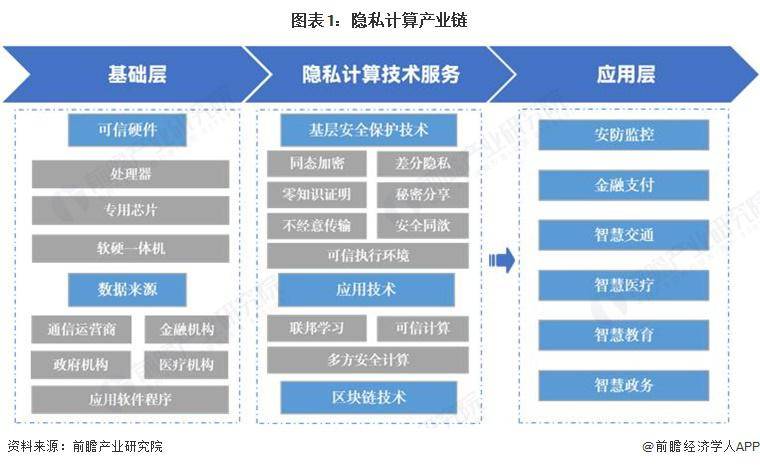
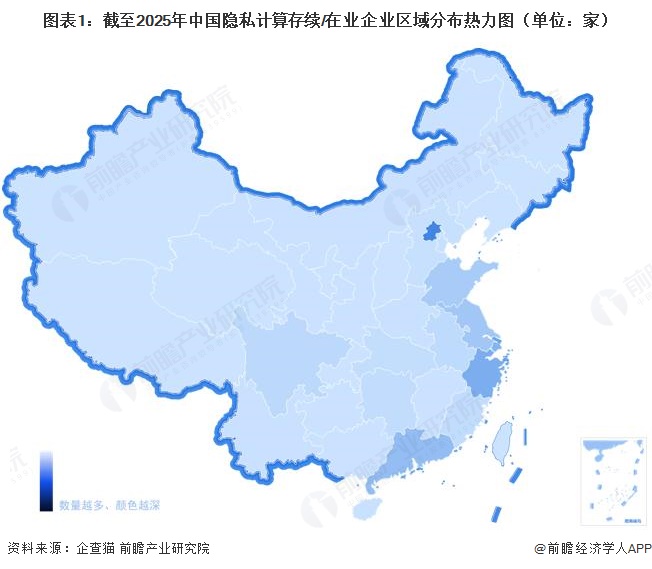
Core Insights - The privacy computing industry is characterized by a collaborative development across its entire value chain, which includes upstream hardware, midstream technology services, and downstream applications across various sectors such as government, finance, and education [1][2]. Industry Overview - The upstream of the privacy computing industry primarily consists of trusted hardware such as encryption chips and specialized processors, while the midstream includes technology and service providers offering various security protection technologies and application technologies [1]. - The downstream application layer encompasses a wide range of sectors, indicating a broad market potential for privacy computing solutions [1]. Regional Distribution - The distribution of representative companies in the privacy computing industry is relatively dispersed, with Shanghai having a well-established layout across the entire value chain, followed by Beijing, Guangdong, and Zhejiang [2]. Company Performance - Tencent leads in R&D investment within the privacy computing sector, followed closely by Alibaba and Baidu, with significant variations in R&D expenditure as a percentage of revenue among companies [6]. - Notable advancements in privacy computing have been reported by companies such as AsiaInfo, NSFOCUS, and Tuolsi [6]. R&D Investment - AsiaInfo's R&D investment totaled 319 million yuan, accounting for 28.8% of its revenue, while NSFOCUS invested 416 million yuan, representing 32.7% of its revenue [7]. - The R&D efforts of various companies are focused on developing comprehensive solutions in privacy computing, including secure execution environments and integrated systems [7]. Investment Trends - Privacy computing companies are actively investing in sectors such as scientific research, technology services, and financial services to enhance their technological capabilities and expand their market reach [10]. - Recent investments include AsiaInfo's 10 million yuan investment in Tianjin AsiaInfo Security Technology Co., and NSFOCUS's 510 million yuan investment in Nanjing Tuolsi Intelligent Systems Co., among others [11][12].


数说安全:2025年数据安全市场研究报告
Sou Hu Cai Jing· 2025-04-12 04:57
报告共计:96页 《中国数据安全市场研究报告(2025)》由赛博英杰出品,深入剖析了中国数据安全市场的发展状况,涵盖政策法规、市场规模、行业需求、技术产品以及 供给侧等多个关键领域。 - 政策法规与市场规模:政策法规体系不断完善,从《数据安全法》到《个人信息保护法》等相继出台,数据跨境流动监管升级,各行业法规标准有序推 进,推动数据安全产业稳步成长。在此背景下,数据安全市场规模逆势增长,2024年首次突破百亿,达到118亿元,4年增长近200%,复合增长率30.9%,且 未来3 - 5年有望持续高于网络安全市场规模增长率。 - 行业数据安全建设:不同行业数据安全建设呈现差异。政务行业,数据局领航建设,浙江、广东示范先行,数据安全服务跃居专项首位;金融行业,政策 细化,大型金融机构和中小型金融机构建设现状不同,银行建设增速放缓,保险行业反弹,数据脱敏等专项项目增长明显;运营商行业,工信部推动加强数 据安全基线建设,运营商内部要求高,数据安全管控平台和服务采购体量领先;医疗行业,整体处于初级阶段,三甲医院引领,安全服务采购量持续增长。 - 技术与产品发展:AI、隐私计算等技术在数据安全领域广泛应用。AI+数据分类 ...

中国银行: 中国银行股份有限公司向特定对象发行A股股票摊薄即期回报、填补措施及相关主体承诺事项
Zheng Quan Zhi Xing· 2025-03-30 09:13
Core Viewpoint - The issuance of A-shares by the Bank of China aims to strengthen its core Tier 1 capital, which is essential for stable business development and compliance with regulatory requirements [1][6]. Group 1: Impact Analysis of the Issuance - The total number of shares to be issued is 27,272,727,272, with a total fundraising amount of RMB 165 billion, excluding issuance costs [1]. - The analysis considers three scenarios for annual growth rates of net profit attributable to the parent company: 0%, 2.5%, and 5% [1][4]. - The issuance will dilute immediate returns, affecting key financial metrics such as earnings per share (EPS) and net profit [1][4]. Group 2: Financial Metrics Impact - Without the issuance, the net profit attributable to the parent company for 2025 is projected at RMB 237.84 billion, while with the issuance under different growth scenarios, it varies from RMB 237.84 billion to RMB 249.73 billion [4][6]. - The basic and diluted EPS without the issuance is projected at RMB 0.75, which may decrease to RMB 0.73 under the 0% growth scenario and increase to RMB 0.80 under the 5% growth scenario with the issuance [4][6]. Group 3: Necessity and Reasonableness of the Issuance - The issuance aligns with national policies to enhance the capital base of state-owned banks, which are crucial for supporting the real economy and maintaining financial stability [5][6]. - The bank aims to improve its capital adequacy ratio, which is currently at 14.38%, and the total capital adequacy ratio at 18.76%, both exceeding regulatory requirements [6]. Group 4: Use of Proceeds - The proceeds from the issuance will be fully allocated to increase the bank's core Tier 1 capital, thereby supporting stable business growth and enhancing competitive strength [6][10]. - The bank has a robust human resource reserve with 312,757 employees, and it is focused on optimizing talent allocation to support high-quality development [7]. Group 5: Risk Management and Operational Efficiency - The bank is committed to enhancing its risk management framework, addressing various risks including credit, market, and operational risks [9][12]. - Measures will be taken to improve operational efficiency and reduce costs, thereby enhancing profitability and minimizing the impact of the issuance on immediate returns to shareholders [10][11]. Group 6: Commitments from Major Stakeholders - The controlling shareholder, Central Huijin Investment Ltd., and the bank's board members have committed to ensuring that the measures to mitigate the dilution of immediate returns will be effectively implemented [12][13].
2025年中国隐私计算行业区域竞争分析 北京市场竞争力强【组图】
Qian Zhan Wang· 2025-03-29 09:08
Group 1 - The core viewpoint of the article highlights the competitive landscape and regional distribution of privacy computing companies in China, with a focus on the leading cities and their respective strengths in the industry [1][3]. - Beijing has the highest number of privacy computing companies, approximately 80, indicating strong competitiveness in the sector [1][3]. - The leading companies in Beijing include Huakong Qingjiao and Shudu Technology, with Zhejiang, Guangdong, and Shanghai following in terms of company presence [3]. Group 2 - Hangzhou is identified as the hottest city for privacy computing financing, with the highest number of financing events, reflecting a vibrant investment market [4]. - The demand for privacy computing projects is highest in Beijing, which has recorded 37 tender projects, followed by Shanghai, Fujian, Shandong, and Guangdong [6]. - Zhejiang province has the most successful bids in privacy computing projects, totaling 44, with Beijing, Shanghai, Guangdong, and Jiangsu also showing significant activity [9].
12家A股上市行晒科技赋能成绩单:有的投入200多亿,有的增长近30%
Sou Hu Cai Jing· 2025-03-28 14:11
Core Insights - The banking industry is undergoing a digital transformation driven by advancements in artificial intelligence, big data, and cloud computing, with 12 banks, including major players like Bank of China and China Merchants Bank, having released their 2024 financial reports by March 28 [1] Investment and Talent Development - Major state-owned banks continue to dominate in technology investment, with Bank of China investing CNY 23.809 billion, accounting for 3.76% of its revenue, a year-on-year increase of 0.27 percentage points [2] - Postal Savings Bank's technology investment reached CNY 12.296 billion, a 9.03% increase year-on-year, representing 3.53% of its revenue [2] - In contrast, China Communications Bank's technology investment fell to CNY 11.433 billion, a decrease of 4.94% year-on-year, although it still had the highest revenue ratio at 5.41% among the six major banks [2] - Among joint-stock banks, investments from China Merchants Bank, CITIC Bank, and Industrial Bank were CNY 13.35 billion, CNY 10.945 billion, and CNY 8.377 billion, respectively, with their revenue ratios declining [3] - Smaller banks like Chongqing Bank and Changshu Bank are increasing their technology investments, with Chongqing Bank's investment growing by 20% year-on-year to CNY 0.574 billion [3] Talent Acquisition and Growth - By the end of 2024, Bank of China had 14,940 employees in its technology division, an increase of 2,234, representing 4.78% of total staff [4] - Postal Savings Bank's IT team grew to over 7,200, a 2% increase, making up 3.6% of its total workforce [4] - China Communications Bank leads in technology talent, with 9,041 employees, a 15.70% increase, accounting for 9.44% of total staff [4] - Joint-stock banks like China Merchants Bank and Industrial Bank also showed strong talent density, with China Merchants Bank's R&D staff reaching 10,900, representing 9.3% of total employees [4] Technological Advancements and Applications - Banks are leveraging technology to enhance various business scenarios, with Bank of China adding over 900 new business scenarios through AI and automation [9] - China Communications Bank's mobile banking app reached over 55 million monthly active users, a 630,000 increase year-on-year, with 80% of new loans coming from online channels [9][10] - Postal Savings Bank launched an AI-driven trading assistant that has processed over CNY 1.5 trillion in inquiries, achieving a 94% reduction in transaction time [11] - CITIC Bank developed an AI system with over 1,600 applications across various business areas, while Industrial Bank optimized its AI applications in over 70 scenarios [12] Overall Industry Trends - The banking sector is experiencing a "Matthew Effect" where larger banks benefit more from technology investments, while smaller banks are finding unique paths to digital transformation [3][13] - The industry is entering a new phase of "technology reconstruction," with technology integration becoming pervasive across various operational scenarios [13]