
美元信用风险

Search documents
金价震荡!这里,金条抢购一空!商家紧急上调保证金
21世纪经济报道· 2025-04-25 04:20
Core Viewpoint - Recent fluctuations in gold prices have led to increased demand for gold bars, with investors seeking to hedge against market volatility and potential losses [4][10]. Price Movements - On April 23, the London spot gold price fell below $3,300, but rebounded to $3,349.09 by April 25 [1]. - Domestic gold jewelry prices have not shown an upward trend despite international price recovery, with brands like Chow Tai Fook and Chow Sang Sang pricing at 1,038 CNY per gram [2][3]. Market Demand - There has been a surge in demand for gold bars, with reports of stock shortages in wholesale markets [4][8]. - Retailers have increased the margin requirements for purchasing investment gold bars due to price volatility and supply-demand imbalances [5][6]. Investment Products - Banks are increasing their allocation to gold in wealth management products, with a focus on "gold-themed" offerings [12]. - Two main types of gold-related investment products are being offered: "fixed income plus" products with limited gold exposure and structured products linked to gold derivatives [12][13]. Market Analysis - Analysts suggest that gold remains in a long-term upward trend, supported by market risk aversion, inflation concerns, and strong central bank demand [14]. - Institutions like Goldman Sachs view recent price corrections as buying opportunities, indicating a shift from dollar assets to gold as a safe haven [15].


金价巨震转跌!国际黄金期价跌超2% 接近3300美元关口
Sou Hu Cai Jing· 2025-04-23 07:54
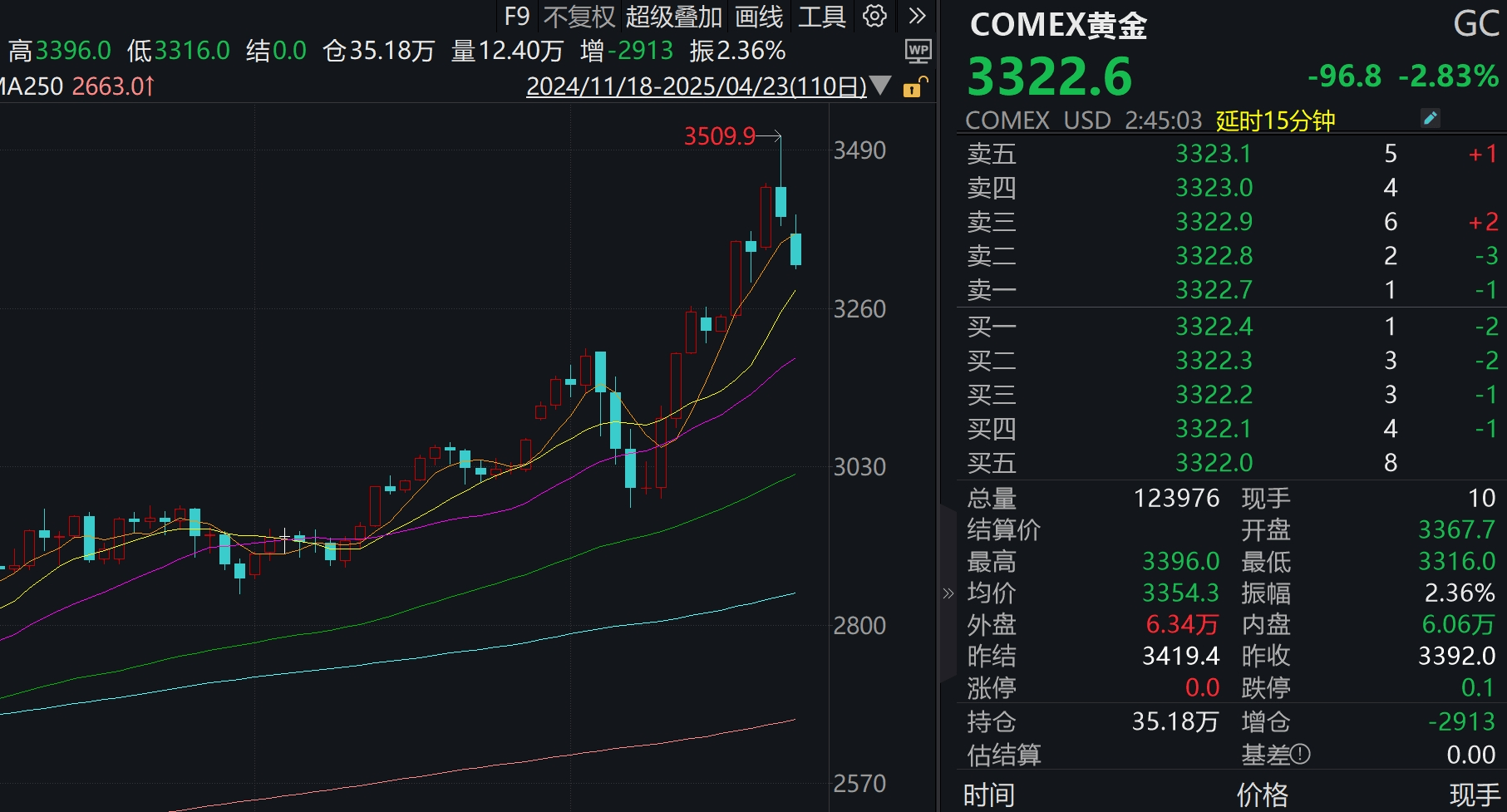
Core Viewpoint - Recent fluctuations in gold prices have captured market attention, with international gold prices reaching a historical high before experiencing a significant pullback [1][3]. Price Trends - On April 22, international gold prices peaked at $3509.9 per ounce but subsequently fell below key levels of $3500 and $3400, currently reported at $3322.6 per ounce as of April 23 [1][3]. - From April 9 to April 21, gold prices surged nearly 15%, with four trading days showing increases of over 3% and one day exceeding 2% [3]. Market Influences - The recent price adjustment is attributed to profit-taking as gold reached historical highs and signs of easing tensions in U.S.-China trade negotiations, which have strengthened the U.S. dollar and applied downward pressure on gold prices [3]. - The ongoing demand for gold is supported by factors such as increased inflation risks in the U.S., strong interest from global central banks in gold allocation, and alternating inflows of speculative and investment funds into the gold market [4]. Future Outlook - The market is expected to remain in a volatile upward trend for gold, driven by persistent demand for safe-haven assets and ongoing economic uncertainties [4].
现货黄金一度涨超3500美元创历史新高 分析称黄金处震荡上行趋势但需警惕风险
Sou Hu Cai Jing· 2025-04-22 09:36
Core Viewpoint - The international gold market is currently experiencing strong performance, with gold prices reaching historical highs due to various supporting factors such as market demand for safe-haven assets and rising inflation risks [1][2]. Group 1: Gold Price Trends - As of April 22, COMEX gold futures were priced at $3460.9 per ounce, up 1.04% for the day, with a peak of $3509.9 per ounce [1]. - Spot gold prices reached $3452.140 per ounce, increasing by 0.83%, and also hit a historical high of $3500.120 per ounce [1]. - Domestic gold jewelry prices have surpassed 1050 RMB per gram, with specific brands like Chow Sang Sang and Chow Tai Fook pricing their gold products at 1080 RMB and 1082 RMB per gram, respectively [1]. Group 2: Factors Supporting Gold Prices - Continued market demand for safe-haven assets due to uncertainties in global trade and geopolitical risks, particularly related to the U.S. and regions like Ukraine and the Middle East [2]. - Rising inflation risks, exacerbated by unexpected tariffs and a hawkish stance from the Federal Reserve, which raises concerns about "stagflation" in the U.S. economy [2]. - Strong willingness among global central banks to increase gold reserves as a strategic asset allocation in response to U.S. debt imbalances and the impact of de-globalization on the safety of dollar assets [2]. - Ongoing credit risks associated with the U.S. dollar, driven by fluctuating tariff policies and weak economic data, leading to a systemic trust crisis in dollar assets and supporting gold prices [2]. - Increased inflow of speculative and allocation funds into the gold market, with notable growth in gold ETFs and futures, pushing prices higher [2]. Group 3: Potential Risks - A significant rebound in U.S. inflation due to the Trump administration's policies could limit the Federal Reserve's ability to lower interest rates, potentially putting pressure on gold prices [3].