Consumer Spending

Search documents
Deutsche Bank's Deepak Puri talks his outlook for 2026
CNBC Television· 2025-12-13 01:06
Market Outlook - Deutsche Bank projects the S&P 500 to reach 7500 by the end of 2026, anticipating US stocks to slightly outperform international stocks and a strengthening dollar [1] - The dollar is expected to stabilize, avoiding the significant weakness seen in the first half of 2025 [2][3] - While the dollar experienced weakness in 2025, it's still up 7% since 2021, representing an annualized increase of around 2% [5] - Deutsche Bank's 12-month outlook includes dollar yen at 145 [5] Economic Factors - The strength of the US economy and double-digit equity market returns are expected to attract fund flows, supporting the dollar [4] - A potential 20% year-over-year increase in tax refunds in the first half of the year could stimulate spending and market activity [9] - Non-residential fixed asset investment, particularly in AI data centers, is driving GDP growth [12] Geopolitical Considerations - Geopolitical risks, especially concerning oil, remain a factor to monitor, although the situation is perceived as potentially more stable in 2026 compared to 2025 [6] Political and Policy Impact - Midterm election years typically exhibit a pattern of positive market performance in the first and fourth quarters, with a lull in the second and third quarters [8] - The market's reaction to the Trump administration and GOP policies, particularly regarding the "K-shaped economy," will be crucial [7][11]


Deutsche Bank's Deepak Puri talks his outlook for 2026
Youtube· 2025-12-13 01:06
Market Outlook - Deutsche Bank projects the S&P 500 to reach a price target of 7500 by the end of 2026, anticipating the US market to slightly outperform international stocks and a stabilization of the dollar [1][4]. Dollar Performance - The dollar experienced significant weakness in 2025 but is expected to stabilize in 2026, with a forecast of the dollar at 115 and dollar-yen at 145 over the next 12 months [5][4]. - The dollar's performance is influenced by the strength of the US economy, which is generating double-digit returns in equity markets, attracting fund flows [4][5]. Geopolitical Factors - Geopolitical conditions are expected to be more stable in 2026 compared to 2025, with fewer crises affecting oil markets, which are sensitive to political developments [6][4]. Political Influence on Markets - The midterm election year is anticipated to create a unique market narrative, with positive performance in the first and fourth quarters, but potential sideways movement in the second and third quarters [8][7]. - Tax incentives and a projected 20% year-over-year increase in tax refunds in the first half of the year could stimulate consumer spending and market activity [9][10]. Economic Drivers - The current economic growth is primarily driven by non-residential fixed asset investments, particularly in AI data centers, but there is a need for consumer spending to contribute significantly to GDP growth [12][11].

November holiday shopping off to a lackluster start, CNBC/NRF Retail Monitor finds
CNBC Television· 2025-12-12 17:00
Retail Sales Performance - Retail sales, excluding auto, gas, and restaurants, remained flat, based on real credit card spending data from Affinity Solutions [1] - Year-over-year retail sales increased by 45%, a slight decrease from the previous month [2] Calendar Impact - The shift of Cyber Monday to December impacted November's retail performance [2] - Seasonal expectations from pandemic spending affected unadjusted changes [2] - November retail performance was affected by the loss of Cyber Monday to December [2][3] Sector Performance - Seven out of twelve sectors experienced month-over-month declines, including electronics and appliances [3] - Digital products, building garment supplies, and general merchandise also saw declines [3] - Food and beverage and restaurants experienced growth [4] Consumer Behavior - Shoppers indicated that more than half of their holiday shopping was yet to be done, the highest percentage since 2019 [4][5]
Analysts set Campbell's stock price target
Finbold· 2025-12-12 15:57
Core Viewpoint - Campbell's shares have reached a 16-year low, trading at $28.58, a decline of nearly 7% since the '3D printed meat' controversy [1][2] Stock Performance - The ongoing slump has erased all gains made over the past four years, with the stock trading well below its 2022 and 2023 averages [2] Analyst Ratings and Price Targets - DA Davidson lowered Campbell's stock price target from $32 to $30 while maintaining a "Neutral" rating, citing weakness in consumer spending and competition in the food sector [5] - Deutsche Bank adjusted its price target to $31 from $33, keeping a "Hold" rating, while RBC Capital cut its target from $35 to $30 with a "Sector Perform" rating [6] - Bernstein lowered its target from $39 to $33 but maintained a "Buy" rating, believing the company's products align with consumer trends [8] - Stifel Nicolaus and Wells Fargo both lowered their price outlooks to $30, opting for a "Hold" rating [9] Market Sentiment - The average stock price target for Campbell's over the next 12 months has an upside potential of 8.47%, sitting at $31.13 [12] - Overall, the sentiment among analysts is mixed, with ten "Hold" ratings, three "Sell" ratings, and only two "Buy" ratings from Bernstein and Stephens [10]


November holiday shopping off to a lackluster start, CNBC/NRF Retail Monitor finds
CNBC Television· 2025-12-12 13:20
Retail Sales Performance - CNBC NRF retail monitor shows November holiday shopping getting off to a lackluster start [1] - Retail sales powered by real credit card spending data rising just 012% [2] - Core retail sales (excluding auto, gas, and restaurants) was flat [3] - Year-over-year retail sales up 45% and core up 47% [3] Calendar Impact - Cyber Monday fell in December this year, impacting November sales [3][4] - Thanksgiving was late this year, delaying holiday shopping [8] - 71% of the time Black Friday through Cyber Monday lands in November [10] Sector Performance - Seven of the 12 sectors saw declines month-over-month, including electronics and appliances [5] - Food and beverage and restaurants saw gains, but not necessarily at malls [6] - Digital products, building garment supplies, and general merchandise were down [5][6] Consumer Behavior - Shoppers had more than half of their shopping left to do after Thanksgiving weekend, the highest percentage since 2019 [6] - American Express data showed business up 9% from Thanksgiving through Cyber Monday [9] Future Outlook - The next couple years are going to be normal, with Black Friday and Cyber Monday in November [11] - Industry is still battling tough comparisons to pandemic spending in 2021 and 2022 [12]

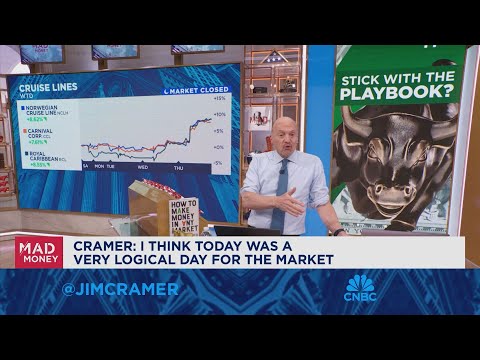
Today was a very logical day for the market, says Jim Cramer
CNBC Television· 2025-12-12 00:14
performance is not in the eye of the beholder and it's pretty easy to see that some formerly unstoppable stocks have momentarily lost some of their mojo. So on a day where the Dow soared 646 points SB advanced 1% but the NASDAQ where much of tech dwells declined.26 26. Let's take a hard look at what should be done with beloved stocks that have been stalled.Stocks like Apple, Meta, and Tesla, all which are up about 10% for the year. Let's start with what's h the heck is happening with the actual stock market ...
Bank of America CEO on the state of the consumer and the job market
CNBC Television· 2025-12-11 15:10
consumers in good shape. They're spending money. Uh we just your team had Liz Ever on earlier and she does a great job describing it.And when you look at the broad base of what they're doing, about 4% of the money yearover-year, November, November went in the economy. Uh the consumer's healthy. There's money in deposits.It's a little bit they were talking about Kep shape or alligator shape. They had all different points, but a little bit uh faster the upper tile of income versus the lower. And but it's all ...

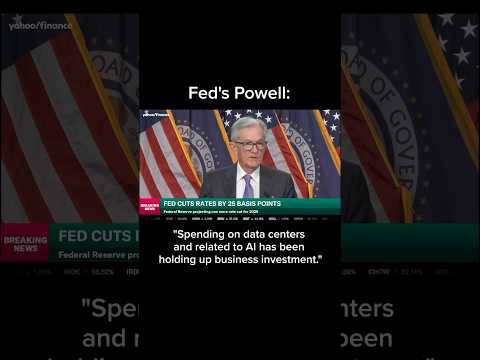
Fed Powell: Spending on AI and data centers has been "holding up business investment."
Yahoo Finance· 2025-12-10 20:25
Economic Growth & Forecast - Broadly, outside forecasts indicate a pickup in growth [1] - The baseline expectation is a growth pickup from the current 1.7% [2] - The SEP median growth is 1.7% for the current year and 2.3% for the next year [2] - Adjusting for shutdown impact, growth would be 1.9% and 2.1% respectively [2] - Solid growth is expected next year [3] Key Drivers - Resilient consumer spending is a contributing factor [1][3] - AI spending on data centers is supporting business investment [1][3] - Fiscal policy is expected to be supportive [2]
X @Bloomberg
Bloomberg· 2025-12-10 16:01
Consumer Spending - American Express CEO 表示美国感恩节期间消费者支出同比增长 9% [1]

Consumer spending is growing but the pace has slowed, says Bank of America's Liz Everett Krisberg
CNBC Television· 2025-12-10 13:26
Consumer Spending Trends - Overall consumer spending is still growing, but the pace has slowed, increasing by 13% year-over-year in November, down from 24% in October [2][3] - Seasonally adjusted month-over-month consumer spending was flat in November, the first time in five months it didn't grow [3] - Higher-income consumer spending grew by 26%, while lower-income consumer spending grew by 06%, indicating a divergence [4] - Middle-income consumer spending experienced a pullback, going from up 17% to up only 14% [5] Wage Growth Disparities - Higher-income wage growth was up 4% in November, the highest level in four years [6] - Lower-income households also saw wage increases, going from 1% to 14%, but the difference remains significant [6] - The labor market for lower-income individuals is stabilizing rather than declining [7] Labor Market Insights - The number of accounts receiving a paycheck increased by 02% in November, indicating the labor market is expanding, though at a slower pace than in previous months [10][11] - The number of new households receiving unemployment benefits remains relatively consistent with previous months [13] - The labor market is described as being in a "higher low fire environment," but still expanding [13] Inflation Analysis - Growth in holiday spending is driven by more transactions, suggesting inflation is not accelerating in that area [15][16]