
Geopolitical Risk

Search documents
Oil Falls as Gaza Deal Eases Geopolitical Risk
Barrons· 2025-10-10 08:08
Core Viewpoint - Oil prices declined following Israel's approval of a U.S.-brokered cease-fire and hostage release deal in Gaza, indicating a potential reduction in geopolitical tensions that could disrupt oil supply [1] Oil Market Impact - Analysts at ANZ Research noted that the cease-fire represents a significant step towards ending the two-year conflict, which had previously heightened the risk of supply disruptions in the oil market [1] - Brent crude and WTI prices both fell by 0.5%, settling at $64.88 and $60.76 per barrel, respectively, after a 1.6% decrease in the previous trading session [1]
Geopolitical Risk Supports Gains in Oil Futures
Barrons· 2025-10-08 19:20
Group 1 - Oil futures are experiencing an upward trend, with WTI increasing for four consecutive sessions and Brent rising for three out of the last four sessions [1] - Geopolitical risks, particularly due to Ukrainian strikes on Russian refineries, are influencing market dynamics and countering oversupply concerns [1] - There are indications that OPEC may be nearing its production limits amid ongoing supply risks related to the prolonged Russia-Ukraine conflict [2] Group 2 - Current discussions about an oil glut are not reflected in the actual supply numbers, suggesting a tighter market than anticipated [2] - The ongoing geopolitical tensions are contributing to a risk premium in oil prices, which may affect future supply and demand dynamics [1][2]
The economy continues to have a tremendous amount of momentum, says Morgan Stanley's Daniel Skelly
CNBC Television· 2025-09-26 12:47
Market Overview & Economic Outlook - Market experienced minor declines, around 1% or less, but this reflects recent market trends [1] - The economy maintains significant momentum, supported by GDP revisions [2] - AI super cycle continues to drive growth in mega-cap tech stocks [2] - A consolidation period is expected, but the strength of the economy and the AI sector suggest it won't be a major correction [3] Investment Strategy & Sector Focus - Today is generally a good day to invest for long-term goals like retirement, savings, and college [3] - For those nearing retirement, a more conservative approach focusing on dividend growth or dividend income stocks is advisable [4] - Healthcare sector is currently undervalued, trading at its lowest relative weight in the S&P since 1994, with big pharma trading at approximately a 30% discount to the S&P [8][10] - Healthcare sector is expected to be positively transformed by AI [11] Bull Market & Historical Context - Historically, bull markets have an average length of about 8 years; the current bull market is approximately 2 and a half years old since the Chat GPT lows in October/November 2022 [5] - The NASDAQ is trading about 12% above its 200-day moving average, which is less extended compared to the technology sector in 1999 [6] Risk Factors & Confidence Level - Geopolitical risks, particularly in Eastern Europe and Ukraine, are concerning and could impact oil prices [14][15] - High confidence in avoiding a recession and limiting drawdowns to a maximum of 5-10% [16]


X @Bloomberg
Bloomberg· 2025-09-25 07:16
Rising geopolitical risk is set to test Poland’s robust economy and may dent the sovereign’s credit profile, according to Moody’s https://t.co/nAZEGYRlfn ...
Gold Success Absent From Fund Allocation, Survey Shows - GraniteShares Gold Trust Shares of Beneficial Interest (ARCA:BAR), VanEck Gold Miners ETF (ARCA:GDX)
Benzinga· 2025-09-23 09:48
Group 1: Gold Performance and Market Sentiment - Gold is on track for its second-best performance in the last 50 years, with an increase of over 43% as investors hedge against geopolitical and monetary risks [1] - Institutional allocations to gold remain low, with only 2.4% of fund managers' portfolios allocated to gold, despite its strong performance [3][4] - A significant 39% of fund managers reported having zero exposure to gold, while only 6% have allocations of 8% or more [4] Group 2: Institutional Investment Trends - Fund managers are heavily concentrated in equities, particularly technology stocks, with a net 28% overweight position in equities, the highest level since February [4] - Cryptocurrencies are also largely absent from institutional portfolios, with two-thirds of respondents reporting no allocation at all [5] - Risk perception is a key factor in the reluctance to allocate to gold and cryptocurrencies, with 26% of respondents citing a second wave of inflation as the most significant tail risk [5] Group 3: Central Bank Activity and Demand - Central bank purchases of gold were neutral in July, marking a pause after three years of record accumulation, where over 1,000 tons were added annually [7] - China continues to import non-monetary gold above the five-year average as part of its strategy to diversify reserves and reduce reliance on the US dollar [8] - This steady flow of gold imports from China provides structural support for gold, even as institutional allocations lag [8]
Maxim Group's Tom Forte: There's a lot of geopolitical and competitive risk for Apple
CNBC Television· 2025-09-19 15:04
and Tom Forte Maxim Group senior consumer internet analyst has a hold rating $21 price target on Apple. What are your expectations here Tom. Yeah so when you think about Apple's guidance for the September quarter they guided to mid-s singledigit to high singledigit revenue growth so clearly even before they announced the new iPhone 17 lineup they expected a strong performance.I think what's interesting from a tariff standpoint is they did take $100 of price on the Pro model, introduced a new product, the Ai ...


油价涨了,金价再创新高!
Sou Hu Cai Jing· 2025-09-18 06:48
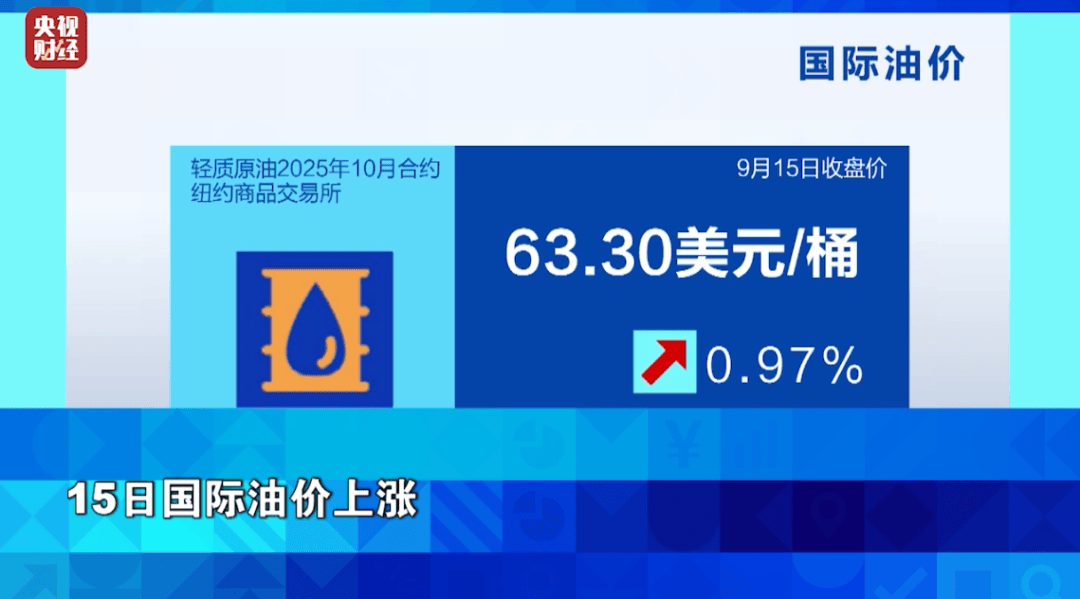
Group 1: Oil Market - International oil prices experienced a slight increase due to concerns over geopolitical risks potentially disrupting global oil supply, with light crude oil futures for October closing at $63.30 per barrel, up 0.97%, and Brent crude for November at $67.44 per barrel, up 0.67% [3] Group 2: Gold Market - International gold prices surpassed the $3700 per ounce mark, reaching a historic high, driven by favorable economic and geopolitical conditions that support expectations for Federal Reserve rate cuts, with COMEX gold rising nearly 1% to $3720 per ounce [5] - Domestic gold jewelry prices also increased, with brands like Chow Tai Fook and Lao Feng Xiang reaching their highest prices of the year, with prices for gold jewelry at 1091 RMB per gram for Chow Tai Fook, 1087 RMB for Lao Miao, and 1086 RMB for Lao Feng Xiang, reflecting daily increases of 17 RMB, 13 RMB, and 12 RMB respectively [7]

【UNFX 课堂】美联储决议落地黄金多头狂欢开启后市布局全解析
Sou Hu Cai Jing· 2025-09-16 10:03
Group 1 - The Federal Reserve's latest decision maintains interest rates but signals a clear dovish stance, with expectations for one rate cut in 2024 and four in 2025 [1] - The acknowledgment of progress in inflation control is a significant development, with the statement indicating that "inflation has eased" [1] - The reduction in the pace of balance sheet reduction from $60 billion to $25 billion per month starting in June is a notable change [1] Group 2 - The immediate market reaction included a 0.8% drop in the dollar index, reaching a one-month low, and a rise in gold prices, stabilizing above $2340 per ounce [1] - The downward trend in real interest rates is established, enhancing the attractiveness of gold as rates decline [2] - The weakening dollar, due to the narrowing policy gap between the Federal Reserve and other major central banks, makes gold cheaper and stimulates global demand [2] Group 3 - The acknowledgment of inflation resilience by the Federal Reserve may lead to increased focus on gold's anti-inflation properties [2] - Technical analysis indicates that gold is at a critical decision point, with initial support at $2320 and strong support at $2280 [2] - Key resistance levels are identified at $2380 and $2430, with current prices fluctuating around $2340 [2] Group 4 - Future factors influencing gold prices include upcoming U.S. inflation data, geopolitical risks, and central bank gold purchasing trends [2] - Investment strategies suggest short-term traders focus on the $2320-$2380 range, while long-term investors should consider buying on dips to $2280-$2300 [2] - Conservative investors are advised to wait for price corrections to the $2250-$2280 range before making purchases [2]
Global Family Offices Unfettered by Military Conflicts, Recession Fears
Yahoo Finance· 2025-09-11 10:05
Core Insights - The investment strategies of ultra-rich family offices remain consistent despite market volatility and geopolitical tensions, with a focus on long-term wealth preservation and growth [2][4] - Family offices are particularly concerned about geopolitical conflicts, political instability, and economic recession, with a significant portion viewing the wars in Ukraine and Gaza, as well as US-China tensions, as risks [3][4] Asset Allocation Trends - The average family office allocates 31% of its assets to public equities, an increase from 28% in 2023, while private equity allocations have decreased from 26% to 21% [6] - Alternative assets make up 42% of total allocations, and 38% of family offices plan to increase their investments in public equities, indicating a strong appetite for risk [6] - Allocations to cash, fixed income, private real estate, infrastructure, hedge funds, private credit, and commodities have remained relatively stable [6] Regional Perspectives - Family offices in the Americas exhibit a positive outlook, with over a third not preparing for extreme market events, while those in Asia Pacific and EMEA show more caution, with only 12% and 14% respectively not positioned for tail risks [4] - The US remains the primary investment destination for family offices, followed by their home countries, highlighting a preference for geographic diversification [4]

石油“站立硬币”倒向何方
2025-09-09 02:37
Summary of Oil Market Conference Call Industry Overview - The conference call discusses the oil market dynamics, particularly focusing on OPEC's production policies and their impact on oil prices and supply-demand balance [1][2][3][4][5][6]. Key Points and Arguments 1. **OPEC Production Increase**: OPEC has unexpectedly increased production since April 2025, leading to a perception of oversupply in the market. The theoretical daily quota released is 2.46 million tons, but actual increments are limited due to geopolitical risks [1][4][6]. 2. **Oil Price Trends**: Following OPEC's announcement to continue increasing production in October, Brent crude prices initially fell but later showed resilience, indicating that the market has priced in the fundamentals adequately. The expectation is for oil prices to remain in a low range in 2025, with potential for a reversal in 2026 [2][5][6]. 3. **Supply-Demand Balance**: The current oil market is characterized by a temporary easing of supply risks, significant production pressure, and poor demand growth prospects. Prices are close to marginal cost levels, with a notable oversupply of approximately 1 million barrels per day earlier in the year [3][7][8]. 4. **Geopolitical Influences**: Geopolitical factors, particularly in the Middle East, have significantly influenced OPEC's production decisions. The conflict in the region has led to increased production levels, but the sustainability of this production is uncertain [4][14]. 5. **US Shale Oil Dynamics**: The US shale oil sector is facing challenges, with a reduction in the number of active drilling rigs and high depletion rates of existing wells. This has resulted in stagnation in shale oil production growth, with total production slightly declining to 9 million barrels per day [9][10][11]. 6. **Future Price Predictions**: The consensus is that the Brent crude price will find solid support around $60 per barrel, with a reasonable price range expected to be between $65 and $70 per barrel. The market is currently facing a supply surplus, which may lead to upward pressure on inventories [12][13]. 7. **Impact of Non-OPEC Supply**: Non-OPEC countries, particularly from offshore projects in Brazil, Guyana, and the US, are expected to contribute significantly to supply increases, further complicating the supply-demand balance [8][10]. Other Important Insights - The market's perception of oversupply is influenced by OPEC's production strategies and geopolitical developments, which could lead to significant price volatility in the future [6][14][15]. - The potential for a reversal in oil prices is contingent on changes in OPEC's production pace, North American shale supply trends, and unexpected global demand growth [2][6][14].