Consumer Spending

Search documents
全球数据观察
2025-12-10 12:16
Summary of Key Points from J.P. Morgan Global Data Watch Industry Overview - The report discusses the global economy, highlighting a growth trajectory that is above potential, with GDP expected to exceed forecasts in the upcoming quarter [1][2]. Core Insights and Arguments - **Economic Growth vs. Labor Market**: There is a noted tension between strong output growth and soft labor markets, which is unsustainable without either increased hiring or a slowdown in growth [1]. The expectation is for a rebound in hiring, supported by consumer spending and fiscal/monetary policies, leading to a more balanced economic expansion in the first half of 2026 [1]. - **Global Composite PMI**: The J.P. Morgan global composite PMI indicates a potential annualized GDP growth of nearly 3%, which is over a percentage point stronger than previous projections [2]. The manufacturing PMI suggests a 1.3% annual rise in global industry, with a positive trend in orders relative to inventories [2]. - **Business Spending**: Mixed signals are present regarding business spending, with U.S. Fed regional surveys showing an uptick in capital expenditure, while the global investment goods PMI fell below the neutral mark [3]. This has led to a stall in the global capex nowcaster for the first time since the beginning of the year [3]. - **Employment Trends**: The global employment PMI has decreased, indicating weak job growth, particularly in the U.S., where a significant drop in private hiring was reported [10]. However, a decrease in unemployment insurance claims is a positive sign [10]. - **Consumer Spending**: Real consumer spending in the U.S. was softer than expected, with a flat report for September and a downward revision for August [11]. Despite this, there were rebounds in Chase card data and auto sales in October and November, indicating some resilience [11]. - **Central Bank Policies**: The report anticipates a variety of outcomes from central banks as the global easing cycle concludes. Expectations include one rate hike, eight cuts, and twelve holds by year-end [13]. The Fed is expected to signal a cautious approach to future cuts, while the Bank of Japan is anticipated to hike rates due to fiscal policy changes [16]. Additional Important Insights - **Euro Area Resilience**: The Euro area shows signs of resilience, with upward revisions to PMI and GDP growth, indicating a growth rate of 1.6% annualized [18]. Despite trade war impacts, fiscal easing in Germany is expected to bolster growth [18]. - **China's Economic Signals**: China's PMIs suggest a year-end recovery, with positive signals from new export orders and construction PMIs, although services have softened [21]. The forecast for GDP growth in Q4 is 3.0% quarter-over-quarter [21]. - **Trade Agreements**: The status of the USMCA renewal is uncertain, with potential delays in legislative approval until 2027, despite expectations for a preliminary agreement [23]. This summary encapsulates the key points from the J.P. Morgan Global Data Watch, focusing on the global economic outlook, labor market dynamics, consumer spending trends, and central bank policies, while also highlighting regional insights and trade considerations.
Josh Brown's 'best stocks in the market': Carvana, Delta Air Lines and Expedia
Youtube· 2025-12-09 18:04
Carvana - Carvana is experiencing a rally due to its addition to the S&P 500, which has brought significant attention to the stock [1] - The company has shown resilience despite previous financial flaws, as consumer appreciation for its car-selling model has helped it overcome challenges [2] - Carvana was highlighted as a potential best stock in May when it was down 27% from its 2021 high, indicating a notable trend reversal [3] - The stock's performance has improved since its S&P 500 inclusion, demonstrating the unpredictable nature of stock spotlighting [4] - Effective risk management is emphasized as crucial for investors, allowing them to minimize losses while capitalizing on significant gains [5][6] - Carvana's market share has increased due to higher interest rates pushing consumers towards the used car market, leading to profitability from a low of $3.50 in December 2022 [7] Airline Industry - Delta Airlines has been added to the best stock list, with a focus on its potential to break through a significant resistance level at $70 [8] - Despite media speculation about consumer spending slowing down, evidence suggests that consumer travel demand remains strong, with record passenger screenings reported [10][11] - The hotel and cruise industries are also confirming robust consumer activity, with hotel revenue per available room (RevPAR) remaining above 85% nationwide [11] - Expedia is viewed as a viable investment opportunity, with a favorable chart pattern indicating potential breakout [12][13] - Delta is recognized as a leading airline brand in North America, with strong operational performance [14]




Trade Tracker: The Committee shares their latest retail and bank moves
CNBC Television· 2025-12-09 18:01
THING WOULD BE IN THE THE MID CAP 400. AND IT WOULD BE MORE DISCOVERED OKAY. >> GOOD STUFF.THANK YOU FOR THAT DESCRIPTION TOO. SO FROM FROM YOU KNOW A STOCK THAT'S DONE OKAY. WITH HIGH EXPECTATIONS BY JOSH TO ONE THAT'S DONE REALLY POORLY THAT YOU'VE SOLD BRIAN BELSKI.IT'S DOWN 50% YEAR TO DATE THEREABOUTS. AND IT IS DECKERS. SO TELL ME WHY YOU'RE BOUNCING ON THIS NOW.IS IT JUST SIMPLY IT'S BEEN SO DISAPPOINTING. YOU CAN'T STAND TO HOLD IT ANYMORE. >> THAT'S PART OF IT. THE OTHER PART OF IT IS THAT WE THINK ...

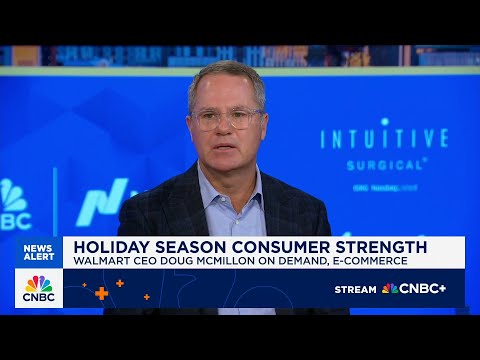
Walmart CEO Doug McMillon on the consumer: There's pressure on lower-income households
CNBC Television· 2025-12-09 12:55
Consumer Trends - Higher-income consumers are shopping more frequently at Walmart, a trend observed for some time [2] - Lower-income consumers are facing pressure due to years of price inflation, although recent low single-digit inflation and lower gas prices offer some relief [2][3] - Walmart U S has over 7,000 rollbacks in place to keep prices down [4] Inflation and Pricing Strategies - In-store inflation at Walmart is 1.3%, compared to a national average of nearly 3% [3] - Grocery store inflation has been 25% over the last 5 years [3] - Walmart is actively managing costs by improving quality, changing country of origin, and moving factories to maintain lower prices [4] Business Performance and Strategy - Walmart's margins are tight, around 4% [5] - The company is approaching $1 trillion in retail sales [5] - The business model is evolving with income from membership and advertising, changing the composition of the income statement [6] Leadership Transition - Doug is leaving his leadership role at Walmart to pursue a combination of business and philanthropic endeavors [1][7][9]

Why the market is pricing in a Fed rate cut for December
Yahoo Finance· 2025-12-08 18:00
Inflation and Interest Rates - September PCE report showed inflation rose 28% year-over-year, the fastest pace since spring 2024 [1] - Tariffs impacted durable goods inflation, but overall inflation is expected to decrease from nearly 3% to around 2% next year [3][4] - The market anticipates the Fed will cut rates, but some dissenters suggest a more cautious approach [6] - Long-term yields are expected to remain around 4%, potentially rising to 45%, due to sticky inflation and supply issues [37] Economic Outlook - The US economy may experience a "code red affordability moment," particularly affecting lower-income individuals and young people [2][13] - Stimulus from tax cuts, the World Cup, and the US's 250th birthday could lead to a strong economic year [9] - Consumer spending remains strong, despite concerns about affordability [16][18] - AI is estimated to contribute about 25% to GDP growth, with AI-related capital expenditure representing approximately 15% of GDP [73][72] Market Dynamics - The market may broaden beyond the "Magnificent Seven" to focus on the "Impressive 493" stocks in the S&P 500, leveraging AI for productivity gains [21] - Bitcoin is primarily a trading vehicle influenced by technical factors rather than fundamentals, with stablecoins potentially replacing its transaction function [23][25] - The labor market shows signs of cooling, with increased layoff announcements and employers limiting headcount [89] - The Beige Book indicates cooler consumer spending and hiring, along with moderate price increases [87][91]

X @Investopedia
Investopedia· 2025-12-06 21:00
Consumer Behavior - Consumers are adapting to budget constraints by opting for smaller, more frequent purchases [1] - Consumers are reducing spending on non-essential discretionary items [1]
4 Things to Watch With DECK Stock in 2026
The Motley Fool· 2025-12-06 17:06
Core Viewpoint - Deckers Outdoor has faced significant challenges in 2025, resulting in a 53% decline in stock value year-to-date, raising questions about its ability to recover in 2026 [2][4]. Group 1: Macroeconomic Environment - The primary challenge for Deckers in 2025 has been weakening consumer spending in the U.S., impacting not only Deckers but also other consumer discretionary companies like Lululemon and Nike [5]. - Revenue growth slowed to 9% year-over-year in the fiscal second quarter, with domestic sales increasing only 1.7%, while international sales grew by 29.3%, now accounting for over 40% of total revenue [6]. Group 2: Performance in New Markets - Growth in international markets, particularly in China and the EMEA region, is crucial for Deckers' long-term growth strategy, with the company opening its first store in Germany [9]. - Hoka has shown strong performance in major European markets, gaining market share and experiencing growth in the direct-to-consumer channel [10]. Group 3: Margin Strength - Deckers has historically maintained high gross margins, which improved from 55.9% to 56.2% despite disappointing second-quarter results, indicating effective management of product pricing [11]. Group 4: Valuation - Following a decline of over 50% in 2025, Deckers' stock trades at a price-to-earnings ratio of 14, suggesting that significant weakness is already reflected in the stock price [13]. - If the valuation decreases further, it may present a buying opportunity for long-term investors, assuming the company can stabilize its business [14].


US sheds 32K jobs as the White House claims ‘explosive growth’ backed by a GDP surge. But is Trump actually winning?
Yahoo Finance· 2025-12-06 10:57
Economic Indicators - ADP's latest monthly jobs report indicates a loss of 32,000 jobs in the private sector for November, complicating the understanding of job market health due to a government shutdown affecting BLS reporting [1] - Traditional economic indicators present conflicting narratives; while GDP and consumer spending are up, employment estimates show job losses, raising questions about the economy's actual performance [2][4] - A revision of second-quarter GDP growth saw an increase to 3.8% from a previously reported 3.3%, marking a significant recovery from a -0.6% growth in the first quarter [3] Consumer Sentiment - A Fannie Mae survey revealed that 67% of consumers believe the economy is "on the wrong track," reflecting a growing pessimism about economic conditions [9] - Pew Research Center reported that 74% of U.S. adults view the economy as "fair/poor," with 42% attributing their negative outlook to rising prices and personal expenses [10][11] Spending Patterns - Research indicates that the top 10% of earners account for nearly 50% of all consumer spending, while the bottom 80% are only keeping pace with inflation, suggesting a potential vulnerability in consumer spending if high earners reduce their expenditures [8]
X @Bloomberg
Bloomberg· 2025-12-05 15:10
US consumer spending stalled in September, suggesting Americans were already stretched going into the government shutdown in the face of stubborn inflation https://t.co/vT1Icgrezx ...
Costco's Earnings Setup: Tariff Roulette, Special Dividend Odds And A 50x P/E
Seeking Alpha· 2025-12-03 23:14
Group 1 - Investors are currently analyzing retailers to identify potential beneficiaries of seasonal consumer spending trends [1] Group 2 - The focus is on U.S. and European equities, particularly undervalued growth stocks and high-quality dividend growers [2] - Sustained profitability, characterized by strong margins, stable and expanding free cash flow, and high returns on invested capital, is emphasized as a more reliable driver of returns than valuation alone [2] - The investment strategy aims to balance asset management to ensure financial freedom while maintaining the ability to work in fulfilling environments [2]