Tariffs

Search documents
lululemon athletica: A Contrarian Hunt In Tariff Territory
Seeking Alpha· 2025-10-03 15:24
lululemon athletica's (NASDAQ: LULU ) stock drawdown is rational, as U.S. comps have turned negative, inventories are up, and management cut FY2025 revenue/EPS explicitly because of higher tariffs and the removal of the de minimis exemption. The impact of these together is likely toAnalyst’s Disclosure:I/we have no stock, option or similar derivative position in any of the companies mentioned, and no plans to initiate any such positions within the next 72 hours. I wrote this article myself, and it expresses ...



X @Bloomberg
Bloomberg· 2025-10-03 14:40
US carmakers have mounted a furious, last-minute lobbying blitz over the Trump administration’s potential tariffs on medium- and heavy-duty trucks, in a fight pitting Detroit’s legacy automakers against each other.] https://t.co/1AuGfjJlHl ...
TCW Relative Value Mid Cap Fund Sold Academy Sports and Outdoors (ASO) Due to Thesis Misalignment
Yahoo Finance· 2025-10-03 11:25
Core Insights - TCW Relative Value Mid Cap Fund reported a strong recovery in the second quarter of 2025, with a return of 7.37%, outperforming the Russell Midcap® Value Index which returned 5.35% [1] - The fund highlighted Academy Sports and Outdoors, Inc. (NASDAQ:ASO) as a key stock, noting its recent performance and market capitalization [2][4] Company Overview - Academy Sports and Outdoors, Inc. is a sporting goods and outdoor recreation retailer founded in 1938, operating 298 retail stores primarily in the southern United States [3] - The company has a strategic supplier relationship with Nike, which accounts for approximately 11% of its revenue [3] Financial Performance - In Q2 2025, Academy Sports and Outdoors, Inc. reported net sales of approximately $1.6 billion, reflecting a 3.3% increase, with a comparable store sales increase of 0.2% [4] - As of October 2, 2025, the stock closed at $52.97 per share, with a market capitalization of $3.529 billion [2] Investment Considerations - Despite the potential of Academy Sports and Outdoors, the company faces challenges due to increased costs from tariffs and limited access to desirable products, which may delay recovery [3] - The position in Academy Sports and Outdoors was eliminated by the fund due to these risks, indicating a cautious outlook on the stock [3]

X @Bloomberg
Bloomberg· 2025-10-03 10:56
Economic Policy - India is implementing long-term strategies to decrease reliance on the US dollar [1] Trade Relations - US tariffs are negatively impacting India's currency and trade outlook [1]
BLS Data Halts, But Chicago Fed Sees Steady 4.34% Unemployment: Private Sources Flag 'Low Fire, Low Hire' Holiday Risk - SPDR S&P 500 (ARCA:SPY)
Benzinga· 2025-10-03 07:59
Core Insights - The Chicago Fed predicts a steady unemployment rate of 4.34% for September 2025, relying on real-time data due to the U.S. government shutdown affecting Bureau of Labor Statistics (BLS) data releases [1][2] - Private data sources indicate a cooling labor market, with weak holiday hiring plans potentially impacting payrolls through year-end [3][4] Labor Market Analysis - The Chicago Fed's analysis shows the unemployment rate unchanged from August, with layoffs at 2.10% and hiring rates for unemployed workers at 45.22%, both slightly down from the previous month [2] - Bill Adams, Chief Economist at Comerica Bank, notes that alternative data sources suggest a "low hire, low fire, low gear" job market, with Revelio Labs estimating 60,100 jobs added in September, contrasting with ADP's reported decline of 32,000 [4][5] - Hiring intentions have plummeted 70% year-over-year according to Challenger, Gray & Christmas, while the Cleveland Fed's WARN Act index dropped 22% to 14,000, indicating minimal planned layoffs [4][5] Economic Pressures - Broader economic pressures include low consumer confidence, tariff impacts on margins, and a potential drop in auto sales following the expiration of EV subsidies [5] - AI-driven growth is noted to be capital-intensive, creating fewer jobs and potentially widening the gap between economic output and employment [5] - The government shutdown could shave 0.1-0.2% off GDP growth weekly, with Comerica forecasting a 0.25% Fed rate cut in late October [5] Market Reactions - The SPDR S&P 500 ETF Trust (NYSE:SPY) and Invesco QQQ Trust ETF (NASDAQ:QQQ) saw slight increases, with SPY up 0.12% and QQQ up 0.41% [7]

Trump’s Market Mayhem: A Daily Dose of Economic Whimsy
Stock Market News· 2025-10-03 06:00
Pharmaceutical Industry - President Trump's 100% tariff on branded pharmaceutical imports took effect on October 1st, causing initial declines in shares of European and Asian drugmakers, with Novo Nordisk experiencing the largest drop [2][3] - Pfizer announced a deal with the Trump administration to cut drug prices and invest $70 billion in U.S. research and manufacturing, receiving a three-year exemption from the tariffs, which led to a surge in its stock price [3][4] - Analysts suggest Pfizer's deal could serve as a model for other drugmakers, but caution that the financial impact may be more about optics than substantial change [4] Trucking Industry - A 25% tariff on heavy trucks imported from other countries began on October 1st, aimed at protecting U.S. manufacturers [5][6] - Shares of Daimler Truck and Traton fell by 2% and 2.4% respectively, with analysts estimating a potential €700-800 million impact on Daimler's earnings, though some losses could be offset by price increases [6] - Volvo Group, which produces all its U.S. trucks domestically, saw a 3.5% increase in shares, while analysts predict increased operational costs and reduced freight demand for trucking stocks like J.B. Hunt and UPS [6] Entertainment Industry - A 100% tariff on movies made outside the U.S. was announced, leading to declines in shares of Indian media stocks and major U.S. media companies, including Netflix and Amazon [9][10] - Analysts expressed concerns that the tariffs could lead to reduced content production and increased costs for consumers [10] Agriculture Sector - President Trump announced a meeting with Chinese President Xi Jinping to discuss agriculture, particularly soybeans, which led to a 1.3% increase in Chicago soybean futures [10][11] - Analysts noted that while the announcement provided support, the underlying issues caused by previous tariffs may not be resolved [11] Government Operations - The U.S. government shutdown began on October 1st, with a muted market reaction, as the S&P 500 saw a slight decline and the Nasdaq Composite managed a small gain [13][14] - Analysts viewed the shutdown as political theater with limited immediate impact, but some warned that the current economic conditions could make the situation more detrimental than in previous shutdowns [14]



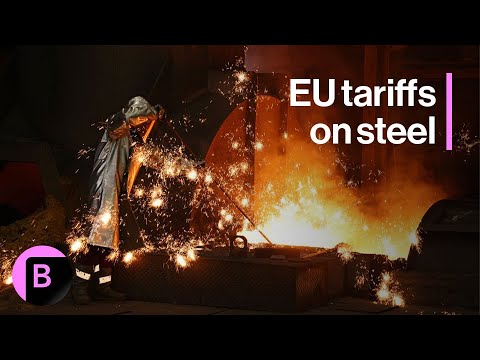
EU Plans to Raise Tariff Rate on Steel Imports to 50%
Bloomberg Television· 2025-10-03 05:41
It seems that the European Union is fighting back when it comes to steel tariffs. They've raised their own levies to 50%. Is this the sort of escalation that precedes negotiation when you're dealing with President Trump.I mean, you know, I think that that's a fair argument there. You know, I mean, if you're looking potentially at sort of how other nations or other blocs and such have kind of tried to approach these types of tariffs, I mean, look at China, for example, which is kind of raising its own. What ...
'A perfect storm of ugly': Trump's policies are devastating U.S. farmers
MSNBC· 2025-10-03 04:50
So, right now, as we monitor the impacts of the ongoing government shutdown, try to keep you all informed and updated, our nation's farmers, especially those who grow and export soybeans, are dealing with a crisis of their own. This all started with Trump's trade war with China. And I will get to that in a moment, I promise. But the way Treasury Secretary Scott Besson tells it, somehow Joe Biden, yes, the man who has not been president for eight months, is at fault here. At the meeting in Geneva, when I ask ...

American Express Company (AXP) Announces Regular Quarterly Dividend
Insider Monkey· 2025-10-02 22:52
Core Insights - Artificial intelligence (AI) is identified as the greatest investment opportunity of the current era, with a strong emphasis on the urgent need for energy to support its growth [1][2][3] - The demand for energy from AI technologies, particularly data centers, is expected to surge, leading to a potential crisis in power supply and rising electricity prices [2][3][7] - A specific company is highlighted as a key player in the energy sector, poised to benefit from the increasing energy demands of AI, owning critical infrastructure assets [3][6][8] Company Overview - The company is described as a "toll booth" operator in the AI energy boom, collecting fees from energy exports and positioned to capitalize on the growing demand for electricity [5][6] - It owns significant nuclear energy infrastructure, making it integral to America's future power strategy and capable of executing large-scale energy projects [7][8] - The company is noted for being debt-free and holding a substantial cash reserve, which is nearly one-third of its market capitalization, providing financial stability [8][10] Market Position - The company is gaining attention from Wall Street as it benefits from multiple industry trends, including the AI infrastructure supercycle and the onshoring boom driven by tariffs [6][14] - It has an equity stake in another AI-related company, offering investors indirect exposure to various AI growth opportunities without high premiums [9][10] - The stock is considered undervalued, trading at less than seven times earnings, which is attractive for investors looking for growth potential [10][11] Industry Trends - The AI sector is characterized as a major disruptor, with companies that embrace AI expected to thrive while traditional industries may struggle [11][12] - There is a significant influx of talent into the AI field, ensuring continuous innovation and advancements, which further supports the investment thesis in AI [12][13] - The future of energy, particularly in relation to AI, is framed as a critical area for investment, with the potential for substantial returns in the coming years [13][15]