世界中国学

Search documents
东西问·中国学丨杨慧林:“中国学”何以是“世界的”?
Zhong Guo Xin Wen Wang· 2025-10-13 08:59
Core Viewpoint - The interview with Yang Huilin emphasizes the evolution of "Chinese Studies" into a global discourse, highlighting the importance of cross-cultural dialogue and the need for international scholars to participate in constructing a "Chinese narrative" [3][8]. Group 1: Historical Context of Chinese Studies - The Western study of China began with the translation of classical Chinese literature, which played a crucial role in shaping Western understanding of Chinese culture [4]. - Literary works serve as a direct entry point to understanding a culture, encapsulating deep cultural memories and societal values [4][5]. - Notable examples include the influence of works like "The Orphan of Zhao" and "The Good Match," which have significantly impacted Western perceptions of Chinese ethics and familial values [5]. Group 2: World Chinese Studies and Cultural Exchange - "World Chinese Studies" encompasses both historical and contemporary perspectives of Chinese scholarship within a global context, emphasizing cultural exchange and mutual learning [8]. - The dialogue between Western and Chinese scholars can reveal overlooked issues and foster new research dimensions, as seen in the works of scholars like Princeton's Martin Kern [9]. - The need for Chinese scholars to respond to Western interpretations is essential for a comprehensive understanding of Chinese culture [9]. Group 3: Language and Thought - Different linguistic expressions can uncover new logical frameworks and thought spaces, suggesting that cross-cultural understanding requires engagement with both Chinese and Western perspectives [11]. - The translation of concepts, such as the term "ren" (仁), illustrates how language shapes understanding and can lead to different interpretations across cultures [11]. Group 4: Importance of Constructing a Chinese Narrative - Constructing a "Chinese narrative" is vital for understanding contemporary global issues, as it reflects specific cultural logics and values [13]. - The essence of the "Chinese narrative" lies in its dialogic nature, which transcends singular conceptual frameworks and promotes mutual understanding among civilizations [13].


第二届世界中国学大会即将在上海举办,大会官方海报发布
Yang Shi Wang· 2025-10-10 08:49
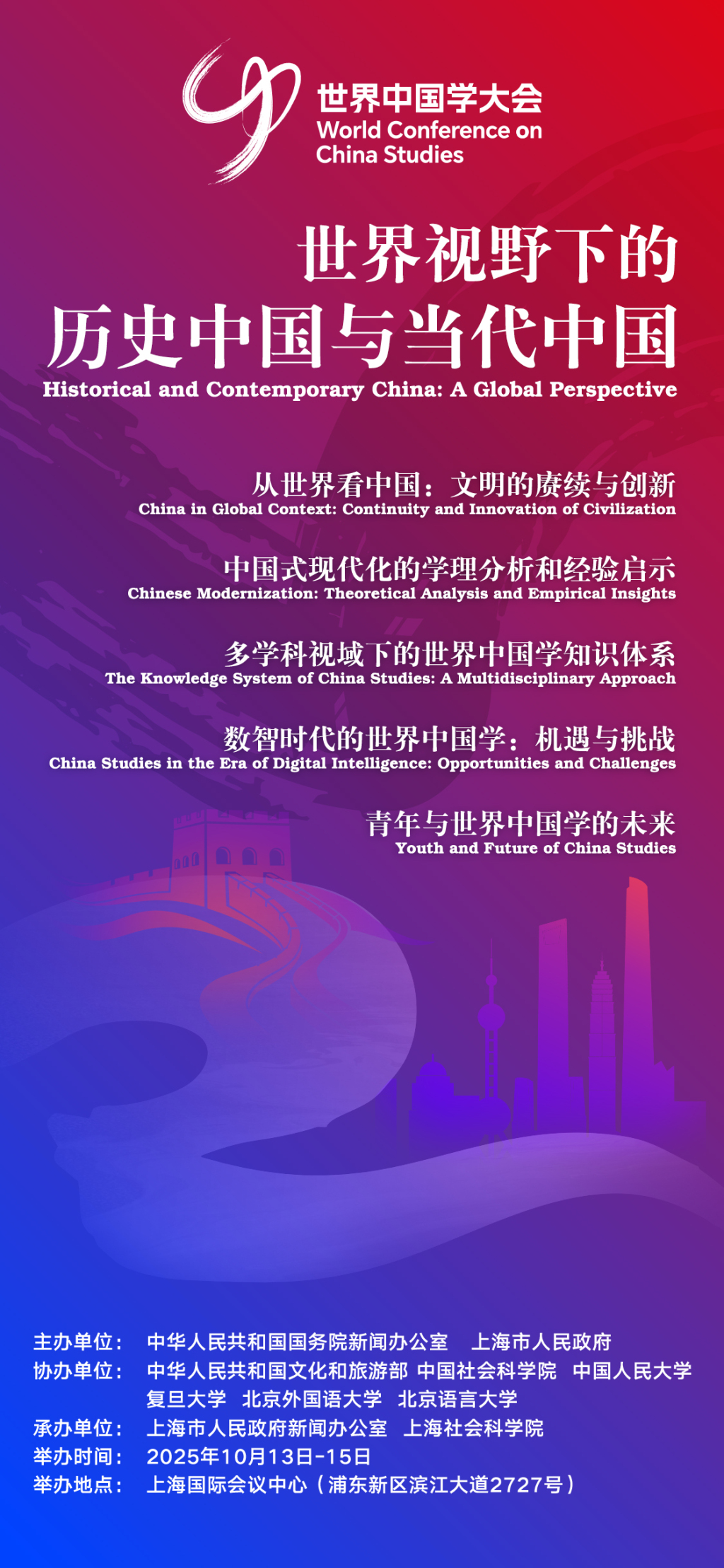
Group 1 - The conference is organized by the State Council Information Office and the Shanghai Municipal Government, focusing on the theme "Historical China and Contemporary China from a Global Perspective" [3] - Five parallel forums will discuss topics such as "Viewing China from the World: Continuity and Innovation of Civilization" and "Theoretical Analysis and Experience Insights of Chinese Modernization" [3] - Approximately 500 renowned experts and scholars from home and abroad are invited to engage in in-depth discussions and exchanges [3] Group 2 - The launch of the journal "Chinese Studies (Bilingual)" is a significant initiative to promote world Chinese studies and deepen Sino-foreign academic exchanges [4] - The journal aims to leverage the advantages of the World Chinese Studies Conference to expand international academic cooperation and enhance the global influence of Chinese culture [4] - The establishment of the journal will further support Shanghai in building a cultural hub and attract more global scholars to focus on and study China [4]
东西问·中国学|张西平:“中国学”具有怎样的世界性意义?
Zhong Guo Xin Wen Wang· 2025-10-10 07:04
Core Viewpoint - The interview with Zhang Xiping emphasizes the global significance of "Sinology" and the necessity of understanding contemporary China through its historical context, especially in light of the upcoming Second World Sinology Conference in Shanghai from October 13 to 15, 2025 [3][4]. Group 1: Historical Context of Sinology - Western academic interest in China began due to the need for understanding following the geographical discoveries and the subsequent cultural exchanges during the colonial expansions of Portugal, Spain, and the Netherlands [4]. - The initial approach involved both the study of Confucian culture by Western missionaries and the translation of Chinese classics into European languages, which sparked interest among Enlightenment thinkers like Voltaire and Leibniz [4]. Group 2: Necessity of World Sinology - The emergence of "World Sinology" is deemed essential due to three main factors: China's rapid rise in the late 20th century, its unique and continuous civilization, and its significant role as a major trading partner for over 150 countries [5]. - Historical perspectives on China, as proposed by Liang Qichao, highlight the urgency of understanding China's role in the world, especially in the context of globalization and cultural exchanges [5]. Group 3: Integration with Traditional Sinology - "World Sinology" is positioned within the framework of traditional Sinology, which has historically been part of Western Oriental studies, and aims to create a dialogue rather than a conflict between the two [9]. - The integration respects the historical contributions of Sinology while fostering a comprehensive research system that encompasses both ancient and modern perspectives on China [9]. Group 4: Global Interaction and Civilizational Understanding - The study of "World Sinology" involves a tripartite dialogue among foreign scholars, local Chinese scholars, and those focusing on "overseas Sinology," which helps clarify China's position in the global context [15]. - This interaction is crucial for enhancing the understanding of other civilizations and for building a self-sustaining knowledge system that reflects China's historical and contemporary realities [15]. Group 5: Importance of Historical Reflection - Reflecting on history is vital for establishing a balanced narrative of Sino-Western relations, moving beyond the one-sided views that have dominated discussions since the 1840s [21]. - Understanding historical interactions can help alleviate Western anxieties regarding China's rise and promote a more equitable dialogue between civilizations [21].