产业集聚效应

Search documents
通马路10月1日通车 北京城市副中心与亦庄新城再添交通大动脉
Zhong Guo Xin Wen Wang· 2025-09-30 12:15
Core Points - The Tongma Road project in Beijing has been completed and will officially open on October 1, enhancing transportation links between the city's sub-center and Yizhuang New Town [1][3] - The road has been expanded from 2-4 lanes to 10 lanes (6 lanes for the main road and 4 lanes for the auxiliary road), upgrading its classification from a first-class road to an urban expressway [1][3] - The project aims to alleviate traffic bottlenecks and improve traffic efficiency in the region, contributing to coordinated regional development and economic integration [1][4] Infrastructure Development - Tongma Road spans approximately 6 kilometers, connecting major thoroughfares and facilitating smooth traffic flow between the sub-center and Yizhuang New Town [3] - The new road includes a dual-system for fast and slow traffic, with the construction of a full interchange bridge on the Beijing-Harbin Expressway to enhance connectivity [3][4] - The road will integrate with existing expressways, significantly improving north-south transportation efficiency in the southern part of Tongzhou District [3] Economic Impact - The road serves as a vital transportation route for the Beijing Fresh Agricultural Products Distribution Center, enhancing the logistics capabilities for agricultural products [4] - Improved accessibility is expected to attract more businesses to the surrounding functional areas, fostering industrial agglomeration and stimulating regional economic vitality [4]

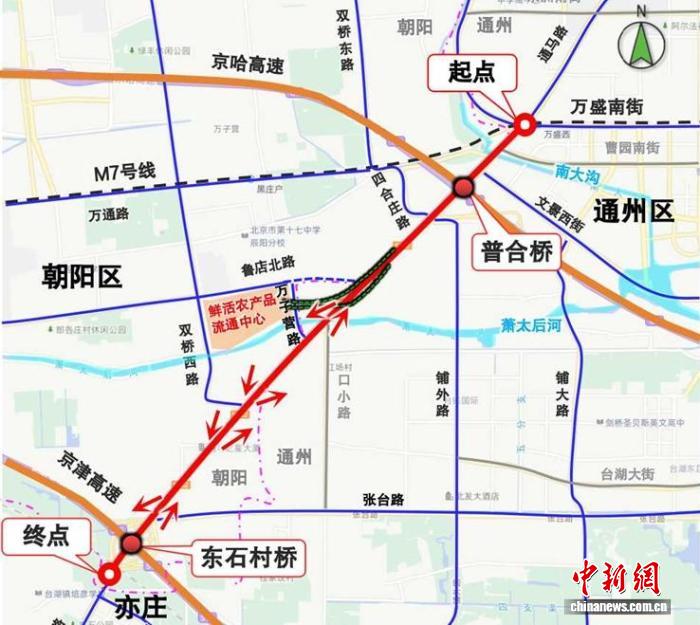
明天起,北京城市副中心与亦庄新城新添一条城市快速路
Bei Jing Ri Bao Ke Hu Duan· 2025-09-30 05:10
Core Viewpoint - The Tongma Road project, a key infrastructure initiative in Beijing, officially opens on October 1, enhancing connectivity between the city's sub-center and Yizhuang New Town, thereby promoting regional economic integration and development [1][3]. Group 1: Project Overview - The Tongma Road has been expanded from 2-4 lanes to a total of 10 lanes (6 lanes for the main road and 4 lanes for the auxiliary road), upgrading its classification from a first-class road to an urban expressway [1][3]. - The project spans approximately 6 kilometers, connecting major thoroughfares and alleviating traffic bottlenecks between the city sub-center and Yizhuang New Town [3]. Group 2: Traffic and Economic Impact - The new road configuration includes a dual system for fast and slow traffic, significantly improving traffic flow and efficiency in the region [3][5]. - Tongma Road will integrate with the Beijing-Harbin Expressway and the Beijing-Tianjin Expressway, forming a high-speed road network that enhances north-south transportation efficiency in the southern part of Tongzhou District [5][7]. - The road serves as a vital transport route for the Beijing Fresh Agricultural Products Distribution Center, facilitating quick access to the expressway network and improving the logistics capabilities of the center, which is crucial for food supply security in the capital [5][7]. Group 3: Regional Development - The completion of Tongma Road provides improved access to key functional areas such as the Tongzhou Cultural Tourism Zone and various high-density villages, fostering regional economic growth and population concentration [7]. - Enhanced transportation convenience is expected to attract more businesses to the area, creating an industrial cluster effect and stimulating regional economic vitality [7].
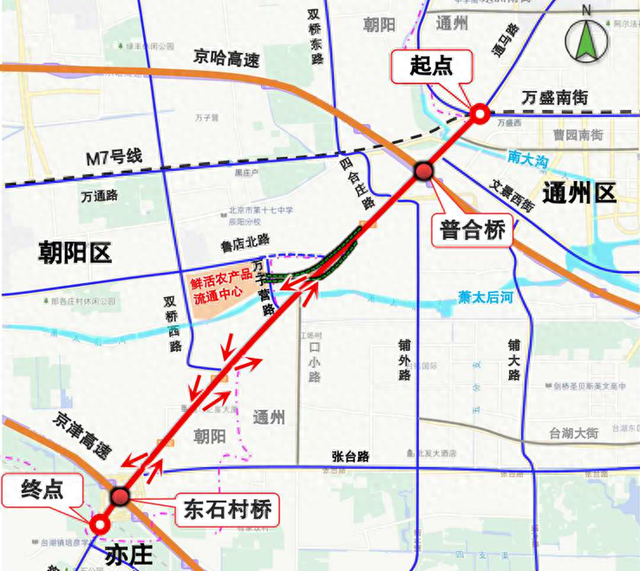
城市副中心与亦庄新城再添交通大动脉,通马路10月1日凌晨通车
Bei Jing Ri Bao Ke Hu Duan· 2025-09-30 04:06
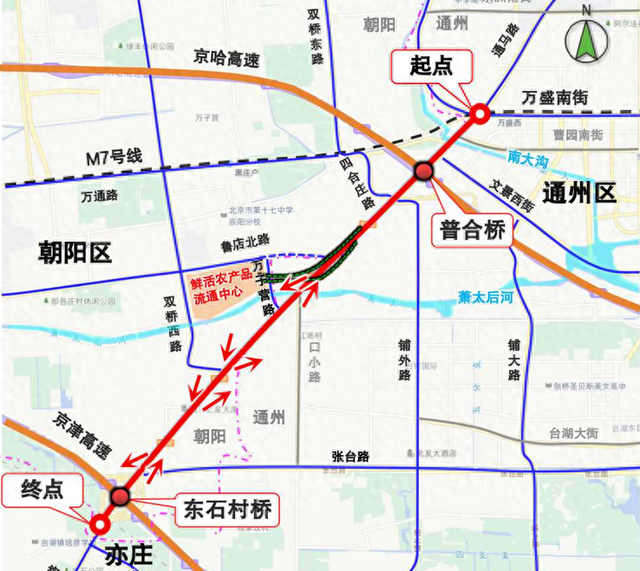
Core Points - The Tongma Road project has officially opened, expanding from a 2-4 lane road to a 10-lane road, enhancing connectivity between Beijing's sub-center and Yizhuang New City [3][4] - The project is approximately 6 kilometers long and includes a new interchange bridge, addressing traffic bottlenecks and improving road efficiency [4][6] - The road serves as a vital transportation route for fresh agricultural products, linking to major highways and enhancing the logistics capabilities of the Beijing Fresh Agricultural Products Distribution Center [7] - The completion of Tongma Road is expected to stimulate regional economic development and attract more businesses to the area, promoting industrial clustering [9] Summary by Sections - **Project Overview** - The Tongma Road project has been upgraded to a dual 10-lane configuration, significantly improving traffic flow and road classification [3][4] - The total length of the road is about 6 kilometers, featuring a dual system for fast and slow traffic [4] - **Traffic Improvement** - The new road design includes a main road with six lanes and a secondary road with four lanes, effectively alleviating traffic pressure between key urban areas [4][6] - The road connects with major highways, enhancing north-south traffic efficiency in the southern part of Tongzhou [6] - **Economic Impact** - Tongma Road is crucial for the transportation of fresh agricultural products, facilitating quick access to the highway network [7] - The improved transportation infrastructure is expected to boost regional economic activity and attract businesses, fostering industrial growth [9]
小蘑菇撑起致富伞
Ren Min Ri Bao· 2025-09-11 22:21
Core Viewpoint - The "Lujingqing" edible mushroom ecological technology demonstration park in Shule County, Kashgar, Xinjiang, has successfully utilized advanced planting techniques and management models to boost local income through mushroom cultivation [1]. Group 1: Company Operations - The demonstration park currently produces 50,000 mushroom sticks daily and generated 360 tons of dried edible mushrooms last year, with a revenue exceeding 20 million yuan [1]. - The park has created job opportunities for over 300 local residents, providing stable employment and contributing to the local economy [1]. Group 2: Community Impact - Local residents benefit from land leasing to the company, receiving rental fees, and can invest in the cooperative by purchasing mushroom sticks, which leads to year-end dividends [1]. - The park emphasizes the importance of community engagement by prioritizing employment for nearby villagers and encouraging them to develop backyard economies using mushroom sticks [1].
陆家嘴金融沙龙第26期圆桌对话 共探“孵投融合”之道
Di Yi Cai Jing· 2025-09-10 13:41
Core Insights - The event focused on the integration of incubation and investment, discussing the core value of incubators and the practical experiences of "incubation-investment linkage" [1][8] Group 1: Incubation Strategies - Incubators aim to provide physical space, shared facilities, and specialized services to help startups transition from laboratory results to market applications [2] - Zhongke Chuangxing emphasizes early and deep incubation to support projects in the "middle water zone," which have some technical foundation but lack a complete team [2] - The goal is to offer comprehensive services from idea generation to IPO, creating a systematic hard-tech incubation system [2] Group 2: Challenges in Innovation - The commercialization of scientific results faces challenges, and incubators must help scientists identify the most viable projects for industrialization [4] - The need for a clear understanding of drug development processes is highlighted, emphasizing the importance of having knowledgeable principal investigators (PIs) [3] Group 3: Ecosystem Development - The development of a "cross-border co-creation" ecosystem is essential, where large enterprises empower startups and facilitate collaboration [5] - A demand-driven approach is proposed, where incubators connect large companies with startups based on real business needs [6] Group 4: Resource Needs by Development Stage - Different stages of startups have varying resource needs, with early-stage companies requiring support to transform ideas into valuable propositions [7] - The industry cluster effect in Shanghai Zhangjiang is noted for attracting talent and resources, enhancing investment efficiency [7] Group 5: Incubation-Investment Linkage - The "incubation-investment linkage" is crucial for enhancing the efficiency of cultivating technology enterprises, requiring incubators to identify quality projects and integrate resources effectively [8][9] - The dual identity of incubators as both incubators and investors presents challenges in balancing the goals of commercialization and investment [9] Group 6: Future Directions - The importance of engineering processes in innovation is emphasized, suggesting that modular construction and rapid iteration can enhance commercialization efforts [10] - The event aims to create a platform for ongoing dialogue and collaboration to support Shanghai's development as an international financial center [10]

北京丽泽金融商务区入驻企业突破1300家
Zhong Guo Jing Ji Wang· 2025-06-13 07:24
Group 1 - The core viewpoint of the news is the significant growth and development of the Beijing Lize Financial Business District, with the number of resident enterprises surpassing 1300, indicating a strong industrial agglomeration effect [1][2] - Jinju Insurance Brokerage (Beijing) Co., Ltd., a national insurance brokerage institution, has officially moved into the Lize Financial Business District, contributing to the increasing number of enterprises [1] - The Lize Financial Business District has seen a rapid increase in resident enterprises, with milestones of 1000, 1100, and 1200 enterprises achieved within a short timeframe, showcasing the area's construction acceleration and regional vitality [1] Group 2 - The Lize Financial Business District is focused on enterprise needs by enhancing industrial support and innovating service models, gradually establishing a comprehensive enterprise service system throughout their lifecycle [2] - The establishment of the "Lize Office Island" comprehensive service platform marks a new stage in smart services, integrating party services with business environment construction [2] - The "Lize Office Island" platform will provide a one-stop smart service window, offering various professional services such as enterprise registration, policy consultation, financial services, talent introduction, and legal support [2]
海外圆柱电池项目投扩产提速
高工锂电· 2025-03-01 07:12
Core Viewpoint - Battery companies are increasingly focusing on expanding their production capacity in the cylindrical battery segment, particularly in Southeast Asia, to meet the rising demand in various applications such as electric tools and 3C electronics [2][5][11]. Group 1: Expansion of Production Capacity - Recent announcements from companies like EVE Energy, Haisida, and Guanyu Group indicate a significant increase in cylindrical battery production capacity overseas, with EVE Energy's Malaysian facility aiming for an annual output of 680 million units [2]. - The cylindrical battery projects are expected to ramp up production steadily, with several projects set to launch in 2024, reflecting the optimism of battery manufacturers regarding the lithium battery market [3][4]. - The overall industry is currently in a capacity clearing phase, with fewer new projects being initiated, and most expansions are still focused on square batteries [3]. Group 2: Market Demand and Regional Focus - The demand for electric two-wheelers and electric tools in Southeast Asia is rapidly increasing, with projections indicating a compound annual growth rate of over 13% for electric two-wheelers from 2025 to 2029 [8]. - Establishing cylindrical battery factories in Southeast Asia allows companies to better align with local market needs and gain cost advantages, thereby capturing market share [8]. - Malaysia is becoming a hub for Chinese lithium battery companies due to favorable factors such as cost, resources, and policies, leading to a concentration of related supply chain entities [9]. Group 3: Strategic Client Relationships - By investing in Southeast Asia, domestic battery companies can facilitate the transition of international clients' supply chains, particularly in sectors like electric tools and 3C electronics, where international customer proportions are higher [10]. - Companies like EVE Energy and Weilan Lithium have established partnerships with major international clients, enhancing their market presence and mitigating tariff risks associated with U.S.-China trade tensions [10]. Group 4: Focus on Niche Markets - As competition intensifies in the traditional lithium battery markets, companies are shifting their focus to niche segments such as electric tools, 3C electronics, and smart home appliances, where growth potential remains strong [11][12]. - The number of companies in the power battery sector is expected to decline significantly by 2027, while niche markets are projected to show better growth and profitability [12].