
保险监管

Search documents
华夏人寿领顶格处罚:保险业务许可证被吊销,原董事长及董秘遭终身禁业;94人累计受罚逾千万…
Sou Hu Cai Jing· 2025-08-04 01:34
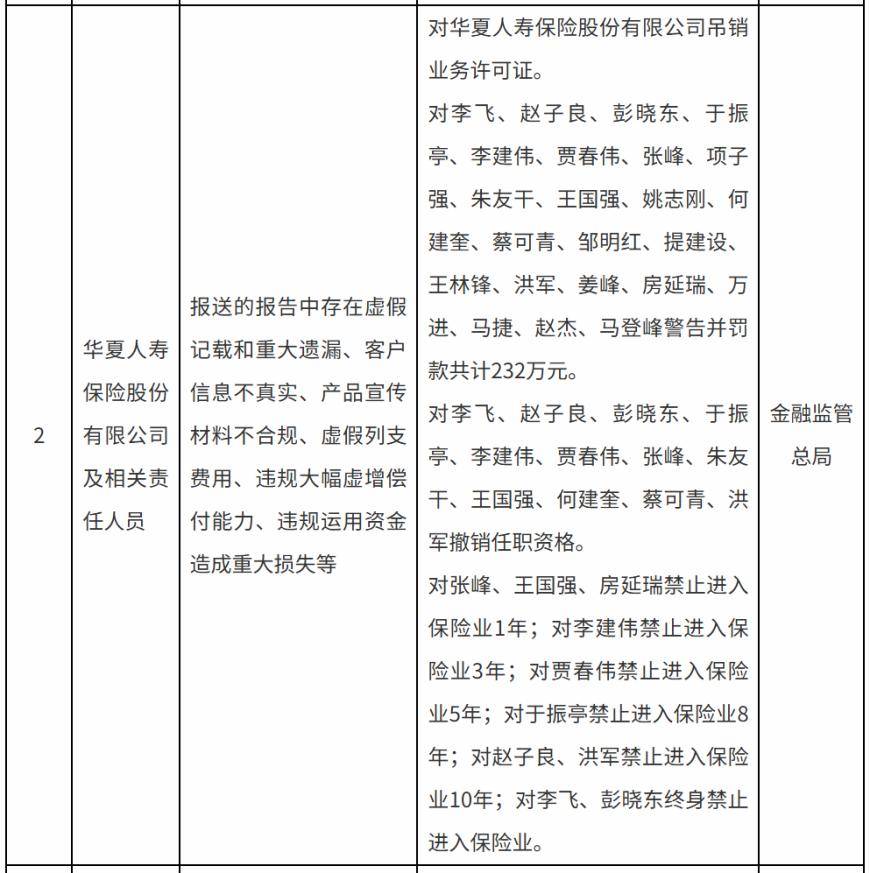
Core Viewpoint - The China Banking and Insurance Regulatory Commission (CBIRC) has issued a significant penalty to Huaxia Life Insurance Co., Ltd., marking a severe regulatory action in the insurance industry, resulting in the revocation of its business license and penalties for multiple responsible individuals [1][2]. Summary by Relevant Sections Regulatory Actions - Huaxia Life Insurance has been penalized for multiple serious violations, leading to the revocation of its business license [1][2]. - A total of 23 individuals, including key executives, received warnings and fines totaling 2.32 million yuan [1][2]. - Specific penalties include lifetime bans for former chairman Li Fei and former board secretary Peng Xiaodong, while others face bans ranging from 1 to 10 years [2]. Violations - Major violations by Huaxia Life include false reporting, significant omissions in submitted reports, untrue customer information, non-compliant promotional materials, fraudulent expense claims, and substantial inflation of solvency capabilities [1][2]. Company Background - Huaxia Life is part of the "Mingtian System" and has undergone significant changes, including regulatory takeover in July 2020 [3]. - In November 2023, the CBIRC approved the transfer of Huaxia Life's insurance business and corresponding assets and liabilities to Ruizhong Life Insurance, ensuring compliance and protection of consumer rights during the transition [3]. Financial Overview - Ruizhong Life Insurance, which took over Huaxia Life's operations, was established with a registered capital of 56.5 billion yuan and is backed by major investors [4]. - The total premium for the new entity is projected to reach 236.8 billion yuan in 2024 [4].

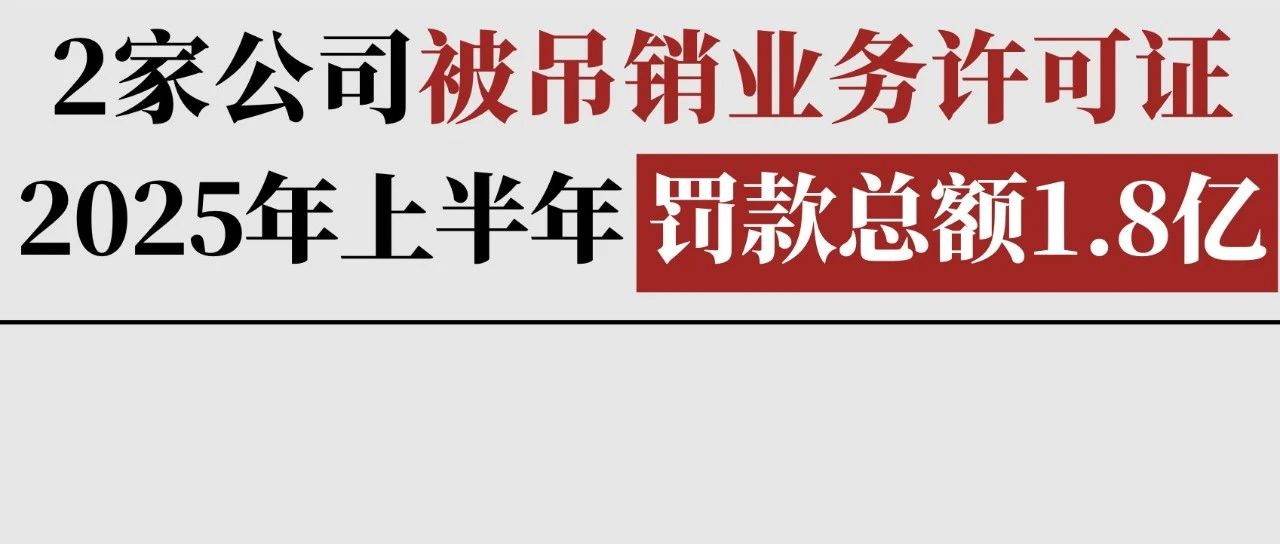
2025上半年保险公司罚款1.8亿:10张百万罚单,2家许可证被吊销,28人终身禁业,11人撤职!
13个精算师· 2025-07-08 14:29
Core Viewpoint - In the first half of 2025, the insurance industry faced significant regulatory scrutiny, with a total of 97 companies fined 180 million yuan, highlighting an increase in large penalties and accountability measures against responsible individuals [1][6][13]. Regulatory Actions - The Financial Regulatory Bureau directly penalized six companies, resulting in over 1305 fines totaling more than 172 million yuan [13][39]. - Two companies, Tianan Insurance and Tianan Life, had their business licenses revoked, and multiple executives faced lifetime bans from the industry [14][22]. - A total of 28 individuals received lifetime bans, while 11 were dismissed from their positions, with 10 fines exceeding one million yuan each [24][31]. Industry Performance - The insurance sector experienced a slowdown in premium growth due to previous product suspensions and a shift in focus away from "New Year" sales strategies [8][11]. - By the end of May 2025, the original insurance premium growth rate for life insurance companies had increased by nearly 8 percentage points compared to the beginning of the year [11]. Financial Trends - The industry is transitioning towards products that offer "minimum guaranteed returns plus floating income" in response to ongoing interest rate declines [9][10]. - The total number of fines issued by local regulatory branches reached 778, accounting for 39% of the total fines imposed on insurance companies [39][40]. Accountability Measures - The regulatory environment has intensified, with a clear emphasis on personal accountability, as evidenced by the significant number of individuals facing penalties and bans [32][31]. - The trend of increasing penalties and the revocation of business licenses for insurance companies is a rare occurrence, indicating a shift in regulatory enforcement [23][22].



437万元!易安财险、华夏久盈资产领罚单,多人遭禁业
Guo Ji Jin Rong Bao· 2025-06-09 14:20
Core Viewpoint - The insurance industry is undergoing strict regulatory scrutiny, highlighted by significant penalties imposed on Easy Insurance and Huaxia Jiuying Asset Management for various violations [1][3][7]. Group 1: Easy Insurance Penalties - Easy Insurance had 13 responsible individuals fined a total of 1.71 million yuan, with former chairman Li Jun disqualified from his position and former general manager Cao Haijing banned from the insurance industry for five years [2][3]. - Violations by Easy Insurance included improper fund usage, engaging unqualified entities for insurance sales, and providing false reports and documents [3][4]. - Easy Insurance, established in February 2016 with a registered capital of 1 billion yuan, was the first insurance company in China to undergo bankruptcy restructuring in June 2022 [4][5]. Group 2: Huaxia Jiuying Asset Management Penalties - Huaxia Jiuying Asset Management faced penalties totaling 2.66 million yuan, with 25 responsible individuals fined and several banned from the insurance industry, including lifetime bans for key figures [6][7]. - The company was found guilty of false reporting, significant omissions in reports, and improper fund usage leading to substantial losses [7]. - Huaxia Jiuying Asset Management was established in May 2015 and was previously part of Huaxia Life Insurance, which was also placed under regulatory supervision in July 2020 [7][8]. Group 3: Industry Context and Developments - In June 2023, Ruizhong Life Insurance was approved to commence operations with a registered capital of 56.5 billion yuan, marking a significant entry into the market [8]. - The restructuring of Huaxia Life Insurance concluded with the transfer of its business and assets to Ruizhong Life Insurance, indicating a resolution to the risk management issues faced by Huaxia Life [8][9]. - Huaxia Jiuying Asset Management is currently in a risk management phase, delaying the disclosure of its 2024 annual report [9].
我国保险监管的演进与展望
Sou Hu Cai Jing· 2025-04-30 00:19
Core Viewpoint - The development of China's insurance industry has undergone three distinct stages, evolving from a focus on insurance compensation to a dual emphasis on underwriting and investment, and now entering a "chain stage" that expands the insurance industry's value chain through integration with healthcare and elderly care services [4][5][6]. Summary of Insurance Regulatory Evolution - The evolution of insurance regulation in China can be divided into several phases, starting from 1949 to 1978, where the People's Bank of China initially managed the insurance sector, followed by the Ministry of Finance, and a period of suspension of domestic insurance business [5]. - From 1979 to 1998, the domestic insurance business was gradually restored under the supervision of the People's Bank of China, leading to the establishment of the China Insurance Company in 1983 and the implementation of the Insurance Law in 1995 [5][6]. - The period from 1998 to 2018 saw the establishment of the China Insurance Regulatory Commission (CIRC) and the introduction of a modern regulatory framework focusing on solvency, corporate governance, and market behavior [6]. - Since 2018, the China Banking and Insurance Regulatory Commission (CBIRC) has unified the regulation of banking and insurance, enhancing solvency regulation and establishing a national financial regulatory authority in 2023 [7]. Challenges Facing Insurance Regulation - The legal framework for insurance regulation in China is still incomplete, with a lack of specific laws governing new business models such as mutual insurance and reinsurance, and unclear regulatory responsibilities across different sectors [8][9]. - There are deficiencies in differentiated regulation for various types of insurance institutions, leading to a "one-size-fits-all" approach that does not adequately address the unique characteristics of different entities [8][9]. - Issues in behavior and functional regulation persist, including misleading sales practices and inadequate oversight of insurance intermediaries, which contribute to market inefficiencies [9][10]. International Insurance Regulatory Experience - Internationally, insurance regulation has evolved from behavior-based oversight to solvency regulation, with frameworks established by organizations such as the International Association of Insurance Supervisors (IAIS) focusing on solvency as a core principle [12][13]. - The United States employs a dual regulatory system with federal and state oversight, emphasizing risk-based capital requirements to ensure insurance companies maintain adequate solvency [13]. - The European Union has implemented the Solvency II framework, which sets capital requirements based on business scale and enhances risk management and governance standards [14]. Future Directions for China's Insurance Regulation - There is a need to improve the legal and regulatory framework for insurance, including timely revisions to the Insurance Law and the establishment of specific regulations for mutual insurance and reinsurance [17][18]. - Differentiated regulatory approaches should be adopted based on the type of insurance institution, with increased scrutiny for those with higher risks [18]. - Innovations in behavior and functional regulation are necessary to protect consumer rights and adapt to new business models, including the implementation of regulatory sandboxes for innovative insurance products [19][20].

保险基本面梳理104:负债端监管继续强化,看好竞争格局改善-20250428
Changjiang Securities· 2025-04-27 23:30
Investment Rating - The industry investment rating is "Positive" and maintained [10]. Core Viewpoints - The report highlights that the regulatory strengthening on the liability side will lead to improved competitive dynamics within the insurance industry. The introduction of a "negative list" for sales behaviors and enhanced supervision will effectively curb issues related to universal insurance products, benefiting well-regulated leading insurance companies and promoting further industry concentration [2][9]. Summary by Relevant Sections Regulatory Strengthening - The regulatory framework for universal insurance products has been reinforced, with new guidelines issued on April 25, which enhance requirements for product development, protection capabilities, account management, fund utilization, and sales behaviors. Only whole life insurance, endowment insurance, and annuity insurance can be designed as universal products, with a minimum insurance period of five years mandated [7][8]. Risk Management and Product Capability - The report emphasizes the importance of lowering interest spread risk and enhancing protection capabilities. The minimum guaranteed interest rate serves as a lower limit for the liability costs of universal products. As new products compliant with the new regulations are sold, the risk of interest spread loss is expected to improve, alongside stricter fund utilization rules to mitigate risks related to mismatched durations and liquidity [9]. Market Order and Industry Concentration - The establishment of a sales behavior "negative list" and enhanced supervision will standardize market practices, effectively addressing issues such as implicit guarantees for universal insurance products and the mixing of these products with other financial products. This regulatory environment is expected to favor well-managed leading insurance companies, leading to an anticipated increase in industry concentration [2][9].