信用卡业务转型

Search documents
股份行信用卡中心密集换帅:广发拟迎新,民生平安总经理核准
Nan Fang Du Shi Bao· 2025-10-10 11:17
Core Insights - The recent personnel changes at the credit card center of Guangfa Bank have attracted industry attention, with the new general manager expected to be Kuang Bo, currently the general manager of the retail financial department at the bank [1][2] - This change is part of a broader trend, as two other joint-stock banks have also recently appointed new leaders for their credit card centers, indicating a wave of leadership transitions in the sector [1][3] Personnel Changes - Kuang Bo is set to replace Jin Qian, who has been serving as the general manager of the credit card center in addition to his role as chief credit officer [2] - The approval of new general managers for the credit card centers at China Minsheng Bank and Ping An Bank has been confirmed by regulatory authorities [4][12] Industry Trends - The credit card industry is facing significant challenges, with the total number of credit cards and combined credit cards declining for 11 consecutive quarters, dropping by 12 million cards compared to the end of the previous year [11] - Guangfa Bank's credit card overdraft amount decreased from 424.88 billion yuan at the end of 2023 to 392.84 billion yuan, marking a significant decline [11] - Minsheng Bank reported a reduction in credit card loans and overdrafts, with total amounts decreasing from 477.25 billion yuan to 449.90 billion yuan [12] Performance Metrics - Guangfa Bank's credit card non-performing rate increased to 2.19%, up by 0.6 percentage points from the end of 2023 [11] - Minsheng Bank's credit card non-performing rate rose from 3.28% to 3.68% [12] - Ping An Bank's credit card receivables decreased by 9.23% to 394.87 billion yuan, while its non-performing rate improved to 2.30% [12][13] Consumer Behavior - The decline in credit card usage is attributed to the rise of mobile payments and changing consumer habits, with a shift towards smaller, more frequent transactions [11][13] - Analysts suggest that credit cards need to evolve beyond mere payment tools to become comprehensive financial service platforms that integrate credit management and consumer rights [14]



双节消费季,银行信用卡营销激战
Bei Jing Shang Bao· 2025-09-29 12:38
Core Viewpoint - The article highlights the surge in consumer spending during the extended holiday period, prompting banks to launch various credit card promotions to capture market share, while emphasizing the need for a long-term strategy beyond short-term marketing tactics [1][5][7]. Group 1: Consumer Trends - During the holiday season, domestic travel intentions increased by 30% year-on-year, and outbound travel demand grew by over 40% [1]. - Banks are responding to this consumer enthusiasm by offering targeted credit card promotions that include discounts, cashback, and exclusive offers across various spending categories [1][3]. Group 2: Bank Strategies - Major banks such as Bank of China, Agricultural Bank of China, and China Merchants Bank have introduced special credit card offers for the holiday season, focusing on travel, shopping, and dining [3][4]. - For instance, Bank of China launched a "Double Festival Global Travel" campaign, providing significant discounts and cashback for cardholders traveling to popular destinations [3]. Group 3: Marketing Effectiveness - Analysts note that promotional strategies like cashback and discounts effectively meet immediate consumer needs and can significantly boost credit card usage during holiday periods [5][9]. - However, there is a call for banks to integrate these short-term promotions with a sustainable long-term benefits system to enhance customer loyalty and usage frequency [5][9]. Group 4: Industry Challenges - Despite the promotional activities, the credit card industry faces growth challenges, with many banks reporting a decline in transaction volumes compared to previous years [7][8]. - For example, while China Merchants Bank led the industry with a transaction volume of 2.02 trillion yuan, it still experienced an 8.54% decrease year-on-year [7]. Group 5: Future Directions - Banks are focusing on transforming their credit card business by optimizing customer acquisition strategies and enhancing service offerings to adapt to changing market conditions [8][10]. - There is an emphasis on deepening the integration of credit cards into everyday consumer scenarios and improving risk management through advanced data analytics [9][10].
信用卡半年再减1200万张:一场年轻人的“无声告别”
Guan Cha Zhe Wang· 2025-09-10 09:23
Core Viewpoint - The credit card market in China is experiencing a significant decline, with a reduction in total credit card numbers and usage among younger generations, driven by the rise of mobile payment alternatives and banks' tightening credit policies [1][2][5]. Market Shrinkage - From 2022 to 2025, the total number of credit cards in China is expected to decrease from 807 million to 715 million, a loss of nearly 100 million cards [1][2]. - In 2025, the first half of the year saw a reduction of 12 million credit cards, with the per capita cardholding dropping from 0.54 to 0.52 [2]. - The total credit card loan balance of 14 listed banks shrank by 197.8 billion yuan in the first half of the year, equivalent to the total assets of a medium-sized city commercial bank [2]. Declining Usage Among Young Consumers - The usage rate of credit cards among individuals born in the 1990s has dropped by 29 percentage points over five years [2]. - Young consumers express dissatisfaction with credit card penalties, citing high late fees and preferring direct payment methods linked to savings accounts [1][2]. Impact of Mobile Payments - Mobile payment solutions like Alipay's Huabei and JD's Baitiao have diverted 35% of credit card usage scenarios, contributing to the decline in credit card transactions [1][2]. Rising Non-Performing Loans - Several major banks have reported an increase in credit card non-performing loan ratios, with notable increases at Industrial and Commercial Bank of China, China Construction Bank, and Agricultural Bank of China [3]. - The balance of non-performing credit card loans at China Communications Bank grew by 25.73%, the highest increase among peers [3]. Banks' Strategic Responses - Banks are adjusting their strategies to focus on high-end customer segments and localized operations to enhance service quality [4]. - China Construction Bank is promoting consumer finance initiatives to stimulate demand in sectors like automotive and home improvement [4]. - Citic Bank reported that 55.48% of new credit card customers in the first half of the year were from high-quality segments, reflecting a shift towards targeted customer acquisition [4]. Industry Trends - The credit card business is undergoing a transformation characterized by differentiation and a focus on sustainable practices, with banks emphasizing risk management and cost control [5].
15家上市银行上半年信用卡贷款余额减少1961亿元
Zheng Quan Ri Bao· 2025-09-04 16:19
Core Viewpoint - The credit card business of several listed banks in China is experiencing a contraction in loan balances and transaction volumes, with some banks facing rising non-performing loan balances and rates [1][4]. Group 1: Credit Card Loan Balances - The total credit card loan balance of 15 listed banks reached 7.56 trillion yuan, a decrease of 196.1 billion yuan or 2.52% compared to the beginning of the year [2]. - Among these banks, 11 reported varying degrees of contraction in their credit card loan balances, with China Bank showing the most significant reduction of 13.88% [2]. - Only four banks, including Industrial and Commercial Bank of China and Agricultural Bank of China, managed to achieve growth in their loan balances [2]. Group 2: Credit Card Transaction Volumes - The total credit card transaction amount for 12 banks was 11.47 trillion yuan, reflecting a year-on-year decline of 11.05% [2]. - Notably, China Bank and China Everbright Bank experienced transaction declines exceeding 18%, while several other banks saw reductions around 5% [2]. - Seven banks reported transaction amounts below 1 trillion yuan, with China Merchants Bank being the only bank exceeding 2 trillion yuan in transactions [2]. Group 3: Factors Influencing Contraction - The contraction in credit card loan balances and transaction volumes is attributed to multiple factors, including banks tightening credit for high-risk customers and shifting resources to corporate lending [3]. - Sluggish consumer demand and the adjustment of the industry ecosystem, including the rise of internet credit, have also contributed to the decline [3]. - The reduction in credit card benefits has led to a loss of "sheep wool party" customers, further decreasing business scale and activity [3]. Group 4: Loan Quality Pressure - Eleven banks reported a total non-performing loan balance of 162.69 billion yuan, an increase of 3.75% since the beginning of the year [4]. - Notably, banks like China Merchants Bank and Industrial and Commercial Bank of China saw significant increases in their non-performing loan balances, at 25.73% and 10.01% respectively [4]. - The rise in non-performing loans is linked to weakened repayment capabilities among small business owners and the spillover risks from the real estate sector [4]. Group 5: Industry Transformation - The credit card market is transitioning into a phase focused on customer retention and value extraction rather than mere expansion [5]. - The industry is expected to face a critical transformation period by mid-2025, with a focus on digital transformation and refined operations [5]. - Banks are shifting their strategies from acquiring new customers to enhancing the value of existing customers, emphasizing product innovation and quality [6]. Group 6: Future Directions - The future direction for credit card businesses includes refined risk management, focusing on customer lifecycle value, and creating differentiated ecosystems [6]. - There is a growing trend towards integrating retail services to enhance comprehensive financial service capabilities for high-end customers [6]. - The emphasis will be on managing high-risk customer segments dynamically and reducing reliance on interest income by embedding credit cards into consumer scenarios [6].
信用卡业务“跑马圈地”退潮后,转型创新路在何方?
Bei Jing Shang Bao· 2025-09-03 15:01
Core Insights - The credit card business in China's banking sector is undergoing a significant adjustment, shifting from an era of aggressive expansion to a focus on optimizing existing customer bases and asset quality [1][2][3] Group 1: Credit Card Business Performance - In the first half of 2025, 11 out of 15 listed banks reported a decline in credit card loan balances, with China Bank showing the most significant reduction of 13.89% to 510.97 billion yuan [2] - The total credit card loan balance for the 15 banks showed a mixed trend, with only four banks, including Industrial and Agricultural Banks, experiencing growth [2] - Credit card transaction volumes also declined, with a notable drop of 8.54% for China Merchants Bank, despite leading the sector with a transaction amount of 2.02 trillion yuan [3] Group 2: Bad Debt and Risk Management - The total bad credit card loans across 11 banks reached 162.69 billion yuan, an increase of 5.88 billion yuan from the beginning of the year, with notable increases in bad loans for banks like China Communications Bank and Industrial Bank [4] - Only three banks managed to improve their bad loan ratios, while eight banks, including China Merchants Bank and Industrial Bank, saw increases in their bad loan ratios [4] - The overall credit card market is experiencing a contraction, with the total number of credit cards decreasing to 715 million by Q2 2025, down from 727 million in Q4 2024 [5] Group 3: Strategic Adjustments and Future Directions - Banks are actively working to optimize asset quality and manage bad debts, with nearly a thousand bad loan transfer announcements made in 2025 [6] - The focus is shifting towards product innovation and differentiated competition, emphasizing quality over quantity in credit card offerings [6][7] - Strategies include targeting high-end customers and meeting basic customer needs, with an emphasis on enhancing customer experience and integrating credit cards with other retail banking services [7]





金融中报观|信用卡业务“跑马圈地”退潮后,转型创新路在何方?
Bei Jing Shang Bao· 2025-09-03 14:58
Core Viewpoint - The credit card business in China's banking sector is undergoing a significant adjustment, shifting from an era of aggressive expansion to a focus on optimizing existing customer relationships and managing risks [1][3]. Group 1: Credit Card Business Performance - In the first half of 2025, 11 out of 15 listed banks reported a decline in credit card loan balances, with China Bank showing the most significant reduction of 13.89% to 5109.69 billion yuan [3][4]. - The total credit card loan balance for the 15 banks showed a mixed trend, with only four banks, including Industrial and Agricultural Banks, experiencing growth [3][4]. - Credit card transaction volumes also declined, with a notable drop of 8.54% for China Merchants Bank, despite leading in transaction amounts at 20.2 trillion yuan [4][6]. Group 2: Bad Debt and Risk Management - The total bad credit card loans across 11 banks reached 1626.9 billion yuan, an increase of 58.85 billion yuan since the beginning of the year, with several banks experiencing significant rises in bad loan ratios [5][6]. - Only three banks improved their bad loan ratios, while eight banks, including major players like China Merchants Bank and Industrial Bank, saw increases in their bad loan ratios [5][6]. - The overall credit card market is adjusting, with the total number of credit cards decreasing from 7.27 billion to 7.15 billion [6]. Group 3: Strategic Responses and Future Directions - Banks are actively working to optimize asset quality and manage bad debts, with nearly a thousand bad loan transfer announcements made in 2025 [6][7]. - The focus is shifting towards product innovation and differentiated competition, emphasizing quality over quantity in credit card offerings [7][8]. - Strategies include targeting high-end customers and meeting basic customer needs, with an emphasis on enhancing customer experience and integrating credit cards with other retail banking services [8].

羊毛太少!信用卡正被年轻人抛弃?有卡民7张信用卡销掉6张
Di Yi Cai Jing· 2025-09-01 22:50
Core Viewpoint - The credit card sector in China is experiencing a significant decline, with various metrics such as credit card loan balances, transaction volumes, and the number of active cards showing downward trends, indicating a shift in consumer behavior and market dynamics [1][2][3]. Credit Card Loan Balances - The total credit card loan balance of 14 major banks reached 7.52 trillion yuan, a decrease of 197.57 billion yuan or 2.56% compared to the beginning of the year, with 11 banks reporting a decline [1][2]. - China Bank reported the largest decrease in credit card loans, down 13.88% to 522.50 billion yuan, while other banks like Ping An Bank and Industrial Bank saw reductions of 9.23% and 8.07%, respectively [2]. Credit Card Transaction Volumes - The total credit card transaction amount for 12 banks was 11.47 trillion yuan, reflecting a year-on-year decline of 11.05%, equivalent to a drop of 1.42 trillion yuan [2]. - The highest decline in transaction volumes was observed in China Bank and Everbright Bank, both exceeding 18%, while Construction Bank and Agricultural Bank experienced declines of around 5% [2]. Credit Card Circulation - The total number of circulating credit cards among 10 banks was 890 million, a decrease of 3.91 million cards compared to the previous year [3]. - Ping An Bank saw a net reduction of 6.26 million cards, a decline of 12%, while other banks like Industrial and Traffic Banks also reported significant reductions [3]. Credit Card Business Revenue - Credit card business revenue for several banks is in decline, with only four banks disclosing figures. For instance, China Merchants Bank reported a 4.96% drop in interest income and a 16.23% decrease in non-interest income [4][5]. - Other banks like Citic Bank and Everbright Bank experienced double-digit declines in credit card business revenue, with reductions of 14.61% and 21.3%, respectively [5]. Credit Card Non-Performing Loans - The non-performing loan (NPL) ratio for credit cards is on the rise for most banks, with Traffic Bank's NPL ratio increasing by 0.63 percentage points [6]. - As of mid-2025, China Merchants Bank maintained a stable NPL ratio of 1.75%, while Postal Savings Bank and Agricultural Bank reported lower ratios around 1.5% [6]. Changing Consumer Behavior - There is a noticeable shift in consumer attitudes towards credit cards, with many individuals opting to cancel excess cards, reflecting a trend towards minimalism in card ownership [7]. - Users are expressing dissatisfaction with the reduced benefits of credit cards, leading to a more selective approach in maintaining only essential cards [7]. Industry Outlook - Despite the overall contraction in the credit card market, there is potential for quality improvement and differentiation among banks, focusing on high-end customer needs and basic customer demands [8]. - Banks are actively pursuing differentiated strategies, such as promotional activities and product innovations aimed at enhancing customer engagement and satisfaction [8].





“羊毛太少!”信用卡正在被年轻人抛弃?有卡民7张信用卡销掉6张
第一财经· 2025-09-01 16:08
Core Viewpoint - The article highlights a significant decline in credit card metrics among major banks in China during the first half of 2025, indicating a shift in consumer behavior and a potential crisis in the credit card industry [3][4]. Credit Card Loan Balance - The total credit card loan balance of 14 listed banks reached 7.52 trillion yuan, a decrease of 197.57 billion yuan or 2.56% compared to the beginning of the year [5]. - China Bank experienced the largest decline, with a reduction of 13.88% in credit card loans, while Agricultural Bank and Industrial Bank saw increases [5][6]. Credit Card Transaction Volume - Credit card transaction amounts fell by 11.05% year-on-year, totaling 11.47 trillion yuan, with 12 banks reporting declines [5][6]. - China Bank and China Everbright Bank reported the highest declines, exceeding 18%, while Construction Bank and Agricultural Bank had the smallest declines around 5% [5][6]. Credit Card Circulation - The total number of credit cards in circulation decreased by 3.91 million to 890 million, continuing a downward trend [6][11]. - Ping An Bank saw a 12% reduction in credit cards, while China Citic Bank increased its card issuance by 6.37 million [6][11]. Credit Card Business Revenue - Credit card business revenue for major banks also declined, with only four banks disclosing figures [8]. - For instance, China Merchants Bank reported a 4.96% drop in interest income and a 16.23% drop in non-interest income [8]. Credit Card Default Rates - The credit card default rates for most banks continued to rise, with China Merchants Bank maintaining a rate of 1.75% [9]. - Agricultural Bank and Postal Savings Bank reported the lowest default rates at around 1.5% [9]. Changing Consumer Attitudes - Consumers are increasingly adopting a "decluttering" approach, with many choosing to cancel excess credit cards, citing a preference for fewer cards that offer better benefits [10][12]. - The shift in consumer behavior is attributed to a saturated market and diminishing cardholder benefits, prompting banks to focus on retaining existing customers rather than acquiring new ones [10][12]. Differentiation Strategies - Banks are exploring differentiated strategies to attract customers, such as promotional activities and tailored products for specific demographics [13]. - For example, Industrial Bank launched a promotional campaign covering over 200 cities, while China Bank introduced a themed credit card targeting younger consumers [13].
从冲量发卡到猛推分期 “失宠”的信用卡向精耕存量转型
Nan Fang Du Shi Bao· 2025-08-26 23:12
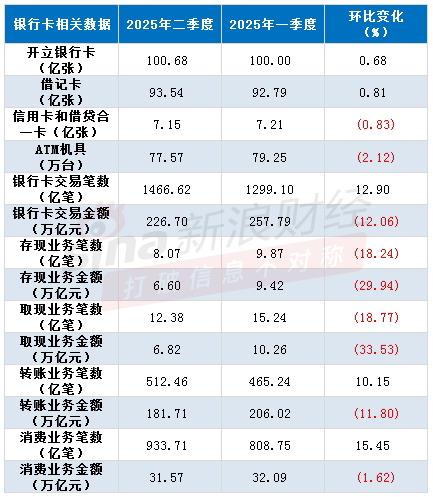
Core Insights - The People's Bank of China reported that by the end of Q2 2025, the total number of bank accounts in the country reached 15.238 billion, with 10.068 billion bank cards issued, reflecting a quarter-on-quarter growth of 0.68% [3][4] - Credit card and loan cards totaled 715 million, showing a quarter-on-quarter decline of 0.83% and a year-end decrease of 12 million [4][6] - The transaction volume of bank cards increased in terms of the number of transactions but decreased in transaction amounts, with 146.662 billion transactions amounting to 226.7 trillion yuan, a quarter-on-quarter decrease of 12.06% [4][5] Banking Sector Trends - The number of bank accounts opened includes 1.16 billion corporate accounts and 15.122 billion personal accounts, indicating a strong consumer banking presence [4] - The decline in credit card issuance has led to several banks shutting down credit card centers, shifting focus towards localized comprehensive financial services [8][9] - The credit card business is transitioning from aggressive customer acquisition to focusing on existing customer value, emphasizing quality over quantity [10][14] Credit Card Market Dynamics - The total number of credit cards has been on a downward trend, with a peak of 800 million in 2021, now down to 727 million in 2024, a decrease of 40 million year-on-year [6][10] - The overdue credit card loans reached 1239.64 billion yuan by the end of 2024, marking a year-on-year increase of 26.31% [7][14] - Banks are increasingly promoting credit card installment plans as a strategy to attract customers and respond to national policies aimed at stimulating consumption [12][14] Payment Processing Insights - In Q2 2025, banks processed 800.53 billion electronic payment transactions amounting to 85.816 trillion yuan, with online payments accounting for 182.17 billion transactions [5] - Non-bank payment institutions also saw a rise in transaction numbers, processing 3338.45 billion transactions worth 8.211 trillion yuan in Q2 2025 [5] Strategic Shifts in Banking Operations - Banks are consolidating credit card operations to reduce costs and enhance efficiency, focusing on digital marketing and customer acquisition [8][9] - The shift towards localized operations allows banks to better understand customer needs and provide tailored financial services [9][10] - Future developments in the credit card sector are expected to integrate digital solutions and wealth management, creating a comprehensive financial service ecosystem [9][10]

央行二季度支付报告来了!信用卡三个月少600万张,借记卡量稳步增长
Xin Lang Cai Jing· 2025-08-22 00:52
Summary of Key Points Core Viewpoint - The central theme of the news is the analysis of the payment system's performance in China for the second quarter of 2025, highlighting trends in card usage, transaction volumes, and the ongoing decline in credit card numbers. Group 1: Card Issuance and Trends - As of the end of Q2 2025, a total of 10.068 billion bank cards were issued nationwide, reflecting a quarter-on-quarter increase of 0.68% [5][4] - Among these, debit cards accounted for 9.354 billion, with a quarter-on-quarter growth of 0.81%, while credit cards and combined lending cards totaled 0.715 billion, showing a decline of 0.83% [5][4] - The number of credit cards and combined lending cards decreased by 6 million from the previous quarter and by 12 million from the end of last year, marking a decline of over 11% from the peak of 8.07 billion in 2022 [8][11] Group 2: Transaction Volume and Trends - In Q2 2025, the total number of bank card transactions reached 146.662 billion, with a total transaction amount of 226.7 trillion yuan, representing a quarter-on-quarter increase of 12.9% in transaction volume but a decrease of 12.06% in transaction value [6][4] - Notably, the number of transactions for transfer and consumption increased significantly compared to Q1, while the number of cash deposit and withdrawal transactions declined by 18.24% and 18.77%, respectively [6][4] - The number of ATMs decreased to 775,700, down 2.12% from the previous quarter, continuing a trend of decline since reaching a peak of 1.1108 million ATMs at the end of 2018 [6][4] Group 3: Electronic Payment and Non-Bank Payment Institutions - In Q2 2025, banks processed 80.053 billion electronic payment transactions, amounting to 85.816 trillion yuan, with online payments accounting for 18.217 billion transactions and 70.785 trillion yuan [6][4] - Non-bank payment institutions handled 333.845 billion network payment transactions, totaling 8.211 trillion yuan, indicating an increase in transaction scale despite a year-on-year decline in transaction volume [6][4] Group 4: Credit Card Market Adjustments - The credit card market has seen significant adjustments, with several banks announcing changes to high-end credit card products, including increased usage thresholds and adjustments to benefits [14][15] - The trend of declining credit card numbers is attributed to banks' ongoing efforts to manage "sleeping cards" and the increasing challenges in credit card asset quality and profitability [11][15] - The industry is shifting from a focus on card issuance growth to enhancing user experience and lifecycle value, with an emphasis on digital transformation and risk management [12][15]