
债券市场波动

Search documents
达利欧献计“3%解决方案”!他能否阻止美国债务海啸?
Jin Shi Shu Ju· 2025-05-30 12:35
Core Viewpoint - Dalio's "3% Solution" is gaining traction among White House officials and Republican leaders as a potential remedy for the U.S. fiscal crisis, despite ongoing efforts to pass a massive spending bill that could disrupt the bond market [1][2] Summary by Sections Proposed Solution - The "3% Solution" aims to reduce the annual deficit as a percentage of GDP from approximately 7% to 3% through three levers: spending cuts, tax increases, and corresponding interest rate reductions [1] Historical Context - Dalio asserts that the 3% Solution has been effective in various instances, with the most recent success occurring in the U.S. from 1991 to 1998 [1] Market Implications - The relationship between U.S. Treasury yields and the budget is critical, as declining confidence in fiscal discipline leads to higher Treasury yields in the bond market [1] Political Challenges - There is a lack of bipartisan interest in substantial spending cuts, and tax increases are also difficult to initiate, which could result in higher interest rates [2] Urgency for Action - Dalio emphasizes that both parties acknowledge the necessity of reducing the deficit to around 3% of GDP to avoid dire consequences, likening the situation to a ship heading towards a reef [2] Potential Triggers for Legislative Action - A debt crisis may serve as a compelling mechanism to prompt lawmakers to take action to avert fiscal disaster [2]
东京时间12:35揭晓:日本国债拍卖是否引发新一轮波动
Zhi Tong Cai Jing· 2025-05-28 01:52
Group 1 - The Japanese Ministry of Finance is set to auction 500 billion yen (approximately 3.5 billion USD) of 40-year bonds, which is seen as a significant indicator for the ultra-long-term bond market amid global sensitivity to Japanese bond yield fluctuations [1][2] - The Japanese bond market is currently experiencing a complex situation with pressures from the Bank of Japan's ongoing reduction in bond purchases and insufficient demand from institutional investors, compounded by concerns over fiscal deficits due to government spending expansion [1] - A dramatic fluctuation in the Tokyo market saw a 25 basis point drop in the 40-year bond yield in a single day, marking the largest recent decline, interpreted as a potential signal for the Ministry of Finance to adjust its bond issuance pace [1] Group 2 - The global bond market is closely monitoring the auction's ripple effects, with the Ministry of Finance's recent measures successfully lowering long-term bond yields across major economies from Europe and the US to Asia [1] - Market opinions are divided, with some analysts suggesting that the absolute yield levels and relatively low bond valuations could lead to better-than-expected auction results, while others caution about the risk of failed bids due to previous significant yield declines [1][2] - The Ministry of Finance has unusually distributed a survey to market participants before the auction to gather opinions on issuance scale and market conditions, indicating a need for policymakers to signal their awareness of long-term market dynamics [2]
特朗普万亿减税法案通过众议院,但“金主们”不太高兴
Jin Shi Shu Ju· 2025-05-23 00:49
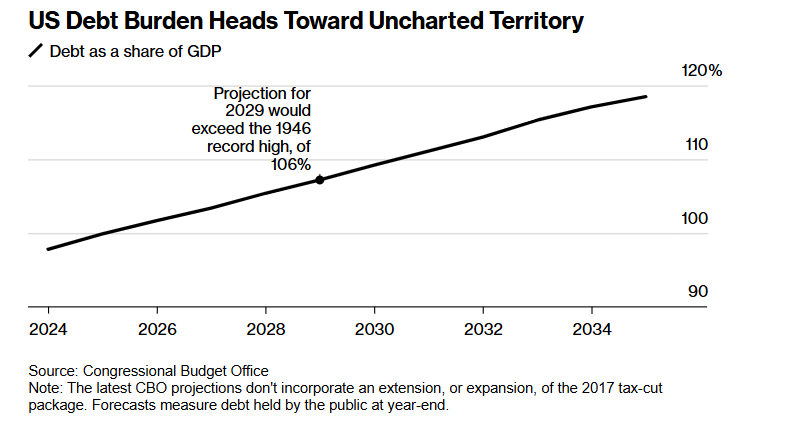
Group 1 - The core issue revolves around President Trump's tax proposal, which has passed the House but faces challenges in the Senate due to rising U.S. debt and bond market concerns [1][9][10] - The 30-year U.S. Treasury yield has surpassed 5%, indicating investor anxiety about the fiscal situation, which could lead to higher borrowing costs and economic slowdown [1][2][8] - Moody's has downgraded the U.S. credit rating, highlighting that the country's economic strength is no longer sufficient to offset declining fiscal indicators, with debt projected to rise to 134% of GDP in the next decade [1][4][7] Group 2 - The tax bill includes new tax benefits for key political groups, but Republican senators are signaling a need for spending cuts to mitigate fiscal pain [1][10] - The demand for 20-year bonds was weak during a recent auction, reflecting growing investor concerns about U.S. fiscal health [2][3] - The Congressional Budget Office predicts that by 2029, U.S. debt will exceed 106% of GDP, marking a historical high [4][7] Group 3 - Republican leaders are under pressure to achieve a legislative victory before the midterm elections, with the tax bill seen as crucial for maintaining support [9][10] - The potential for increased interest payments due to rising yields could exacerbate the government's fiscal challenges [2][3] - The proposed increase in state and local tax deduction limits from $10,000 to $40,000 is a key negotiation point among Republicans [7]

韩国代理财长:密切关注美国和日本债券市场波动加剧对国内市场的影响。
news flash· 2025-05-23 00:11
Core Viewpoint - The South Korean acting finance minister is closely monitoring the increasing volatility in the U.S. and Japanese bond markets and its potential impact on the domestic market [1] Group 1 - The South Korean government is concerned about the effects of external bond market fluctuations on its own financial stability [1] - There is an emphasis on the need for vigilance regarding the bond market trends in major economies like the U.S. and Japan [1]