
债券市场波动

Search documents
植田和男:4月企业涨价成加息关键考量 央行将灵活应对债券利率飙升
Zhi Tong Cai Jing· 2026-01-23 08:21
Core Viewpoint - The Bank of Japan maintains its interest rate at 0.75% while raising economic growth expectations and retaining a hawkish inflation forecast, indicating confidence in Japan's moderate economic recovery, which supports the potential for further interest rate hikes [1] Group 1: Monetary Policy Decisions - The Bank of Japan decided to keep the policy benchmark interest rate at 0.75%, aligning with market expectations after a previous increase from 0.5% in December [1] - The central bank will consider the extent of corporate price increases starting in April when discussing potential rate hikes, with the specific path and pace of increases dependent on economic, price, and financial market conditions at that time [1][2] Group 2: Economic Indicators and Considerations - The impact of the previous rate hike in December is still being assessed, with a focus on the gradual rise in corporate funding demand and banks' lending attitudes remaining positive [2] - The central bank is closely monitoring the rising long-term interest rates, which have reached a ten-year high, and is prepared to take flexible measures to stabilize the bond market [1][2] Group 3: Inflation and Price Dynamics - Companies are increasingly raising prices not only to pass on raw material costs but also to cover rising labor costs, which is a significant factor for the central bank to monitor [3] - The upcoming April period is critical for price adjustments, but it is not the sole determinant for rate hike timing; various data will be analyzed to assess the sustainability of current trends in prices and wages [3][4] Group 4: Future Rate Hike Considerations - The central bank will evaluate the actual impact of previous rate hikes on corporate investment, overall investment, and consumer spending, as well as the subsequent effects on inflation, which requires a considerable amount of time [4] - The decision-making process for future rate hikes will involve a comprehensive assessment of economic data and signals, with a focus on the marginal changes in the financial environment and high-frequency surveys of businesses [4]
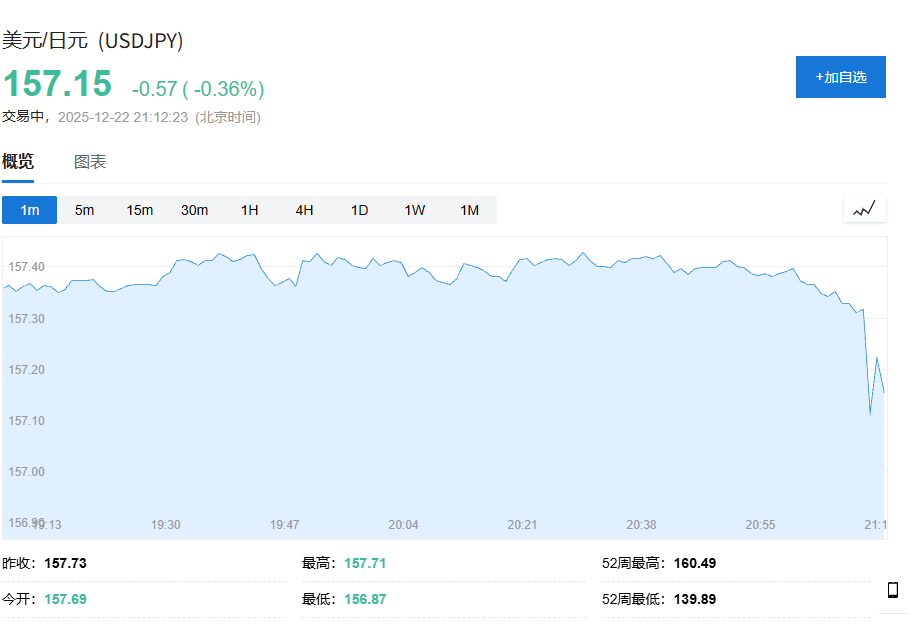
迄今最严厉警告!日本财务大臣:针对汇市投机拥有“自由裁量权”,将采取大胆行动
Sou Hu Cai Jing· 2025-12-22 13:47
Group 1: Government Intervention and Currency Policy - The Japanese government has issued its strongest warning to currency speculators, indicating a readiness to take bold actions against exchange rate fluctuations that deviate from economic fundamentals [1] - Finance Minister Katsunobu Kato's previous agreement with U.S. Treasury Secretary Bessent allows Japan to intervene in the currency market under certain conditions, including excessive volatility [7] - The recent depreciation of the yen is counterintuitive given the Bank of Japan's interest rate hike to 0.75%, the highest in 30 years, but lack of clear guidance on future rate increases has disappointed market participants [8] Group 2: Bond Market and Fiscal Policy - The Japanese bond market is experiencing significant volatility, with the 10-year government bond yield reaching 2.1%, the highest in 27 years, due to concerns over the government's aggressive fiscal stimulus plans [4] - The new fiscal year budget for April 2024 may expand to a record 120 trillion yen (approximately 760 billion USD), alongside a supplementary budget of 18.3 trillion yen, which is the largest since the easing of pandemic restrictions [9] - The rise in bond yields is partly driven by investor fears that a weak yen will exacerbate domestic inflation, potentially forcing the Bank of Japan to accelerate interest rate hikes [9]

固收-年末波动,如何应对
2025-12-16 03:26
Summary of Conference Call Records Industry Overview - The records primarily discuss the bond market dynamics and strategies for 2026, focusing on the impact of institutional behaviors and economic indicators on bond performance [1][2][3][4]. Key Points and Arguments Bond Market Performance - The bond market has shown weakness in the fourth quarter, influenced by institutional behaviors such as banks facing duration assessment pressures and insurance companies shifting asset allocations towards equities [2][3]. - Despite a relatively balanced supply-demand structure, the pressure from bank duration limits persists, leading to a cautious attitude from public funds towards ultra-long bonds [1][4]. Future Expectations for 2026 - It is anticipated that the demand for ultra-long bonds will remain weak, with a projected allocation returning to around 20% [1][5]. - The 30-10 year yield spread is expected to fluctuate between 30 to 50 basis points, with the current market position being neutral [5]. Investment Strategies - The recommended strategy for the bond market in 2026 emphasizes holding 3-5 year interest rate bonds in Q4 2025, transitioning to credit bonds in Q1 2026, and focusing on 10-year government bonds for long-term trades [3][9]. - Investors are advised against bottom-fishing in the current adverse environment, suggesting a wait-and-see approach based on redemption data and market equilibrium [6][7]. Economic Indicators - November economic data indicates stronger resilience in production compared to demand, with an expected annual growth rate of around 5% [11]. - Manufacturing investment is projected to perform better in 2026, supported by resilient exports and government policies aimed at stabilizing investment [12][13]. Inflation and Market Impact - The inflation trajectory for 2026 will be influenced by adjustments in the consumer price index (CPI) and producer price index (PPI), with Q1 being a critical observation period for market expectations [14]. Risk Management - The central government has emphasized the importance of managing risks associated with local government financing platforms, indicating a proactive approach to mitigate potential financial instability [15][16]. Additional Important Content - Recent events such as the Zhejiang Financial Center incident and the acquisition of China Metallurgical Group's assets by China Minmetals are highlighted as significant influences on the credit market [17]. - The anticipated issuance of convertible bonds in 2026 is projected to be around 85 billion yuan, with a notable increase in medium-sized issuances [19][20]. - The demand for convertible bonds is shifting, with relative return institutions increasing their holdings, while absolute return institutions have reduced theirs [22]. This summary encapsulates the critical insights and projections regarding the bond market and related economic factors as discussed in the conference call records.
白宫经济顾问哈塞特:债券市场波动,部分原因或许是美联储政策的不确定性。
Sou Hu Cai Jing· 2025-12-08 13:32
Core Viewpoint - The volatility in the bond market may be partially attributed to the uncertainty surrounding Federal Reserve policies [1] Group 1 - The White House economic advisor, Hassett, highlighted that fluctuations in the bond market are influenced by the unpredictability of the Federal Reserve's actions [1]
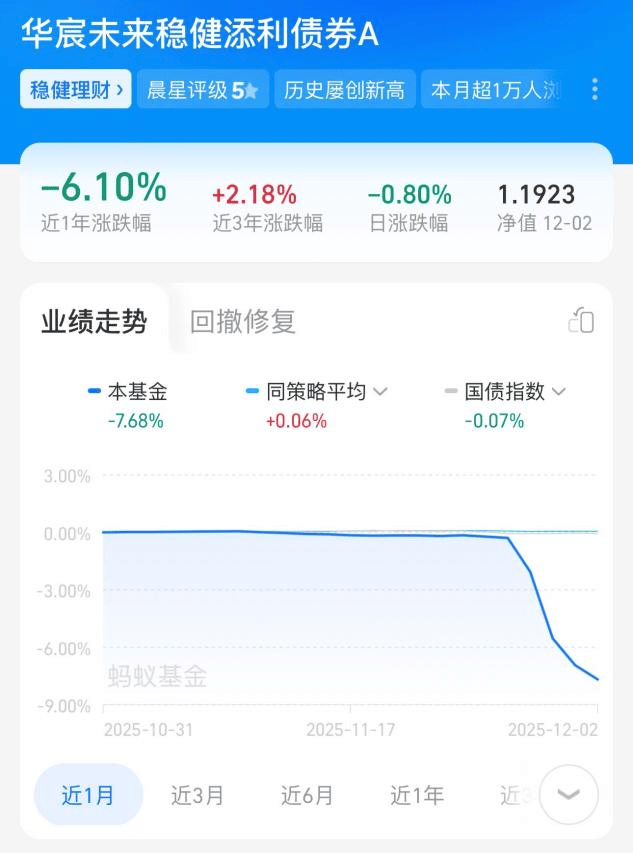
4天亏掉两年收益!华宸未来基金回应旗下债基产品大跌
Sou Hu Cai Jing· 2025-12-03 06:44
Core Viewpoint - The bond market has experienced significant volatility, particularly affecting Vanke's domestic bonds, leading to a sharp decline in the net value of the Huachen Future Stable Income Fund, which has seen a cumulative drop of 6.76% over three trading days, erasing nearly two years of gains [1][5]. Fund Performance - The Huachen Future Stable Income Fund's net value has shown continuous negative returns since November 25, with daily declines of -0.06%, -0.08%, -1.77%, -3.56%, -1.48%, and -0.80% [1][3]. - From November 27 to December 2, the fund's performance ranked last in the market with a return of -7.41% [3]. - The fund's historical performance from November 26, 2023, to November 26, 2025, indicated a total return of 6.53%, which was completely wiped out in just four days due to recent declines [4]. Investment Strategy and Holdings - The fund's benchmark is the China Bond Composite Full Price Index, with a year-to-date return of -1.483%, which has dropped to -6.64% following recent market turmoil [5]. - As of September 30, 2025, the fund's bond holdings reached 115.29%, with corporate bonds making up 56.34%, government bonds 32.73%, and financial bonds 10.93% [6]. - Speculation arose regarding the fund's potential exposure to Vanke's bonds, which have faced significant price drops, coinciding with the fund's net value decline [5][6]. Company Background and Challenges - Huachen Future Fund has a low management scale, ranking among the bottom ten in the market, with total assets under management insufficient to support its operations [9]. - The fund's major shareholder, Huachen Trust, is in the process of transferring 40% of its shares, raising concerns about the fund's stability [9]. - The fund reported a net profit of -1140.35 million yuan for the first three quarters of 2025, with total assets of 7875.2 million yuan and total liabilities of 8263.83 million yuan, leading to questions about its ongoing viability [11].
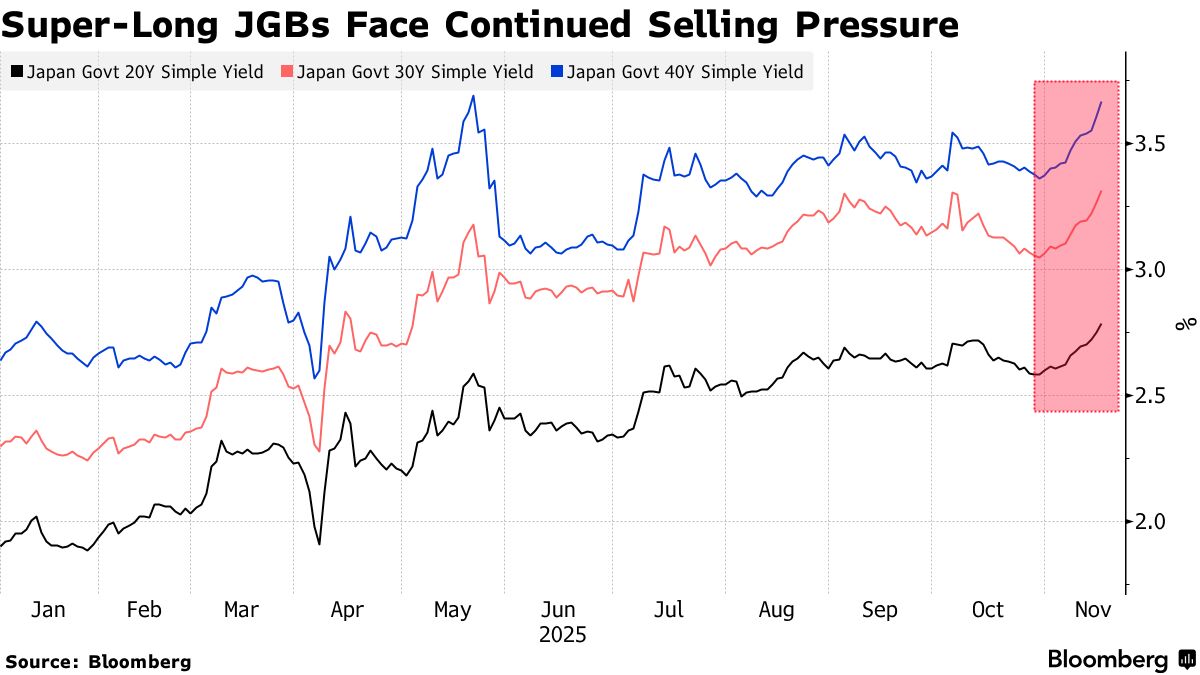
日本长期国债跌势加剧 市场日益担忧大规模经济刺激方案将冲击财政
智通财经网· 2025-11-18 06:20
Group 1 - Japanese long-term government bonds have declined further, raising concerns about the potential impact of Prime Minister Kishi's upcoming large-scale economic stimulus plan on public finances [1][4] - The yield on Japan's 40-year government bonds has surged by 8 basis points to 3.68%, the highest level since its issuance in 2007; yields on 20-year and 30-year bonds have also increased by at least 4 basis points [1][4] - The government is considering an additional budget of approximately 14 trillion yen (about 91 billion USD) for the current fiscal year, exceeding last year's 13.9 trillion yen, reflecting Kishi's commitment to a "responsible and expansionary fiscal" policy [4] Group 2 - The recent GDP data showing a 1.8% annualized decline in Japan's third quarter supports the push for a large-scale stimulus plan, marking the first negative growth in six quarters [4] - Market participants are closely monitoring the upcoming auction of 20-year government bonds, with expectations of weak demand due to the current volatility in the bond market [4] - Prime Minister Kishi is scheduled to meet with Bank of Japan Governor Ueda, with market attention focused on their statements for clues regarding the timing of the next interest rate hike [5]
What Bond Market Volatility Says About The Economy And Corporate Earnings
Seeking Alpha· 2025-11-14 07:50
Group 1 - The article does not provide any relevant content regarding company or industry insights [1]

金荣中国:现货黄金开盘后略微回吐此前涨幅,但仍守住强势区间
Sou Hu Cai Jing· 2025-09-01 08:20
Fundamental Analysis - Gold prices have surged, with a monthly increase of 4.81% in August, marking the best performance since April, currently trading around $3450 per ounce [1] - The rise in gold prices is primarily driven by the latest U.S. inflation data, with the Personal Consumption Expenditures (PCE) index showing a monthly increase of 0.2% and an annual increase of 2.6%, aligning with market expectations [1] - Market expectations for a 25 basis point rate cut by the Federal Reserve in September have increased from 85% to 87% following the inflation data release, with predictions of one to two rate cuts throughout the year [1] Additional Factors - The U.S. dollar index has weakened, dropping 2.2% in August, which has made gold cheaper for international buyers, thus boosting demand [3] - The U.S. bond market has shown significant divergence, with the two-year Treasury yield experiencing its largest monthly drop in a year, down 33 basis points to 3.619%, reflecting strong expectations for lower short-term rates [3] - Political risks, such as concerns over the independence of the Federal Reserve due to actions by former President Trump, are also influencing gold prices [3] Technical Analysis - Gold prices closed strongly on Friday, reaching a near historical high of $3453, indicating potential for a breakout from the current trading range [5] - The market is currently testing resistance around $3450, with support expected in the $3420-$3430 range [5] - Short-term trading strategies suggest attempting to buy near $3450 with a stop loss at $3455, targeting levels around $3433-$3423 [6]

贵阳银行:上半年净利润24.74亿元,同比下降7.2%
Zheng Quan Shi Bao Wang· 2025-08-25 11:52
Core Viewpoint - Guiyang Bank (601997) reported a decline in both operating income and net profit for the first half of 2025, primarily due to reduced interest income from lending and market fluctuations affecting financial assets [1] Financial Performance - The bank achieved operating income of 6.501 billion yuan, a year-on-year decrease of 12.22% [1] - The net profit attributable to shareholders was 2.474 billion yuan, down 7.2% year-on-year [1] - Basic earnings per share stood at 0.68 yuan [1] Reasons for Decline - The decline in operating income and net profit is attributed to: - Continuous concessions to the real economy, leading to lower interest income due to the downward adjustment of LPR rates and the reduction of interest rates on existing assets [1] - Decreased fair value gains from trading financial assets due to market volatility [1]

北欧联合银行:日本债券市场波动料将持续
news flash· 2025-05-30 12:46
Core Viewpoint - The volatility in the Japanese bond market is expected to persist due to the Bank of Japan's attempt to exit its long-standing ultra-loose monetary policy and the dynamics of other major bond markets [1] Group 1: Market Dynamics - The report indicates that the long end of the Japanese government bond yield curve has become steep compared to the flatter slopes of the German and US government bond yield curves [1] - Analysts suggest that Japan is beginning to test the limits of how much long-term yields can rise [1]