
债市策略

Search documents
债券研究周报:年末债市还有哪些好策略?-20251222
Guohai Securities· 2025-12-22 08:04
Group 1 - The report analyzes the recent trends in the bond market, highlighting a general strategy of reducing duration and increasing leverage as year-end approaches [6][11] - As of December 19, the leverage ratio in the interbank bond market increased by 0.23 percentage points to 107.68%, indicating a notable rise in leverage [11][22] - The median duration of medium to long-term bond funds decreased to 2.68 years, down by 0.07 years compared to December 15 [11][38] Group 2 - The report suggests focusing on short to medium-term credit bonds due to a favorable funding environment and large banks purchasing short-term bonds [12] - There is a notable trend of non-bank institutions, such as asset management and trust companies, significantly buying 5-year subordinated bonds and perpetual bonds, indicating a compression opportunity in spreads [12][13] - Caution is advised regarding 30-year government bonds, as there has been significant selling pressure from joint-stock banks, and the report maintains a cautious stance on this segment [13] Group 3 - Key interest rates and spreads have shown changes, with the 1-year government bond yield decreasing by 3.25 basis points to 1.35% and the 10-year yield down by 1.80 basis points to 1.83% [14] - The report notes that the yield spread between the 30-year and 10-year government bonds decreased by 3.60 basis points to 39.44 basis points [14] - The report tracks the changes in government bond yield spreads, indicating fluctuations in the 3-year to 1-year and 5-year to 3-year spreads [16] Group 4 - The interbank pledged repo balance rose by 0.38 trillion yuan to 12.80 trillion yuan as of December 19 [19] - The average transaction amount for pledged repos from December 15 to 19 was 8.48 trillion yuan, with overnight transactions accounting for 90% of the total [26] - The report highlights the net funding outflow from banks, with a total net outflow of 5.09 trillion yuan as of December 19 [28] Group 5 - The median duration of interest rate bond funds was reported at 3.74 years, down by 0.03 years from December 15, while credit bond funds had a median duration of 2.43 years, also down by 0.09 years [43] - The report provides insights into the borrowing balance of 10-year government bonds, indicating fluctuations in borrowing activity [48]
谜题尽解,尚待新局 - 2026年债市年度策略展望
2025-12-01 00:49
Summary of Key Points from Conference Call Industry Overview - The conference call primarily discusses the **debt market** outlook for 2026, highlighting various strategies and market dynamics affecting bond yields and credit performance. Core Insights and Arguments - **Yield Predictions**: The mainstream view anticipates that the 10-year government bond yield will fluctuate between **1.7% and 2.0%** in 2026, with a cautious approach towards the **97 strategy** and a focus on institutional behavior [1][4] - **Market Dynamics**: The debt market is expected to experience a slight upward fluctuation, influenced by weak economic sentiment and insufficient social demand, with potential risks from equity market rallies and tightening monetary policy [1][6] - **Credit vs. Interest Rates**: Credit performance is currently superior to interest rates, with short-term credit bonds showing strong performance. The focus has shifted back to **yield strategies** rather than merely avoiding risks [3][12] - **Key Strategies**: The main strategies for 2026 include **low volatility**, **high yield strategies**, and a cautious approach to the **97 strategy**. Emphasis is placed on understanding institutional behaviors and market dynamics [5][8] Important but Overlooked Content - **Impact of Anti-Competition Policies**: The anti-competition policies have significantly reduced the leading indicators' effectiveness, particularly the PPI, which historically had a strong influence on the debt market [7] - **Financial Debt as Core Investment**: Financial bonds remain a core investment for non-bank institutions due to their safety, yield, and liquidity advantages, despite short-term impacts from redemption fee regulations [8][29] - **Sector-Specific Insights**: The real estate sector is under pressure due to demographic changes, with a declining number of new births affecting future housing demand. This demographic shift is expected to continue impacting the economy and real estate sector negatively [22][31] - **Credit Strategy Adjustments**: The strategy for credit bonds involves adjusting allocations based on yield levels, favoring high elasticity subjects during high yield periods and low elasticity subjects during low yield periods [28] Conclusion - The debt market outlook for 2026 is characterized by cautious optimism, with a focus on credit performance and strategic adjustments in response to evolving market conditions. The interplay between policy, economic indicators, and institutional behavior will be crucial in shaping investment strategies moving forward.
债券周报20251123:2026年债券供给和节奏怎么看?-20251123
Huachuang Securities· 2025-11-23 09:15
1. Report Industry Investment Rating No relevant content provided. 2. Core Viewpoints of the Report - The fiscal policy in 2026 is expected to maintain an active tone to support stable growth, with a projected fiscal policy combination of a 4% deficit - rate (5.88 trillion yuan deficit), 2 trillion yuan in special treasury bonds, 4.7 trillion yuan in special local bonds, and 2 trillion yuan in replacement bonds, corresponding to 14.6 trillion yuan in net government bond financing [1][11][13]. - The government - sector leverage ratio is expected to rise to 74.6% in 2026, with a slightly slower upward slope compared to 2025 [1][15]. - The net financing of interest - rate bonds in 2026 is expected to be 17.1 trillion yuan, an increase of 0.8 trillion yuan compared to 2025, and the supply rhythm is in line with the front - loaded fiscal policy [2][16]. - After the "last dip" in the bond market, it is advisable to layout for the year - end pre - emptive market. The bond market strategy should flexibly switch between α and β strategies [4]. 3. Summary According to the Table of Contents 3.1 2026 Bond Supply Outlook - Fiscal Policy: The fiscal policy in 2026 is expected to remain active, but with limited room for further increasing the deficit rate. "Quasi - fiscal" tools may still have room for action [1][11]. - Government Bond Net Financing: The net government bond financing in 2026 is expected to be 14.6 trillion yuan, including 7.1 trillion yuan in treasury bonds, 7.5 trillion yuan in local bonds. The government - sector leverage ratio is expected to rise to 74.6%, with a slower growth rate, and the central and local government leverage ratios are expected to rise to 32.1% and 42.5% respectively [1][15][16]. - Interest - Rate Bond Net Financing: The net financing of interest - rate bonds in 2026 is expected to be 17.1 trillion yuan, including 7.1 trillion yuan in treasury bonds, 7.5 trillion yuan in local bonds, and 2.5 trillion yuan in policy - bank bonds. The supply rhythm is front - loaded, and the supply in the fourth quarter may be relatively small [2][16][19]. - Impact of Unused Quotas: If unused quotas are considered, there is still room for an increase in government bond supply in 2026, which may be decided based on economic conditions [3][20]. 3.2 Bond Market Strategy: Layout for the Year - End Pre - emptive Market after the "Last Dip" - Current Situation of 10 - year Treasury Bonds: The 10 - year treasury bonds are currently fluctuating narrowly around 1.8%, which is in the middle of the central bank's attention range. Due to limited expectations of interest - rate cuts this year and the unimplemented fund fee - rate regulations, the bond market lacks a trading theme, and 1.8% has become a short - term neutral psychological point formed by institutional games [4][28]. - Seasonal Pattern: Historically, there has often been a "last dip" in mid - to late November. After the negative factors are exhausted, the bond's allocation value becomes prominent, and institutions such as rural commercial banks usually start building positions, driving down yields [4]. - Strategy Switch: The α - mining strategy for medium - term bonds is nearing its end, and it is advisable to gradually switch back to the β strategy. There may be opportunities for both α and β in ultra - long - term bonds in December [34]. - Interest - Rate Bond Selection: Currently, bonds with α - space can be selected from multiple dimensions such as riding, variety spreads, and term spreads. A dumbbell strategy can be adopted to participate in short - term and ultra - long - term bonds [5][35]. 3.3 Interest - Rate Bond Market Review: The Bond Market Lacks a Trading Theme, and Yields Remain Narrowly Fluctuating - Overall Market: In the third week of November, the 10 - year treasury bond yields fluctuated weakly around 1.8%. The 1 - year treasury bond yield decreased by 0.5BP to 1.4%, the 10 - year treasury bond yield increased by 0.75BP to 1.8125%, and the 30 - year treasury bond yield increased by 1.05BP to 2.1585% [9]. - (1) Funding Situation: The central bank made large - scale net injections through open - market operations (OMO), and the funding situation was balanced but tight [10][52]. - (2) Primary Issuance: The net financing of policy - bank bonds increased, while the net financing of treasury bonds, local bonds, and inter - bank certificates of deposit decreased [52]. - (3) Benchmark Changes: The term spread of treasury bonds widened, while the term spread of China Development Bank bonds narrowed. The short - term treasury bonds performed better than the long - term ones, and the long - term China Development Bank bonds performed better than the short - term ones [50].

固收专题:重启国债买卖的影响和应对
Minsheng Securities· 2025-10-28 12:26
Report Summary 1. Report Industry Investment Rating No relevant content provided. 2. Core Viewpoints of the Report - The central bank's restart of treasury bond trading is expected to cooperate with government bond supply, align with the current bond market yield curve, and supplement long - term liquidity for the banking system [2][13][19]. - The probability of an interest rate cut within the year has increased compared to the third quarter, while the probability of a reserve requirement ratio cut may decrease after restarting treasury bond trading, but it remains a direct option [3][25][26]. - For the subsequent bond market strategy, the decline space of bond interest rates needs further support. Attention can be paid to whether the central bank's bond - buying scale and maturity exceed expectations [4][27]. 3. Summary According to the Directory 1.1 Why Restart Treasury Bond Trading? - **Cooperate with Government Bond Supply and Synergize Fiscal Efforts**: In 2025, the government bond issuance from November to December is expected to be around 4 trillion yuan, similar to the same period in 2024. The net financing scale is about 1.70 trillion yuan, significantly lower than 2.98 trillion yuan in 2024 due to the large maturity of treasury bonds in December. Restarting treasury bond trading helps the central bank cooperate with fiscal efforts [2][14]. - **The Bond Market Yield Curve Meets the Central Bank's Expectations and Market Risks Decline**: Since July 2025, the bond market sentiment has been weak, with the current fund duration at a low level. The 10Y - 1Y and 30Y - 10Y term spreads are both above 35bp, and the yield curve is steep. After restarting treasury bond trading, the short - term interest rate may decline more than the long - term interest rate, and the 30Y - 10Y spread may further compress [2][19]. - **Supplement Long - term Liquidity to the Banking System and Stabilize Liability Expectations**: As of September 2025, the central bank mainly provided medium - term liquidity through MLF and outright reverse repurchase, accounting for 91.52% of the annual net investment. The 1 - year inter - bank certificate of deposit rate has been rising, indicating that banks lack long - term funds [2][21]. 1.2 Will There Be Other Monetary Policy Coordination within the Year? - **Interest Rate Cut**: Externally, the pressure of RMB depreciation has decreased, and the narrowing of the Sino - US interest rate spread has reduced the external constraints on China's interest rate cut. Domestically, economic growth has slowed down, and the policy - makers are determined to stabilize growth. The probability of an interest rate cut within the year has increased compared to the third quarter [3][25]. - **Reserve Requirement Ratio Cut**: Restarting treasury bond trading may reduce the probability of a reserve requirement ratio cut. However, the amount of long - term liquidity provided by treasury bond trading may not meet the banks' demand for long - term funds, so a reserve requirement ratio cut remains a direct option [3][26]. 1.3 How to View the Subsequent Bond Market Strategy? - Since the interest rate has declined significantly, further support is needed to open up the downward space. Attention can be paid to whether the central bank's bond - buying scale and maturity exceed expectations. Currently, the value of chasing and holding active bonds is not strong [4][27]. - **10 - year Treasury Bonds**: The main bond has switched to 250016, and the 250016 - 250011 spread may compress to about 3bp in an optimistic scenario [28]. - **10 - year China Development Bank Bonds**: Continue to focus on 250215. The uncertainty of 250220 becoming the main bond is high [28]. - **30 - year Treasury Bonds**: For short - term trading, focus on 25T6. Consider holding non - active bonds such as 25T5, 24T1, 250002, and 25T3 [28]. - **Long - term Interest - rate Bonds**: Pay attention to 30 - year old bonds and 50 - year treasury bonds with slightly higher interest rates. For short - term trading with high liquidity requirements, focus on 25T6. For 10 - year interest rates, focus on 250016 and 250215. For medium - term interest - rate bonds, focus on 240006, 250007, and 250018 [29].
9月利率策略展望:债行债道
GOLDEN SUN SECURITIES· 2025-09-05 00:22
Group 1: Fixed Income Market Outlook - The fixed income market is expected to gradually recover in September, with a recommendation for a gradual increase in allocation and a preference for a barbell strategy [3] - The anticipated reduction in pressure from the stock market on the bond market is due to the continuous decrease in non-bank positions and the increase in allocation by institutional investors [3] - The adjustment space for interest rates is limited, with the upper limits for 10-year and 30-year government bonds projected at around 1.8% and 2.1% respectively [3] Group 2: Banking Sector Overview - The banking sector is benefiting from the repricing of deposits and improved management of funding costs, leading to a continued trend of narrowing interest margins [5] - Overall asset quality is expected to remain stable, with manageable credit cost pressures, suggesting stable profit growth for the year [5] Group 3: Company-Specific Insights Cloud Computing - Cloud Computing Company (云赛智联) reported a revenue of 3.132 billion yuan for H1 2025, a year-on-year increase of 7.25%, while net profit decreased by 15.94% [6] - The company is positioned well in the digital economy with core capabilities in cloud services and data elements, leading to an adjusted revenue forecast of approximately 6.489 billion yuan for 2025 [6] Medical Sector - KaiLi Medical (开立医疗) reported a revenue of 964 million yuan for H1 2025, a decline of 4.78%, with a significant drop in net profit by 72.43% [9] - The company is expected to see revenue recovery driven by terminal bidding recovery, with a focus on new product launches [9] - Yuyue Medical (鱼跃医疗) achieved a revenue of 4.659 billion yuan in H1 2025, up 8.16% year-on-year, with net profit increasing by 7.37% [11] - The company is expanding its overseas market presence, particularly in home medical devices, indicating strong future growth potential [11] - Microelectrophysiology (微电生理) reported a revenue of 224 million yuan for H1 2025, a growth of 12.80%, with net profit increasing by 92.02% [13] - The company is focusing on expanding its product matrix and maintaining high growth in international markets [13] - United Imaging (联影医疗) achieved a revenue of 6.016 billion yuan in H1 2025, a growth of 12.79%, with net profit increasing by 5.03% [17] - The company is leveraging AI to enhance product capabilities and is seeing strong growth in both domestic and international markets [17] - Mindray Medical (迈瑞医疗) reported a revenue of 16.743 billion yuan for H1 2025, a decline of 18.45%, but is expected to see a turnaround in Q3 due to recovering market conditions [19] - The company is focusing on high-potential business segments and has a strong R&D pipeline [19] Home Appliances - Anfu Technology (安孚科技) reported a total revenue of 2.43 billion yuan for H1 2025, a year-on-year increase of 5.0%, driven by export growth [22] - The company is expected to see significant profit growth in the coming years, with net profit projections of 330 million yuan for 2025 [22]
债市策略的进与退:量化信用策略
SINOLINK SECURITIES· 2025-08-24 13:36
Group 1 - The simulated portfolio continues to show negative returns, with the medium and short-term credit style portfolio experiencing smaller drawdowns compared to the corresponding interest rate style portfolio, while the long-term portfolio has seen significant declines [2][14] - In the interest rate style portfolio, the weekly returns for the deposit sinking and deposit bullet strategies were both -0.25%, while in the credit style portfolio, these strategies had smaller drawdowns with returns of -0.14% each [2][14] - The credit style deposit-heavy portfolio's weekly average return slightly rebounded to -0.14%, outperforming the corresponding interest rate style portfolio by 10.7 basis points, marking the strongest defensive strategy since late July [2][17] Group 2 - The credit strategy has created a certain yield space, with the secondary bond duration strategy's yield distance from the year's low exceeding 20 basis points [3][26] - The main strategy combinations have seen yields stop falling and start to rise, with the secondary bond duration strategy's weekly yield increasing by nearly 0.16 basis points, bringing the annualized yield to 2.02%, which is 22.3 basis points wider from the year's low [3][26] - The weekly yield contribution from the credit style portfolio remains in the range of -25% to -5%, with capital gains continuing to drag down returns [3][26] Group 3 - In the past four weeks, the medium and short-term perpetual bond heavy strategies have shown certain defensive attributes, with cumulative excess returns for the city investment short-term sinking, commercial bank bullet, and perpetual bond sinking strategies reaching 13.3 basis points, 7.2 basis points, and 6.6 basis points respectively [4][32] - The city investment heavy strategies have recently underperformed compared to the secondary perpetual heavy strategies, with the cumulative returns for the city investment duration and barbell strategies deviating from the benchmark by -10 basis points and -30 basis points respectively [4][32] - The short-end strategies have outperformed the benchmark, while the city investment sinking strategy's excess returns have fallen into negative territory [4][35]
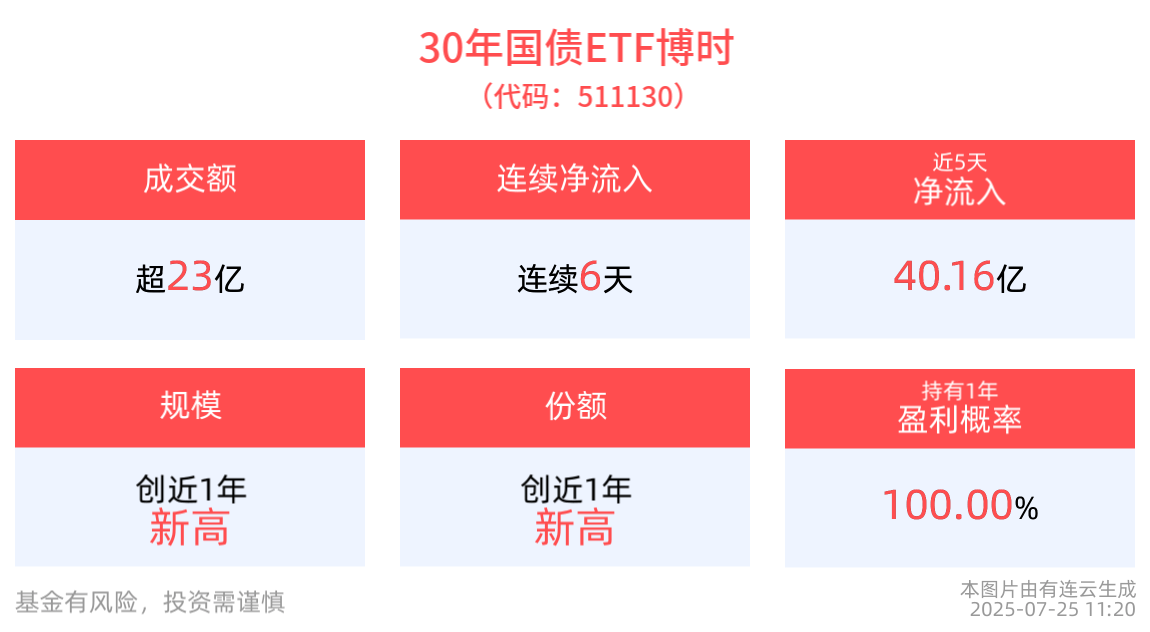
30年国债ETF博时(511130)午前强势翻红,近6日净流入超40亿元,最新规模、份额再创新高
Sou Hu Cai Jing· 2025-07-25 04:08
Core Viewpoint - The 30-year government bond ETF from Bosera has shown a significant increase in both price and trading volume, indicating a strong market interest despite a potentially weak short-term trend in the bond market [3][4]. Group 1: Performance Metrics - As of July 25, 2025, the 30-year government bond ETF from Bosera rose by 0.07%, with a latest price of 110.92 yuan, and has accumulated an increase of 11.40% over the past year [3]. - The ETF's latest scale reached 12.952 billion yuan, marking a one-year high [4]. - The ETF has seen a net inflow of 40.61 billion yuan over the past six days, with a maximum single-day net inflow of 1.51 billion yuan [4]. Group 2: Trading Activity - The ETF recorded a turnover rate of 18.01% and a trading volume of 2.34 billion yuan, indicating active market participation [3]. - The average daily trading volume over the past week was 3.59 billion yuan [3]. Group 3: Investment Strategy and Outlook - Industry experts suggest that the current "strong stock, weak bond" trend may continue in the short term, with the bond market's performance heavily reliant on stock market dynamics and the continuity of liquidity [3]. - Despite short-term concerns, the long-term pricing logic remains intact, with potential opportunities arising from market adjustments [3]. Group 4: Fund Characteristics - The ETF has a management fee of 0.15% and a custody fee of 0.05% [5]. - The tracking error for the ETF over the past month was 0.029%, indicating a close alignment with the underlying index [5].

中加基金权益周报︱中美贸易关系缓和,债市关注风险偏好及资金面变化
Xin Lang Ji Jin· 2025-05-21 09:30
Market Overview and Analysis - The issuance scale of government bonds, local government bonds, and policy financial bonds in the primary market last week was 590.5 billion, 197.3 billion, and 151.8 billion respectively, with net financing amounts of 501.2 billion, 171.1 billion, and 35.7 billion [1] - The total issuance scale of non-financial credit bonds was 122.2 billion, with a net financing amount of -11.2 billion [1] Secondary Market Review - Interest rates rose last week, influenced by factors such as the Sino-US Geneva joint statement, fluctuations in funding rates, the implementation of reserve requirement ratio cuts, and April credit data [2] Liquidity Tracking - Liquidity conditions shifted from loose to tight last week, as the demand for funds from reverse repos, MLF maturities, and government bond payments partially offset the increase in supply from the reserve requirement ratio cuts, leading to a marginal tightening in the latter half of the week [3] Policy and Fundamentals - The Sino-US Geneva joint statement canceled 91% of countervailing tariffs and exempted 24% of reciprocal tariffs for 90 days [4] - In April, new RMB loans amounted to 280 billion, and total social financing reached 1.2 trillion [4] Overseas Market - Moody's downgraded the US credit rating; however, the Sino-US negotiations boosted risk appetite, resulting in a 5.3% increase in the S&P 500 for the week and a 6 basis points rise in 10-year US Treasury yields [5] Equity Market - A-shares were positively impacted by the unexpected results of Sino-US negotiations, with major indices experiencing fluctuations; the total A-share index rose by 0.72%, the CSI 300 by 1.12%, and the ChiNext by 1.38%, while the Sci-Tech Innovation Board fell by 1.10% [6] - A-share trading volume decreased, with an average daily turnover of 1.27 trillion, down by 87.158 billion week-on-week [6] - As of May 15, 2025, the total financing balance for A-shares was 1.796728 trillion, slightly reduced by 410 million from May 8 [6] Bond Market Strategy Outlook - The 90-day tariff exemption period between China and the US is expected to stimulate exports, reducing the risk of economic slowdown in the short term, which is the macro backdrop for the recent marginal tightening of liquidity [7] - Despite insufficient credit demand, weak real estate sales, and persistently low prices, there is no basis for significant tightening of funds [7] - Future broad interest rates, including deposit and loan rates, are expected to follow policy rate cuts, and the urgency for counter-cyclical policies is reduced due to the export stimulus [7] - The bond market may provide good entry opportunities if it overprices the temporary tightening due to tax periods and payments [7] - In the convertible bond market, the weight of fundamental pricing is expected to increase, with recent valuations slightly compressed, but still supported by supply-demand dynamics [7]